


Oxford Street in London doesn’t look like a good location for fishing. But in street photography terms, being a ‘fisher’ means finding a promising location and waiting for the right moment. “Fishers wait in a space where they feel there’s something in the composition,” explains Sean Tucker. “I often find a space and wait to see what comes to me.”
Tucker describes how the process worked for one of his favourite images. “There was a place on Oxford Street with dappled lighting from the trees on the siding. A gentleman was walking past – I spotted him coming down the road. He had white hair flying out at the back, but his face was in shadow.
When the light hit his hair, it mirrored the dappled lighting in the background. There’s also someone fiddling with a door, casting a shadow. I felt instinctually there was something good in this space, but the right subject had to come at the right time and things had to snap into place together.”

The opposite approach is a ‘hunter’, which is how fellow street photographer Joshua K. Jackson describes himself. “I keep moving around, looking for subjects,” he says, pointing to an image taken in Islington on an otherwise quiet day, during the Covid pandemic, of a woman reading with her feet out of the window. “I try not to be too fixated on one particular location or image, and to be fluid and reactive to whatever I see.”

Though their strategies differ, what Jackson and Tucker both share is an interest in pushing street photography as an art form. The two photographers have produced a book together, The Art of Street Photography, featuring their images, along with advice and inspiration for other photographers.
Street photography has become incredibly popular, with over 134 million #streetphotography posts on Instagram, and dedicated collectives and online groups around the world. Its rise has been helped by the accessibility of high-quality cameras on phones, as well as advances in smaller, more discreet digital cameras.

“It hasn’t got any barriers for entry for anyone who’s a beginner,” says Jackson. “You can use any camera, practice it anywhere, in a village or a big city, and it doesn’t require you to travel or to have a specific subject to work with, so it’s quite a democratic genre. So many people are getting into photography via street photography.”
Part of the appeal is that it’s exciting – it demands a keen eye and fast reactions to changing scenes, shifting light and authentic, unscripted moments. “It’s the challenge that I enjoy, trying to tap into something that is overlooked in the everyday,” explains Jackson. “You’re looking for little notes that are out of place in the song. Sometimes the most pedestrian subject matter can grab your attention in a way you can’t explain.”

The two men – Jackson originally from Farnham in Surrey and Tucker originally from Hemel Hempstead in Hertfordshire – met in London in 2018. “I reached out to Josh on Instagram because I liked his work,” Tucker recalls. “We met for a coffee and went on an impromptu photo mission afterwards. We began shooting together fairly regularly.”
Though Tucker’s now based in Kirkbymoorside, North Yorkshire, both men still see London as the most exciting city for street photography. Both also work on other photography to pay the bills, including portraiture, advertising and commercial work.

“I started doing street photography as an antidote to the day job,” says Tucker. “I was doing product photography at the time, which is like a production line. You have to set the lights up and push through 70-100 products in a day at the same angle. Street photography felt more like intuitive photography. I like the unplanned, unprepared nature of it.
I started on my phone. It was a way to fall back in love with photography, capturing whatever might happen. It sharpens you like no other genre of photography because you have to think so fast and react so quickly. It gives you a set of skills that helps with all the other types of photography you might be doing: using your camera quickly, how to frame on the fly and anticipating what’s going to happen.”

Classic street photography often involves moments of action, human interactions, or juxtapositions between people and the environment that have a humorous or tender effect. Images can also hint at a larger story. “We talk about something called the Curiosity Gap, where you leave room for the viewer to fill in the gaps,” says Jackson.
“There’s a photo in the book of a phone booth where someone has written a message “Your cocaine is killing me.” We’re asking people to try to capture some sort of mood or emotion, whether it’s an echo of humanity or the marks we leave behind. It doesn’t need to be explicit.”

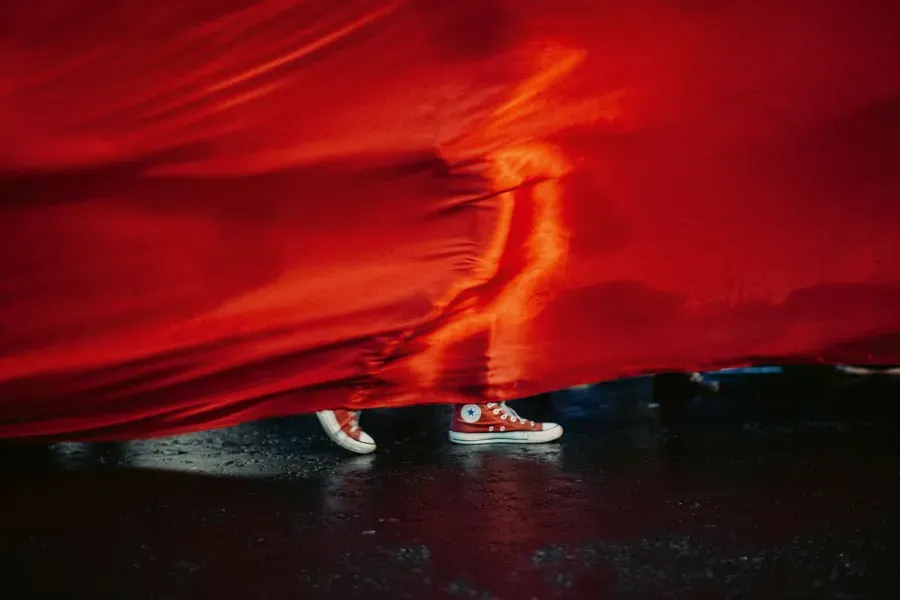
Though some of their images are documents of everyday life, Jackson and Tucker prefer a more artistic approach. Citing the likes of Ernst Haas, Alex Webb and Harry Gruyaert as influences, they create images that are abstract or impressionistic, rather than journalistic, making creative use of light, shadow, colour, shapes, reflections.
“By stepping away slightly from the documentary DNA of the genre, it gives you permission to play and experiment,” says Jackson. “Maybe I’ll use a lens one day that breaks with convention, such as a 90mm, or maybe you want to do a cr. eative focus or slow shutter speed.”

“I like to pick up on what’s temporary in a city,” he goes on. “It could be the light, or some form of harmony or disharmony between things. One exercise is doing laps in a tiny area and noticing what’s different each time you loop around. That state of flux creates opportunities for images.”
Tucker also particularly enjoys playing with light. “That’s the main thing I use to abstract, using the fact that the camera doesn’t have the dynamic range of my eye,” he tells me. “If I’m exposing for the brightest thing in the image, I’m creating a lot of shadow, mood and mystery in the rest of the shot, and maybe some negative space. It’s a trick I’ve nicked from cinema – this is how cinematographers work.”

Deciding which images from the many experiments work “comes down to gut feel,” says Jackson. “But there are some basic things, like “Is there too much going on?” or “Are there too many colours that jar?” You look and know immediately.”
“It’s definitely not what Instagram thinks is right,” adds Tucker. “There are so many times that I make an image that feels good, then I post it online and no one cares. As soon as you go down this more artistic route, you have to trust your own instincts in what’s good and what isn’t, and to make images over time, regardless of what people think, so that you have a body of work that gets its own aesthetic.”

For beginners or any photographers more used to the controlled environments of a studio or the slower pace of landscape photography, working on the street does take time to get into the required mentality. “There is no substitute for getting out and photographing a lot,” Tucker suggests.
“You have to be out as often as possible, walk as far as you can, take as many photos as possible. You learn how to take better images and how to find your style. While you’re out there, you’re also going to work out the things you’re noticing that other people aren’t. You have to listen to your personality and find your way.”
Being in an uncontrolled environment, often with crowds of people moving around, can be intimidating. “It’s normal and rational to feel some fear,” Jackson says.

It’s also possible that people around you as you take photos might be intimidated. There are important conversations going on currently within street photography around ideas of privacy, consent and intrusion.
With more impressionistic or expressive work, which doesn’t focus on faces and easily identify subjects, photographing people going about their daily lives might be less of a problem. But whether they’re anonymous in the final image or not, many people are uncomfortable with a random stranger on the street pointing a camera at them.

“In the UK, street photography is legal,” Tucker says. “If you’re in a public place, you don’t have a right to privacy. But the other side is ethics, how you approach street photography and what lines you draw.
I don’t photograph children – it’s not illegal, I just don’t want to do that when I might make people feel uncomfortable. I don’t photograph homeless people because I feel like I might be taking advantage of a difficult situation for somebody. I’m not telling other people they shouldn’t do those. You have to figure out what your own ethical lines are.”

For both men, their intention behind each image is important. “I’m not out to make people look bad,” says Jackson. “As long as my positive intent carries through in the image, I don’t think anyone will have a problem with it. Whereas if someone tripped over and you’re making an image of that, I don’t think that has a good intention behind it, because someone’s the butt of a joke.”
Jackson and Tucker both tend to be unintrusive and respectful in their approach, unlike more aggressive street photographers who get up-close and often leave startled people in their wake. “I saw a video of Mark Cohen on Youtube,” says Jackson. “He’s within two feet of someone and he’s using a flash in someone’s face. It’s a bravado thing: “How close can I get?”
You’re almost photographing the person’s reaction to the photographer’s presence, whereas we tend to step back, let things evolve naturally and take more of an outsider’s view. It’s not a case of pointing a camera in someone’s face, as I don’t think that has any value whatsoever.”

“We don’t want to be noticed,” Tucker nods. “It’s not because we’re trying to be sneaky. It’s because we want the honest moment. Joel Meyerowitz calls it ‘bruising the scene’. When people start to become aware of you and react, you’ve lost the authentic moment.”
The two street photographers are sympathetic to the idea that their presence might be unnerving for some people, something they always aim to avoid if possible. “We’re in a world now that is a lot more suspicious of photographers in public,” Tucker says.
“Photography is so ubiquitous. Everyone has a decent camera in their phone. Where that image is going has become a bigger question over the last 15 years than ever before with social media. That image might be seen by millions of people. A lot of people’s fear or suspicion is legitimate.

It’s our job as street photographers to learn how to flex and change with the times. How can we keep doing this artform that we love, but doing it in a way that doesn’t make people feel that we have bad intentions or where our images are going to go viral and embarrass them somehow? Our intentions matter more than ever.”

The Art of Street Photography by Joshua K. Jackson and Sean Tucker is published by Ilex Press and is available to order now. ISBN: 9781840919950 See www.joshkjack.com and www.seantucker.photography
Related Reading: