

Amateur Photographer verdict
A slender, cheap snapshot camera with flip-up LCD; limited by its 4x digital zoom, but at 115g and under $100 its a distraction-free option that may tempt kids away from smartphones.
- Extremely portable
- Classic styling catches the eye
- Flip-up selfie or vlogging-enabling LCD
- Good value for money, with caveats
- Small sensor means snapshot quality images
- No optical zoom
- Nothing much to get a grip on
- Frill-free feature set
Kodak Pixpro C1 at a glance:
- Price: $99/£79
- 13MP 1/3-inch BSI CMOS sensor
- 3.57mm lens (26mm equivalent), f/2.0
- 4x digital zoom
- Min. focus: 8cm in macro mode
- 2.8-inch tilting LCD screen
- Full HD 60fps video
- 103x60x20.3mm in size
- 115g body-only weight
Time has looped back on itself and compacts digicams are on the rise again. Cheap and cheerful options are popping up to fill the gap left by more renowned photographic brands too hesitant to fulfil demand for what – reading between the lines – they might consider a passing trend.

Given the presumed Gen Z target audience for any new compact launch, it makes sense for Kodak’s current license holder to shoehorn a flip-up selfie screen onto the back of what is, this time around, a very slim, classically styled example.
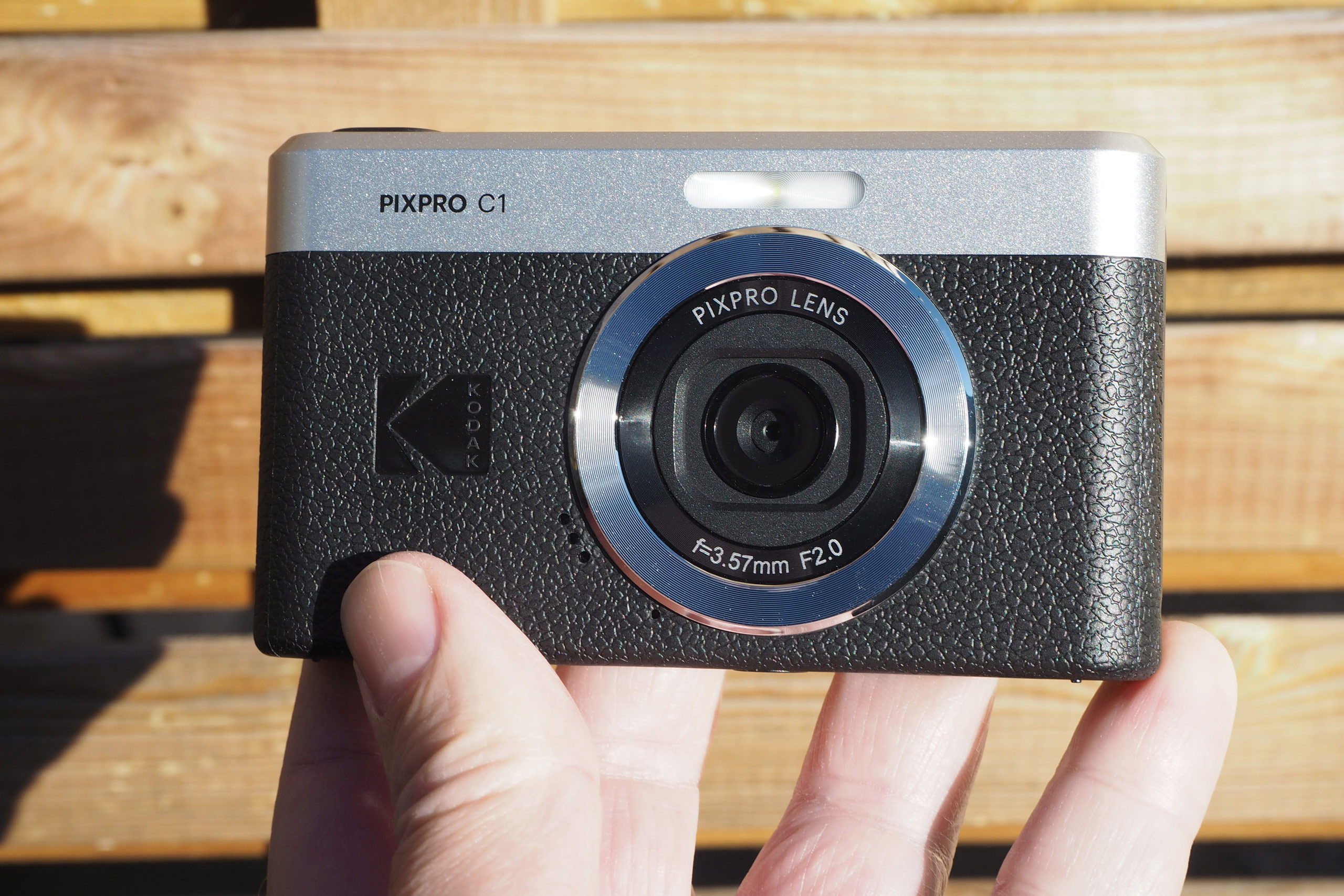
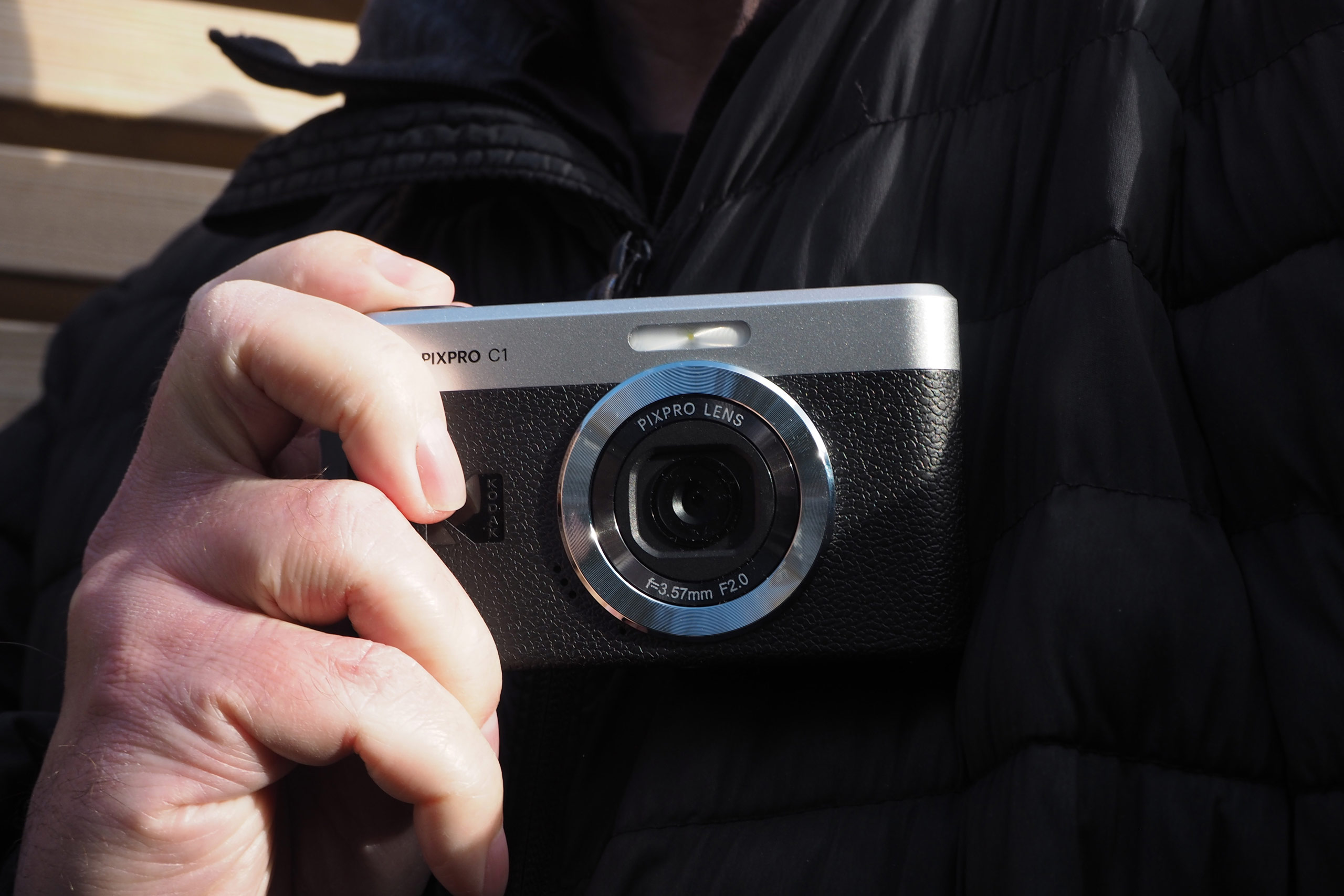
The 13-megapixel Kodak Pixpro C1 features a plastic faceplate with faux leather finish plus metallic silver accents. It’s not quite the Fuji X-Pro3 beloved by K-Pop stars, but the C1 gifts their teen fans a camera that, at an almost pocket money friendly $99/£79, is a lot more within their grasp.
The other immediately appealing aspect here is portability. The C1 is almost as slim as a mobile phone, so it’s no surprise that its built-in battery is charged via a standard USB cable, supplied in the box. My review sample did not come bundled with a mains plug, but that may differ in territories outside the UK and in any event any standard USB enabled plug does the job. So far, so promising.
Kodak Pixpro C1 – Handling and design
The Kodak Pixpro C1 reminds me of the once popular but long-vanished Casio Exilim snapshot range, marketed back when as the ‘wearable card camera’. Similarly, the C1’s svelte dimensions ensure it slips as easily into the top pocket of my shirt as it might a lady’s clutch bag.

However, there are obvious practical issues from the outset. Despite the faux leather detailing on the plastic faceplate and raised nodules on the back that fall under the thumb, it’s difficult to get a tight grip on the unit. There’s a slightly thicker screen bezel at the LCD’s left side, but my sample’s 2.8-inch screen still quickly became covered in thumb prints as I attempted to hold the C1 steady.
In terms of extra support, a screw thread is centrally located at the base of the camera allowing for, in theory, a mini tripod to be attached. The camera’s underside also features an exposed slot for inserting the necessary microSD card, with support for up to 32GB stated. So, a 32GB card was what I used during my test period.

The Kodak Pixpro C1’s top plate is similarly frill free. Making it newcomer friendly, it features just a lozenge-shaped power button, slightly recessed to avoid accidental activation, plus a larger, raised and springy shutter release over at its right-hand edge. This is a camera you’d be able to pass to a friend for a quick snap without any explanation needed, beyond ‘point and shoot’.

Image credit: Gavin Stoker
What I immediately noticed is that there’s no top plate zoom lever here. Unsurprisingly, the camera’s slender dimensions have been enabled by omitting any optical zoom. Instead, an image cropping 4x digital zoom is offered, users able to tab between wideangle and telephoto setting via a vertical button pairing top right of the camera back.

The familiar control we do get is the standard four-way control pad, with display, flash activation, macro mode, delete / self-timer options ranged around it and an equally familiar ‘set’ button at its centre, for implementing menu selections. Above and below this, are a red video record and playback button respectively, with the final controls being a menu button esoterically marked with the letter ‘C’, plus a dedicated mode button in lieu of the usual dime / penny shaped shooting mode dial. These controls are all typically tiny, requiring pressing with the nail of my thumb.
Kodak Pixpro C1 – Build quality
While first impressions were positive as I lifted the Kodak Pixpro C1 from its box – appearing more sophisticated than I’d expect of a pocket snapper, including the brand’s own FZ55 – in the hand the C1 feels plastic-y.

After first charging the internal lithium-ion battery, I was attracted by the most tactile aspect of the camera: the flip-up LCD screen. This arcs through 180 degrees from flat against the camera back to facing whatever is in front of the lens, making it suitable for selfies, group portraits and ‘walk and talk’ influencer-style videos. Its hinged mechanism feels reasonably solid, with a nice action.
Given the C1’s budget pricing it is hardly a shock that the LCD isn’t a touch screen and that the menu displays are very basic, with childish looking icons. It does all feel like a bit of a throwback to digital compacts of 15 to 20 years ago.

The camera is noticeably lightweight at 115g, but since its dimensions are so slender, its lack of heft doesn’t come as a surprise. Still, slightly more solidity would reassure, especially as there is no on-board stabilisation of any sort to counteract hand wobble and camera shake.
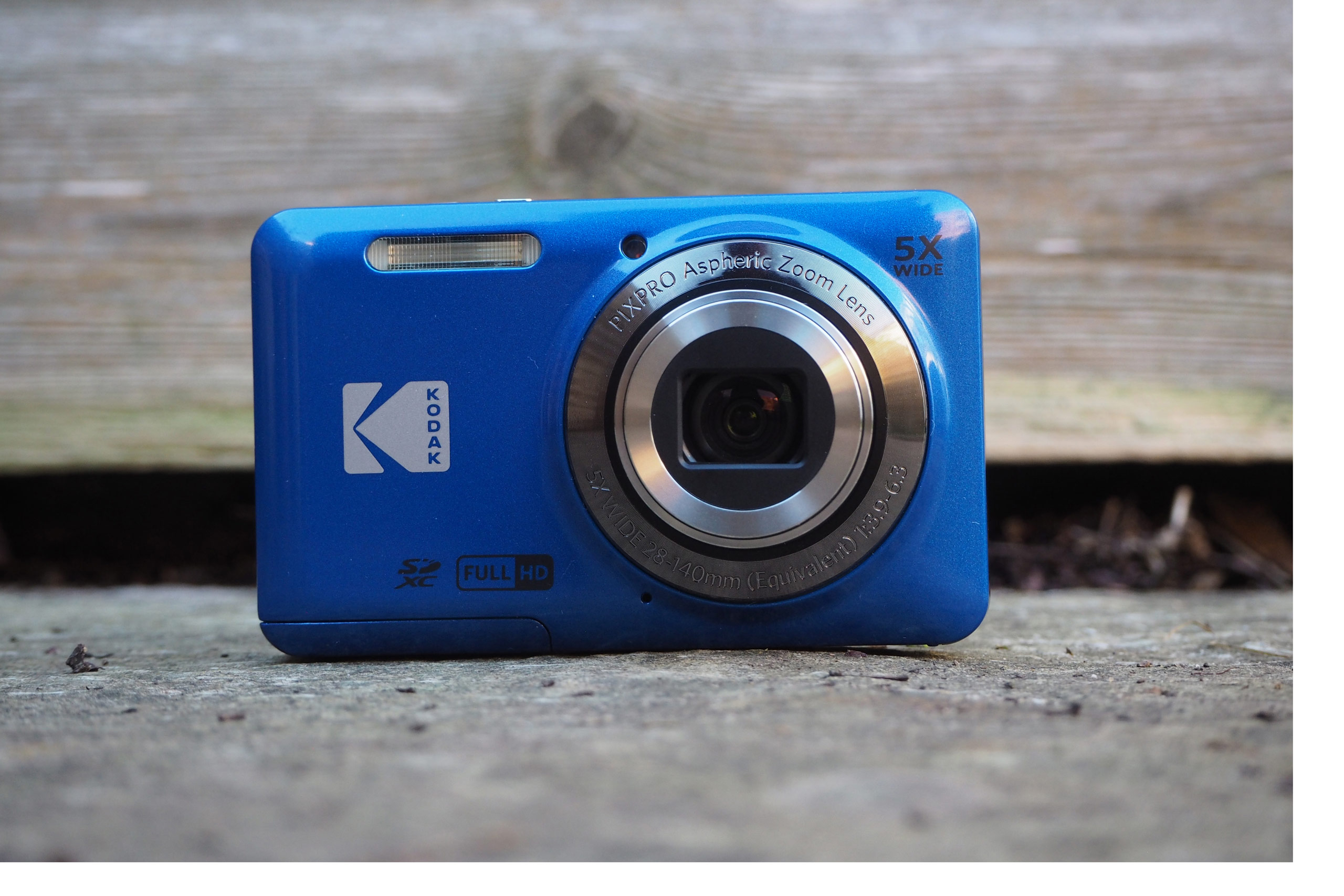
There’s a built-in LED flash directly above the lens, its proximity delivering the threat of red eye when capturing human subjects but luckily located far enough from the camera’s edges to avoid me accidentally placing a finger in front of it, as I did several times on the even smaller Kodak Pixpro FZ55 alternative. The latter adds an optical zoom and three million extra pixels to its top resolution, albeit for half as much again as the C1 costs.

Taking in the whole picture regarding this camera, build quality and handling are passable, while achieving around 200 captures from its fully charged battery is so-so. If you’re a bit more experienced, yet are still seeking a cheap pocket camera that delivers decent results, the alternative option could be to explore what is available second hand for a similar outlay.
Kodak Pixpro C1 – Performance
Powering up in two to three seconds, at the heart of the Kodak Pixpro C1 is a distinctly old school, backside illuminated CMOS sensor offering a 13-megapixel top resolution. Unsurprisingly given the camera’s size and cost, the sensor is a modest 1/3-inches, but this is coupled with a 26mm equivalent wide-angle lens and a bright f/2.0 aperture, thereby best catering to the two most popular subjects for photography: portraits and landscapes. Video with audio is likewise provided, but again it feels like its maker has turned the clock back. Maximum recorded footage quality is at Full HD resolution, not 4, 6 or 8K.

For stills, the best option is selecting ‘Best’ quality, least compression 13MP JPEGs, which is what I selected for the sample images shown here. In being a snapshot camera, all I was expecting to get out of the C1 was snapshot type images – and that proved to be the case.
A full squeeze of the (electronic) shutter release and the 230K dot resolution screen momentarily goes blank before briefly displaying the captured image for literally one second. The lack of optical zoom means that if I want to fill the frame with my subject, I simply need to get as close as possible to it, which isn’t always an option.

While any chromatic aberration is kept reasonably at bay, it is present on occasion and noticeable even without having to enlarge portions of the image. Images appear softer towards the edge of frame and, in anything other than sunny conditions, blur due to hand tremor is a constant possibility, with selectable light sensitivity topping out at a conservative ISO1600 to avoid intrusive image noise.

More positively, when photographing sunlit subjects, well saturated colour is achievable, with a further boost to be had via the pre-optimised landscape mode option. Indoors I found the camera sometimes struggled to find focus, particularly as the light dimmed on an autumn afternoon, yet before it got dark enough to warrant switching an interior light on. In dull weather or when the light was fading, it was pretty much forget it if wanting to avoid similarly dull looking results.

In terms of creative options, Kodak’s license holder has kept it simple. A press of the backplate ‘mode’ button affords access to full Auto setting or Program mode, which, when the ‘C’/ Menu button is pressed, adds the ability to adjust white balance on the left side of screen drop-down menu. Further settings include the forementioned landscape mode, plus a brief selection including night landscape, children, beach, backlit portrait and movie mode.

Pressing ‘Menu’ in movie mode provides a more restricted range of colour filter options compared with those selectable when shooting stills, here just comprising retro, black and white, sepia and vivid alongside the default of ‘normal’. We can choose to shoot Full HD quality video at 60fps rather than the 30fps default, or HD quality video at the same frame rates if needing to save space on the microSD card. Additional digital effects accessible in photo mode include coloured pencil, film negative, charcoal pencil-like ‘sketch’, plus partial red, green, blue and yellow options. Pretty forgettable stuff, all told – and all as authentically ‘retro’ as the exterior of this camera.
Ultimately, the casual snapper wanting a different experience than handling a smartphone will find the C1 delivers that, even if there’s not much here to hold the interest long term, especially for the grown ups. Alternatives include the Kodak Pixpro FZ45, with optical zoom, or you could look at vintage digicams.
Kodak Pixpro C1 – Verdict
The Kodak Pixpro C1 is undoubtedly more about having fun making pictorial memories than serious photography, while its flip up screen has added appeal for the ‘content’ creating vlogging community – or at least teenagers who one day aspire to become influencers. It’s not going to challenge any interchangeable lens mirrorless for photo quality, with most smartphones also capable of delivering better results. But to criticize the C1 for that reason is to largely miss the point.
Its target audience isn’t going to be demanding gallery quality imagery. It will be more about making memories with mates and wanting a ‘cute’ camera via which to do it, while providing a different ‘experience’ to smartphone captures. In that respect this undemanding snapshot fulfils the brief. Its pricing also suggests gifting potential. However, those of us with twenty years of experience under our belts will simply feel we’ve seen all this before, and inexpensive point-and-shoot digicams were, with few exceptions, never that great the first time around.

Review sample kindly provided by Wilkinson Cameras.
Full specifications
| Sensor | 13MP resolution from backside illuminated 1/3-inch BSI CMOS sensor |
| Lens | 3.57mm lens (26mm equivalent), f/2.0 |
| Zoom | 4x digital zoom |
| Focus range | 60cm to infinity focus range, or from 8cm in macro mode |
| Screen | 2.8-inch LCD screen, tilts through 180-degrees |
| Video | Full HD video recording up to 60fps |
| Storage | MicroSD card slot (no card provided) |
| Battery | Powered via built-in lithium-ion battery |
| Dimensions | 103x60x20.3mm in size |
| Weight | 115g body-only weight |