In this guide, I’m going to be a purist and pick out solely the best DSLRs you can buy from Pentax. Despite all the hype around mirrorless, DSLRs still have many fans, as plenty of photographers prefer their optical viewfinders, rugged bodies and big batteries over mirrorless technology. It can be easier to pick up lenses more cheaply, too. Pentax is the only major camera manufacturer to have reaffirmed its commitment to DSLRs, with others jumping firmly into the mirrorless camp.
If you’re new to DSLRs (digital single-lens reflex cameras) in general, rest assured that Pentax is a fine choice, and our team has reviewed all the latest offerings from the manufacturer. Our selections are based on our extensive testing experience, and we’re confident that all the cameras on this list represent value for money. You also have a good variety of Pentax lenses to choose from.
The best Pentax cameras: our quick list
Best Pentax for landscapes and portraits: Pentax K-1 II – Buy now
Best Pentax DSLR for action: Pentax K-3 III – Buy now
Best Pentax DSLR for detail: Pentax 645Z – Buy now
Best Pentax for black & white photography: Pentax K-3 III Monochrome – Buy now
Best Pentax DSLR for beginners: Pentax K-70 – Buy now
Best ultra-cheap Pentax DSLR: Pentax K100D – Buy now
Best limited edition Pentax: Pentax K-x rainbow
Best second-hand Pentax under £1000: Pentax K-1 – Buy now
Best Pentax bargain under £100: Pentax K-r – Buy now
Looking for the best deals on Pentax DSLRs? Above, you’ll find some of the best Pentax camera deals, as our ‘Buy now’ buttons are set up to automatically take you to the best prices from trusted retailers. You’ll also find below each camera a list of other retailers so you can find the right deal for you.
Why you can trust Amateur Photographer
We spend many hours testing every product we recommend, in detail, in a variety of situations and shooting scenarios, and only use experts for our reviews, so you can be sure that you’re getting the best products. Find out more about our expert writers.
Let’s get started looking at the best Pentax DSLRs you can buy…
Best overall
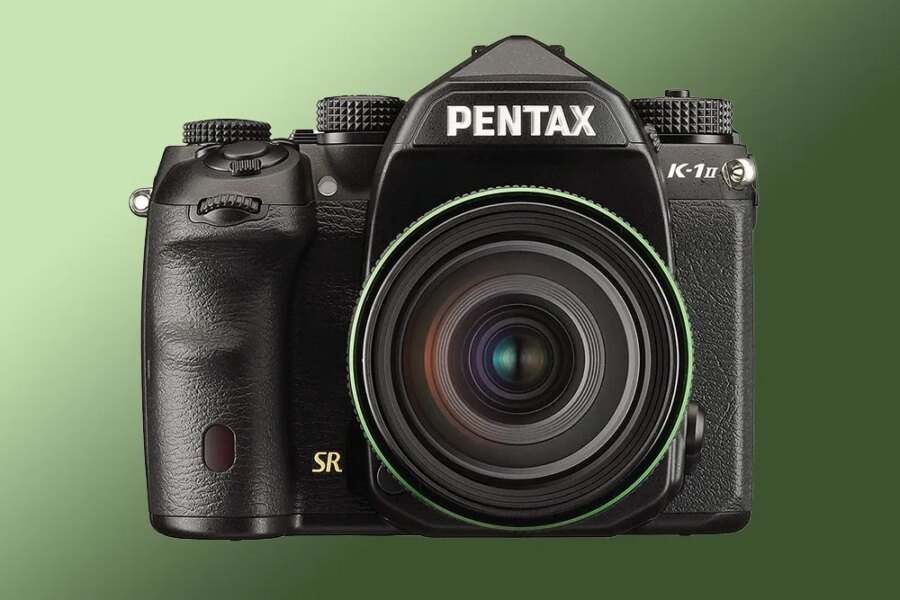
Best Pentax for landscapes and portraits: Pentax K-1 II
Pentax K-1 II Full-frame DSLR
Amateur Photographer verdict
This full-frame DSLR flagship is weather-resistant and among the toughest Pentax cameras.
Pros
Excellent images in any light
Bright and big optical viewfinder
Clever vari-angle-touchscreen design
Excellent build quality
Cons
Only HD video up to 60p
Modest upgrade from the K-1
Middling battery life
Heavy
Specifications at a glance:
Sensor
36.4MP full-frame CMOS sensor
Screen
3.2in 1.04m-dot vari-angle-touchscreen
Continuous shooting
4.4fps full-frame, 6.4fps at APS-C setting
ISO
ISO 100-819,200
Image stabilisation
5-axis sensor-shift stabilisation
Video
Full HD 60p
If you want a full-frame DSLR with a Pentax badge on the front, the choice is very simple. There is only one series of full-frame DSLRs, comprising two iterations. The most recent Pentax K-1 II represented a modest upgrade from its predecessor the K-1, with the most notable improvement being the increased sensitivity by 2EV to a whopping extended ISO 819,200.
So, what do the K-1 and K-1 II cameras have in common? Plenty of good things: a 36MP full-frame sensor with excellent low-light performance. A large pentaprism optical viewfinder (pentaprism is superior to pentamirror). Then there is sensor-shift stabilisation, paired with GPS and a unique feature called Astrotracer, which arguably makes the K-1 II the DSLR choice for astrophotography. There are also some great value, high-quality Pentax K-mount lenses available, so landscape and portrait photographers are very well catered for.
Pentax has a tradition of well-made cameras – the brand would not have lasted so long otherwise. This flagship weather-resistant camera is the toughest of them all, and you feel it in every one of its 1010 grammes! We love the clever four-arm design of the vari-angle touch screen, plus the illuminated buttons are a nice touch for low light handling.
Pentax K-3 III, DSLR in hand with lens. Photo credit: Andy Westlake
Amateur Photographer verdict
The Pentax K-3 III is a mighty fine flagship APS-C format camera that takes quality images and 4K video.
Pros
Excellent detail
Bright and big optical viewfinder
Ergonomics and build quality
Quickest Pentax DSLR
Cons
Fixed touch screen
No external charger
Very expensive
Specifications at a glance:
Sensor
25.7MP APS-C CMOS sensor
Screen
3.2in 1.62M-dot fixed LCD
Continuous shooting
12fps
ISO
ISO 100-1,600,000
Image stabilisation
Sensor-shift shake reduction “SR II”(5-axis)
Video
4K 30p
Pentax caused something of a stir by releasing a new DSLR in 2021, but as we found in our review, the Pentax K-3 III is a mighty fine flagship APS-C format camera, afforded a wealth of K-mount APS-C lenses and high performance. Features are too many to list here, but highlights include the back-illuminated sensor with maximum ISO 1,600,000 sensitivity, 12fps with 101-point AF system and, wait for it, 4K video! Yes Pentax can do video, too.
Handling-wise, high expectations are met. This is a solid weather-resistant camera weighing 820g. It has excellent ergonomics, dual card slots, a bright and large OVF, top LCD, though the 3.2in 1.62m-dot rear touch screen is fixed which is a shame. However, if you want a high performance Pentax DSLR for the likes of sports and wildlife and don’t mind the cost (at launch the K-3 III was more expensive than the full-frame K-1 II and rivals like the Nikon D500), then K-3 III is the choice for you.
This medium format DSLR boasts a 51.4MP resolution, a tank-like build both in size and durability, plus a gorgeous viewfinder and handy tilt-LCD for waist-level shooting.
Pros
Excellent detail
Sublime optical viewfinder
Clever tilt-LCD design
Solid build quality
Cons
Heavy and bulky
Limited lens choice
Outperformed by modern rivals
Specifications at a glance:
Sensor
51.4MP medium format sensor
Screen
3.2in 1.04m-dot tilt-LCD
Continuous shooting
3fps
ISO
ISO 100-204,800
Image stabilisation
No
Video
HD 60p
The digital medium format market was disrupted through the introduction of the Pentax 645D in 2010. Not only did Pentax do away with the digital back, but also significantly undercut the big players Phase One and Hasselblad. At around a third of the cost, the 645D opened up digital medium format to a whole new group of photographers, and was eventually replaced by the Pentax 645Z in 2014.
What you get in the successor is a camera boasting a 51.4MP resolution on a 43.8×32.8mm image sensor, a tank-like build both in size and durability that lets you confidently break free from the studio, plus a gorgeous viewfinder and handy tilt-LCD for waist-level shooting.
It’s a real shame that Pentax seemingly lost interest in its medium format DSLRs, and never felt the need to extend the lineup that is limited to six lenses, because it no longer enjoys predominance. Since the 645Z, Fujifilm launched its GFX range of cameras that includes the more cutting edge Fujifilm GFX 50S II, while Hasselblad added a more wallet-friendly lineup in the dazzling Hasselblad X1D series.
Best Pentax for black & white photography: Pentax K-3 III Monochrome
Being a DSLR, the camera is chunky front-to-back. But it still fits nicely in your hand. Credit: Andy Westlake
Amateur Photographer verdict
If you’re a Pentax user with a nice set of APS-C lenses, who loves shooting in black & white and has the money to spare, it’s an easy recommendation.
Pros
Creates lovely monochrome images
Large, clear viewfinder
Robust weather-sealed build
Comprehensive array of external controls
Works with a large range of K-mount lenses
Cons
Rear screen is fixed and doesn’t tilt
Poor autofocus speed in live view
ISO 200 setting prone to clipping highlights
Specifications at a glance:
Sensor
25.7MP APS-C CMOS sensor
Screen
3.2in, 1.62m-dot fixed touchscreen
Continuous shooting
12fps
ISO
ISO 200-1,600,000
Image stabilisation
5.5 stops IBIS
Video
4K30p, Full HD 120p
The Pentax K-3 Mark III was released by Ricoh as a high-end APS-C DSLR aimed squarely at enthusiast photographers. It turned out to be a very capable camera, combining fine handling, a robust build, and impressive image quality. The Pentax K-3 Mark III Monochrome combines the robust, enthusiast-friendly design of the K-3 Mark III with all the establishedadvantages of a monochrome sensor: high pixel-level sharpness, low noise, end excellent dynamic range.
At $2,200 / £2,000, the Monochrome model commands a premium over the stock Pentax K-3 Mark III at $1,799 / £1,899 body only, but is dramatically cheaper than either of Leica’s current offerings, the Leica Q2 Monochrom ($6,195 / £4,995) and Leica M11 Monochrom ($9,495 / £8,300). It’s still not exactly a camera for the masses, but it makes the idea of a dedicated mono model more accessible than before.
This mid-range DSLR continues Pentax’s tradition of offering affordable yet well-specified cameras.
Pros
ISO range of 100-51,200
Impressive built-in image stabilisation, working with almost any lens
Feels solid in the hand and benefits from a weather-resistant finish
Cons
Bulky handgrip
There’s no way to switch off the manual focus wheel on the lens
Specifications at a glance:
Sensor
20.2MP APS-C CMOS sensor
Screen
3in, 921k-dot touchscreen
Continuous shooting
5.4fps
ISO
ISO 100 – 51,200
Image stabilisation
3.5 stops IBIS
Video
Full HD 30p
The naming convention suggests that the Pentax K-S2 is a replacement for the popular entry-level K-S1; yet a glance at its specifications reveals a more advanced camera likely to succeed the K-50. The K-S2 features a 20.1MP APS-C CMOS sensor, which boasts an ISO range of 100-51,200 and has had the low-pass filter removed for maximum sharpness.
Any concerns about moiré and alias patterning are managed through the presence of an anti-alias filter simulator provided by the built-in image stabilisation system, which provides 3.5 stops of benefit as well as working with almost any lens, including both wide-angle and prime optics. Other features include in-camera Raw processing, HD video capture and built-in Wi-fi and NFC connectivity.
It could well be argued that the K-S2 is one of the most pleasing DSLRs to use thanks to its large viewfinder and impressive control set-up. Throw in the extensive range of compatible Pentax K-mount lenses and you’ve got a camera which represents excellent value and is one of the best in its class.
For those who’ve bought into the Pentax K-mount and want to advance from entry-level Pentax DSLRs, the KP serves up an attractive set of features, impressive image quality and excellent customisation.
Pros
Effective in-body stabilisation that works with all lenses
Extremely robust body with weather sealing
Interchangeable grips let you tailor it to your needs
The Pentax KP inherits features from the full-frame Pentax K-1 as well as the mid-range K-70 and targets keen enthusiasts who are committed to photography and insist on advanced features in a solid, weather-resistant body.
There is a lot to like about the KP. It has in-body stabilisation, the dynamic range is excellent for this size of sensor, it’s easy to use, and the interchangeable grip design gives the user choice over the way the camera handles and feels with different lenses.
While it shoots slightly faster and offers a greater number of AF points than the K-70, it lacks a top-plate LCD, dual card slots, has a lower battery life and can’t shoot at 8.3fps.
Pentax K-70 in hand, as used by Jessica Miller. Photo credit: Joshua Waller
Amateur Photographer verdict
Entry-level DSLRs don’t come any better than the Pentax K-70. In fact, the K-70 possesses plenty of qualities that even advanced photographers appreciate, such as a weather-sealed body.
Pros
Excellent image quality
Class-leading pentaprism viewfinder
Weather-resistant
Lovely ergonomics
Cons
HD video only
Better AF elsewhere
Vari-angle screen is not touch sensitive
So-so battery life
Specifications at a glance:
Sensor
24.2MP APS-C sensor
Screen
3in 921k-dot vari-angle screen
Continuous shooting
6fps
ISO
ISO 100-102400
Image stabilisation
4.5 stops IBIS
Video
Full HD 30p or 60i
Entry-level DSLRs don’t come any better than the Pentax K-70. In fact, the K-70 possesses plenty of qualities that even advanced photographers appreciate, such as a weather-sealed body, comfortable grip, and a bright pentaprism optical viewfinder with 100% field of view. You simply don’t get these sorts of features in similarly priced DSLRs. On the downside, it is larger and heavier at 688g when compared to other entry-level DSLRs.
For photographers, the innards of the K-70 are equally impressive; 24MP and a maximum ISO 102,400 with sensor-shift stabilisation, 6fps and built-in flash. Not forgetting its rugged build quality that is well-suited to adverse outdoor conditions, and you have an all-purpose camera that is simply a great option to start out with DSLR photography. It’ll even provide on-screen prompts as you learn the ropes.
Pentax K100D Super DSLR – an update to the K100D, the Super adds a dust removal system.
Amateur Photographer verdict
The K100D understandably shows its years, with a modest 6MP resolution and it can’t shoot video. Still, you can pick up a K100D body only for around £50.
Pros
Sensor-shift stabilisation
Top LCD
Cheap
Cons
Low light image quality
Small LCD screen
No video
Specifications at a glance:
Sensor
6.1MP APS-C CCD sensor
Screen
2.5in 210k-dot LCD
Continuous shooting
2.8fps
ISO
ISO 200-3,200
Image stabilisation
Sensor-shift stabilisation
Video
No
Sensor-shift stabilisation under the guise ‘Shake Reduction’ was introduced in the Pentax K100D and arguably set Pentax DSLRs apart for quite some time. Evolved to its current 5-axis form and compatible with a huge number of lenses, this feature paved the way for DSLR features unique to this very day, including Astrotracer (works with GPS), Pixel Shift and AA filter simulation. Even though the K100D was discontinued in 2007 you can still find it second-hand for as cheap as $50/£50. It is an excellent, affordable choice for a beginner wanting to learn proper exposure control and also have a good selection of similarly affordable lenses to choose from.
As for the camera itself, the K100D has an 11-point AF array and optical viewfinder that would remain in Pentax APS-C DSLRs for many years, plus it boasts a top LCD to review your current exposure settings, which is usually only found in high-end cameras. Otherwise, the K100D understandably shows its years, with a CCD sensor, modest 6MP resolution, small LCD screen, 2.8fps drive mode, and it can’t shoot video. Still, you can pick up a K100D body only for around £50! The Pentax K100D Super, released at a later date, introduced a dust-removal system that is now standard across numerous other camera brands.
Best limited
Best limited edition: Pentax K-x rainbow
Pentax K-X Rainbox (Image Pentax/DC.Watch)
Amateur Photographer verdict
The camera’s styling is a matter of taste, but it certainly makes a statement. The rainbow edition is identical in almost every way to a standard Pentax K-x that harks back to 2010.
Pros
It’s going to be a talking point at the pub
A decent OVF for the money
Sensor-shift stabilisation
Video recording
Cons
It’s going to be a talking point at the pub
Specifications at a glance:
Sensor
12.4MP APS-C sensor
Screen
2.7in 230k-dot LCD
Continuous shooting
4.7fps
ISO
ISO 200-6,400
Image stabilisation
4 stops
Video
720p video up to 24p
We can’t remember a DSLR that has been available in so many colours as the Pentax K-x, and the most memorable has to be the Pentax K-x rainbow edition. Made in collaboration with Tower Records and limited to 1,000 units, you’ll either want sunglasses as an accessory or for your own protection, depending which way you look at it. The camera’s styling is a matter of taste, but it certainly makes a statement.
Other than booting up with a rainbow image on the LCD (and its psychedelic shell), the rainbow edition is identical in every way to a standard Pentax K-x that harks back to 2010. That means you get a 12.4MP APS-C sensor, a decent OVF for the money, sensor-shift stabilisation, 4.7fps and, yes, video recording – gosh! It’ll be a mission to get your hands on this rainbow version, and you’ll have better luck if you like all-red.
Have a look at MPB.com, eBay, and other retailers to see what used stock is available.
Best under £1000
Best second-hand Pentax around £1000: Pentax K-1
The Pentax K-1, a second-hand bargain if you can find it.
Amateur Photographer verdict
Unless you are a serious low-light photographer, then the K-1 offers virtually everything that the K-1 II does but at a significantly lower price (though the K-1 is no slouch in low light either).
Pros
5-axis image stabilisation
Extensive weather-sealing
Clever vari-angle-touch screen design
Well designed ergonomics
Cons
Only HD video up to 60p
Good value
Heavy
Specifications at a glance:
Sensor
36.4MP full-frame sensor
Screen
3.2in 1.04m-dot vari-angle-touch screen
Continuous shooting
4.4 fps
ISO
ISO 100-204,800
Image stabilisation
Sensor-shift stabilisation
Video
Full HD 30p / 60i
To its credit, there’s not a lot more to say about the Pentax K-1 that hasn’t already been said about the K-1 II above. Unless you are a serious low-light photographer, the K-1 offers virtually everything that the K-1 II does but at a significantly lower price (though the K-1 is no slouch in low light either). At less than £1,000 second-hand, it’s such a compelling purchase.
Both cameras offer high levels of sharp detail thanks to a 36MP sensor with no anti-aliasing filter. Where there is a risk of aliasing artefacts, the anti-aliasing filter simulator can be called upon – a feature that is present thanks to sensor stabilisation. Both cameras are comfortable in the hand, albeit on the heavier side. Both cameras really make use of sensor shift stabilisation for unique shooting modes. Overall, you’ll struggle to find a more capable DSLR for photography at this price point.
The K-r is a highly capable shooter considering its age and is able to make excellent pictures for all types of photographers.
Pros
Shoots excellent A3 prints
Decent LCD screen
Wide lens choice
6fps
Cons
Not weather resistant
Aggressive shutter action
Specifications at a glance:
Sensor
12.4MP APS-C sensor
Screen
3in 921k-dot LCD
Continuous shooting
6fps
ISO
ISO 100-25,600 (extended)
Image stabilisation
4 stops
Video
720p video up to 25p
We’ve scoured second-hand stock held by reputable dealers and the best Pentax camera you can snag sub-£100 is the Pentax K-r, where you’ll get the 18-55mm kit lens chucked in, too. It may have had a short 18-month shelf life being discontinued in 2012, but the K-r is a highly capable shooter considering its age.
With a 12.4MP APS-C sensor, extended ISO 100-25,600 range, an excellent choice of lenses, a much improved LCD screen, a continuous drive mode of 6fps and an 11-point AF system, the K-r can make excellent pictures for all types of photographers. Despite its more premium feel over the K-x, the K-r is not, in fact, weather-resistant. A Li-ion battery was introduced, whereas the K-x and other cameras from this era rely on AA batteries.
Have a look at MPB.com, eBay, and other retailers to see what used stock is available.
How to choose the best Pentax DSLR
When picking a Pentax DSLR, you’re choosing from three sensor sizes: APS-C, full-frame, and medium format. APS-C is the smallest, generally found in cameras pitched at beginners, while full-frame is the professional standard, producing better images, but costing more. You can learn more about the differences in our full run-down of APS-C vs full-frame. Medium format, meanwhile, is a larger sensor size, designed to capture unparalleled levels of detail. Pentax only made a couple of medium-format DSLRs, but they’re still a worthwhile buy if you can find them.
Other specs to look at will depend on what you want to shoot. Pentax cameras are famous for good weatherproofing, so the brand in general will suit the outdoor photographer. Beyond that, though, you may want to compare burstrates if you’re planning to shoot fast action, or ISO range if you want to photograph in low light (some Pentax DSLRs can go surprisingly high).
You may also want to look at which cameras have built-in stabilisation to keep shots blur-free at slower shutter speeds, and some have extra useful features like GPS. Finally, while no one would say it is Pentax’s forte, later cameras have been begrudgingly given the ability to shoot Full HD video, and even 4K video on the most recent offering.
FAQ: Does Pentax still make cameras?
Yes. The Pentax brand was purchased by Ricoh in 2011, and the firm has continued to release cameras under the Pentax branding to this day. Recent releases include the Pentax 17 film camera and Pentax WG-1000 waterproof camera in 2024, as well as the Pentax K-3 III Monochrome in 2023. While Pentax doesn’t release new cameras at the same frequency as many of its competitors, it is definitely still developing new cameras. Also, by virtue of staying out of the ultra-competitive mirrorless market, Pentax has been able to explore a few interesting niches of its own.
FAQ: Do old Pentax lenses fit on new Pentax cameras?
Yes. Pentax has shown impressive respect for its heritage in keeping its old lenses compatible with its newer bodies, and you shouldn’t have a problem fitting them. Just bear in mind that if you’re using an old lens from the film era, you won’t be able to take advantage of autofocus and will have to reacquaint yourself with manual focusing. On some bodies, you may need to set the camera to a specific ‘M’ mode to get things working.
How we test Pentax cameras
We test Pentax cameras primarily by using them to take photographs and video in a wide range of real-world situations. We evaluate their control layouts and handling, and the usability of their viewfinders and screens. We assess their autofocus across a range of different subjects and shooting scenarios and check their continuous shooting capabilities.
We also examine the effectiveness of their image stabilisation systems, called SR – Shake Reduction on Pentax DSLRs. Last but by no means least, we critically evaluate the image quality, in both JPEG and raw, including resolution, high-ISO noise, and dynamic range. We then take all these factors into account, along with such things as portability and lens systems, when giving our final conclusion and score. You’ll find the full breakdown of how each camera has performed in our full reviews.
Recent updates:
December 2025: Prices updated on the Leica Q2 Monochrom and Leica M11 Monochrom