

The National Aeronautics and Space Administration (NASA) deservedly holds a major place in human history with its pioneering space exploration projects, mostly notably the flagship Apollo program. But the success of Apollo wouldn’t have been possible without the existence of two other key programs – Mercury and Gemini.
The US Air Force’s original ‘Man in Space Soonest’ program had morphed into NASA’s Project Mercury, which ran from 1958 to 1963. It had the original aim of getting a person into Earth orbit as soon as possible, but that specific objective was trumped when the cosmonaut Yuri Gagarin completed a single Earth orbit on 12 April 1961 and ensured the Soviets won that part of the ‘space race’.
Both the Project Gemini and Project Apollo programs began in 1961. Gemini was based on studies to increase the capabilities of the Mercury spacecraft to long-duration flights. It was a support project to Apollo with a focus on extra-vehicular activity, rendezvous and docking. Apollo was a manned spaceflight program that used a combination of the Saturn V launch rocket, a Command Module to take astronauts into orbit around the Moon and then bring them back to Earth, and a Lunar Module to land on the Moon.

Early Mercury missions
In the early days of NASA’s Mercury missions the emphasis was more on collecting scientific data than the visual documentation of space flights. NASA sent up the first two Mercury astronauts – Alan Shepherd and Gus Grissom – with an automated Maurer 220G time-lapse camera that faced out of the window of their spacecrafts, shooting every six seconds, but no hand-held camera options.

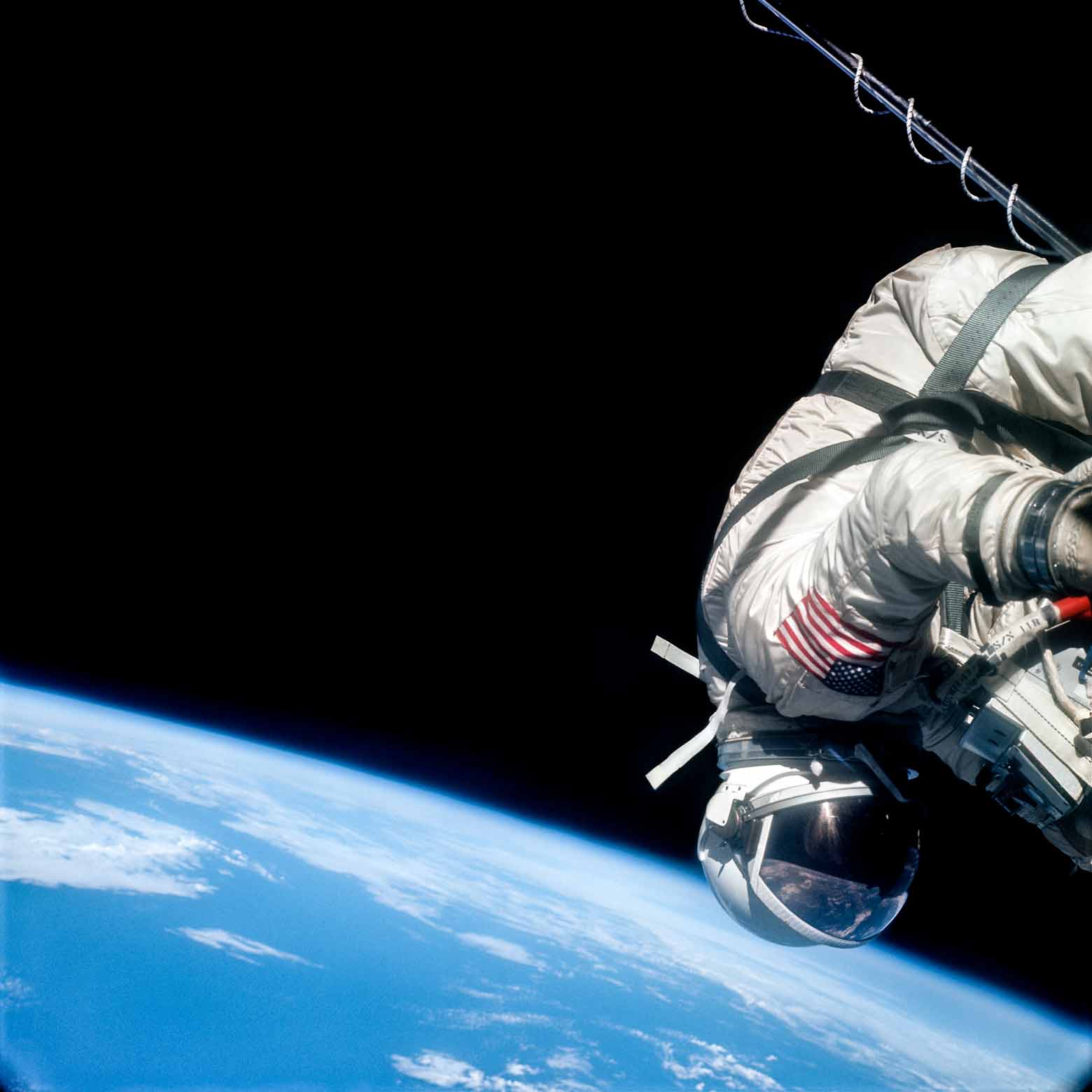
John Glenn’s decision to buy a $40 35mm Ansco Autoset (Minolta) camera, and take it with him on the February 1962 Mercury-Atlas 6 orbital mission, meant astronauts were now lobbying NASA to use their own cameras. Later the same year Wally Schirra, under advice from LIFE photographers he knew, took the first Hasselblad medium format camera into space on his Mercury-Atlas 8 mission. But, arguably, the real imagery breakthrough was when the US public became enthralled after seeing the incredible images of Ed White’s historic spacewalk during the 1965 Gemini 4 mission. It was the first ever US spacewalk and produced the first ever still photographs of a spacewalk.

NASA realised that such stunning imagery was igniting the public’s imagination and this could help to secure continued congressional support and finance for JFK’s stated goal of putting a man on the Moon before the end of the 1960s. This was the point when more finance went into the camera technology for NASA missions and the time given for photographic training for astronauts increased.
Extraordinary image edits
One thing that also unites the Mercury, Gemini and Apollo space missions is the extraordinary image editing of Andy Saunders, who hails from north-west England. He reveals, ‘Since being a child, I’ve had a passion for photography and an obsession with the moon landings and early human space exploration. I did a few paid photography jobs, but I was more of a serious amateur.’

In 2018 the window of opportunity was opened up for Saunders to unite his two passions – photography and space. That year NASA decided to make RAW TIFFs from scans of the original photographic films from the missions available as ‘open source’ material for anyone who wanted to use it. The films had previously been kept frozen in a vault for almost half a century, for preservation purposes, in Building 8 at the Johnson Space Center in Houston, Texas.
Saunders notes, ‘This was a time, a “sweet spot”, when scanning technology got to such an extent that it was worth getting the originals out, because you don’t want to handle them multiple times as they are too important and too valuable.’
He continues, ‘I was always disappointed and frustrated at how poor a quality NASA’s images were. That didn’t make sense because they used Hasselblad cameras, the best lenses, the best photo lab, the astronauts trained really well… so, why were we seeing them in such a poor state? It’s partly because they used the duplicate film, copies of the dupes, or an inter-negative was made of a copy of the copy. By the time we saw an image, certainly in an analogue world, it was multiple generations away from the original image. Then, when this “Holy Grail” of film became available, I started to work on it digitally processing.’

Armstrong on the Moon
In 2019 Saunders was able to use 16mm film of Neil Armstrong on the Moon as the source to stack a number of frames and produce the first clear image of Armstrong on the Moon. As commander of Apollo 11, Armstrong was in charge of holding and operating the Hasselblad still cameras on the Moon, so there are no good quality photographs of him.
Saunders reveals, ‘I got a name for doing this when I produced the image of Neil Armstrong on the Moon – it was released on the 50th anniversary of Apollo 11. I was quite fortunate in the timing in that I’d done that Armstrong image and all these RAW files were sitting on the NASA server with nobody doing anything with them.’
The freshly released NASA image archive included tens of thousands of photographs of the Apollo missions and Saunders set about working on them. He explains, ‘It’s a scan of analogue film, so they look flat and uninteresting straight out of the scanner, but there’s this incredible archive of 35,000 photographs from the Moon landings. I started to process those and realised how much they could be transformed, and, because I knew the history, I was looking at some of the results and thought, “I’ve never seen them like this before”. That’s when I decided to take on the project.’

This work resulted in the 2021 book Apollo Remastered, which took Saunders ‘about three years’ to complete. ‘There were 10,000 hours of processing. I’m an obsessive, so I was doing 16- or 18-hour days and weekends, but it’s also quite addictive. You’ll get a section of images and it’s just like… moon, moon, moon and then there’ll be something incredible, so that’s what kept me going. I knew the missions and I did them in mission order.’
He admits, ‘I didn’t know what I would do with them when I’d got to the end. I just knew someone had to do something with these. I was lucky enough to be able to put my career and life on hold. Part of the way through the process I got a book deal and that gave me focus and an end product to the project.’
Incomplete NASA records
NASA had categorised their Apollo open source material in mission order, which helped Saunders, but he wasn’t as fortunate with the Mercury and Gemini archive. ‘The historical record when you go back to Mercury and Gemini is much more incomplete. Although they took only 5,000 photographs, and less 16mm film, the processing of the images on this was 18 months, but the research and the writing was just as much time and effort. I’ve been doing this for six and a half years across the two books. The cover of the Apollo book is the same dimensions as the new book, so they are kind of a set. There are 400 images in the Apollo book and about 300 in the Gemini and Mercury book.’

Saunders worked closely with the publishers to ensure the colours were spot on in print. Notably a fifth colour was added to the process, which is actually a varnish on the image areas in the books. He was involved in digital pre-proofing and went to help to oversee the book on the presses at the printers in Italy.
He reveals, ‘The quality of printing in the book is great. In space it’s the blackest black you can comprehend. You have to get the blacks right. In these two books we’ve got a fifth colour, which is a varnish. So, every photograph, just the photograph not the border, has got a coat of varnish to give that pop, that contrast and those black levels.’
Self-taught editing – and the first selfie in space
Saunders is self-taught in terms of image editing. ‘I use the kind of obvious Adobe software for processing the still images. I’ve never wanted to give away too many secrets, but it’s nothing you couldn’t get. The other point to make is there’s absolutely no AI-based processing. These are such important historical images that their authenticity is absolutely essential. For me, if you apply AI to a photograph you can’t call it a photograph any more. No pixels have been harmed during the processing of these images! It’s never about trying to embellish or reinvent; it’s about restoring and bringing clarity, peeling back the layers of ageing, degradation and noise to reveal what was always inherent in that film and see it more clearly, but as faithfully as possible.’

He adds, ‘A typical still image that was reasonably well exposed probably takes about four hours to process. A difficult one may take a day. The stacking ones of 16mm film are typically at least half a day, but can be one or two days. There’s quite a variance in terms of how much work the images need. Those shot during Project Mercury needed more work because they were just in a much worse state.’
Saunders continues, ’The beauty of these projects is being able to use the original film that was actually in those cameras. The Mercury footage clearly didn’t enter the vault, or certainly not for a long time. It’s clearly aged badly. There are tears in it that they’ve repaired with sticky tape. Alan Shepherd on MR-3 (Mercury-Redstone 3) became the first American in space and only the second human to go into space. He took this frame every six seconds out of the window and, when they got back, on the original film they scribbled over every frame with felt pen. If you think about the climate at the time, they were just trying to catch up with the Soviets. These photographs weren’t taken for aesthetic quality or posterity – they were technical information and they wrote the frame numbers on them. So, they needed more restoration work than Gemini images.’

Life or death missions
Aside from the work that went into the images, Saunders is also mindful of the sacrifices that the astronauts made to push the boundaries of space exploration. ‘When people read the book, I think they’ll be surprised at the level of risk that was taken because they were trying to catch up with the Soviets. There was life or death type human drama on every single mission.’
For example, Neil Armstrong’s Gemini 8 spacecraft tumbled out of control, Gene Cernan (the last man on the moon during the Apollo 17 mission in December 1972) nearly died on his spacewalk on Gemini 9, John Glenn entered the atmosphere believing his heat shield to be loose and on Ed White’s first spacewalk the Gemini 4 command pilot Jim McDivitt had lost sight of him, didn’t know he was close to the thrusters and could have burnt him to death if he hadn’t double-checked White’s whereabouts on comms.
The latest book contains 75,000 meticulously researched words – Saunders had read all of the transcripts of the audio from all of the missions – but he notes,‘The heart of it is this stunning imagery. These are some of the most important photographs ever taken and we can now see them in a way we’ve never been able to see before. We can climb onboard the spacecraft, ride along with these pioneers on these most amazing ever human voyages, look around the capsules, look out the windows they looked out of, see earth and see what they saw in the way they saw it. It’s really the whole story of when we first left Earth told through the eyes of those who risked everything to achieve it.’

The book Gemini and Mercury Remastered by Andy Saunders (ISBN: 978-0-241-63819-4) is published by Particular Books (an imprint of Penguin Books) and has an RRP of £50. An accompanying exhibition of the Gemini and Mercury Remastered images is running at Jodrell Bank Observatory till 4 January 2026. www.jodrellbank.net
Andy Saunders
Andy Saunders is one of the world’s foremost experts in digital restoration of NASA photographs. He is the author of the Sunday Times bestselling book Apollo Remastered and his new book Gemini and Mercury Remastered. His work has been exhibited internationally and he collaborated with Apollo 13 actor Tom Hanks to produce an immersive show about the Apollo missions, The Moonwalkers. His restored images have appeared in the Daily Telegraph, Smithsonian Magazine, the New York Times and NASA’s archives. In 2019 he created the only clear recognisable image of Neil Armstrong on the Moon. In 2023 he received the Royal Photographic Society Award for Scientific Imaging.

Related reading:
- Iconic Nasa Apollo Images go under the hammer
- Nikon Cameras in Nasa Shuttle Launches
- Out of this World Images – Astrophotography Competition
- Astronaut Tim Peake chooses his Best Photos from Space