

I’ve spent a very long time, sometimes with success and sometimes without it, trying to create pictures that show every facet of my subjects resolved in crystal clear detail and frozen in that moment forever. That’s pretty much what we all do. Because that’s what we’ve been taught to strive for.
Frankly, even after the intervention of varifocals, I don’t always experience the world in crystal clear detail. I can see the detail when I really look, and look through the right part of my freshly cleaned bi-focal spectacles, but most normal people are hardly ever looking. They’re walking about thinking of something else, and paying no attention to the characters they are passing in the street.
To reflect the oblivion of the normal people I wanted to make a project that shows how they experience the world, using pictures that offer a visual representation of that low refresh frequency of the eye-brain processor – you know, when a friend walks by and you’re a few steps further on before it sinks in and you realise who it is.
That sharpness we so often strive for denies how much movement there is in the street. In sleepy villages there’s not much action perhaps, but in a busy city there’s more bustle and changing information than we can sensibly take in. Getting it all frozen in time can make it appear the world conspired to play musical statues at the moment you opened the shutter, when really populations are rushing to work, cycling furiously with a rapidly cooling pizza or nattering ten-to-the-dozen on strike-force shopping trips.
We are often a part of all that motion but when we stand still and let it all wash over us, and when we pay attention to what we sense around us, our experience can be very different. Try stopping in a busy street and staring into the space ahead of you. Take on a meditative state and note what your eyes tell you when you aren’t moving them, your head or your attention. Relax. Let the world flow by without you feeling the need to keep up. You’re not in a rush, and you don’t have to take on the group anxiety of city folk and their requirement to have got where they are going ten minutes ago. You’re there to take pictures.
The shape of walkers
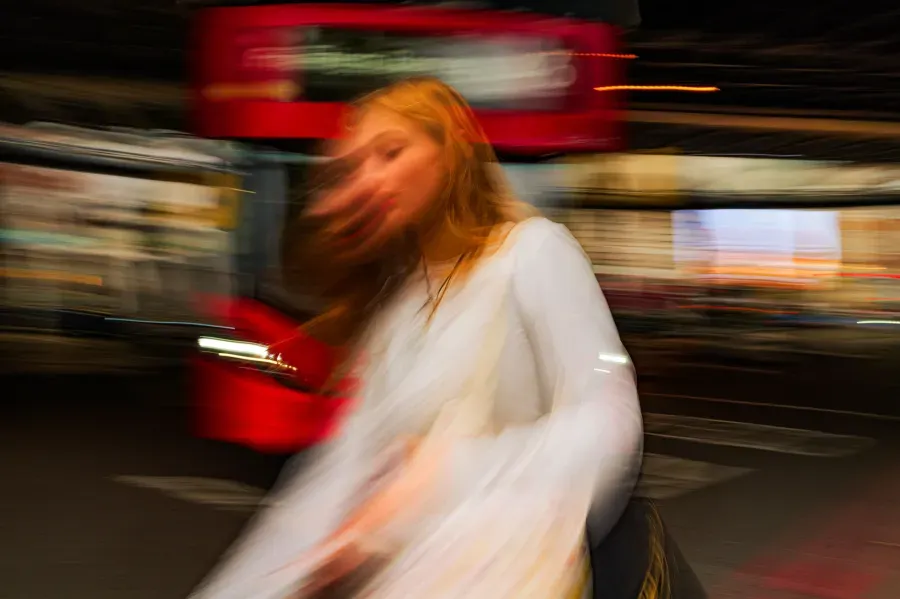
When I started using a longer shutter speed in the street I expected traffic-trail streaks to appear behind my subjects as they sped along the pavement. However, humans don’t travel like cars. They have legs instead of wheels, and as they walk their top half bobs up and down. Instead of the straight streaks I anticipated I got undulations of light and colour as shirts, jackets and hats bounded along.
With striding legs our body parts don’t all move at the same speed. Sometimes a foot might be planted in the same place for the duration of the shutter opening as the rest of the body transitions into position for the next stride, leaving us with stray boots amid a blur of material. Until you try it you might be surprised how some backgrounds make a chromatic wave stand out, while others can swallow the subject entirely, leaving no trace of them in the image at all.
With the juddering motion of a human walking we sometimes get the motion blur in front of the person, and other times behind, depending on the progress of the step at the moment the shutter opens. At first the effects in every shot are a surprise, but with practice I’ve come to know what to expect and how to time a shot to create the particular look I’m after. Even so, the process is still full of wonder and amazement.
Still static
When I began this project I really concentrated on keeping the camera still and allowing the subjects to move across a static frame of architecture. I really liked the effect, and still do, but in later times I’ve also been moving the camera to create an entirely different effect.
Keeping a still camera replicates the sense of us standing stationary and looking in one direction while life passes us by, but we get a perception of turning our head when we move the camera. Imagine someone walking by and something catches your eye, so you turn to get a better look.
Sometimes I’ll walk and shoot at the same time, which delivers camera motion in one direction while the people coming towards us travel in the opposite direction. That’s exciting too.
Miss hit
If you think the hit rate is low for your favourite photographic subject, wait until you’ve tried this. I do shoot a lot of junk, and before I press the shutter release I have no idea whether the picture will be any good or not. It’s hard to get it right, and it has taken me a lot of practice and experience to get to a stage where I know what I’m doing. I can have a good feeling about a shot, and I can suspect when something isn’t going to work, but there are still so many variables that certainty of success or failure can’t be had.
What can be had though – and in spades – is a massive thrill, a lot of excitement and an indescribable delight when a photograph turns out well. As the chances of getting an effective image are so low, the elation when we get one that works is heightened to a dramatic level. Take it up with some caution though – you may find working this way is really quite addictive.
You can find out about Damien’s Slow Shutter Street workshops on his website and see more of his work on his Instagram.
Related reading: