You need to see these beautiful vintage art deco cameras from the 1920s and 30s

The Art Deco movement was defined by designs that were dominated by streamlined, geometric shapes and lines, smooth, sleek and often a little futuristic. The style originated in France around 1910, its name derived from ‘Arts Décoratifs’, flourished in the 1920s and 1930s, then faded away in the 1940s before enjoying a brief revival in the 1950s. Art Deco became synonymous with the look of everything from huge buildings to the smallest pieces of jewellery. And of course, cameras.
With the coming of Art Deco, cameras that might once have been considered only as utilitarian devices began to appeal as articles of beauty as well. Manufacturers soon realised that if they wanted to increase profits, form might be as important as function. In the camera world, then, Art Deco wasn’t just a style. It was a means of entry into new markets for camera makers.
The Teague influence
![[Pic-01]
The five colours of the Kodak Vanity camera – notice the stylus next to the lens of each camera, ready for use with autographic feature](https://amateruphotographer.com/wp-content/uploads/ap-imports/2025/11/wade-deco-01.jpg?w=1024)
The five colours of the Kodak Vanity camera – notice the stylus next to the lens of each camera, ready for use with autographic feature
Walter Dorwin Teague was a freelance industrial designer, architect, illustrator, graphic designer and entrepreneur. In 1927, he was hired by Eastman Kodak in America to take a new look at, and expand the market for, some of the company’s already popular models. Teague immediately saw a need for cameras that might appeal to fashion-conscious women of the time and, since this was the 1920s, the fashion of the day was Art Deco.
He began with the Vest Pocket Kodak, originally launched in 1912 as the first camera to use 127 film. In 1925, Kodak restyled and relaunched it as the Model B, which followed the then-popular style of having a bed that folded out from the body along which the lens was extracted on bellows. The next year, the Series III followed, which was technically a little more sophisticated.
The cameras were made in black – until Teague turned them into the Kodak Vanity range. Out went black and in came five colours for bodies and bellows, each with its own distinct name: bluebird (deep blue), cockatoo (green), seagull (grey), redbreast (red) and Jenny Wren (brown).
The camera bodies were streamlined with gold Deco-style lines, and the faces around the lenses took on a new Deco-style ornamentation. Each used Kodak’s patented Autographic feature which featured a small trapdoor in the camera back that was opened to allow a stylus to impress words on the film’s backing paper.
Doing so, broke a thin wax membrane between the backing paper and the special autographic film in the shape of the writing. When the trapdoor was left open for a short time, light fogged a small area of the film in the shape of the writing. In this way, names, locations, dates, etc could be recorded on the negative, and so onto the print, in the rebate between frames.
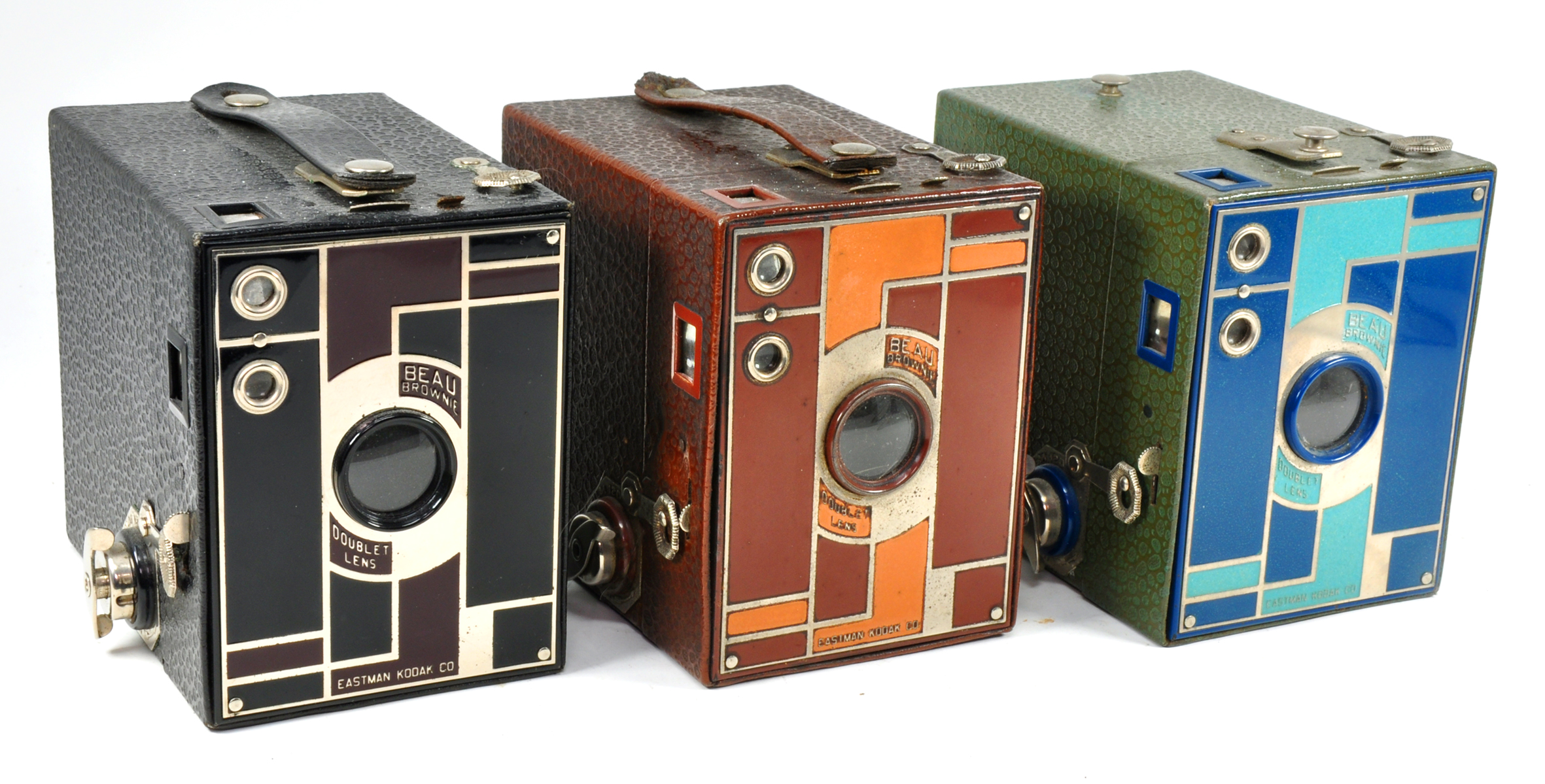
Teague’s next project, in 1930, saw him update the humble No.2 and No.2A Brownie box cameras made respectively for 120 and 116 size roll film. In the new Deco styling, each featured a faceplate around the lens where dark and light-toned squares and rectangles emulated the body colours of black, blue, tan, green or rose. The cameras were known as Beau Brownies.
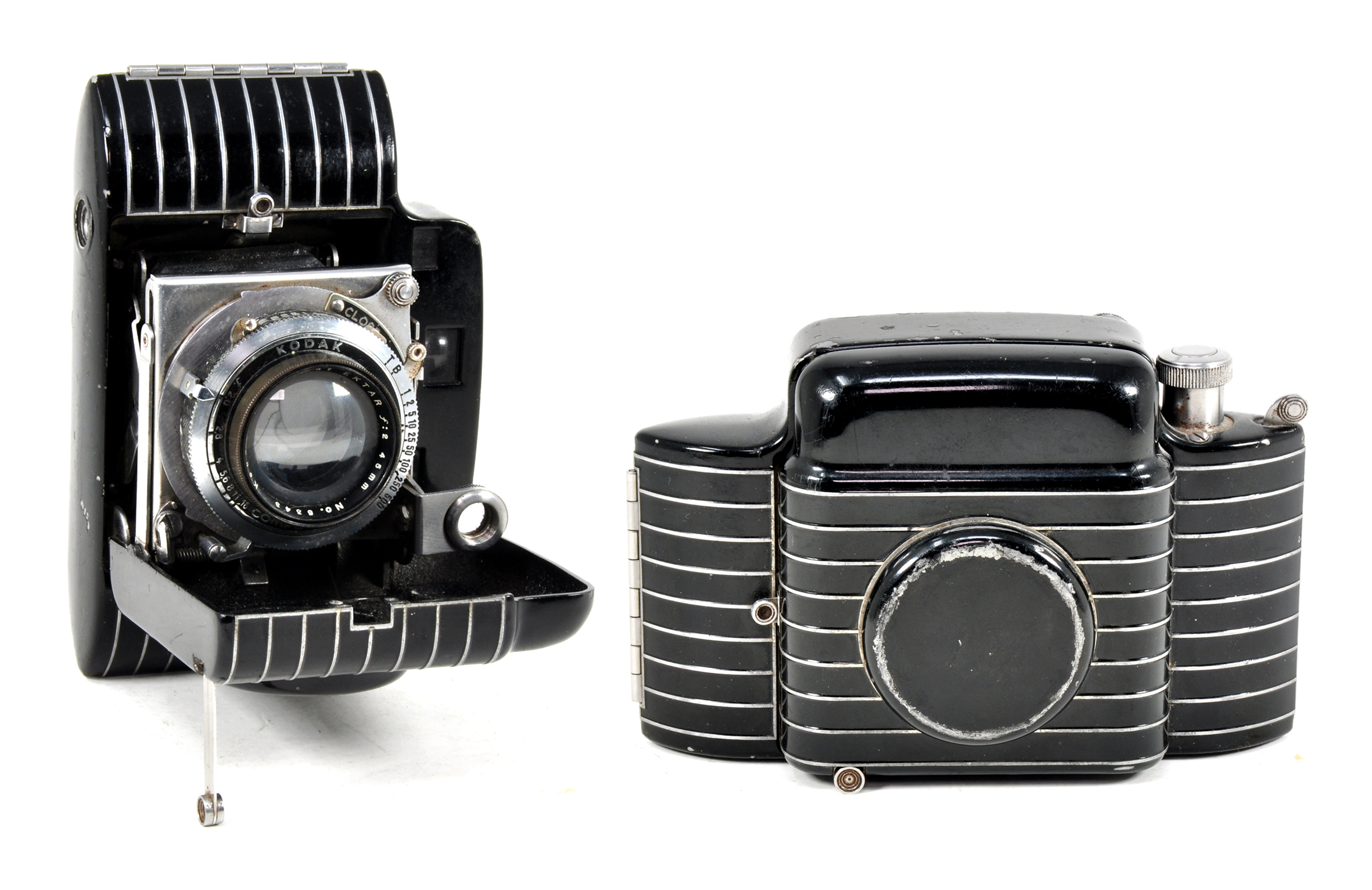
Teague’s masterpiece in Art Deco styling came in 1936. At that time, the Bantam name was already seen on a series of easy-to-use cameras that were fairly bland as far as styling was concerned. Then came Teague’s Bantam Special. As well as being more sophisticated technically than other Bantams, its styling was stunning.
The body was made from black enamelled aluminium with silver horizontal stripes along its length, both front and back. The camera folded into a clam-shaped metal case, from which it unfolded to reveal a 45mm f/2 Anastigmat Ektar lens that focused down to 3ft, coupled rangefinder and shutter speeds running 1-1/500sec. It shot 3x4cm images on 828 size film.
More from Kodak
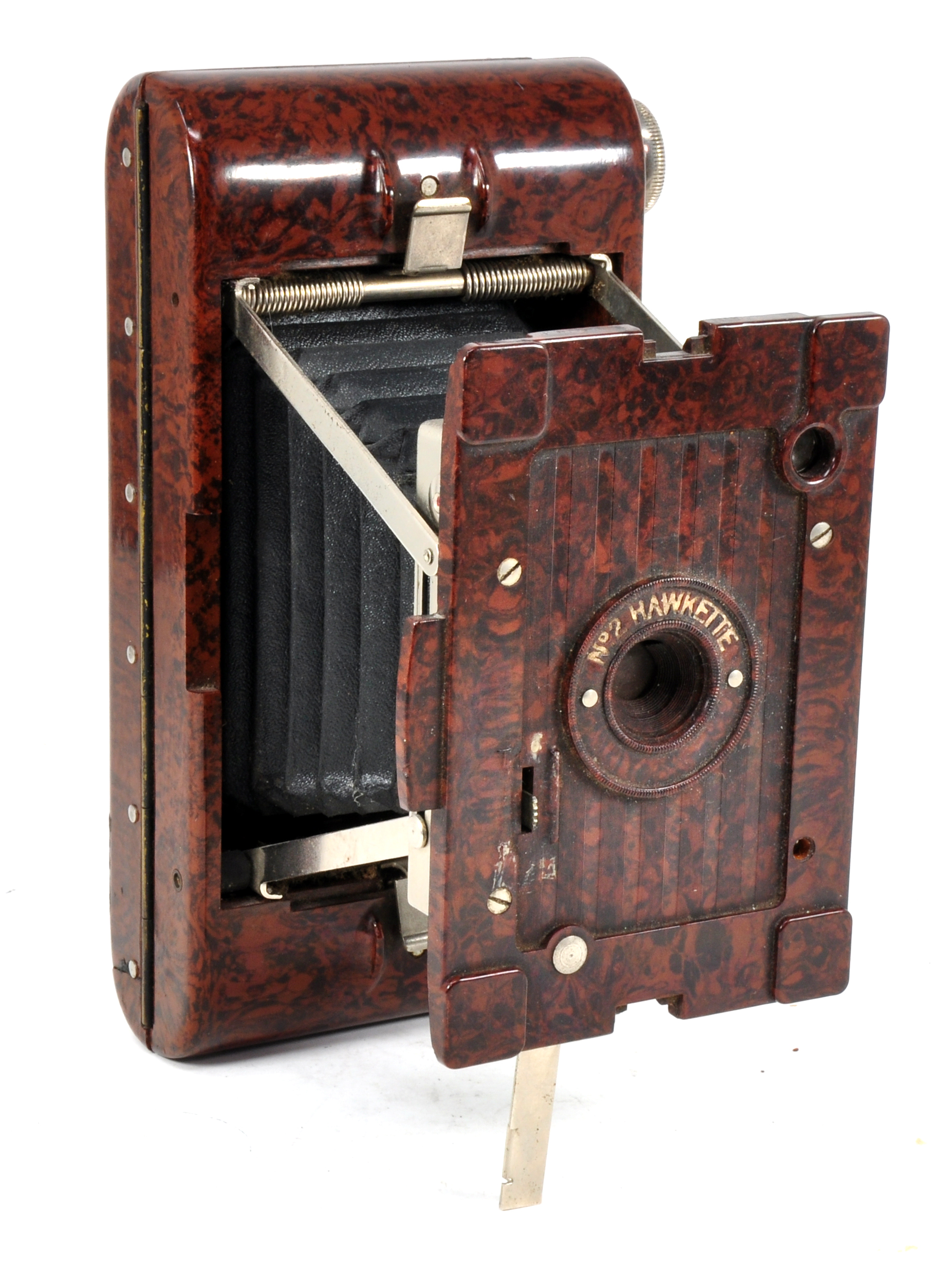
Kodak was more prolific than other camera makers when it came to Art Deco designs, many of which took advantage of the versatility of Bakelite. The world’s first synthetic plastic was introduced in 1907, but it was 1929 before the material was used in camera manufacture with a model called the Rajar No.6.
That one wasn’t made by Kodak, but the year after, Kodak made its first Bakelite model. It was called the No.2 Hawkette (no one seems to know what happened to the No.1), using Bakelite to produce a smooth brown marbled body with rounded ends and a Deco pattern embossed on the front.
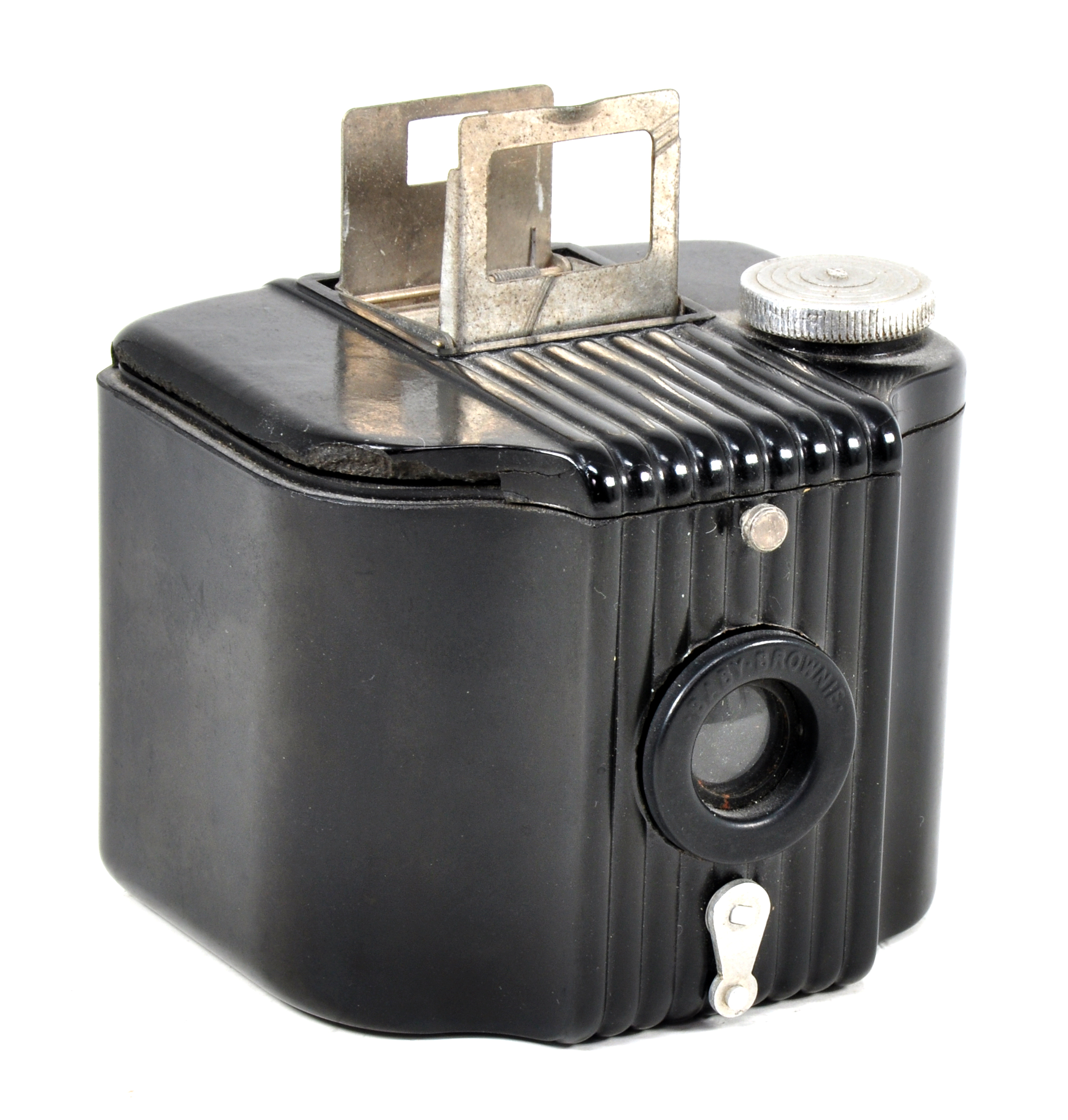
Bakelite also lent itself to the styling of the Baby Brownie that appeared in 1934 with an Art Deco pattern of ribs that ran across the top of the body, down the front, along the base and up the back.
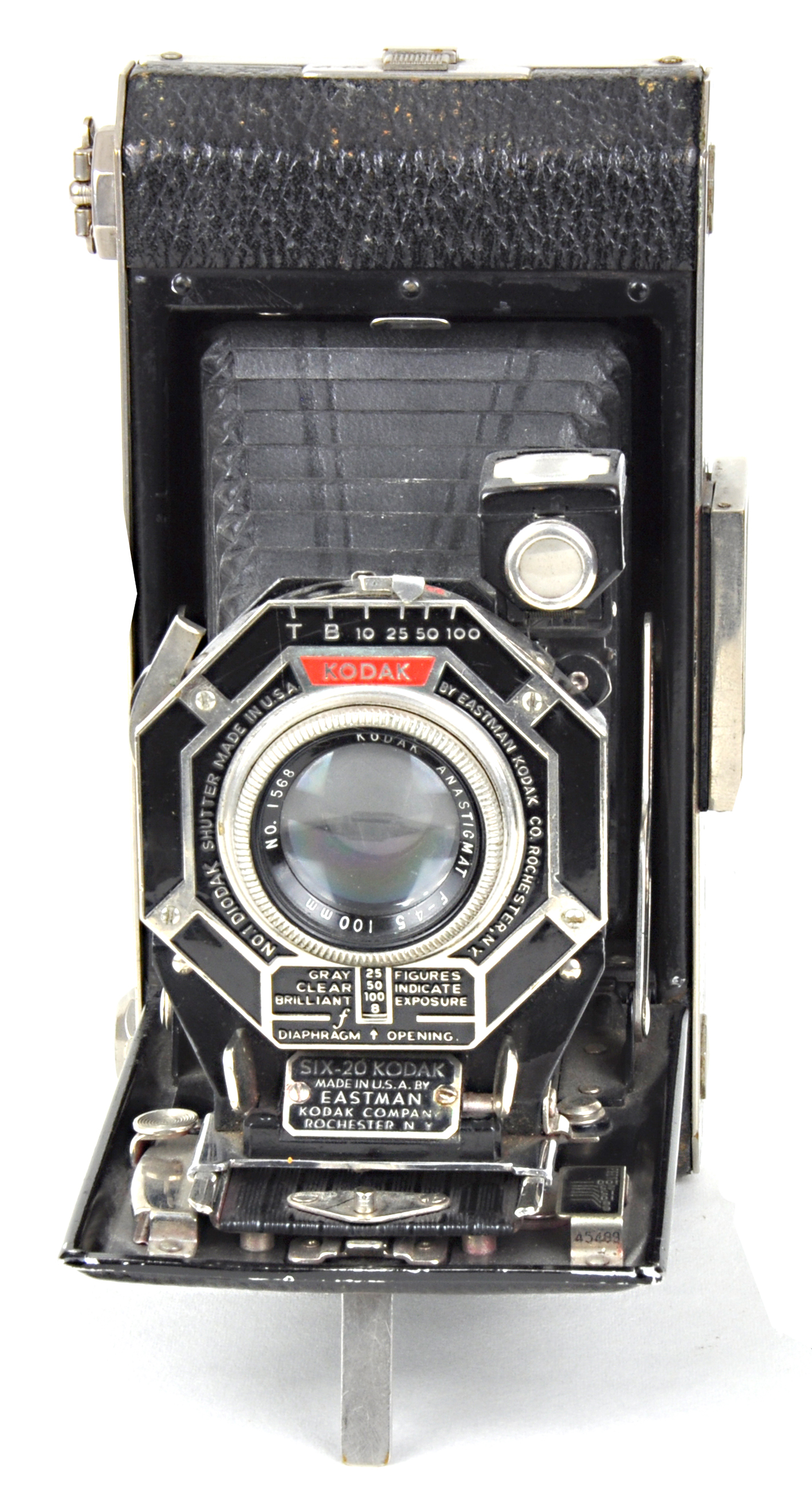
The place where so many Kodak cameras of this era exhibited Deco influences was on the face plate that supported the lens, exemplified to perfection by the Six-20 Kodak of 1935 with its lavishly decorated black and silver octagonal shutter and lens panel.
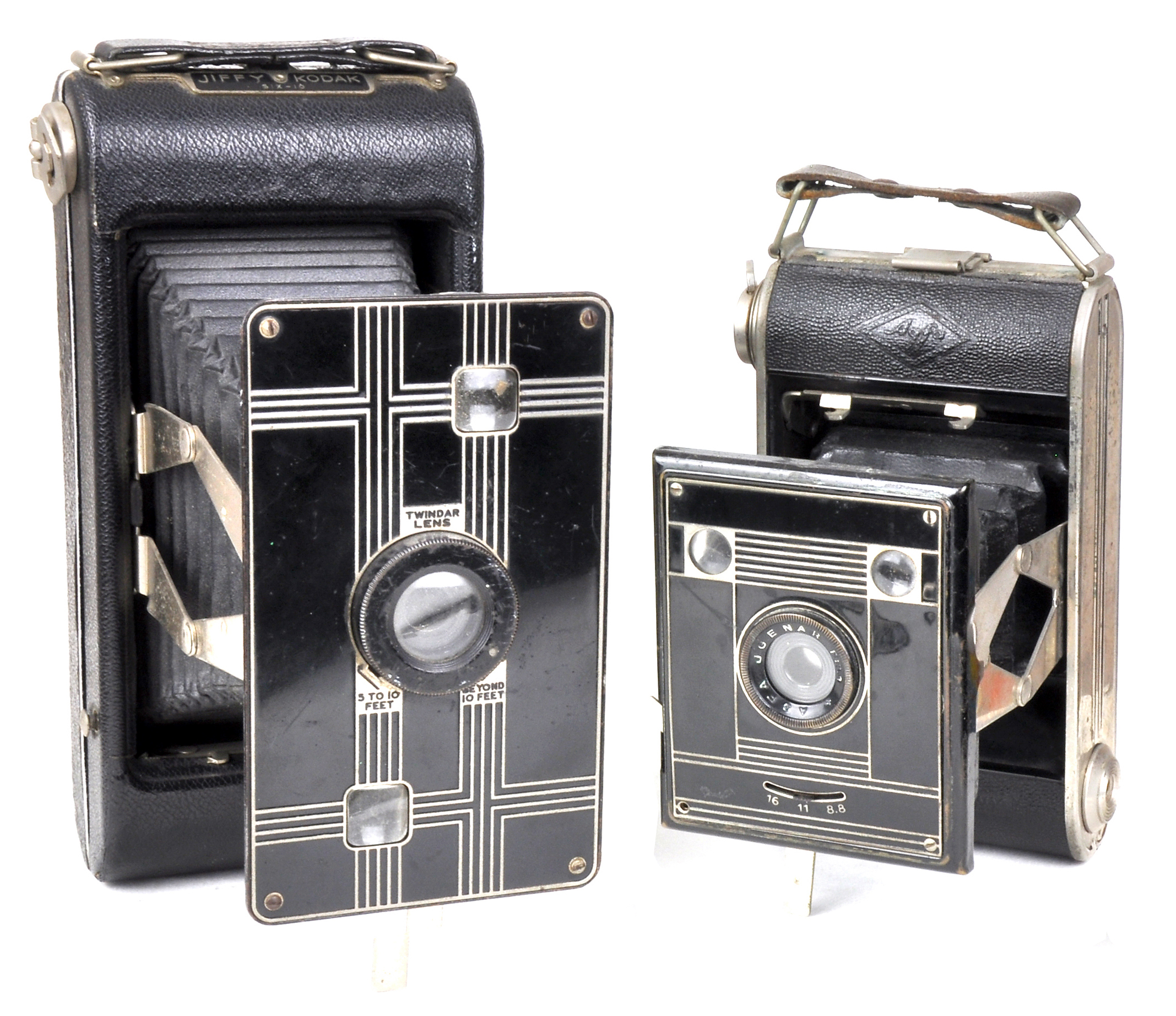
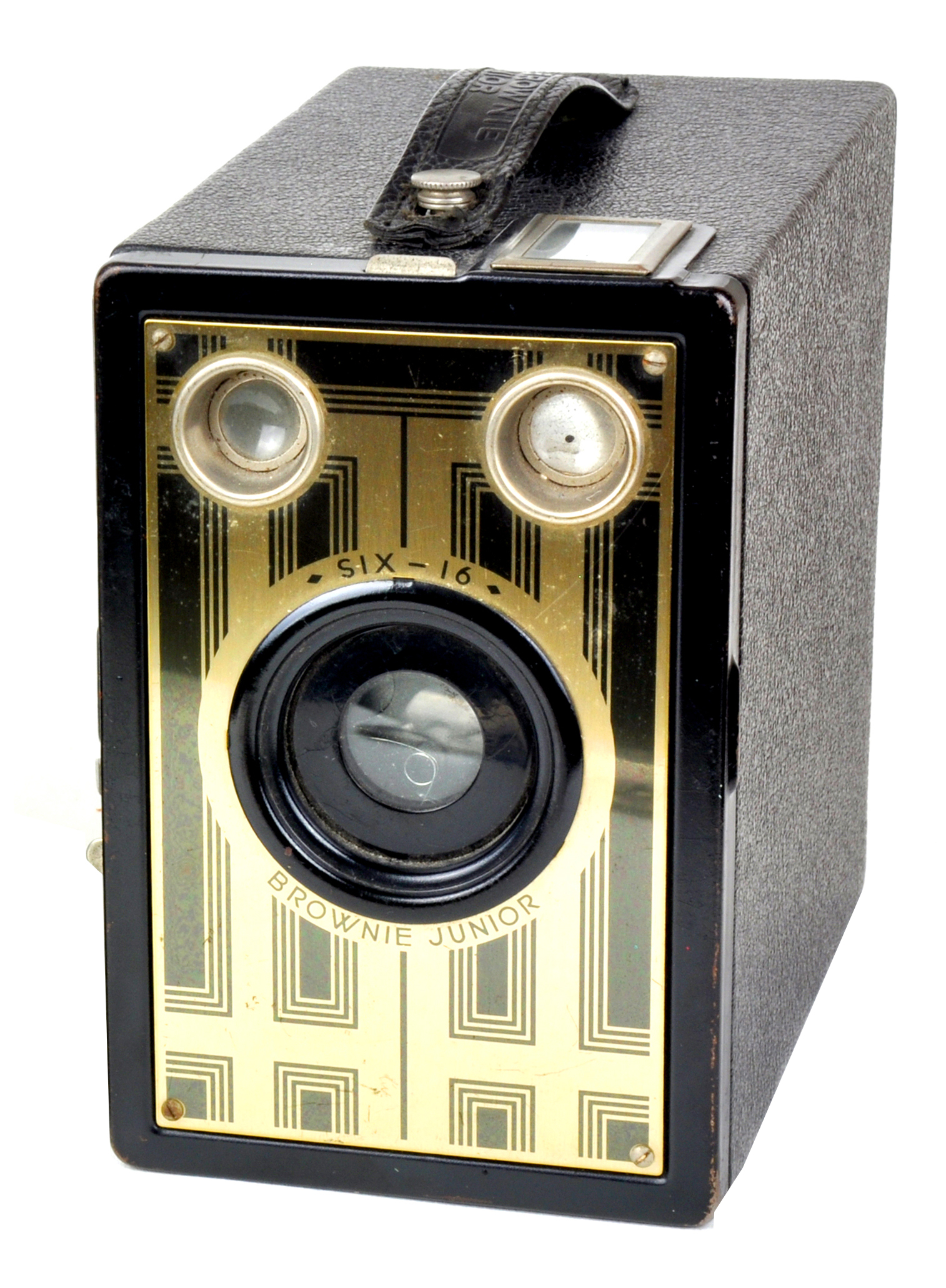
Similarly, Deco designs proliferated on the lens panels of folding cameras like some of the Jiffy Kodak series in the 1930s, as well as box cameras like the 1934 Six-16 Brownie Junior, to mention but a few
At the height of its popularity, the Deco styling often extended beyond the camera itself and onto the box in which it was sold, notably in the Gift Kodak Camera of 1930. Here, a body covered in brown leather blended wonderfully with an enamelled metal inlay on the hinged bed to match the decoration on the faceplate around the lens.
The camera was sold in a cedar box with a strong Deco design and packed in a cardboard box with a similar pattern.
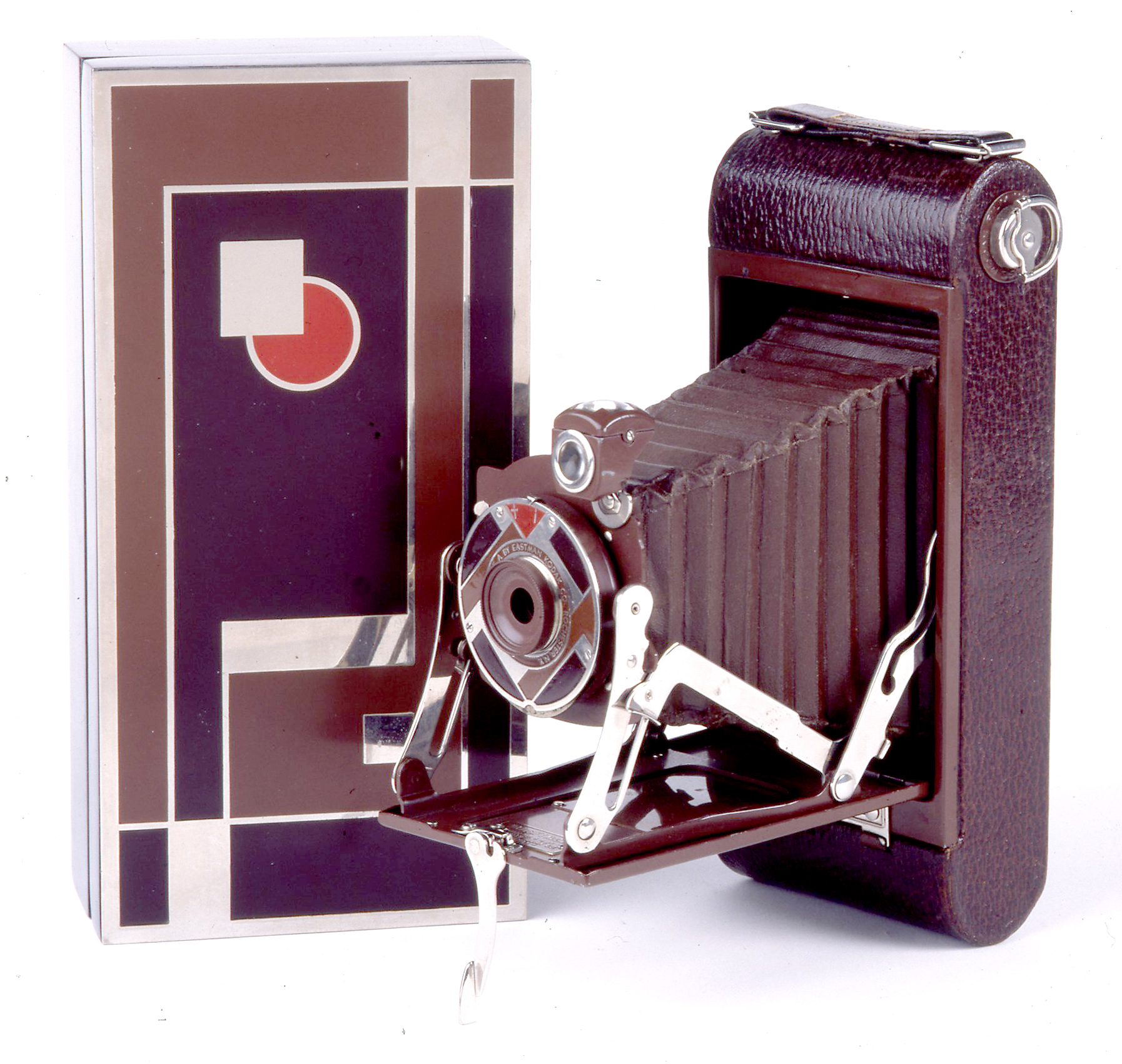
Sometimes the Deco styling was hidden on the base of a camera’s fold-down bed, and so could only really be appreciated when it was folded. That was very much the case in the Boy Scout and Girl Guide Kodak cameras, both from 1929.

The French connection
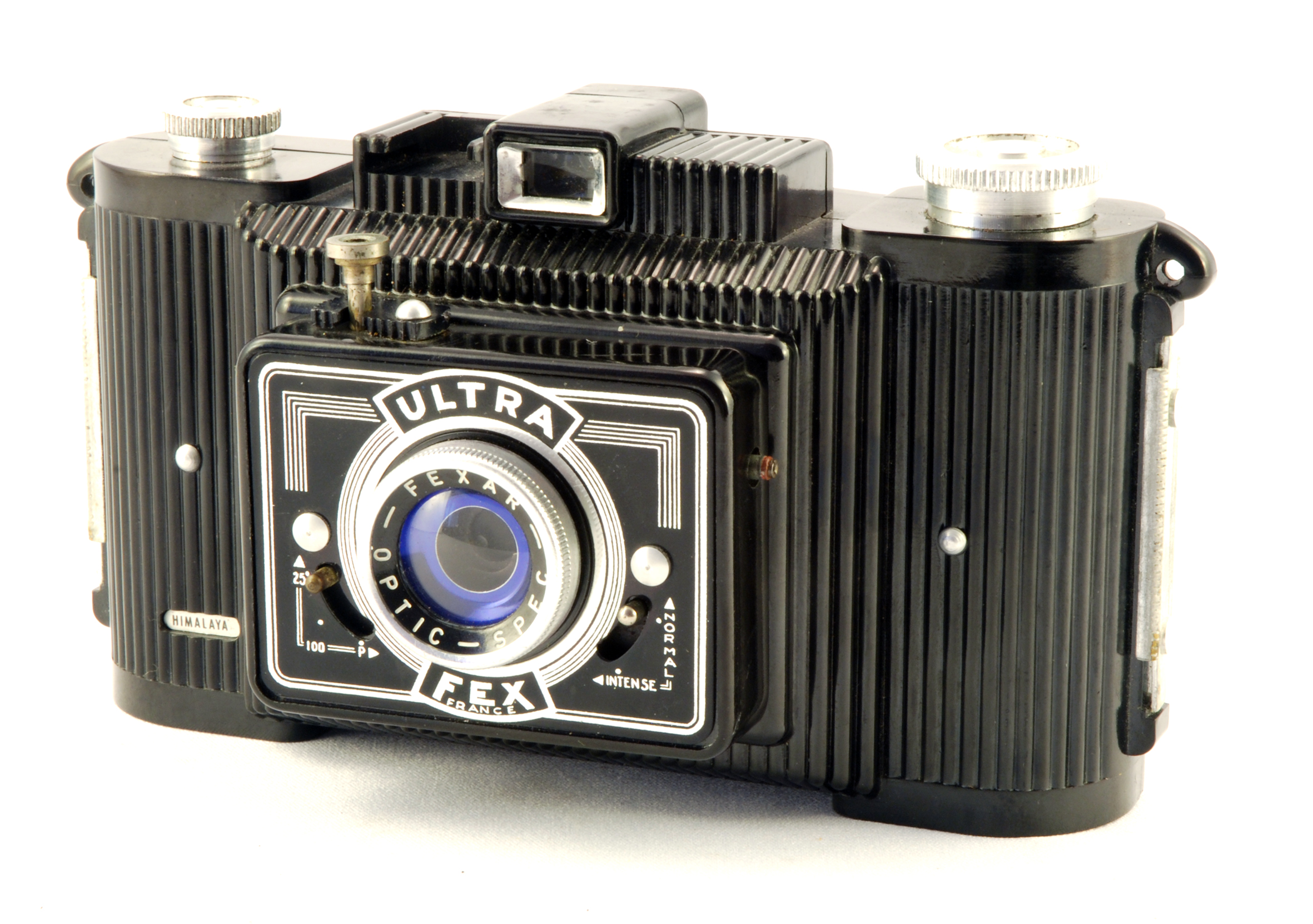
Art Deco began in France, so it’s no surprise that the country made its fair share of cameras in that style. The Fex/Indo company’s name was derived from France Export and Industrie Optique. Many of its range showed Art Deco influences, but the Ultra Fex, launched in 1946, exhibited a positive explosion of Deco design.
Made in black Bakelite with chrome fittings, the Ultra Fex featured a ribbed body and a faceplate around the lens and shutter that displayed all the expected angular lines and ornamented design associated with the Deco period.
The panel supporting the Fexar lens and shutter pulled forward from the body on a shiny metal tube, and two small sliding knobs on either side of the lens were its only controls. One gave shutter speeds of 1/25sec and 1/100sec. The other offered two apertures, related to weather conditions, which it designated as ‘normal’ and ‘intense’. The camera took eight 6x9cm exposures on 120 roll film.
The Gap was a box camera whose name had nothing to do with a gap, as in the space between objects. It was pronounced the French way with a soft ‘G’. This was a simple camera with a wire frame viewfinder on top of the body. Some models were also produced for promotional purposes, stamped with the name of a business. What earns it a place here is an Art Deco design around the lens.
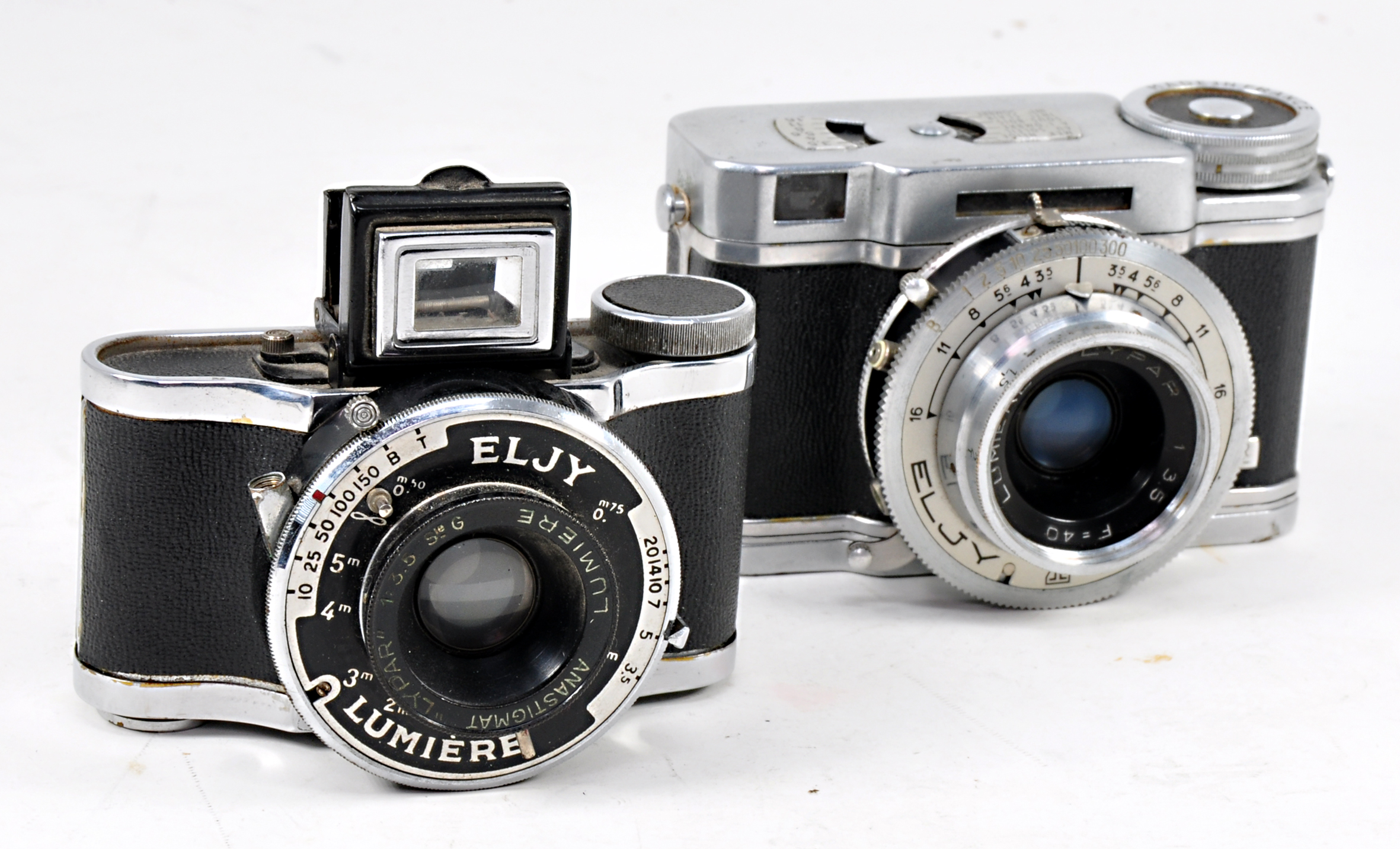
The name Lumière goes back to the earliest days of photography, when it was connected more with photographic plates, film and processes like early colour photography than equipment. In 1927, the company began making cameras, and in 1937, the first of a series of models appeared under the Eljy name.
The range of Eljy cameras was many and various, but typically with small bodies, up to f/3.5 lenses that pulled out from the body on a tube for shooting and a respectable range of shutter speeds.
At first, the designs were fairly bland, but as time went on, they developed an Art Deco style around the lens and shutter mechanisms. The series ended in a new design under the name Eljy Club, which was far more streamlined than earlier models, but still retained faint echoes of Art Deco.
Deco in America
Art Deco was very popular in America, especially in the design of its buildings: think of the Empire State Building, the Chrysler Building and much of Miami. American Art Deco cameras were made by more than just Kodak.
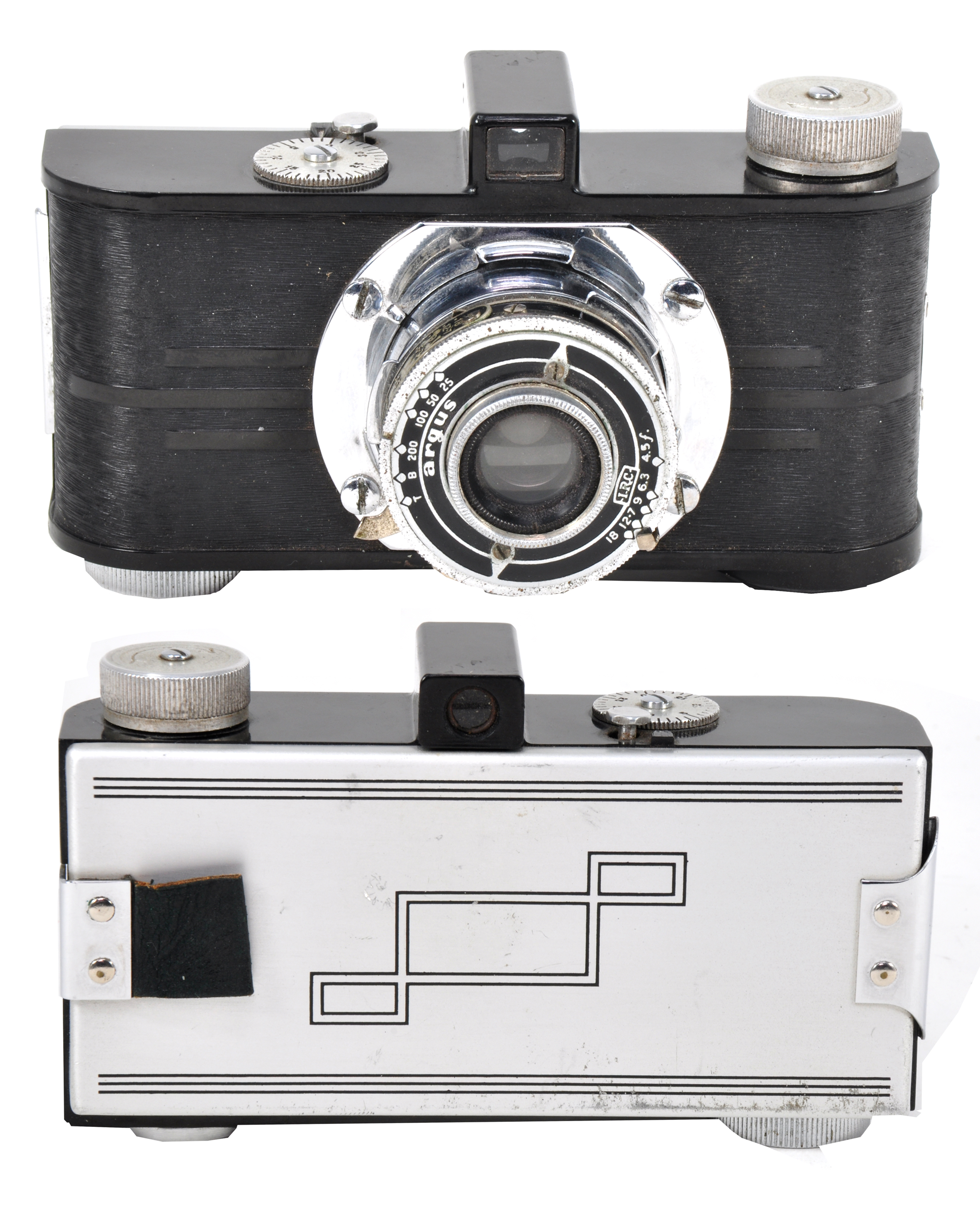
The American International Radio Corporation, as its name implied, was a successful radio manufacturer, but it had a seasonal problem. Radio reception at this time was better in winter than in summer, which caused radio sales to drop off in summer. So what could the company make that was likely to sell more in summer than winter? Answer: cameras. Enter the Argus A in 1936. Until then, 35mm cameras were expensive models imported from Europe.
The Argus A was relatively cheap, and it became the camera that truly popularised 35mm in America. Made predominantly of Bakelite, it featured distinctive Art Deco lines on the front and especially the back. It sold by the thousand, turning the company from a radio manufacturer into a camera maker practically overnight. It also paved the way for the Argus C3, one of the best-selling cameras of all time, and another triumph of Art Deco styling.
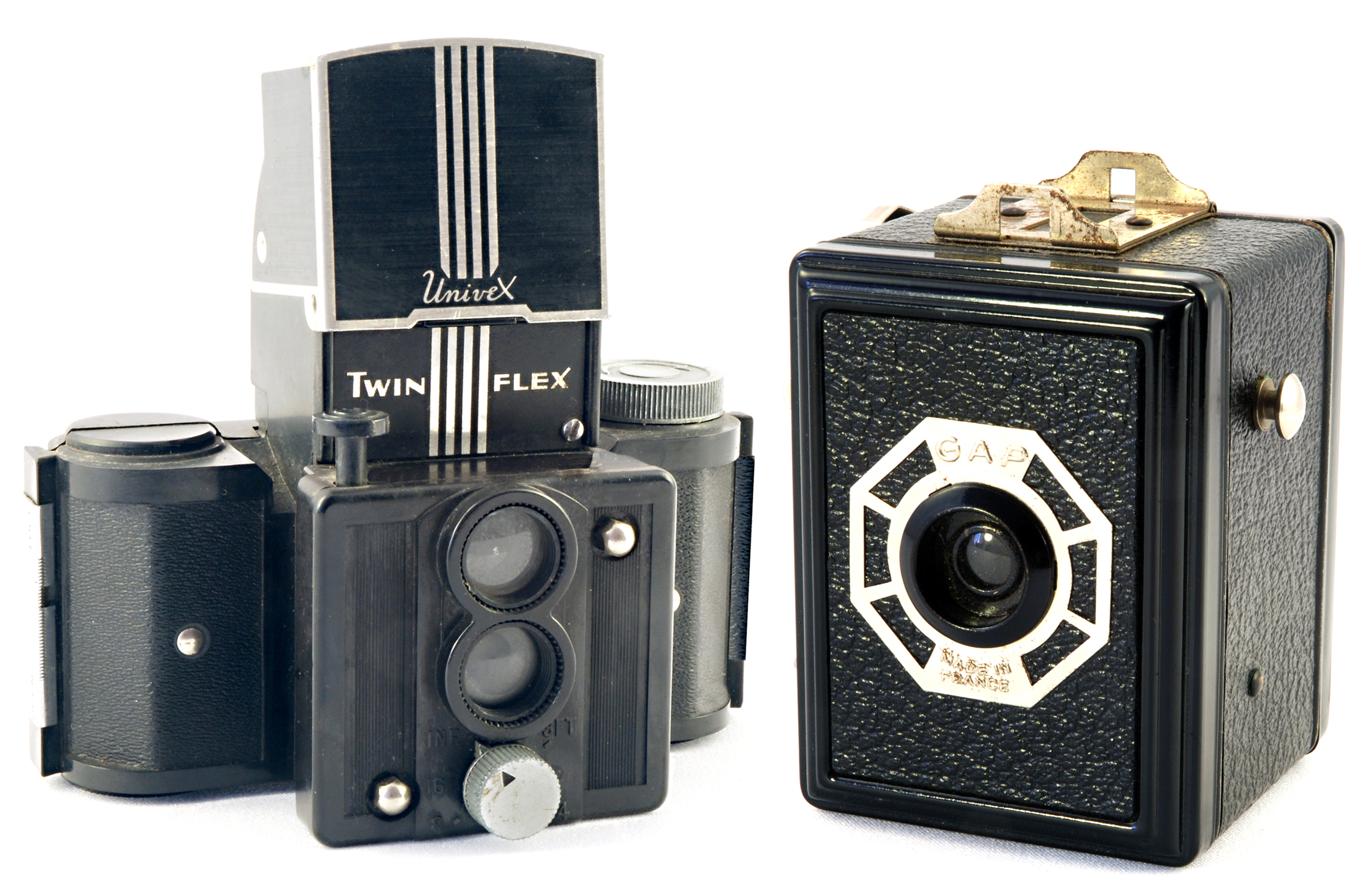
The Universal Camera Corporation was known for the slightly offbeat designs of its cameras, none more so than the Twinflex, produced in 1939. Although cheaply made of plastic, with only a meniscus lens, fixed aperture and simple shutter, the Twinflex was a true twin lens reflex that offered focusing linked to two lenses, one for taking and one for viewfinding. A knob on the front moved the lenses back and forth as the upper one focused its image, via a mirror, onto a small ground-glass screen under a hood on top of the body.
The camera had a slightly curved film plane and a corresponding hump in the back to allow for aberrations in the meniscus lens. The shape of the camera and, in particular, the pattern of lines on its focusing hood were all pure Art Deco.
Germany and Italy
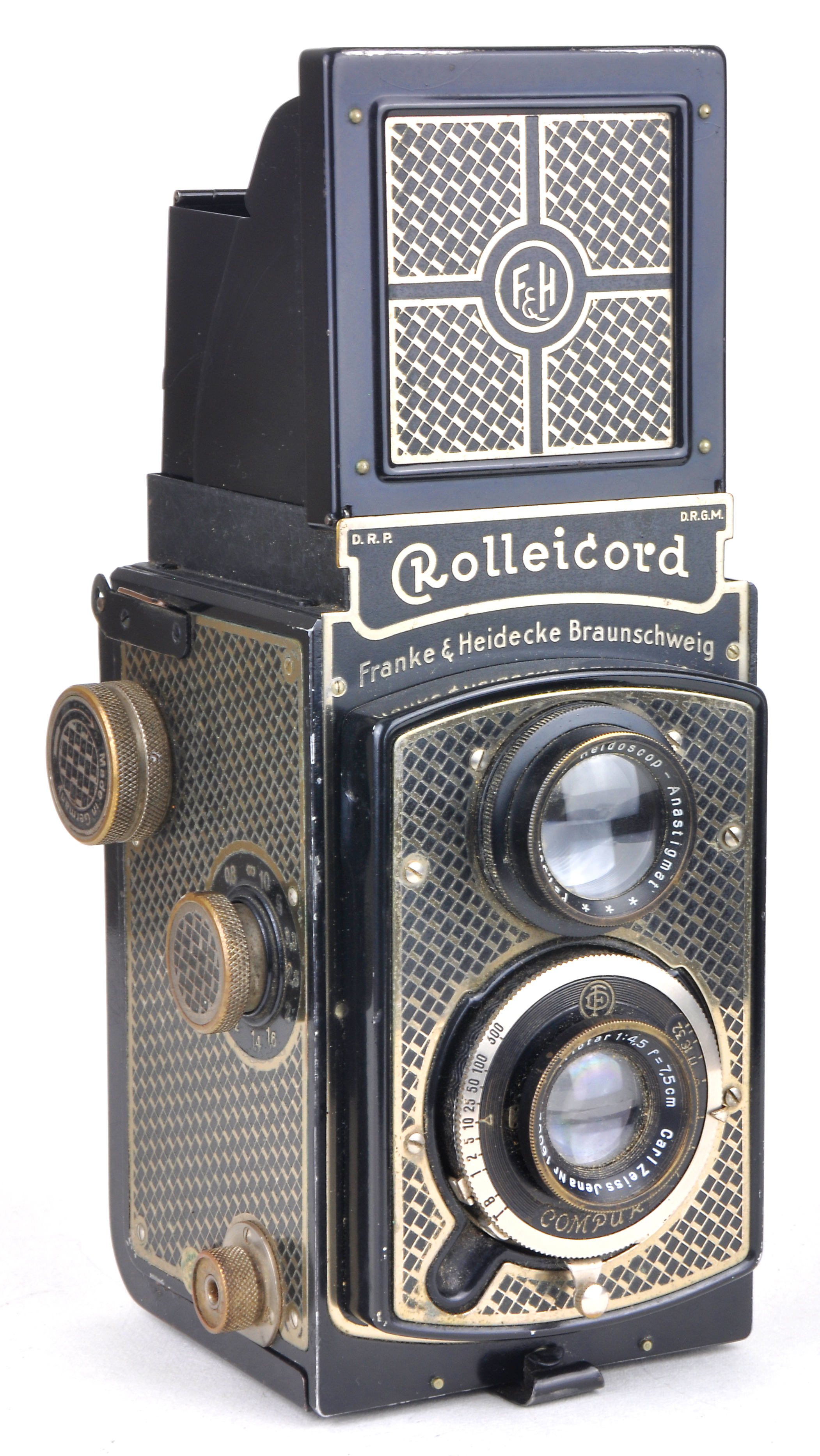
Franke and Heidecke, the company that made the Rolleiflex, had one brief flirt with Art Deco, and they really made the most of it. It came in 1933, five years after the first Rolleiflex appeared. Aiming for a simplified and stripped-down version of the Rolleiflex, the company introduced the Rolleicord, which was flamboyantly Deco. While taking the shape of the traditional twin lens reflex, the camera was nickel-plated with diamond-patterned panels inlaid across the front, top, back and sides.
It was known colloquially in Germany as the Tapeten-Rolleicord (tapeten meaning wallpaper). A year after its launch, a more traditional black leather version was launched, which was sold side-by-side with the Deco camera until that one was withdrawn in 1936.
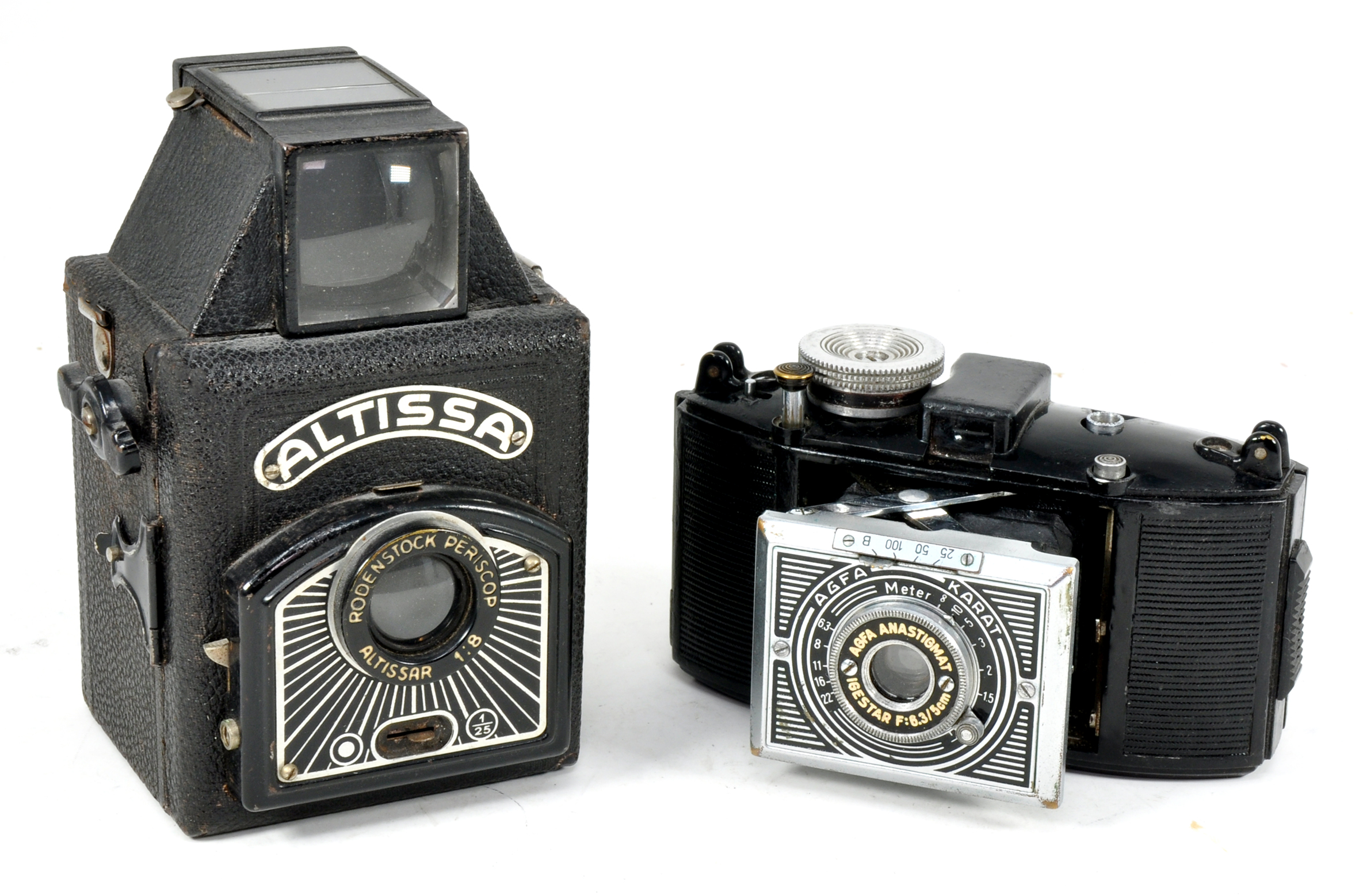
Also in Germany, in 1936, the Eho-Alitissa company introduced a strangely-shaped box camera called the Altissa with strong Deco influences in its general shape and especially in the designs around the lens. Its unusual design incorporated a viewfinder that could be switched from waist-level to eye-level by means of a small lever on the side.
The following year, Agfa produced the first of its range of Karat cameras. They were small folding models in which the lens panel pulled out from the front of the body for shooting, and used twin cassettes which wound the film from one and pushed it into the other. The first Karat was heavily decorated around the lens in Art Deco styling. Those that followed over the next decade abandoned the style.
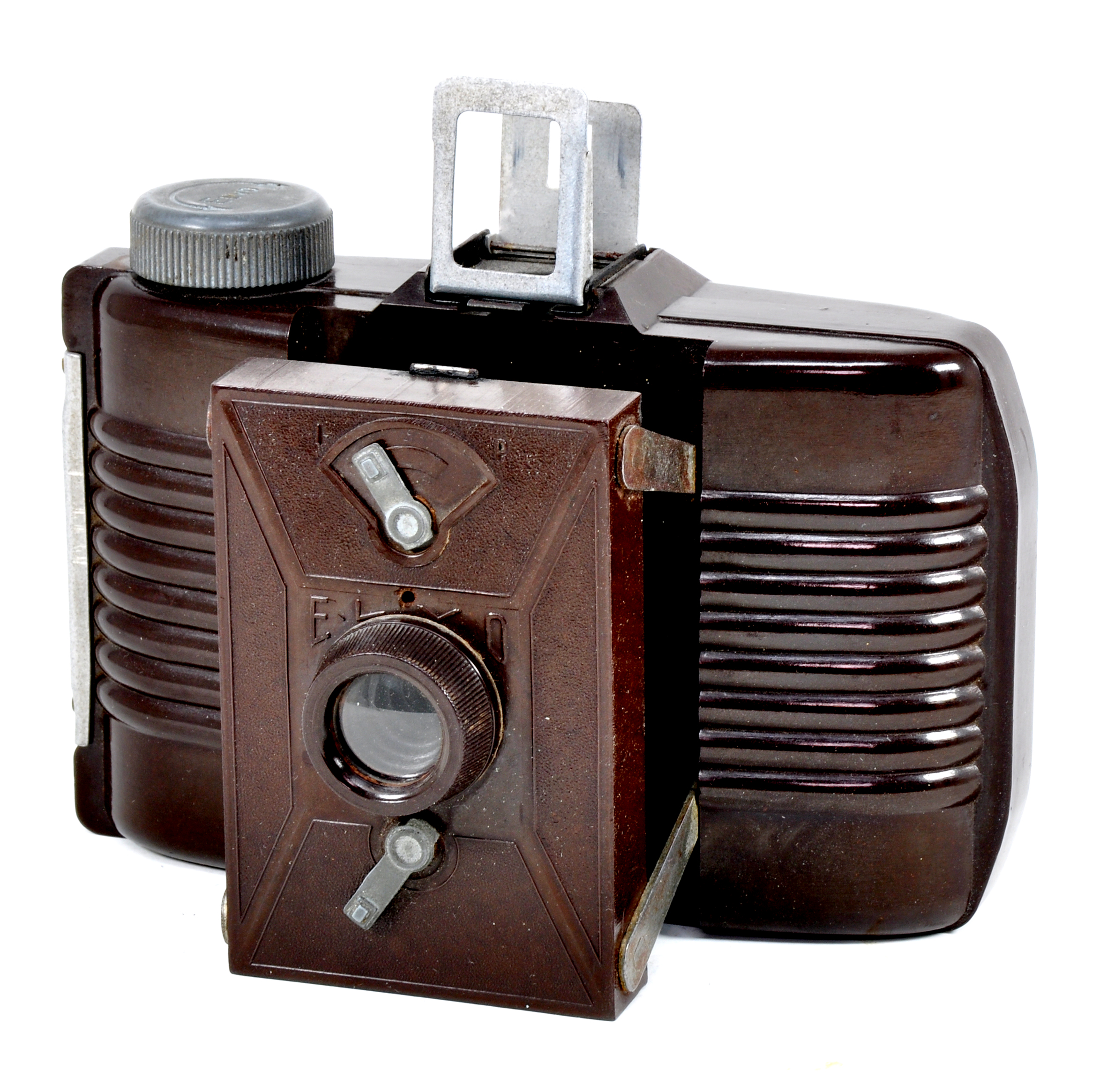
Meanwhile in Italy, in 1938, the Roto company in Turin came up with the Elvo. Although little more than a snapshot camera, its style, made in brown Bakelite, was pure Art Deco, from its ribbed body to the styling around the lens, and even the way the name was written and embossed on the front panel.
English Deco
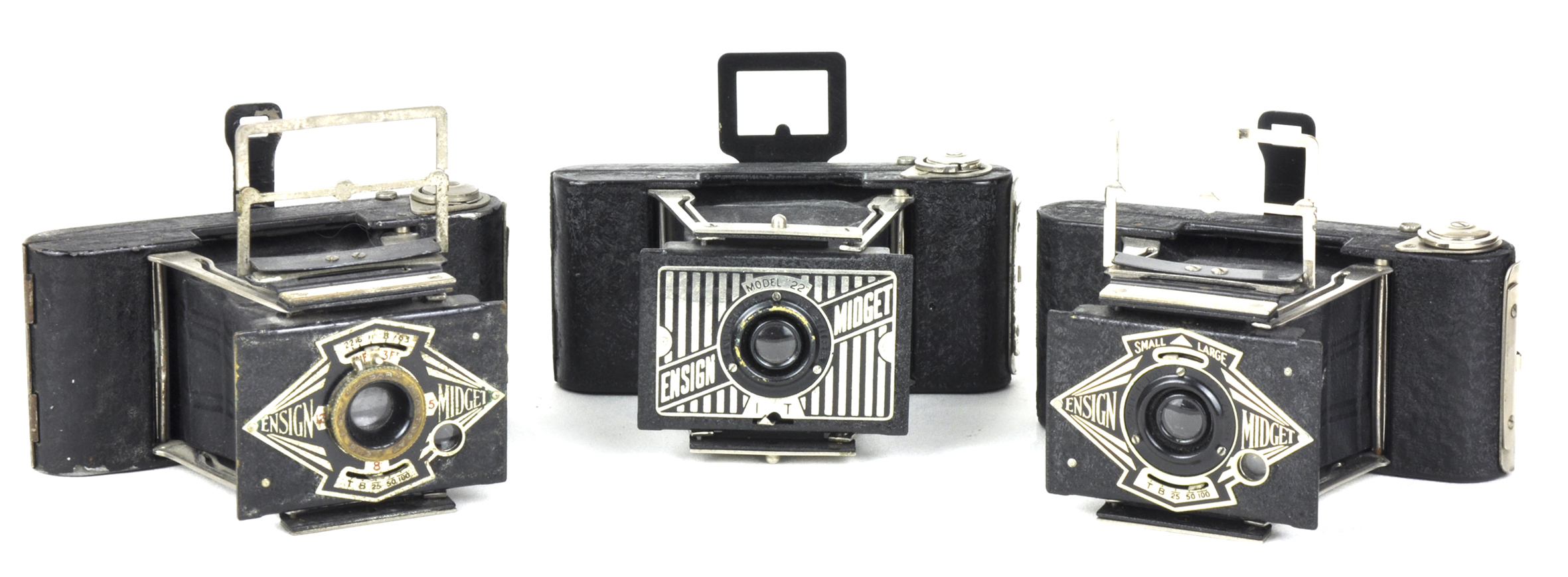
Ensign was the selling arm of an English camera manufacturer called Houghton, and the Ensign name appeared on many of the company’s cameras. In 1934, the first of a series of five Ensign Midget cameras was launched, each with strong Art Deco influences.
The cameras were based on a folding design with lens panels that extended from the body on four struts, and it was on these panels that the Deco designs were most evident. The first model was decorated with vertical stripes on the lens panel with the camera name diagonally across them; two other, more sophisticated, models were decorated in Deco-style diamond shapes surrounding the lenses.
The three models were designated as the Model 22, Model 33 and Model 55, the numbers referring to the cost in shillings when the cameras were first sold. Models 33 and 55 were made in black or silver, the latter versions to celebrate the silver jubilee of King George V and Queen Mary in 1935.
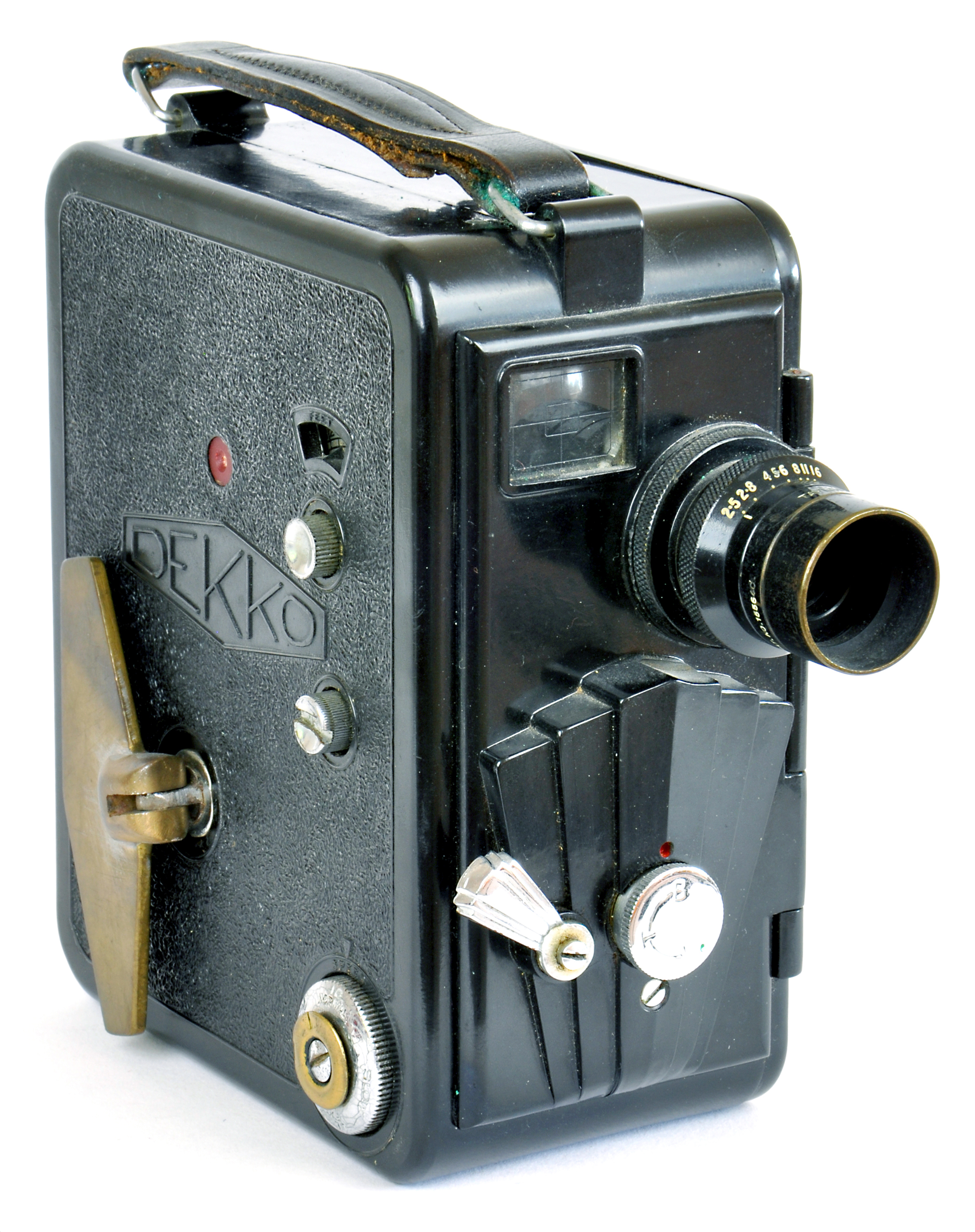
For at least one English company, Art Deco extended beyond still photography cameras and made an appearance in a cine camera. In 1934, Cameras Limited made a model for 9.5mm film, a type that had been introduced in 1923 and aimed squarely at the amateur, rather than the professional, movie maker. The camera body, in black Bakelite with chrome fittings, featured a typical Deco design on the front, around the operating lever and surrounding the nameplate on the side.
Appropriately, the camera was called the Dekko, but, as might be surmised from the spelling, the name had nothing to do with the Art Deco movement. The word in this context had a nineteenth-century origin, used by the British army in India and derived from the Hindi word ‘dehko’, meaning ‘look’.
A last hurrah
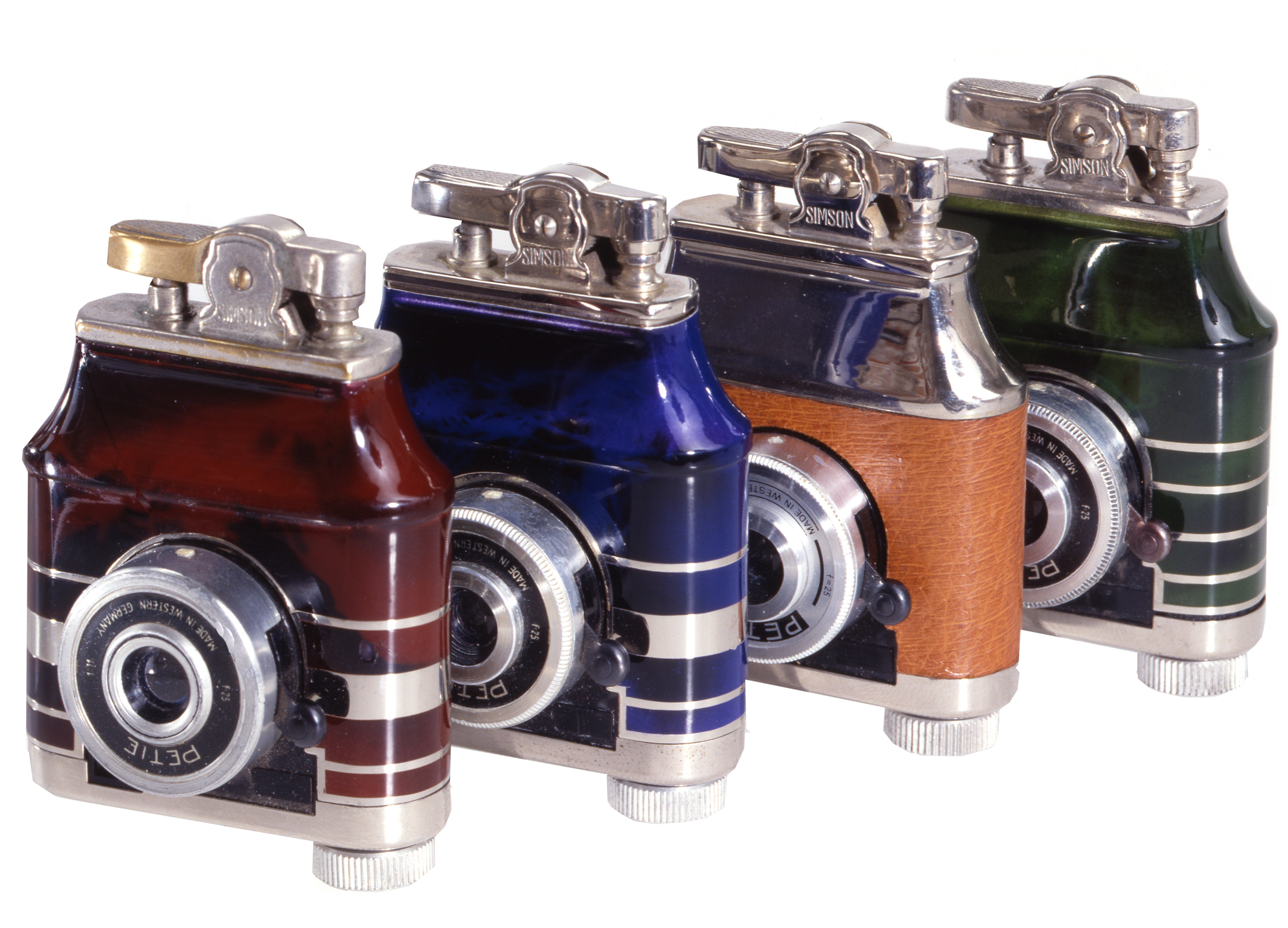
In the 1950s, when it looked like Art Deco was finished, a German camera manufacturer named Walter Kunik revived it and then pushed it to extremes. In 1956, the company launched a subminiature camera called the Petie. It had a fixed focus lens, fixed aperture, and shutter speed, and used 16mm film.
Basically, it was a low-quality snapshot camera with nothing remarkable about it, until Kunik introduced a series of unusual versions of the Petie integrated into other Art Deco objects, aimed at the female market.
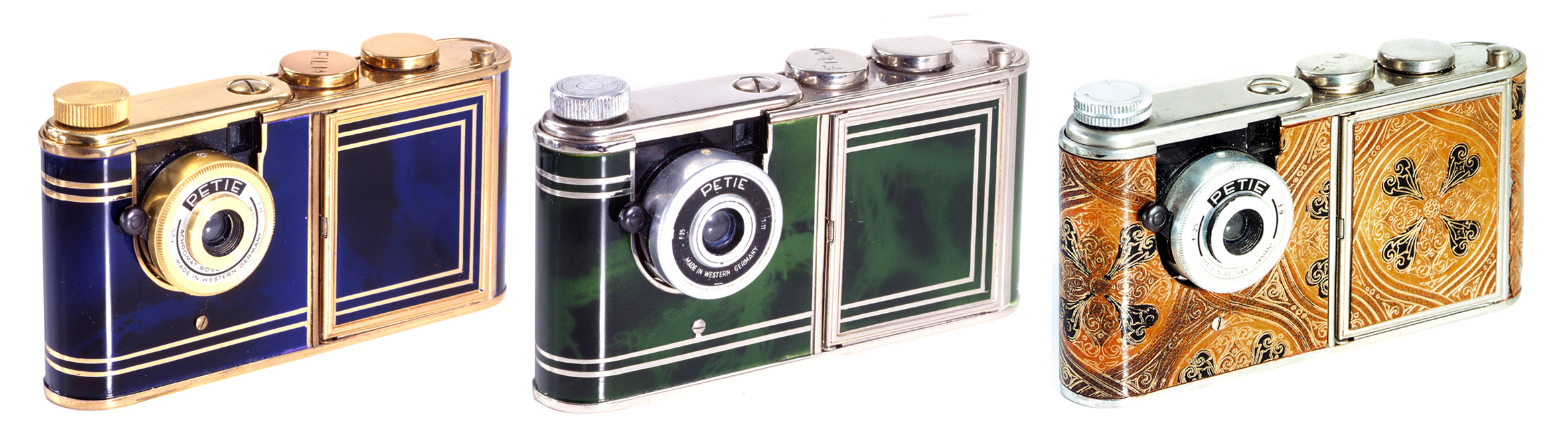
One saw the camera incorporated into a working cigarette lighter housed on the base so that, when in use, the camera was upside down. The lighters were produced in colours that included red, blue, orange and green with an Art Deco enamel finish.
Another design saw Petie cameras incorporated into clockwork musical boxes. But the desire to feminise camera design went right over the top when Kunik introduced the Petie Vanities. For this, the cameras were held in an unashamedly ornate Art Deco series of ladies’ make-up compacts in which pressing a small button flipped up a flap to reveal a place for face powder, a powder puff and a small mirror. Two tubular compartments on the top of the casing were withdrawn to reveal a lipstick holder and a place for spare films.
All the Vanities were beautifully finished in plain or patterned styles and colours, etched with silver or gold Deco lines.
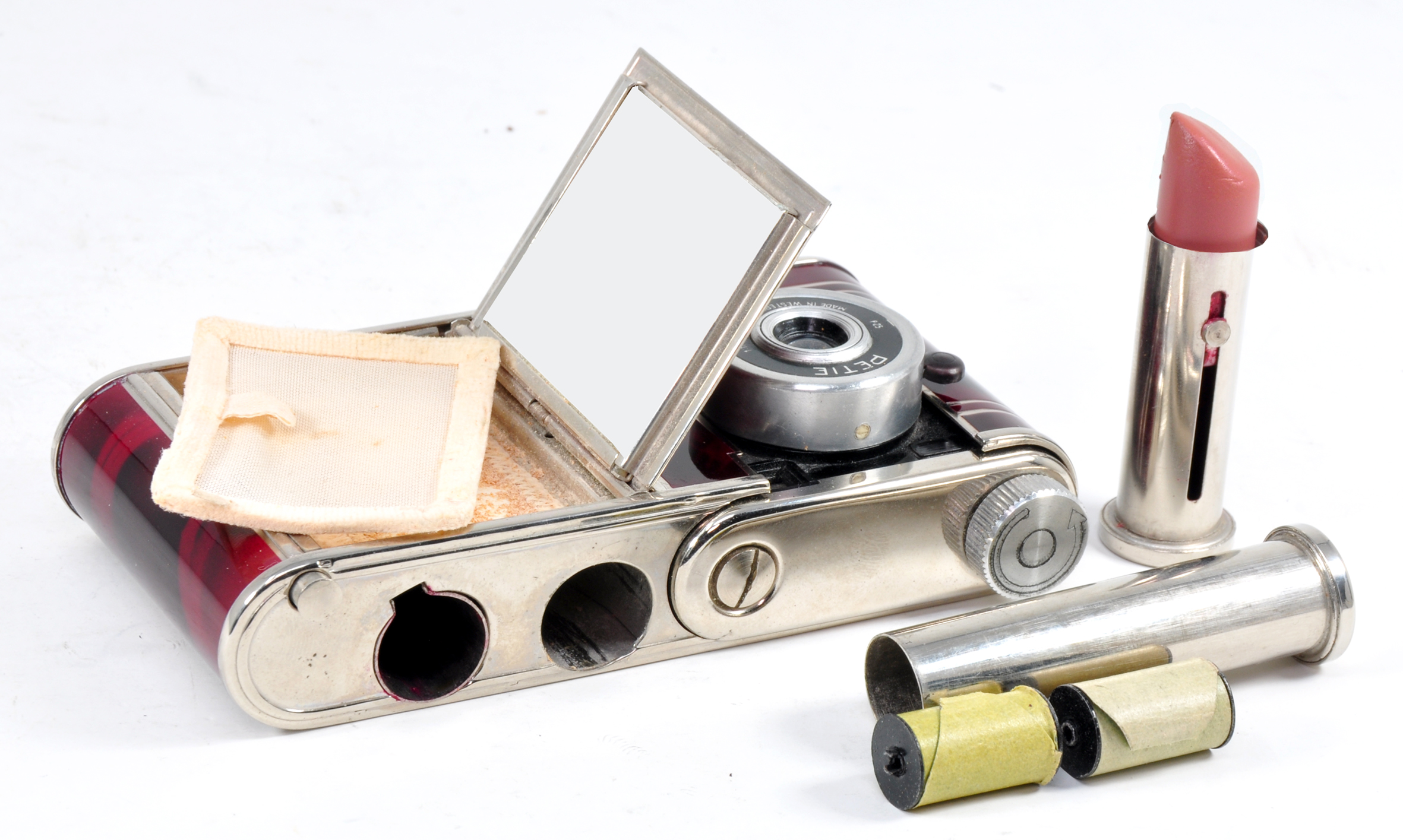
It’s doubtful that many male photographers bought the Petie Vanity, and so Art Deco cameras ended much in the way they began, as a way of enticing the fairer sex into camera buying.
Related reading
- Best 35mm film cameras
- Like a Leica – copies, replicas, and fakes of the World’s most famous camera
- The great Mickey Mouse Camera Mystery you’ve never heard of
Follow AP on Facebook, Instagram, YouTube and TikTok.



John Wade