

Whether you are looking to downsize from full-frame or just starting out in photography, and looking for a portable camera system, Fujifilm and OM System will very likely be on your radar. Both brands have well established systems with a choice of camera models to suit different budgets and are supported by an extensive collection of own-brand and third party lenses.
While there are differences in design and features, the fundamental difference is format. In one corner, there is the APS-C format Fujifilm X System with a 23.6×15.6mm sensor and in the other is the Micro Four Thirds OM System which uses a 17.3x13mm sensor. In theory, the smaller MFT sensor means more compact bodies and smaller lenses but that doesn’t always play out in practice.
So, if going small is your ambition, should you go Fujifilm or OM System?
Fujifilm X vs OM System: an overview of the cameras
With eight models in the Fujifilm X System, you’re not going struggle too much for choice and while they all share the same core characteristics including lens mount, Film Simulation modes and X-Trans CMOS sensors, they are aimed at different users.
Speaking very generally, the X-S, X-M and X-E models are for less experienced shooters while the X-H and X-T models are higher end models appealing to more experienced enthusiasts and professionals. Interestingly, the three top models, the Fujifilm X-H2, Fujifilm X-H2S and Fujifilm X-T5 have been around since 2022 and, without wishing to start rumours, updates may be on their way.
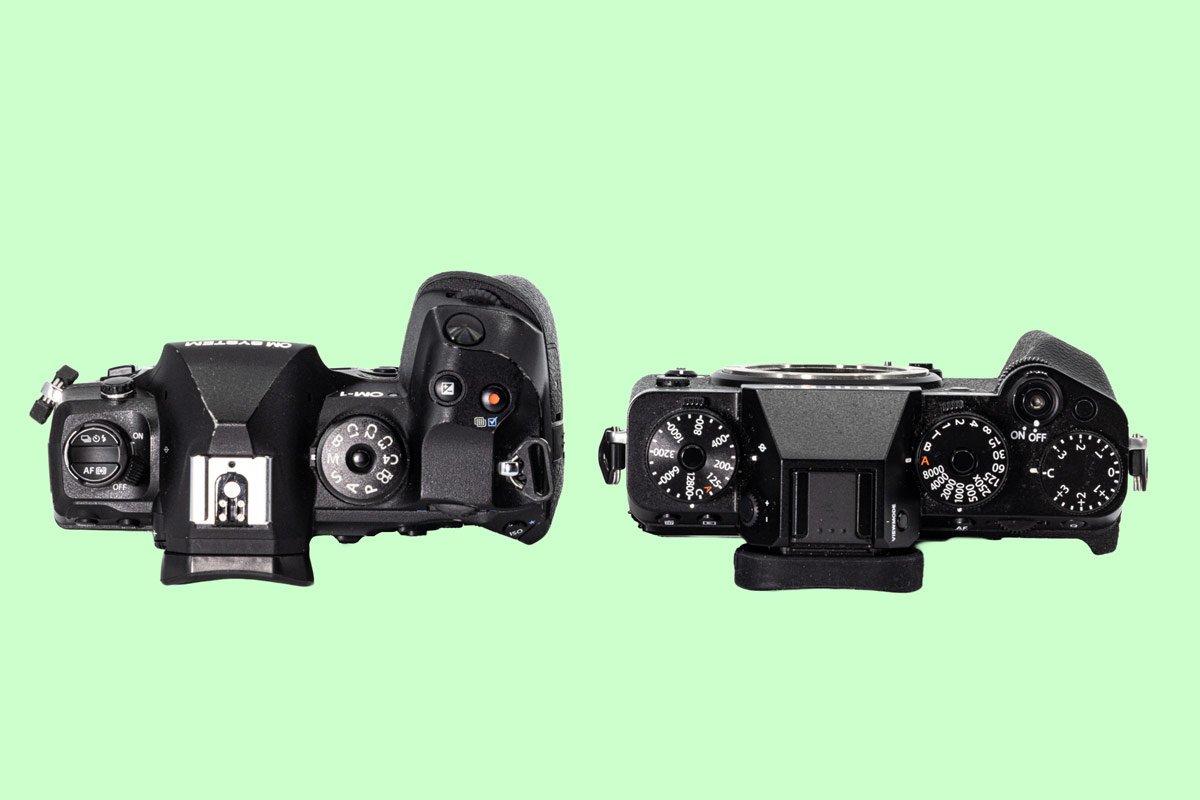
Fujifilm’s success with its X Series is largely thanks to the X-T family which features a classic design with a faux pentaprism bump and a top-plate populated by control dials.
The OM System family currently comprises six models with the OM System OM-1 Mark II sitting top of the pile, and is ably supported by the OM System OM-3 and the OM System OM-5 Mark II. The remaining three models, the OM System OM-D E-M10 Mark IV, OM System OM-5 and Olympus Pen E-P7 (launched only in Europe and Japan) date back several years so are available at competitive prices and may be due for updating.
Fujifilm X vs OM System: key features
Both systems have excellent focus and exposure systems and there little to choose between the two, but there are clear differences in megapixel count and burst shooting.
In the Fujifilm family, we have models at 26.1 megapixels (the Fujifilm X-M5, Fujifilm X-S20, Fujifilm X-T30 III, Fujifilm X-H2S) and others at 40.2 megapixels (Fujifilm X-T5, Fujifilm X-T50, Fujifilm X-H2, Fujifilm X-E5) using the X-Trans CMOS 5 HR sensor. OM System cameras top out at 20.4 megapixels which is more than enough for most users but if large prints and deep cropping are key aims in your photography, Fujifilm has the upper hand here.
Having fewer megapixels is a benefit when it comes to burst shooting and the OM-1 Mark II can race along at 120fps with fixed focusing and exposure using the electronic shutter. If that’s too much, drop down to 50fps with AE/AF tracking, again with the electronic shutter. Switch to the mechanical shutter and the rate is still a rapid 18fps.
The Fujifilm is no slouch, though, and can achieve 20fps with the electronic shutter (cropped) and 15fps with the mechanical shutter.
A feature that has made OM System cameras popular is the well implemented Pro Capture. The Pro Cap SH1 mode gives 120fps with fixed AE/AF and Pro Cap SH 2 gives 50fps with AE/AF tracking, and there’s the option of setting the number of pre-shutter frames. Fujifilm does have a Pre-shot mode with its electronic shutter but overall it’s not as well implemented.
OM System’s computational features are big attractions. High res mode gives 50 megapixels handheld and 80 megapixels with a tripod mounted camera. Fujifilm also has a pixel shift high res shot mode but there are features exclusive to OM System. There’s impressive in-body focus stacking, Live Composite and Live ND that simulates long exposure shooting without filters.
A feature currently unique to the OM-1 Mark II is in-built Live graduated ND filters, available in three strengths and gradation styles that can be positioned to suit the scene
If you enjoy using filters to control contrast in your scenics, the Live ND graduate feature is amazing and the results are realistic, maybe even better than using actual filters.
Fujifilm has its own tricks up its sleeve and if you shoot JPEGs and want impressive out of camera results, you will be hard pushed to find anything as fun as its Film Simulation modes. Drawing on its film science background, there are up to 20 Film Simulation settings available to help stylise your photos and in recent Fujifilm cameras they can be called up with a dedicated dial making them easy to use.
OM System has picture settings but they don’t have the depth of Fujifilm’s Film Simulation options although the OM-3 has the ability to create or download picture recipes.
Fujifilm X vs OM System: lens options
There is no problem with lens choice as both Fujifilm and OM System are well supported when it comes to lens options, own brand and third party.
If there is any advantage in availability, it lies with the OM System because its Micro Four Thirds lens mount is a standard shared with Panasonic so there are two camera brands providing identical mount lenses. However, although OM System lenses will fit Panasonic MFT cameras and vice versa there may be performance limitations with autofocusing and the image stabiliser, so this is something to check when lens shopping.
Whether it’s fast aperture primes or long zoom lenses, there are options available for Fujifilm and OM System. MFT’s smaller image format means lenses are often smaller, lighter and more compact, notably when it comes to telephoto lenses where crop factor plays its part. With the 2x crop factor of Micro Four Thirds, a 300mm lens gives the equivalent field of view of a 600mm lens in full-frame. With Fujifilm’s 1.5x crop factor a longer 400mm lens is needed to give an equivalent 600mm view and a longer lens means bulk and more material used in its construction which leads to greater cost.
Have a look at our guides to the best lenses for Micro Four Thirds and the best lenses for Fujifilm.
Fujifilm X vs OM System: Image quality
To check out ISO performance, we shot a low light scene with a Fujifilm X-T5 and OM System OM-1 Mark II. No in-camera high ISO noise reduction was used and the raw files were processed through Adobe Lightroom Classic without denoising.
Both camera formats performed well and while noise is evident at ISO 1600 and 3200 it is not horrible and overall image quality is pretty good. However, at these speeds, fine detail is affected so subjects with high frequency detail such as bird feathers would lose definition. Denoising would have a huge benefit and to show its potential we put the ISO 3200 shots through Lightroom Denoise and these are shown here too.
Overall, though, Fujifilm’s APS-C format just about outperforms the OM System’s MFT format although there’s not much in it.
Fujifilm X vs OM System: Summary
Ultimately, buying a camera is a personal matter, not just based on budget and features but also how a camera looks and feels in the hand.
The good news is that whether you go for Fujifilm X or OM System you can’t go far wrong and you’re unlikely to be disappointed. The cameras are first-rate and highly featured and they are extremely well supported when it comes to lenses. It’s also a very balanced view when it comes to assessing shooting and picture performance.
Related reading:
- Best zoom lenses for Micro Four Thirds
- Why Micro Four Thirds offers so much
- Olympus vs DSLR: Why I choose Olympus every time