



Whatever happened to Casio cameras? Gavin Stoker wonders why Casio’s digital cameras of the 2000’s to 2010’s – with a range big enough to see it crowned ‘king of the compacts’ – failed to make much of a long-term impact. Why is Casio now almost completely forgotten as a photographic brand?
Even though I was commissioned to review shedloads of Casio’s compact cameras over the 15 or so years they were at the height of their popularity, I’d almost forgotten the brand was ever an option when it came to choosing a new snapper.
As a child of the 1980s, for me the Casio name still most vividly conjures up memories of digital watches. It also produced musical keyboards and scientific calculators required for school maths exams; the latter of which were more likely to be turned upside down to display the word ‘boobies’ than to solve equations.
As a pioneer in the world of electronics, it wasn’t a total surprise that Casio started producing digital cameras with gusto as the market exploded in the early noughties. And that they were very popular with consumers. At one time it even had its own dedicated store in Covent Garden, shared with G-Shock watches. But it’s surprising how quickly Casio cameras have subsequently faded from view, even if there are still plenty to be found second-hand on eBay.
So, what happened to Casio’s foothold in the world of photography? And when did it start to slip?
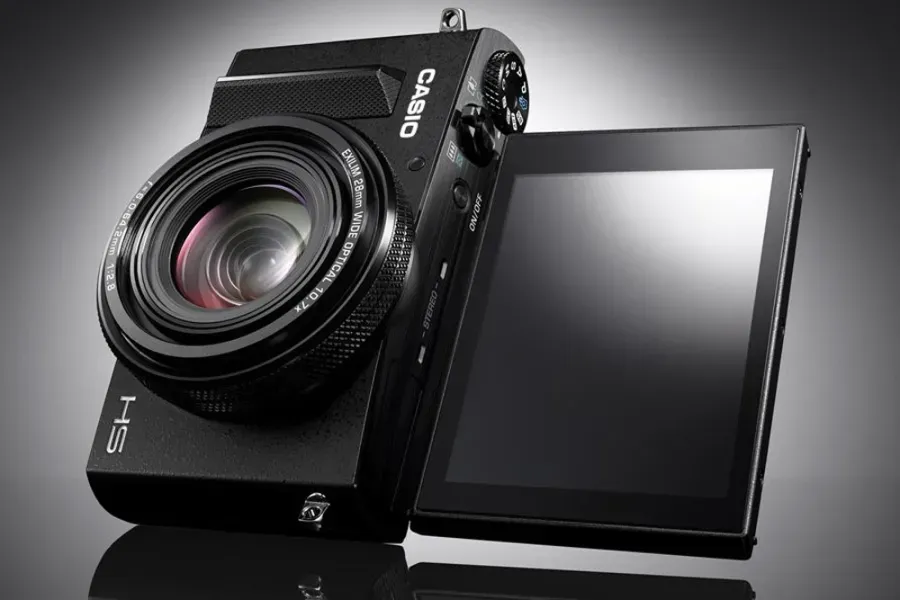
A stylish and more affordable alternative to the Canon Digital IXUS, Fujifilm FinePix, Nikon Coolpix, Panasonic Lumix or Sony Cyber-Shot of the time, Casio’s Exilim range (2002 to 2018) appeared for a short while to rule the roost as king of the compacts, flooding the market with options to win market share. These were the days in which we’d regularly get half a dozen new cameras announced just before the summer holidays and then the whole range refreshed in time for Christmas.
Wearable card cameras
A self-stated selling point of the Exilim line-up was that its snapshots were the width of a credit / business card, and half the depth of a pack of playing cards. This meant, with their retractable lenses, they slotted easily into the average shirt or jeans pocket – indeed they were marketed as ‘wearable card cameras’. But of course, very quickly, our mobile phones could offer the same degree of convenience, and then some.
Even then it seemed clear that Casio was more about cashing in on the digital photography boom, than being in it for the long run. After all, it didn’t have competing brands’ longstanding heritage in the photographic arena. It also never seemed plausible it was going to step beyond humble point and shoots and into digital SLR production, like its fellow manufacturers. It just wasn’t a name to excite the photo enthusiast.
Competing with DSLRs?
That said, Casio was not without innovation and obvious expertise – or it would have been quickly dismissed. In the mid-1990s its QV-10 was the first digicam with a TFT LCD screen, that camera’s rotating lens later inspiring several Nikon Coolpix models.
Subsequently, the 3.2MP CCD incorporating Exilim S100 shoehorned the world’s first ceramic lens into its stainless-steel body, thereby allowing for thinner yet stronger lens compared to traditional glass examples. Also of some note, the aptly named high-speed EX-F1, Casio’s first super zoom / bridge camera, offered pioneering-for-the-time 60fps shooting at full resolution. On its announcement Amateur Photographer reported that Casio suggested, in this respect, it could compete with the very DSLRs it did not produce. Later models like the FH100 offered 40fps continuous shooting.
A short battery life has always been the bugbear of most digicams, but, generously, Casio’s 10x zoom Exilim H15 and 12.5x H30, both of which I reviewed in spring 2010, offered up to 1000 shots per charge. The H30G model, another so-called’ travel zoom’, added GPS, something also much the rage at the time.
Ultimately, despite innovative features here and there, Casio either chose or failed to progress beyond compact cameras with tiny sensors and so limited improvement, if any, as regarded image quality. This meant that when smartphone photography became ‘good enough’ for most of us, the classic snapshot camera, and Casio itself, had nowhere to go. It hadn’t developed any DSLR or mirrorless alternatives with which to entice photographers who did still want a ‘pure’ dedicated camera, which may have – possibly – allowed it to continue through to this day.
It’s nevertheless arguable whether even this would have saved it. The market for dedicated cameras is much smaller now than it was in the mid 2000’s, meaning only the biggest beasts have survived.
The inevitable end
Responding to the decline in the camera market, Casio clung on in the mid 2010’s with the introduction of selfie-orientated cameras, including the LED-incorporating TR-M11, with distribution limited to few select retailers. But following a disastrous 2017 where its camera division lost around $4.57 million/ 500 million Yen, in April 2018 it was announced Casio was pulling out of camera production entirely. The last ‘new’ camera introduced in the once popular Exilim series had been the Japan-only EX-100 back in 2014.
Long before this stage, the end had felt inevitable. With mirrorless cameras being the most in-demand device of that decade and even DSLR sales having flatlined, most of us were very much unaware Casio was still producing any type of camera whatsoever. Fast forward to today and many of us have wiped its cameras from our memory altogether.
It’s a sad reminder that those who innovate aren’t always the ones who ultimately win the race. In the fast-moving world of technology our back cupboards are littered with formerly must-have devices that are now long forgotten (digital photo frames anyone?). On an imaginary blue plaque, we can now scratch the name of ‘Casio cameras’.