

Amateur Photographer verdict
The Simple 90 offers a unique “zooming” bokeh and a crispy center. It’s a fun, affordable, 3D-printed creative tool that proves more useful than your average novelty lens.
- Really nice effects
- A range of effects possible
- Low cost
- Fit’s almost any camera
- Effects aren’t suited to every occasion
- Focus ring could be quieter
Irwin Workshop Simple 90 at a glance:
- Price £76.64 excluding mount adapter
- Filter Diameter 82mm
- Aperture f/2.8, f/5.6, f/11
- Min focus 61cm
- Measurements: 153×86, 310g
- Mounts: M42 + Numerous adaptations
- www.irwinworkshop.com
My father was a great English teacher. He also enjoyed astronomy. Using a pair of glass elements and some lengths of balsa wood he built his own telescope that he’d make us look through in the back garden when we’d come home from the pub. There’s no question that he was better at explaining Shakespeare than he was at optical design and helping us to spot Betelgeuse. I don’t remember anything I saw through that telescope.
I will remember lots of things I’ve seen through the new Irwin Workshop Simple 90 lens, though. Tim Irwin, the man behind it, isn’t an optical designer either, and is probably better at making documentary films than he is at tangential calculus. It seems though that he knows enough to have created a lens that produces images with an exciting and pretty unique look. There are lots of homemade, and some factory made, plastic lenses on the market, and while some make decent images, most are, frankly, a waste of time and effort. This one is actually useful.
Irwin Workshop Simple 90 Review – Features
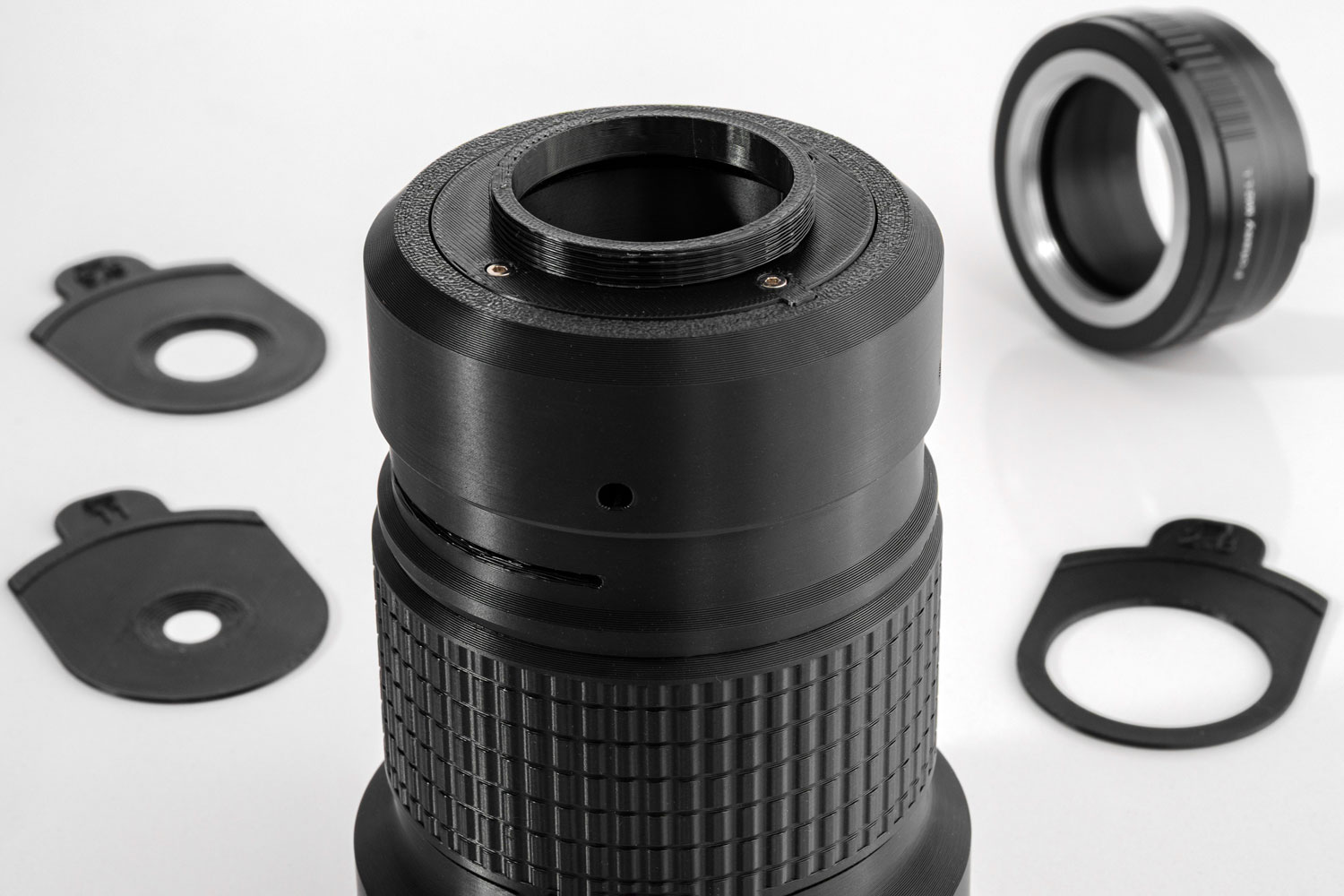
The ‘The Irwin Workshop Simple 90’ is a 90mm lens that comprises two elements set in a cemented achromatic doublet – the elements are stuck together and don’t move apart. The doublet is mounted in a helicoid system so it can be shifted along the inside of the barrel to alter the distance from the lens to the sensor for focusing. The elements are actually made of real glass, and Tim uses two different types – crown glass for the first element, and flint glass for the second – in an attempt to reduce chromatic aberrations and improve sharpness.
The barrel of the lens is made from polyethylene terephthalate glycol (PETG) which should make it more durable and stronger than some other plastics used in 3D printing. Tim makes all the parts himself, other than the glass elements, the screws and the pins that connect the lens group to the helicoid.

At the back end we have an M42 screw mount that allows a wide range of adapters to be used to attach the lens to almost any camera. Tim offers the lens with some adapters already attached – 13 options in all – but users with mounts not listed can buy their own adapter and screw it on themselves. Tim says the lens covers medium format-sized sensors, and shows images shot on the Fujifilm GFX series on his website, but it will also work on Micro Four Thirds models and everything in between.
Obviously, when mounted in front of different sized sensors the area of imaging circle in use will change. So on a Fujiiflm/Hasselblad medium format camera the lens will behave as a 71mm would in a full frame camera, and on MFT you’ll get the angle of view you’d expect from a 180mm.

Unlike normal modern lenses we don’t adjust the aperture with a ring or a body control. Instead, we use a series of slot-in Waterhouse stops to control the amount of light leaving the lens, as was common in the second half of the 1800s. The lens comes with three of these stops, marked f/2.8, f/5.6 and f/11, but others can be ordered. Tim also supplies blank ones so people can cut their own holes – in different shapes perhaps, to create pretty out-of-focus highlights.
Do I need to say the lens is manual focus? I suppose I should, and there’s no electronic contact with the camera – so there’s no body control and no aperture value in your EXIF data. The front of the lens has an 82mm sized filter thread.
Irwin Workshop Simple 90 Review – Build and handling
There’s no getting round that this is a plastic lens that’s been 3D printed in some bloke’s house in Utah. He’s done a great job of it, but don’t expect fancy production standards. It has the feel of one of the better versions of those Canon lens mugs that we all get for Christmas. It is remarkably solid, though, and with little to break I should think it will last very well.

The weakest point will probably be the plastic filter thread on the front, but Tim himself suggests frequent filter users might consider screwing in a clear 82mm protector or a magnetic ring to leave in place permanently. You can then attach your filters to that instead of the plastic thread of the lens itself. The M42 thread on the rear is also plastic, but the mount adapter supplied will be metal – so that will last fine.
The focus ring turns freely and smoothly enough, and despite making a sound like ice being scraped off a windscreen on a December morning, it is actually very nice to use. You won’t be focusing while recording audio from the camera position though. And as the focusing is all inside the lens, the barrel doesn’t turn or change length. The f/2.8 Waterhouse stop could be another weak point, but it isn’t – its thin edges are just nicely flexible, and don’t feel like they will easily snap. New ones are available if needed.

The lens is remarkably lightweight (310g with the mount adapter), so can sit carefree in your camera bag on a day out even on the off-chance of some action, though at 153x86mm it is reasonable big.
Irwin Workshop Simple 90 Review – Image quality
Readers may or may not be surprised how many ‘cinema’ lenses are so soft they fail to trigger the peaking function of normal cameras even when ‘best focus’ has been found. Not the case with this lens! In fact the Simple 90 is remarkably sharp – in the middle section of the frame at least. Around that central area chaos breaks out and details streak off into the corner of the picture with a dramatic zooming effect.


The magnitude of that effect is dependent on the size of the aperture in use, with the f/2.8 stop producing the more pronounced distortions and the f/11 stop creating much wider sharp zone. Strength in the effect is also dependent, to some extent, on focus distance, with more disruption when we pull the focus back to the minimum 2ft position. In each situation it pays to consider how much blur we’d like, so apertures are chosen for the effect they create rather than for controlling exposure.
As I said though, the central area of the frame is crispy sharp, and the out-of-focus highlights are clean and stretch in an attractive manner.
Verdict
This is a very cool lens, and one I’ve really enjoyed using. Some novelty lenses wear pretty thin once the limitations become a bit too…limiting. The Irwin Workshop Simple 90 also has its limitations, but it won’t be a lack of optical quality that makes it unsuitable for every job. The effects are interesting, consistent and, with time, predictable. So when the moment arises, you’ll know whether this lens will add something to you images and you’ll know when to keep it in the bag.
I’ve found it fun for portraiture, cityscapes and night work, as well as for creating atmospheric/dreamy interior décor shots. But I’m sure there are plenty more uses you can think of. Pick the right subject, situation and aperture and you’ll produce some cool images, but get any of those wrong and you’ll end up with a mess.
But crucially, it is cheap enough to buy for fun occasional use, unlike some ‘alternative’ lenses that have become so expensive the fun wears off a lot more quickly. This is a most enjoyable lens, designed successfully with enjoyment and creativity in mind, and I hope Irwin Workshop will consider some wider focal lengths soon. I’d like a 50mm.

Full Specifications

| Filter Diameter | 82mm |
| Lens Elements | 2 |
| Groups | 1 |
| Diaphragm blades | 1 |
| Aperture | f/2.8, f/5.6, f/11 |
| Min focus | 61cm |
| Length | 153mm |
| Diameter | 86mm |
| Weight | 310g |
| Lens Mount | M42 + Numerous adaptations |
| Included accessories | Front cap |
Follow AP on Facebook, Instagram, YouTube and TikTok.