

Just seconds after I’ve rung the doorbell Denis O’Regan smiles as he opens the door of his London gallery. It’s situated in a tall building which was easy to find due to huge photographic posters of Freddie Mercury, Bob Marley and David Bowie dominating its frontage. Although he’s almost 72, he sports a mop of curly black hair and has an infectious energy about him. He ushers me inside where huge photographic prints of Bowie, Bon Jovi, Kiss, Duran Duran, Queen and others hang on the walls and windows.
After a brief interruption from a small kitten O’Regan has recently adopted we settle down inside and begin by discussing where it all started. ‘My interest in music came first. I got my mother to take me to see The Beatles as a child. After I left school I went to see The Who, the Rolling Stones, Elton John, Alice Cooper and Led Zeppelin at Alexandra Palace. I was standing way back and when Jimmy Page hit the guitar with a violin bow he’d wait for the echo then gesture towards the audience… dust came up from the spotlight and I thought, “God, I‘d love to capture that”.’
O’Regan was born in west London to Irish parents and his local venue was the Hammersmith Odeon. He recalls, ‘I went to see David Bowie at the Hammersmith Odeon in 1973. When they say “that moment that changed your life”, well it did. I liked taking pictures of whatever happened to be around me, but I thought, “this is what I want to photograph and it’s him”. Two days later I saw the headline DAVID BOWIE QUITS. I thought I’d discovered him one day and lost him the next. I thought that was that, not knowing he’d only retired Ziggy Stardust.’
The following year O’Regan was working in a shop in Barnes to earn money to go around Europe interrailing. ‘Two very excited girls came into the shop to buy pens and paper. I said, “What’s going on?” and they said, “David Bowie’s over at the studio”. I shot home, got my little camera, came back and waited with them for him to arrive. I had to go back a second day because I slightly missed him the first day. Bowie said, laughing, “Oh, you should work for NME”. I then went around Europe and became hooked on travel. I decided I’d combine touring with photography and music – that’s what I ended up doing… going on tour, photographing rock bands.’
Punk gives access
Although he’d already photographed Bowie and Wings, for a couple of years O’Regan found getting access to bands tricky, until the punk era arrived in 1976. He explains, ‘Suddenly I had access to the bands that the music papers wanted the most. I went to photograph The Damned at only the second gig they’d ever played.’ However, he’d forgotten to bring a flashgun and had to borrow one from another photographer, Chalkie Davies, who admitted he didn’t really like punk and advised O’Regan to send his pictures into NME, which he did.
Back in those days O’Regan would shoot the punk bands, go home, develop the films, do a contact sheet, print up a couple of his selected shots and then drop the prints off at the NME office in Carnaby Street at lunchtime the following day.
His connection, and later friendship, with Chalkie Davies was to prove pivotal. Davies lodged with Thin Lizzy’s guitarist Phil Lynott and, in 1978, O’Regan visited Davies at Lynott’s house. He remembers, ‘By that time, I’d done a lot of photography for NME and Phil Lynott said, “We’re off to Scandinavia next week”. I just went, “take me along”… and he did.‘
The Serious Moonlight tour
O’Regan’s cheeky manner later earned him the slot as the official photographer for the Rolling Stones’ eight-week 1982 European tour. The accountant for the Stones was a music industry professional called Bill Zysblat. O’Regan reveals, ‘Bill’s a very clever guy – he saw that huge Stones tour from the inside and thought, “I’ll replicate that and offer it to David Bowie”, and that’s what happened. He’s still huge in the music business and runs the Bowie estate.’
Zysblat told him he’d have to come up with a business plan if he wanted to cover Bowie’s Serious Moonlight tour. O’Regan pitched the idea of producing a book and admits, ‘There weren’t loads of photographers vying to do it, because tour photography wasn’t a big thing. I put together a business plan: they pay for everything, I sold the approved images to the press, David has approved images going out, and the magazines love it because they’re getting the kind of pictures they’d never get themselves. It was a win, win.’
But, first off, O’Regan had to meet Bowie. ‘They asked me down to rehearsals. Each day David would train for the tour by going to the gym and boxing. He asked me along and I photographed that. I think he got the feel of what I was like, which was someone who wasn’t ever going to hassle him. He was actually very normal, very funny and very personable. I think he found me to be the same thing, so we got on really easily.’
He continues, ‘David loved the idea of doing a book. He’d never done anything like that and he’d never taken anyone on tour, so off we went.’ With the explosion of Bowie’s Let’s Dance album the tour, which started off as only a few weeks, was extended and eventually ran for over eight months around the world.
O’Regan explains, ‘At the time [in 1983], I’d have two cameras so I’d shoot both colour and black and white. I love black and white and I’ve also turned a lot of digital stuff into black and white. At the end of the Serious Moonlight tour I had about 10,000 pictures, but a lot of them had been dumped – anything that was out of focus, David didn’t want or I didn’t like, got dumped.’
Tour logistics
Having shot his films on tour, Denis O’Regan would get them developed at labs in major cities along the way. He’d sometimes have to wait several weeks for the developed films to be flown to another city later on in the tour. He’d then do an edit to present to Bowie for approval or rejection.
The upside of the delay was that, unlike in today’s digital age when most bands and PRs expect to see an image edit the next day, this freed O’Regan up to go out to dinner with Bowie and his friends or just hang out with Bowie so he could capture the iconic musician in off-guard and private moments.
He reveals, ‘We’d have a slideshow in my hotel room. I’d do a carousel’s worth of slides. David was fine with me curating the pictures and didn’t want to see too many. Then he decided which ones we would use. The two of us would sit either side of the projector and it’d be, “yeah, I like that” or “save that for the book; it’s unique”. I was never given a brief, but David would say, “let’s do this”, or “why didn’t you get that?”, which was the opposite of what I expected.’
Glass Spider tour
After the Serious Moonlight tour O’Regan toured with Duran Duran, Spandau Ballet, Neil Diamond, the Bee Gees and Queen, amongst others. He was also the official photographer for the London leg of Bob Geldof’s giant 1985 Live Aid concert.
In 1987 he was back on tour with Bowie for the Glass Spider tour, which supported the singer’s Never Let Me Down album. He notes, ‘There was no book deal that time, but I’d supply the press stuff. I didn’t get married till I was 44, so I was having a great time. I thought I might as well be on tour with David Bowie for a year than staying in the UK. Instead of having to find different things to do, there was just one client that I could do for a year.’
In 1990 Bowie embarked on his Sound + Vision tour, but Denis O’Regan only shot occasional shows. ‘I just hung out with David and went out to dinner… things like that. It was a lot more relaxed because I would just come and go. I’d already done two years with him.’ He also shot ‘a tiny bit’ of Bowie’s band project Tin Machine, but thereafter his work with Bowie was minimal.
Technology trailblazer
After some ‘intense’ years between 1980 and 1988, in the late 1980s O’Regan decided to shoot celebrity portraits for the likes of HELLO! and OK! Magazines. He also he set up one of the UK’s first legal music download companies. ‘I wanted to move away from music photography for a while. I was a bit fed up with it. Then you move into a new era and along come Blur, Oasis and grunge, which I did photograph a chunk of, but it sort of moved on.’
He was also an early embracer of imaging technologies. ‘It began with Minolta who brought out the first autofocus [SLR, the 7000] and I used that in 1987. In ’87 I started working with a Mac [computer] and in ’89 I got Photoshop when it first came out, so I’ve been using that for 36 years. I now use Peakto software and it pulls in all of my images from different drives.’
O’Regan says he has used Nikon cameras for ‘a long time’ and I spy a D5 DSLR lying on one of the couches in his gallery space. He notes, ‘Digital is free. Beforehand, if I went on tour I’d have to buy all the film in advance and pay to have it developed. Now you can buy one [memory] card and do everything on it. It costs you nothing. 40 years ago it often cost me £150 to shoot a show.’
New Bowie book
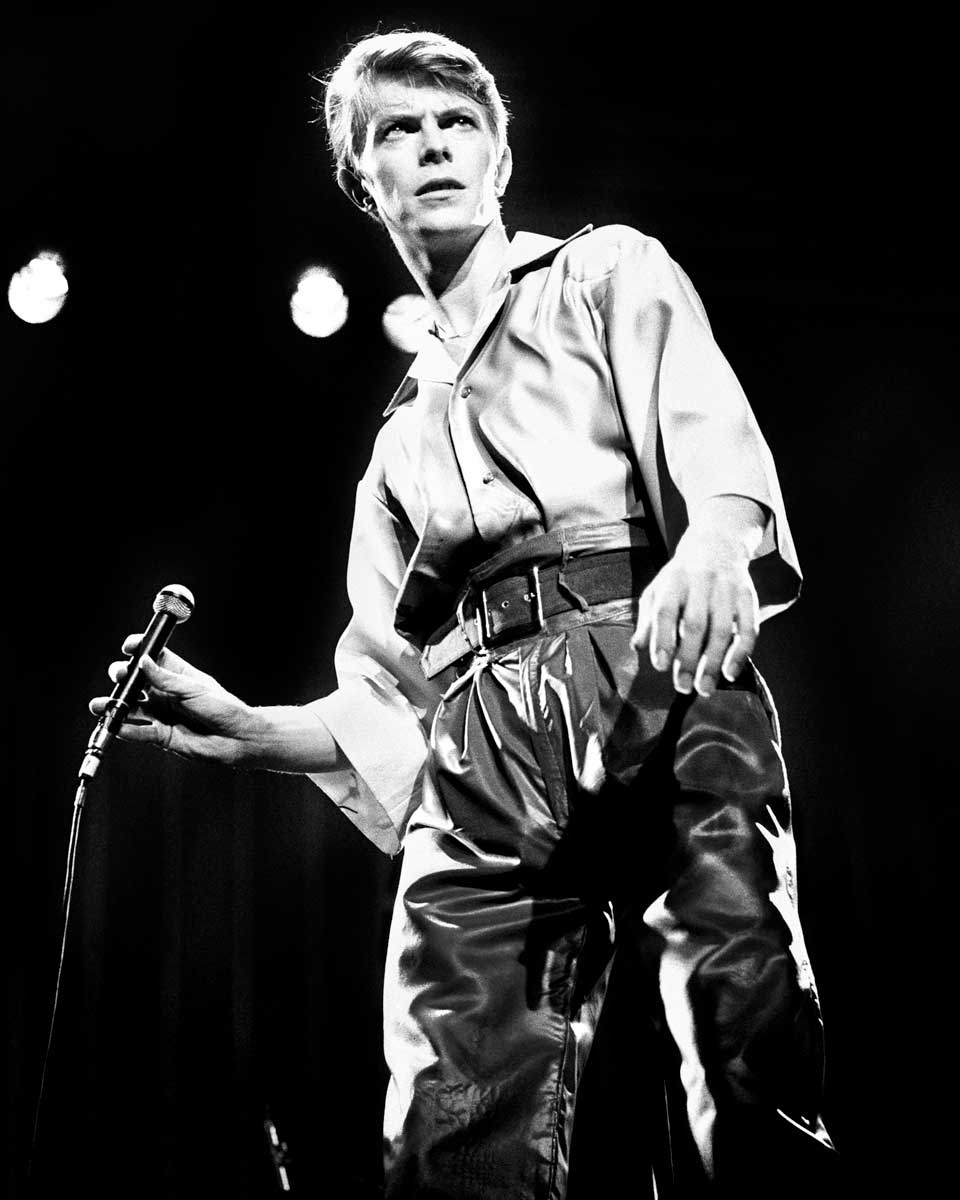
O’Regan’s latest book, titled David Bowie by Denis O’Regan, showcases his iconic photographs of the rock legend across a 20-year period. In 2018 he produced the photo book Ricochet, which only focused on images from the Serious Moonlight tour. Originally, O’Regan wanted this new book to be based on the Glass Spider tour, but Bill Zysblat ‘wasn’t nuts on it’. Instead, it features a mixture of all of Denis O’Regan’s Bowie pictures.
He describes the new book as, ‘David by Denis. It’s just my selection of pictures of him across the period I photographed him. There are the pictures outside Olympic Studios at the beginning, when he didn’t know me from Adam, to ’94, after I’d spent two years on tour with him. There are things like a one-off show at The Dominion Theatre and little bits and pieces.’
The 276-page book beautifully demonstrates the unprecedented access that Denis O’Regan had to Bowie. It includes pictures like Bowie in a Berlin hotel room (a Helmut Newton shoot for Vanity Fair that Bowie insisted O’Regan be included in), Bowie having a cigarette in an airport, Bowie being measured for Madame Tussauds and dozens of other scenarios.
He explains, ‘this is the kind of access I wanted. I wanted to follow David Bowie around and shoot him hanging out, rather than just do three songs for the rest of my life, which a lot of photographers still do.’ As his 19-year-old son Rory enters the gallery I take it as my cue to leave, but Denis O’Regan looks at me and says, ‘Believe it or not I’ll tour tomorrow. I loved a lot of it, but a lot of it was boring. Now you’ve got iPads and mobile phones, so you can stay in touch and it’s a lot easier now. I toured more than people in bands did because they would tour and go home and I’d go off on another one, which is why I never got married till after I’d finished touring. The same with having a child and, when that happened, I wanted to spend time with him. I think every life goes through a lot of chapters and I’m in another one now.’
The book David Bowie by Denis O’Regan (ISBN: 9781788842846) is published by ACC Art Books and has an RRP of £60. www.accartbooks.com
Denis O’Regan
Denis O’Regan was born in London, England, in 1953. He is a self-taught photographer who smuggled a camera into the Hammersmith Odeon to shoot Queen and Paul McCartney and Wings. He documented the punk era and worked for NME before carving out a career as a music tour photographer with the Rolling Stones, Bowie, Queen, Duran Duran and others. His concert images have featured on the covers of live albums by Queen, Sting, The Cure, Thin Lizzy, Pink Floyd and the Rolling Stones. He is based in the Denis O’Regan Gallery in west London.
Related reading:
- David Bowie was lovely and down to Earth says Photographer
- Elvis Presley is this the Most Influential Album cover of all time
- Rock photography descends on Kings Cross Station
- Greatest Album Cover Photography Aladdin Sane by David Bowie
- Mick Rock Interview: Shooting David Bowie