

France isn’t a country whose name instantly leaps to mind when it comes to camera makers. So, really, what did the French ever do for photography? Well, they invented it for a start. Yes, but apart from that?
How about they were the first to put motor drives in cameras, introduced 35mm before the Leica, manufactured serious rivals to the Leica, pioneered colour photography, popularised stereo photography, produced the first shutter priority single lens reflex (SLR), not to mention a smattering of unusually strange and innovative designs… shall we go on?
In the beginning…
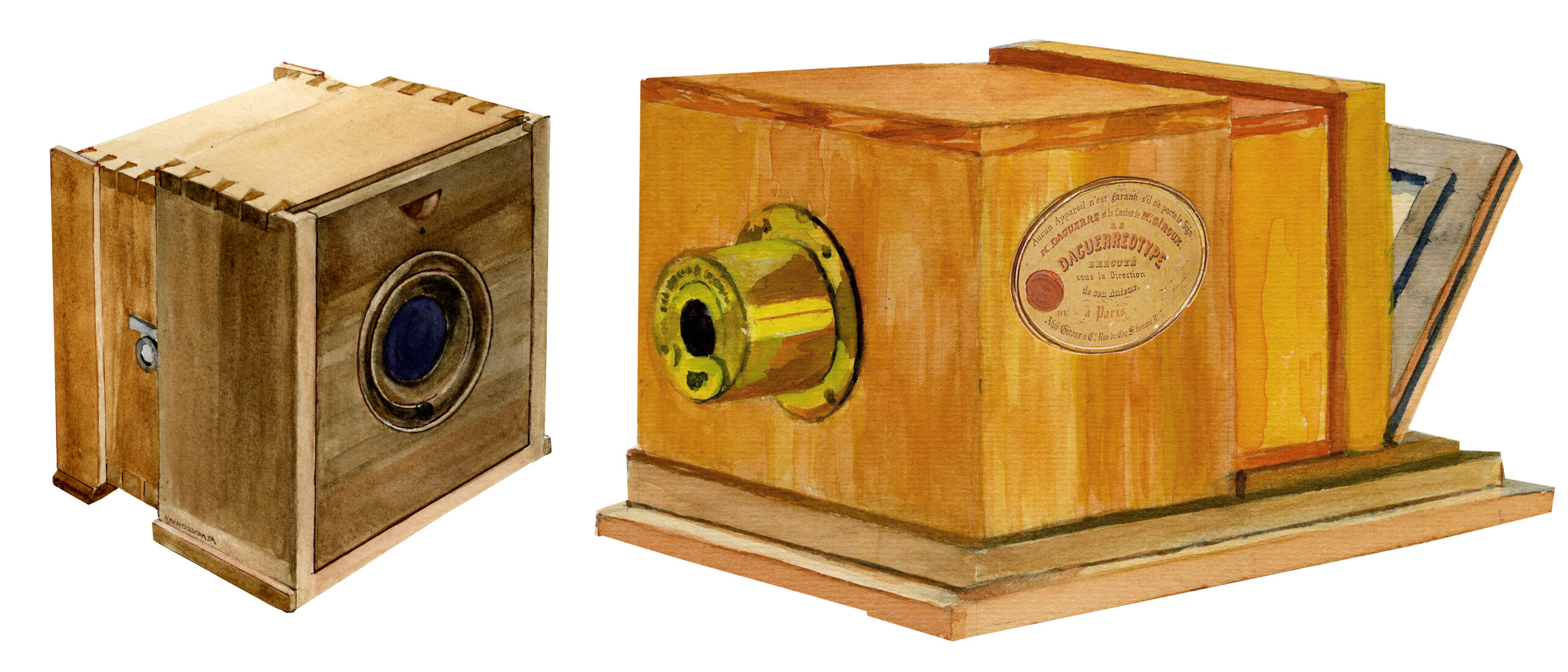
What has come to be accepted as the first photograph was taken by Joseph Nicéphore Niépce in 1826. His camera was made by Paris opticians Charles and Vincent Chevalier, and by definition must be considered as first photographic camera. The process – involving a pewter plate coated with bitumen of Judea, a day-long exposure, the application of lavender oil and treatment with iodine vapour – produced a positive image, but was totally impractical.

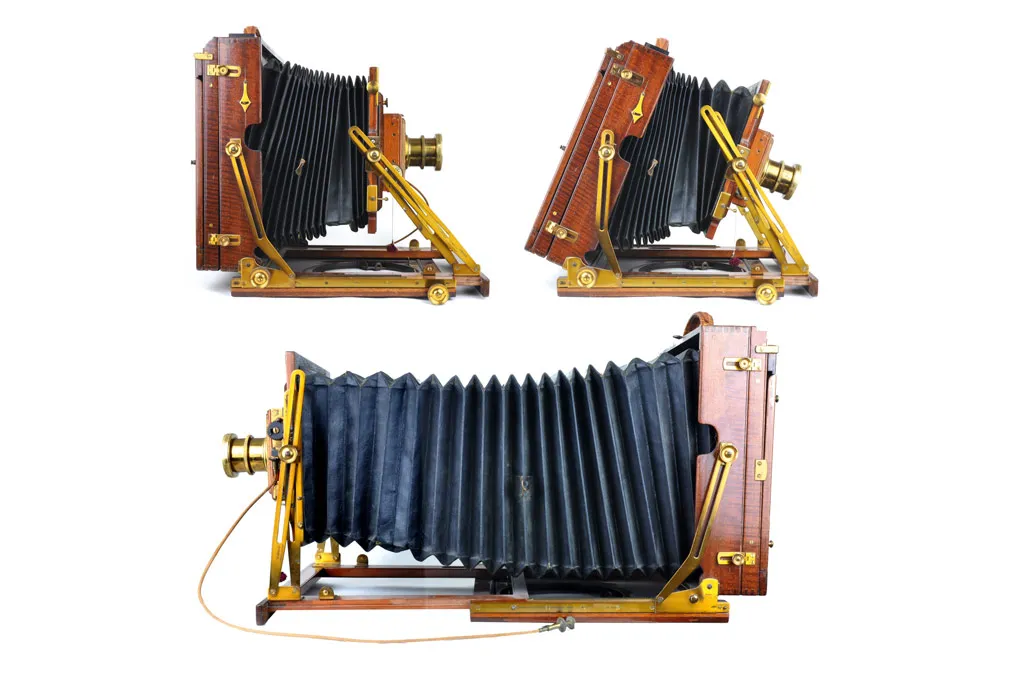
The man who made photography truly practical was Louis Jacques Mandé Daguerre who, in 1839, announced the daguerreotype process, which produced a positive image on a silver-plated copper base. Daguerre’s camera, built by Alphonse Giroux of Paris, can be considered the first commercially successful photographic camera, and soon other manufacturers began making cameras for Daguerre’s process. For the first time, photography became viable, reasonably easy to handle, commercially profitable and extremely popular.
Motor drives and 35mm
Common wisdom states that the first camera with a built-in motor drive was the Robot in 1935 and the first 35mm camera was the Leica in 1925. Both were German. Lesser known are the French cameras that preceded them.

The first camera to use a motor drive to wind the film was called Le Pascal, made as far back as 1899 by Japy Frères & Compagnie. It was a box camera that took twelve pictures 1½x2in on specially-made film. This was inserted in the usual way, then wound all the way through the camera and onto the take-up drum. At the same time this tensioned a clockwork spring. Thereafter, as the shutter release was pressed and each exposure made, the clockwork automatically wound the film back onto the original spool one picture at a time.

A clockwork motor drive also featured in the 1922 Debrie Sept. As a normal still camera it shot 250 18x24m exposures on 35mm film housed in special cassettes with the motor advancing the film one frame at a time. Or, by shooting continuously, the camera doubled as a cine camera to produce short-run movies. The Sept was so called because the word is French for seven, the number of ways it could be used: still camera; sequential camera; movie camera; with the attachment of a suitable light source, as a still projector; likewise, as a movie projector; likewise, as an enlarger; with an unexposed film fed through the camera alongside a developed film, to print a strip of negatives as a positive film strip or short cine sequence. And it used 35mm three years before the Leica.
Jumelle cameras

The French word ‘jumelle’ means ‘twin’, ‘jumelle de vue’ translates as binoculars and binoculars influenced the shape of jumelle cameras, a style predominantly originating in France. Here are two of the more unusual French jumelle models.
The Photo-Jumelle Binocular Camera of 1892 looked like a pair binoculars crossed with a stereo camera. One lens took the pictures, the other one was the viewfinder, through which the subject was viewed via an eye-level aperture in the back of the body. The viewfinder took up half the body, and was covered by a red filter to prevent light from fogging the plates inside. The other half of the body contained a holder for 12 plates positioned behind the lens. Plate changing was a complicated affair that involved a lever that moved all the plates, other than the one just exposed, to be yanked into the opposite side of the body, which allowed the exposed plate to fall to the bottom, and then the pile of unexposed plates were pushed back on top ready for the next exposure.

The Bellieni Jumelle Simple of 1898 also used two lenses. The main one was a 110mm f/6.8 lens positioned to one side of the body and mounted on a faceplate that moved backwards and forwards for focusing when a lever on the top was operated. The second lens was an 86mm wide-angle revealed behind a sliding panel on the front of the body. Each lens had its own shutter. After an exposure, a handle drawn from the side of the camera pulled exposed plates into a chamber where they were stored until ready for removal and development.

Stereo cameras
The principals of stereography were first demonstrated by Englishman Sir Charles Wheatstone as far back as 1832, but only with drawings. Then along came Daguerre with his daguerreotypes and suddenly stereo photography became possible. The craze spread around the world, but the French in particular were known for producing many notable stereo cameras. Here are four.

Of all the French stereo camera manufacturers, Jules Richard of Paris made more than most. Starting manufacture in the 1890s, more than 60 models using different plate sizes continued to be produced into the mid-1950s. Most cameras had simple exposure systems with fixed apertures and shutter speeds, some had focusing lenses, others were fixed. Small lenses between the two taking lenses reflected their images to waist-level viewfinders recessed into square apertures on top of the body.
Also from Jules Richard, in 1904, came Le Glyphoscope. This one’s peculiarity was in having a panel that housed the single speed shutter, two apertures and viewfinder which was unclipped to reveal the lenses. With the shutter and apertures thus removed, and with a developed stereo plate inserted in the back, the camera was transformed into a stereo viewer.

The Monobloc, made in 1914, was a stereo camera that converted into a panoramic camera. For stereo, it shot two 6x6cm images side by side on glass plates. Then, a mask in the viewfinder was adjusted and the lens panel shifted sideways so that only one lens came into play. This action also moved the septum inside the body, normally positioned to separate the two stereo images, to allow the single lens to shoot a panoramic 6x13cm picture.

The Stereo Spido Metallique, made in 1920, is another that took on the jumelle shape, shooting twin images on 6x13cm glass plates, housed in a holder with a mechanism for changing plates after each exposure. The twin Krauss lenses were linked for focusing by a bar on which a depth of field scale was engraved. An engraving in red on the front, stating ‘Grand Prix 1900’ indicated that the company won this prize at the Paris Exposition in that year.
Foca cameras

Although sometimes referred to as Leica copies, Foca cameras, made by Optique et Précision de Levallois (OPL), were very much their own designs, launched to rival the Leica and Contax. Originally planned in 1938, the project was abandoned with the outbreak of World War II, but resurrected in 1944, with cameras ready for sale by the end of hostilities in 1945.
The PF3, shown here with its dedicated flashgun, was identified by the three stars engraved on a small badge beside the lens. This model was the first of the range to add a slow speed dial to the front of the body, adding speeds of 1–1/25sec. The prime control on top of the body gave the other speeds of 1/25–1/1,000sec. One unusual feature of the camera was its depth of field scale found on a small platform beside the lens with its markings lining up with the lens’s focusing scale. As the lens was focused, moving back and forth from the body, this platform moved up and down to keep its scale flush against the lens’s focusing marks. A comprehensive close-focusing outfit figured among the camera’s accessories.

SEM cameras
The Société des Etablissements Modernes de Mécanique, thankfully more often abbreviated to SEM, made some innovative small but well specified 35mm models plus twin lens reflexes (TLRs) for 120 roll film.

Of the smaller models, the Babysem is worth seeking out. Despite measuring only 10.5x6x6.5cm, it’s a full frame 35mm camera, with a 50mm f/3.5 lens and a shutter speeded 1/10-1/250sec, all in a camera that sits easily in the palm of the hand.

The company’s TLRs were mostly of the traditional design, but one departed curiously from the norm. The Semflash was sold as a kind of all-in-one home studio in a purpose-made outfit case. Fixed to the side of the body was an early form of electronic flash that was extremely ugly and powered by a permanently fixed wire that plugged into mains electricity. Designed for ease of use by less-experienced photographers, photographic shops often hired the outfit out to families for special occasions.
Single lens reflexes
The French did not go big on SLRs, but two companies that did make them, each managed to produce something a little out of the ordinary.

In 1959, Foca, the company more famous for 35mm coupled rangefinder cameras, introduced the Focaflex, which used a peculiar light path into the reflex design. As the film was advanced, a reflex mirror swung up, not down in the usual way. Behind it a capping plate shielded the film from light entering the lens as the aperture iris and shutter blades opened to their widest settings for focusing. The mirror was semi-silvered to allow light to be both reflected from it and transmitted through it. Light entered the lens, hit the mirror and was reflected down to a silvered focusing screen in the base of the body. From there the image was reflected up again through the semi-silvered mirror to a small prism arrangement that turned it the right way up and right way round before reflecting it back out of the viewfinder. As the shutter was released, the aperture closed to its pre-set f-stop, the shutter blades closed and the reflex mirror plus the film-shielding capping plate swung away so that light could reach the film as the shutter opened and closed. At the same time, a blind closed over the viewfinder to prevent stray light from entering the body.

France’s other notable SLR came in 1961, when the Royer company launched the Savoyflex Automatic, the world’s first shutter priority SLR, using a selenium cell above the lens which activated a trap-needle method of automating apertures, according to the selected shutter speed. As the shutter release was pressed, the shutter closed, a flap moved across the viewfinder to block stray light, the mirror was raised, the automatic system selected and set the correct aperture, a needle swung across a scale in a window on the front of the body to indicate the chosen aperture, and then the shutter was released.
Two peculiarities
When the French decided to take a fresh looks at camera design, they didn’t hold back. Witness the Maton and Cyclope.

The Maton was made by Multipurpose Portable Cameras Ltd in 1930.It was held by a handle on the back into which three fingers were hooked, rather like a knuckle duster. Waist-level viewfinders were situated on the top and side for vertical and horizontal pictures. Inside the body, an angled mirror reflected light from the lens, onto positive paper-baked film in square cassettes and running from one to the other along the base of the body. A crank on the side advanced the film and fired the shutter as it was turned. Shutter speeds of 1/25–1/100sec were adjusted by a control above the lens, with a lever to adjust apertures beneath. In this way, it shot 24 exposures of 24x30mm. Once developed, the film could be loaded back into the camera which, with the attachment of a special light source, became a projector.

In 1952, the Alsaphot company produced the Cyclope, so called because of the strange position of its lens at the top, rather than the more usual centre, of the body. It shot eight exposures on 120 roll film and the space needed between lens and film was reduced by the introduction of two angled mirrors. Placed at the back of the body these reflected light from the lens twice onto the film, which ran along the front of the camera, emulsion side facing back and with the red window for reading film numbers on the front beside the lens. A direct vision viewfinder sat beside the lens, mounted in a Prontor II shutter speeded 1–1/175sec.
Colour photography pioneers

The French were not known solely for their cameras. They were also major pioneers of colour photography. In 1907 two French brothers, Auguste and Louis Lumière, introduced the Autochrome, and with it revolutionised colour photography at a stroke. There had been methods before of producing a colour image, but it was a complicated process involving three exposures through different filters. The Autochrome’s big advantage was that its specially-prepared plates needed only a single exposure in any suitable camera.
Put simply, Autochromes were made by coating a photographic glass plate with minute grains of potato starch, dyed red, green and violet with a monochrome emulsion coated over them. The plates were placed into a camera with the potato starch layer facing the lens, so that light passed through the particles to reach the emulsion. The plates were developed normally to make positive monochrome images to be viewed against a suitable light source. The coloured potato starch grains, being too small to be individually identified, coalesced so that the filtered monochrome image was seen in full colour. The Lumière brothers went on to apply similar technology to flexible films called Filmcolor and Lumicolor.

In 1909, French inventor Louis Dufay improved on the Autochrome’s technology by coating a glass plate with a more regular-shaped grid consisting of pairs of lines coloured magenta and green at right angles to a pattern of cyan and yellow lines. With the plate developed to make a positive image, a coloured picture appeared when viewed through the grid. Dufay called these images Dioptichromes. He later journeyed to Britain where he obtained backing to transfer his process from rigid glass plates to flexible film. The result was Dufaycolor, the first truly popular colour film, available as 35mm and 120 roll film in 1935.
The funny French
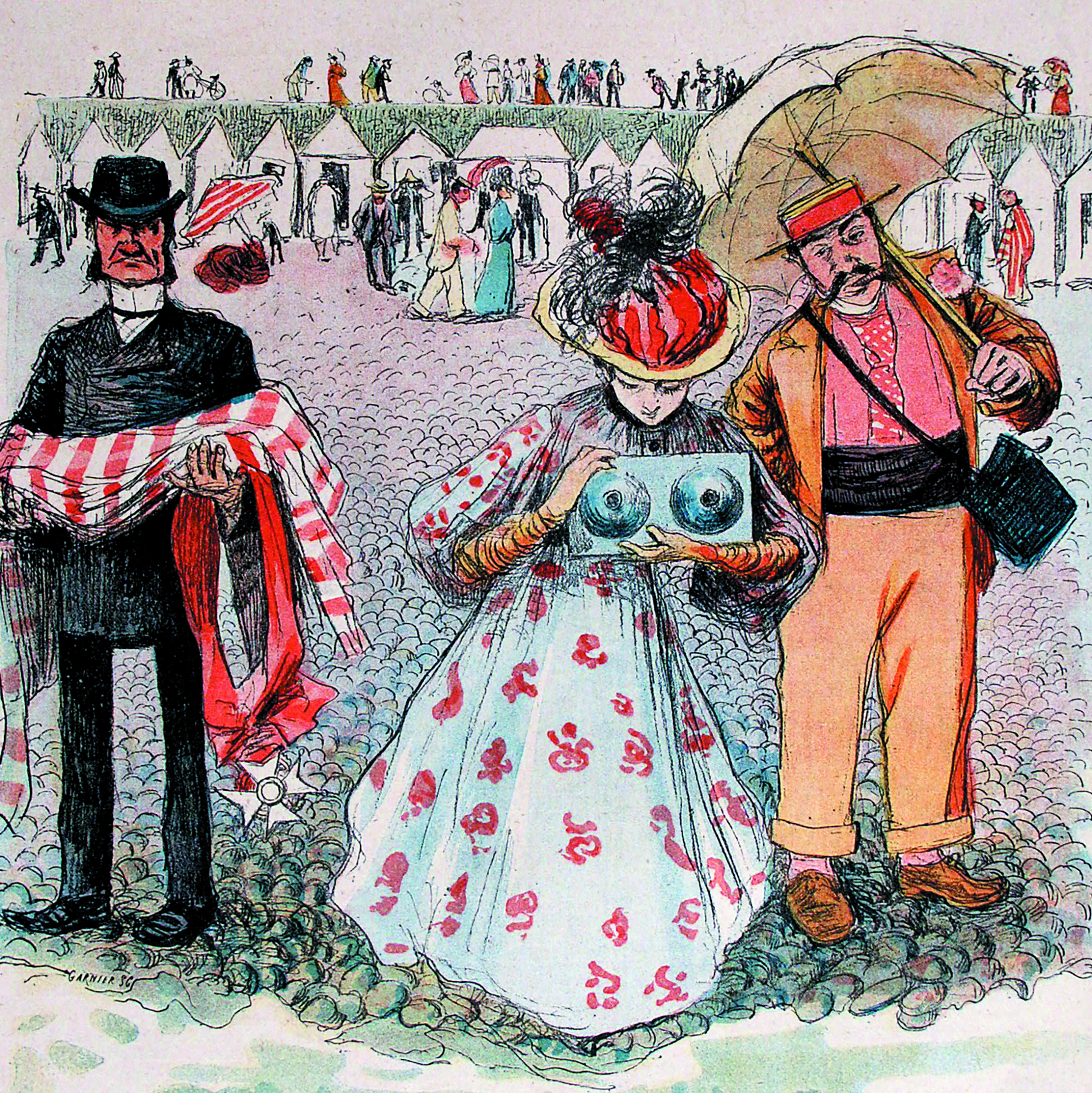
Who says the French don’t have a sense of humour? This picture appeared on the front cover of a magazine called Le Rire (The Laugh), in August 1895. A caption below the picture translated as: “Does it amuse you to take a snapshot of this fat man taking a bath?” “Idiot. Can’t you see it’s the President!” The camera being held, some might say somewhat suggestively, by the fashionable young lady was a Stereo Photosphère, an all-metal stereo plate camera made in 1888.
Related reading
- Film stars – how roll film makers tried to fight 35mm and lost
- How the World’s first Leica camera came to be (and changed photography forever)
- 100 years of the most significant Leica Cameras from 1925-2025