




The birth of digital cameras 50 years ago was followed by an evolution that, after a fairly slow start, took off at lightning-fast speed in terms of both exterior design and interior technology. With no longer the necessity for placing the lens in the centre of the front of a camera body, it could now be moved to one side, or placed on the top, or even detached completely. Traditional viewfinders could be replaced by small, movable LCD screens, later to be miniaturised and placed in the viewfinder itself. Cameras didn’t even have to look like cameras, when flat box-like shapes with lenses and basic controls in unexpected places worked just as well.
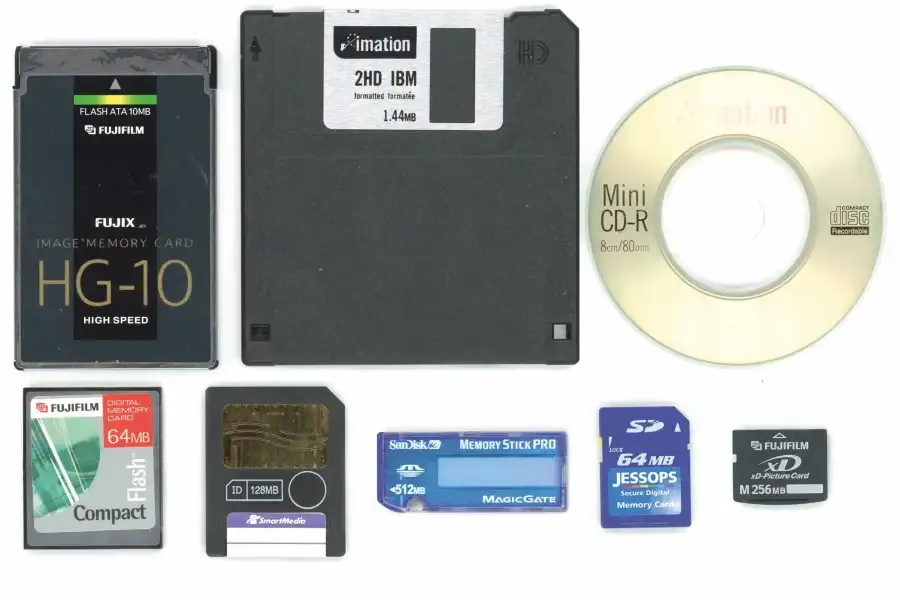
Early technologies came to the fore, died away, were replaced by new processes which in turn were transformed again, and again. Different types of sensors grew in both physical size and ISO sensitivities that would have been unheard of only a few years before. Storage devices went from huge PC cards to micro SD cards. Prices dropped from stratospheric to attainable and, when reaching the second-hand market, to ridiculously low.
The cameras that follow represent a mixture of landmarks in digital imaging, along with a selection of oddities whose once revolutionary designs and features are now best described as something that might just have seemed like a good idea at the time.
1981: Sony Mavica
It took an electronics company with no interest in film or processing to take the first major step into digital camera production, and Sony was the one to take it. The Mavica, short for Magnetic Video Camera, was similar in style to a 35mm single lens reflex (SLR), with interchangeable 25mm f/2, 50mm f/4 and 16-65mm zoom lenses in Sony’s unique mount.
It was actually a stills video camera that incorporated an image sensor and processing hardware similar to those used in then current video camcorders. Each image was stored in its own circle on the Mavipak’s rotating magnetic disc. To play back and view the image, the disc was rotated and the appropriate frame was read repeatedly. The result was a signal that could be viewed on a television, the camera’s own viewer or printed using a thermal printer, specially made for the purpose. Resolution was 570×490 pixels, equivalent to a little under 0.3MP. The Mavica never went into commercial production.
1988: Canon iON
The iON, standing for Image Online Network, was one of the first digital cameras to reach the consumer market. It took the shape of a flat body with an f/2.8 lens at one end of the narrow side and a built-in flashgun at the other. Similar to the Mavica’s technology, images were captured on a rotating disc inserted into the top of the body. First pressure on the shutter release started the motor that rotated the disc, while a flashing red light in the viewfinder indicated if flash was needed. Each disc could record 50 images.
1990: Kodak DCS cameras
Kodak’s major entry into the consumer digital market came with a digital single lens reflex (DSLR) which was actually a Nikon F3, with a Kodak digital image sensor mounted on the back. Two sensor backs were available for colour or monochrome images with a resolution of 1.3MP. A large shoulder pack, linked by a cable to the camera, held a hard disc drive to record up to 600 JPEG images.
Originally just called the DCS (for Digital Camera System), the camera became known as the DCS 100 when the DCS 200 was launched in 1992, based on a Nikon F801 body with a 1.5MP megapixel sensor back attached. In 1994, the DCS 400 Series was launched with digital backs and huge hard disc/battery bases attached to Nikon N90 and N90X bodies. Each of the DCS 400 series offered more resolution, which peaked with the DCS 460 in 1995 with 6.2MP.
1994: Apple QuickTake 100
In its shape and the way it worked, the QuickTake was similar to the iON, but made to connect to Apple computers of the day (no longer compatible). Resolution was 640×480 pixels, or about 0.3MP. Despite being badged by Apple, the camera was built by Kodak, as was the subsequent QuickTake 200. A third model, the QuickTake 300, was built by Fujifilm.
1995: Casio QV-10
Although capable of producing little more than 0.08MP, this little snapshot-type camera was a landmark in being the first with an LCD screen on the back to both preview the picture being taken and to review the picture after shooting. The screen measured 1.8in, and the camera had a swivelling lens.
1996: Nikon E2
One problem with digital cameras adapted from film models was that having a sensor smaller than a 35mm film frame meant a 50mm standard lens acted like a medium telephoto. The 1.3MP E2 solved this by introducing reduction optics technology with a convoluted light path from lens to sensor. Light entering the lens was reflected off the reflex mirror and up to the pentaprism in the viewfinder in the usual way.
But the reflex mirror was semi-silvered so that as well as reflecting light, it also allowed some to pass through, where it met a second mirror at the back of the body. From here, it was reflected down to a third mirror on one side of the base of the body, then sideways, through the reduction optics to meet a CCD sensor on the opposite the side of the base of the body. That was why the E2 had such an unusual and ugly shape.
1996: Pentax EI-C90
The company’s first digital model was shaped like a flat box, part of which formed a detachable camera and the other part housing a monitor with a pop-up screen. The image size was a mere 0.41MP, stored on a PC card.
1998: Minolta Dimage V
The Dimage V had an unusual manually operated 4.8-13mm zoom lens that could be detached from the body and waved about on the end of a 1m long cable to shoot in places other digital cameras might not reach. The image size was a respectable 3.5MP stored on smart media cards.
1998: Nikon split-body cameras
Over four years Nikon introduced an unusual range of cameras in which the part holding the lens swivelled 270° against a rigid section that held the LCD screen and main controls. Models included the Coolpix 900, 950, 990 and 4500. The first shot 1.2MP images, the last a more respectable 4MP. That one was the best with a 7.85-32mm f/2.6-5.1 Nikkor lens, 16 scene exposure modes, pop-up flash, macro setting and five-area autofocus functions to shoot JPG and TIFF files.
1999: Nikon D1
The D1 was the first DSLR built from the ground up by a single manufacturer. It boasted a 2.7MP sensor, continuous shooting up to 4.5 frames per second and fast-for-the-day autofocus. The full range of Nikon manual and autofocus lenses was compatible. Images were stored on CompactFlash cards. In 2001, the D1 was replaced by the D1X and D1H, with the former offering 5.3MP and three frames per second continuous shooting. The D1H retained the 2.7MP sensor but upped continuous shooting to 5fps.
2000: Nikon Coolpix 880
For those who didn’t want the split-body, swivel-lens style of Nikon, the company took the technology from the Coolpix 990, placed it in a small, redesigned rigid body and came up with the Coolpix 880. With 3.34MP and a 2.5x optical zoom lens, the camera recorded JPG or Tiff images on CompactFlash cards.
2000: Sony Cyber Shot DSC-F505V
This strangely designed 3.3MP camera featured a small body containing the controls and LCD screen, with a huge Carl Zeiss 10x zoom lens mounted on the front, made to swivel up and down through 140°. Images were recorded on a Sony memory stick.
2000: Pentax EI-2000
Designed by Pentax in association with Hewlett-Packard, this was a stylish camera with a reflex viewfinder that looked directly through the 3x optical zoom lens courtesy of a beam-splitter. Its 2in LCD screen could be tilted through 90 degrees, while images were recorded in colour, monochrome or sepia.
2001: Sony Mavica MVC-FD97
This was a rather large and cumbersome, but nevertheless impressive-looking camera, despite only outputting 2.1MP. It stored images on 3.5in floppy discs of the type used in desktop computers. These could therefore be inserted directly into a computer disc drive to view the images. To store more images than the floppy allowed, the camera also offered a removable Sony memory stick. The camera incorporated a fixed 10x optical zoom lens with additional 2x digital zoom, boasted a 2.5in LCD screen, and shot both JPG and TIFF files.
2001: Ricoh RDC-i500
Offering 3.1MP, this was referred to by the makers as an ‘image-capturing device’. It comprised a flat box with the lens and flash on the narrow side, with a 2in flip-up screen on top that could be orientated to face forwards, backwards or at an angle of about 45° for previewing the image, alongside a more traditional eye-level viewfinder.
The RDC-i500 was rare in its ability to connect to the internet via a modem card that fitted into the CompactFlash card slot. With this, the photographer could upload pictures by file transfer protocol (FTP) or as attachments to emails which the camera could also send and receive.
2002: Sony Mavica CD400
The CD400 was well specified with a Carl Zeiss Vario Sonnar f/2-2.5 3x optical zoom lens, five-area multi-point autofocus, multi-pattern metering, shutter speeds to 1/1,000sec and a 4MP sensor. But its short life was largely the result of recording images on mini compact discs. Before use, the CD needed to be formatted and, once the pictures had been taken, it needed to be ‘finalised’ before images could be viewed on a computer screen.
2002: Fujifilm FinePix S602 Zoom
This used the third generation of Fujifilm’s so-called SuperCCD technology. It meant pixels were arranged in a 45° honeycomb pattern instead of the conventional square layout. The result was a 3.1MP sensor that was claimed to produce a 6MP image.
Other features included a pop-up flash, 7.8-46.8mm zoom lens, electronic viewfinder, 1.8in LCD screen, ISO 160-1,600 sensitivity range, autofocus macro down to 1cm, 15-1/1,000sec shutter speeds and the ability to record JPG and TIFF files.
2003: Minolta Dimage Z1
With its unusual round body and attached hand grip, plus a control panel on the back, this one looked like something from a 1950s science fiction film. The Progressive Capture feature saved images in the buffer memory when the shutter button was held down. A moving mirror reflected the LCD image into an eye-level viewfinder, creating an electronic viewfinder. Other features included a pop-up flash, 3.2MP sensor, 5.8-58mm 10x optical and 4x digital zoom lens, macro shooting down to 50cm, three autofocus modes, three metering options, six subject exposure modes and 4-1/1,000sec shutter speeds.
2003: Olympus E-1
In 2001, Olympus and Kodak joined forces to develop new technology which allowed any other camera or lens manufacturer who signed up access to design specifications and technologies to produce cameras and lenses all with the same mount. They called it the Four Thirds system. Initially seven manufacturers signed up: Fujifilm, Kodak, Leica, Olympus, Panasonic, Sanyo and Sigma. The Olympus E-1 was the first Four Thirds camera.
Built with a magnesium-alloy body, the E-1 offered an optical viewfinder, multi-pattern metering, shutter speeds up to 1/4,000sec, and 3fps shooting. The 18×13.5mm sensor offered a 5MP resolution. The camera also introduced a patented dust-reduction system that shook dust from the sensor on start-up (and one that is still used to this day).
2003: Canon EOS 300D
With a less than £1,000 price for the first time in a DSLR, Canon entered and opened up the affordable amateur market with the EOS 300D, referred to as the Canon Rebel in the American market. Based on the company’s prestigious EOS 10D, with the same 6MP CMOS sensor, the 300D used a plastic body and introduced Canon’s new EF-S lens mount, based on EF, but which allowed the rear element to extend further into the body and closer to the sensor. The spec included ISO 100-1600, 2.5 frames per second continuous shooting, seven-point autofocus, pop-up and external flash capability, seven image size/quality combinations, the usual four exposure modes, plus six scene exposure modes and the ability to shoot RAW and JPG files.
2004: Spyc@m 100
Shaped like a large, chunky pen, this even had clips on two sides so that it could be secured into the top pocket of a jacket. There was no LCD screen to preview pictures, but a small one below the viewfinder displayed the number of pictures taken and their resolution. In high-definition mode, the camera shot 100 pictures; at low resolution it shot 150.
2004: Nikon D70
The D70 brought Nikon DSLRs into the consumer amateur market for the first time. The camera’s main features included a 6MP sensor, pop-up flashgun, optical reflex viewfinder, five autofocus functions, 30-1/8,000sec shutter speeds, 1.8in LCD screen, Nikon F lens mount, ISO 200-1,600 and three JPG quality levels.
2005: Casio Exilim EX-Z50
As digital camera technology progressed, a craze for credit-card-size cameras developed. Pentax, Canon and Olympus were among the photo company pioneers, but among the electronic company manufacturers, the Casio cameras had just that bit more style. The EX-Z50 measured just 8.5×5.5x2cm, yet into those trim dimensions it packed a 5MP sensor, a 2.5in LCD screen and a 3x optical Pentax zoom lens.
2008: Panasonic Lumix G1
In 2008, Olympus, in association with Panasonic, announced another new system. Using the Four Thirds sensor they had pioneered five years previously, they removed the mirror box and pentaprism or porro prism from their DSLRs and replaced them with an electronic viewfinder. This shortened the distance between lens and sensor, allowing smaller cameras and more compact interchangeable lenses. In this way the Micro Four Thirds system was born.
The Panasonic G1 was the first Micro Four Thirds camera. It was also the first mirrorless camera, looking and behaving like a DSLR, only with a smaller body and compact interchangeable lenses. The spec included a 12.1MP sensor, 3in tilt-and-swivel LCD screen, 23-point contrast-detection autofocus, face detection, ISO 100-3,200, 60-1/4,000sec shutter speeds, all in a body that measured just 12.5×8.5×4.5cm.
After the Panasonic G1, everything changed. It was the model that led the way forward to become the blueprint for a new generation of digital cameras that continues to this day.