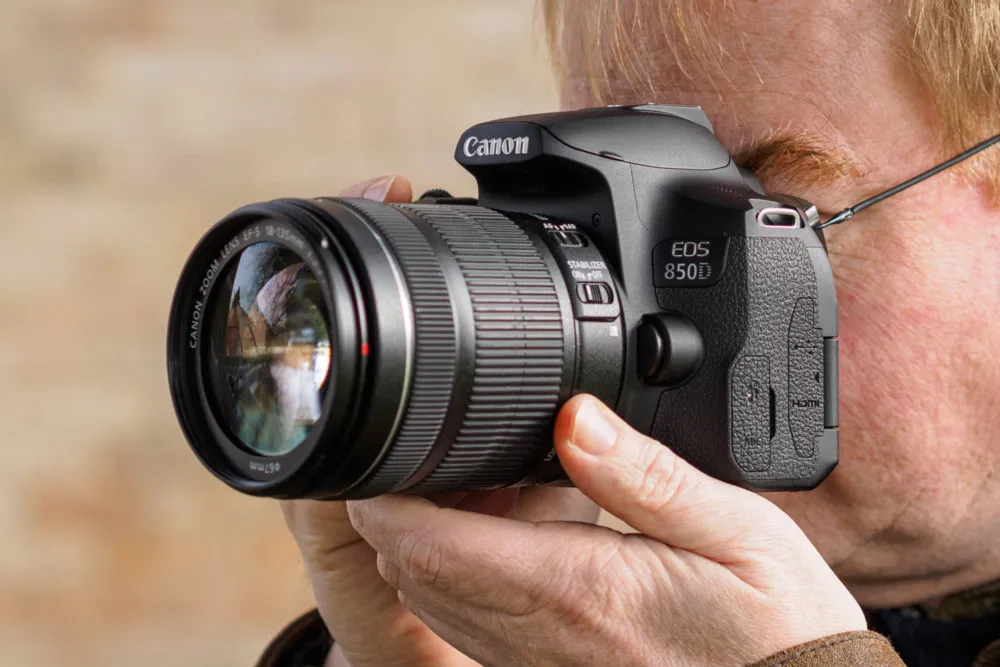
A compact and capable DSLR for enthusiasts, the EOS 850D will suit photographers who want to travel light. Its nasty 4K crop restricts its usefulness for video.
The Canon EOS 850D has been around for a while but is still a terrific all-round package, and capable DSLR with which enthusiast photographers can expand their creative horizons. Buy it with the 18-135mm USM lens, and you have compact, lightweight package with a zoom range suitable for a wide range of subject matter, from portraits and snapshots to landscape and street. Another, more affordable kit option is with the 18-55mm IS STM lens.
Powerful processor
The EOS 850D has a 24.1MP sensor paired with a Canon DIGIC 8 processor and is capable of first-class photographs full of crisp detail and rich colours. Its ISO 100-25,600 range also allows you to shoot successfully when light levels drop. There’s the option of 4K /25p video on this camera, but the usefulness is limited because the image is cropped by 64% and there’s no Dual Pixel AF available. This restricts your angle of view, and the live view autofocus is slower; though you don’t have these limitations when shooting 1920 x 1080 full HD.
The Canon EOS 5D Mark IV DSLR. Photo credit: Canon
Amateur Photographer verdict
A veteran professional DSLR, the Canon EOS 5D Mark IV may look a little low-res by today’s standards, but it’s a solid performer that delivers consistently excellent imagery.
The rugged Canon EOS 5D Mark IV body has been a favourite amongst professional photographers for years, boasting advanced weather sealing and a 30.2MP full-frame sensor. The camera delivers images of outstanding clarity, colour fidelity, low noise and with excellent dynamic range giving detailed highlights and shadows. This makes it a great choice for landscape shooting, producing maximum tonality in your images. It is in fact a highly capable all-rounder that can be used for a wide range of professional and commercial subjects.
Dual Pixel Raw
Autofocus is first rate in stills and video with 61 AF points through the finder and, for shooting action, 7fps shooting with full AE/AF tracking is available. The EOS 5D Mark IV also has a neat feature called Dual Pixel RAW (DPRAW) that captures imaging data from each pixel from two very slightly different points of view. Using Canon’s free DPP software, you can edit a DPRAW image and fine-tune to adjust lighting, give a different point of focus, or adjust background bokeh. This is a somewhat technical process, and the effects are not always obvious.
Best professional Canon DSLR for sports and action
Canon EOS-1D X Mark III
The EOS-1D X Mark III is (probably) one of the last great DSLRs. Photo credit: AP
Amateur Photographer verdict
While the professional sports photography world has since moved on, this is still a thunderingly fast pro-spec camera and an absolutely superb DSLR for capturing action.
Pros
Pro-level build quality
Large ISO range
Fast shooting
Takes two CFexpress Type B cards
Cons
High asking price
Big, heavy body
Resolution perhaps too low for scenic/studio shooters
Canon’s flagship professional DSLR has an impressive feature set, including a native ISO range that peaks at 102,400. This means poor light definitely won’t stop play, which is one of the reasons why this camera has become a stalwart or professional sports and action photographers. Thanks to the advanced sensor, a special Gaussian Low Pass filter and DIGIC X processor, the image quality is remarkably good even at that high sensitivity.
High-speed shooting
Indeed, speed is the key word for this camera. You can shoot with a top speed of 16fps through the optical viewfinder, or get even more in Live View with a speed of 20fps. Perhaps even more important is that the EOS-1D X Mark III takes high-speed CFexpress Type B cards, so you can capture a lot of frames without hitting the buffer.
To cope with fast-moving action, the EOS-1D X Mark III boasts an AF system with 191 points, of which 155 are cross-type. It also has Canon’s Deep-Learning AF Algorithm that can recognise faces even when they are upside down.
The best used Canon DSLRs to buy
The second-hand market offers value for restricted budgets. Opting for a second-hand version of a camera from a few years ago is a great place to find a bargain. We recommend going with reputable dealers rather than buying privately, as you’ll get some limited warranty (usually 3-6 months) and some assurance that the camera has been checked over by professionals. With DSLRs, it’s also important to check the shutter actuations, as every camera is rated to perform to a specific number. For more, check out our guide to buying second-hand cameras.
Below, we’ve picked out a few of our favourite Canon DSLRs on the second-hand market.
Best used Canon DSLR for beginners: EOS Rebel T5 / Canon EOS 1200D
Canon EOS 1200D DSLR. Photo credit: Canon
Amateur Photographer verdict
A solid beginner’s DSLR that has seen tempting price drops on the used markets, this one is well worth snapping up.
Pros
Excellent value on used market
Reliable autofocus system
Good high-ISO performance
Cons
Only 3fps burst
Only 9 AF points
At a glance:
$265 with 18-55mm lens / £150 body only (excellent used condition)
18MP APS-C sensor
DIGIC 4 processor
ISO 100-6400 (extended to ISO 12,800)
3in, 460,000-dot, TFT LCD screen
Going for about a third of its original asking price on the used market, the EOS 1200D has retained a reputation as a solid, do-everything DSLR for beginners. With its 18MP APS-C sensor, it’s not quite as high-resolution as many other cameras on this list, but the autofocus system is fast and accurate in a way that punches above its weight.
Basic AF system
Once again, you only get 9 AF points, and a burst mode of 3fps – this is going to come with the territory of shopping for a beginner’s camera in 2014. This will likely be enough for most purposes, and if you need more speed than that, check out the EOS 7D Mark II below.
In our original review of the EOS 1200D, we also singled out the low-light performance as being particularly impressive. We were happy with the results we got right the way through the camera’s native ISO range of 100-6400, and that isn’t always the case with entry-level cameras. If you’re planning on urban night shoots, this is a great choice of DSLR, especially if you pick up a cheap 50mm lens to go with it.
Best used Canon DSLR for enthusiasts: Canon EOS 80D
The Canon EOS 80D. Photo credit: Canon
Amateur Photographer verdict
With a lovely large viewfinder and an impressive autofocus system, the EOS 80D is a capable DSLR in a host of situations. It’s also a dab hand at video – lack of 4K notwithstanding.
Pros
Accurate focusing in all modes
Very good build quality
Solid video spec
Cons
Not 4K
Single card slot
At a glance
Around $475 / £480 (excellent used condition)
24.2MP APS-C CMOS sensor
45 cross-point AF
ISO 100-16,000, expandable to 25,600
7fps shooting speed
100% viewfinder with 0.95x magnification
Canon’s two-digit EOS DSLRs built up a reputation for being good APS-C all-rounders, useful for photographers who want an affordable camera that does a bit of everything. The EOS 80D is an excellent example and is plentifully available second-hand. It adds a number of improvements on the previous EOS 70D, including a beefed-up autofocus system with phase-detection points across the entirety of the frame. The big optical viewfinder covering 100% of the frame is also welcome, and helps the EOS 80D deliver a marvellous shooting experience across the board.
The EOS 80D uses a relatively sophisticated autofocus system. While it cannot touch the sublime subject-detect system of cameras from the 2020s, its 45 highly accurate cross-type points are very respectable and will get the job done in most situations.
Capable for video
As it was preceded by the EOS 70D – which proved a surprising hit with YouTubers – the EOS 80D is a handily capable video camera. Having Full HD video at a frame rate of 60p is welcome, as is the vari-angle touchscreen that lets you shoot from all angles with ease. The addition of a headphone port also wins the EOS 80D a few points from videographers. It’s not 4K though, which may be a deal-breaker for some users.
Best used Canon DSLR for action and sports photography: Canon EOS 7D Mark II
The Canon EOS 7D Mark II with lens. Photo credit: AP
Amateur Photographer verdict
A hit budget wildlife camera, the EOS 7D Mark II has been a deservedly big hit with bird photographers. Having weather-sealing is a big plus for outdoor photography.
Pros
10fps shooting
Dual Pixel AF
Dual card slots
Weather-sealed body
Cons
No touchscreen
Fixed monitor
iTR inconsistent
No Wi-Fi
At a glance
$680 / £575 (used, excellent condition)
20MP APS-C sensor
65 cross-point AF
ISO 100-16,000 expandable to 51,200
10fps shooting speed
Dual card slots – CompactFlash and SD
The Canon EOS 7D Mark II was introduced in 2014, a replacement for the EOS 7D that came out in 2009. Its big selling point was being an APS-C DSLR with advanced AF features derived from the EOS 5D Mark III and EOS-1D X.
As such, Canon’s renowned Dual Pixel sensor delivers good Live View AF, and 65 cross type AF points for viewfinder AF, with Intelligent Tracking and Recognition (iTR) to give improved subject tracking. The EOS 7D Mark III was the first Canon to have iTR after the EOS 1D X, and uses the RGB+ IR meter sensor to improve servo focusing with moving subjects.
Making the most of the EOS 7D Mark II’s enhanced AF skills, it can rattle along at 10fps, and when shooting raw you can get around 30 shots before buffering.
A solid build
The Canon EOS 7D Mark II has been equipped with an impressive degree of weather sealing. In the course of our testing, we took this DSLR out in “brutal weather conditions that gave it a thorough soaking” and were happily able to report that the camera came through it with no problems. If you’re an adventurous outdoor photographer, this is definitely a DSLR to consider (just make sure you also stick to weather-sealed lenses).
The EOS 7D Mark II also has two card slots, however, the camera shows its age here, as one of the slots is for the CompactFlash memory card format, which is little-used these days. You can still buy these cards from most photographic retailers; just be aware that if you upgrade from the EOS 7D Mark II to a newer camera, the CompactFlash card will almost certainly end up gathering dust in a drawer.
Best used Canon DSLR for video: Canon EOS 5D Mark III
Canon EOS 5D Mark III, with lens. Photo credit: Canon
Amateur Photographer verdict
Once an expensive professional’s camera, now an incredible bargain for full-frame, the Canon EOS 5D Mark III will suit any photographer looking for all-around excellence.
Pros
Solid build
Full HD video
6fps shooting
Cons
Slow face-detect AF
Fixed rear screen
At a glance
$1,150 with 24-105mm lens / around £520 (Used, excellent condition)
22MP full-frame sensor
3.2in monitor
DIGIC 5+ processor
ISO 100-25,600
61AF points
Dual CompactFlash and SD card slots
The Canon EOS 5D Mark III is an excellent full-frame camera that has proved itself a fine machine since it was introduced over ten years ago in 2012. Key features include a 22MP full-frame sensor, a 61 point AF system for speedy and accurate focusing while a 63 zone metering system ensures spot-on exposures. These days, it can be picked up second-hand for a great price.
This camera was the first Canon DSLR capable of High Dynamic Range shooting where three bracketed exposures are made and merged in-camera, and an auto align feature means you can even get perfect handheld shots. It can also shoot multiple exposures for creative effect.
The EOS 5D Mark III has a shutter rated at 150,000 actuations, so do check this aspect when shopping for a second-hand model.
Great video, but Full HD only
This camera is part of a line that basically revolutionised run-and-gun filmmaking. The EOS 5D Mark II was a genuine game-changer in terms of the quality of video output, and the EOS 5D Mark III also shoots great-quality Full HD content, and fixes a few issues with the Mark II, such as the prevalent rolling shutter. Time has marched on, of course, and many video shooters will now want 4K resolution. The EOS 5D Mark III also lacks a few features that are useful on newer cameras, such as a fully articulating screen.
Impressive on release, the Canon EOS 6D now feels quaint. Its shooting speeds were modest even at the time, and the 20MP resolution feels low today. For used prices, however, it does offer good value.
Pros
Great price for full-frame
Lightweight and portable
Excellent image quality, especially in low light
Cons
No built-in flash
Max flash sync of 1/180sec
Basic 11-point AF system
At a glance
From $389 / £380 (used, excellent condition)
20.2MP full-frame sensor
4.5fps continuous shooting
ISO 100-25,600 (exp. 50-102,800)
11-point AF
In-camera HDR and multiple-exposure modes
Announced at Photokina 2012 and released a couple of months later, the EOS 6D was marketed as a smaller and more affordable alternative to the hugely popular EOS 5D Mark III. Fulfilling this brief, the 6D borrows hardware from the 5D III while also bringing some of its own to the table. For example, while the 5D III was built around a 22.3MP full-frame CMOS sensor, the 6D instead employs a 20.2MP chip. However, both cameras share the same DIGIC 5+ image processor, and both provide a native sensitivity range of ISO 100-25,600 that can be expanded to the equivalent of ISO 50-102,800.
It was released with a body-only price of $2,200/£1,680, and it’s now possible to source a second-hand 6D in ‘excellent’ condition with a shutter count less 10,000 for just a few hundred dollars/pounds. That could give you money left over to spend on an extra lens.
Magnesium alloy body
The Canon EOS 6D is very small and light for a full-frame DSLR. It’s constructed from magnesium alloy, and weighs 755g with battery and card. If you like the ergonomics of a full-frame DSLR but don’t necessarily want to carry a big, bulky system, this model could potentially strike an elegant balance that’ll suit your needs.
The higher the megapixel count, the more detail the camera can capture. However, it is true that even a fairly basic camera like the Canon EOS 4000D with ‘just’ 18MP of resolution can produce professional level, detail-rich prints at A2 size and more – as long as you have a reasonably sharp lens and competent camera technique.
Autofocus
Canon DSLRs use two autofocus systems – one for the optical viewing system and another for ‘live view’ on the LCD screen, which uses Canon’s unique Dual Pixel AF, a feature introduced by Canon in 2013, first seen on the EOS 70D, and now found on most of its recent DSLRs like the EOS 90D. Each pixel on the imaging sensor is divided into two light-sensitive diodes, and they are analysed for focus data, the end result being snappy, reliable focusing in both stills and video. Dual Pixel CMOS AF is on all newer Canons and definitely worth seeking out.
APS-C vs full-frame
Canon DSLRs come with two sensor sizes – APS-C and full-frame. For many camera users, an APS-C camera is more than adequate, giving excellent image quality and is a great choice. The smaller format means physically more compact cameras and usually lower prices for both the cameras and the lenses. Full-frame cameras are preferred by dedicated enthusiasts and professional photographers. The larger format provides better image quality, with greater dynamic range and better low-light performance, but the cameras are bigger, heavier and more expensive, as are the lenses.
Canon DSLRs were at the forefront of a revolution in video in the mid-2000s. These days, a mirrorless model will serve better for video. They generally have more features, greater sophistication and better performance. The latest Canon mirrorless cameras have 4K, 4K Cine, 6K and 8K, and features like in-body image stabilisation; which Canon’s DSLRs don’t have.
That said, the enthusiast-level Canon EOS 90D is a very effective camera for shooting video. In fact, video recording is available on most Canon DSLRs, including the Canon models featured here. For serious filmmaking, you’ll likely want to get one of the best tripods for steady footage.
Canon DSLRs – frequently asked questions
Here are answers to some of the most common questions we get asked about Canon DSLRs.
Do Canon DSLRs have IBIS (in-body image stabilisation)?
No, Canon DSLRs do not have IBIS. While Canon added optical stabilisation to plenty of its EF-mount lenses, an equivalent system didn’t make its way to the camera bodies until the arrival of the mirrorless Canon EOS R5 and EOS R6.
Is Canon going to discontinue DSLRs?
We may not see any new Canon DSLRs in the future. In 2022, Canon CEO and Chairman, Fujio Mitarai, said that the Canon EOS-1D X Mark III would be Canon’s last flagship DSLR. The last new DSLR the firm announced was the Canon Rebel T8i / Canon EOS 850D in early 2020, and since then, the focus has clearly been on Canon’s mirrorless cameras. However, Canon DSLRs are still on sale and there are plenty of used examples in excellent condition and with little wear.
Can you use Canon mirrorless lenses on Canon DSLRs?
No. Canon RF mirrorless lenses cannot be adapted to work with EF-mount DSLRs. While it’s possible to adapt EF DSLR lenses to RF mirrorless cameras via Canon’s EF-EOS R adapter, there is currently no adapter that flows the other way, and there is unlikely to be one. Making such an adapter would be technologically challenging due to the RF-mount’s shorter flange distance and wider throat, and Canon has little incentive to do so when it is aiming to move photographers over to its mirrorless system.
Which Canon DSLRs are full-frame?
The Canon EOS-1Ds, EOS-1D X, EOS 5D and EOS 6D DSLRs all use full-frame sensors. All of these lines have gone through multiple iterations, with the most recent and advanced cameras being the EOS-1D X Mark III (released in 2020), the EOS 6D Mark II (from 2017) and the EOS 5D Mark IV (from 2016). Looking at older models on the second-hand market can be a great way to get full-frame quality for an affordable price, and you may have already seen we’ve put a few in this guide. Just be aware that the further back you go, the more you’ll have to compromise on features like autofocus speed, burst mode, high ISO performance and others.
Are Canon DSLRs weatherproof?
Some Canon DSLRs are weather-sealed, but not all of them. In general, the more expensive professional cameras, such as the EOS-1D X, EOS 5D and EOS 6D lines, are the ones that feature extensive weather-sealing. However, some more affordable mid-range models such as the EOS 90D also feature weatherproofing. Really, it just depends on the individual camera, so check before you buy if this is a priority feature for you.
Will Cheung FRPS is a very experienced photographic journalist and in his long career on imaging magazines has edited Practical Photography, Digital Photo and Photography Monthly. He is also a very capable photographer and achieved the Fellow of the Royal Photographic Society distinction with a submission of black & white photographs.