

Amateur Photographer verdict
Sony’s RX1R III delivers excellent image quality in a remarkably small size for a full-frame camera. But this comes with some serious compromises in terms of both features and operability.
- Superb raw image quality from the best full-frame sensor around
- Excellent Zeiss Sonnar lens
- Physical aperture ring and exposure compensation dial
- Very capable subject detection autofocus
- No real handgrip and cramped controls
- No image stabilisation, either in-lens or in-body
- Screen is fixed and doesn’t tilt
- No specific claim of weathersealing
- Focus area selection is relatively awkward (no joystick or dedicated d-pad)
Sony took everyone by surprise back in July 2025, when it announced a new full-frame fixed-lens compact camera, in the shape of the Sony RX1R III. Appearing a mere decade after its predecessor, it employs a similar fixed Zeiss Sonnar 35mm f/2 lens, but now with a 60MP sensor. This means it promises stunning image quality to match any full-frame camera in a body that, if exactly not pocketable, will certainly fit into a small bag. It’s not hard to see where the attraction lies – indeed on paper, it looks like one of the best Sony cameras.
Sony RX1R III at a glance:
- $5099 / £4199
- 61MP full-frame sensor
- Zeiss Sonnar T* 35mm f/2 lens
- ISO 100-32,000 (standard)
- Up to 5fps continuous shooting
- 4K 30p video recording
- 2.36m-dot, 0.7x viewfinder
- 3in, 2.36m-dot fixed touchscreen
Naturally, you get some significant technology updates over the old Sony RX1R II, as we’d expect to see after such a long gap between models. Most obviously, Sony’s AI co-processor brings subject recognition for autofocus. The body design has been refreshed too, with changes including a neater flat top-plate design and a fixed, rather than pop-up, viewfinder.
It’s probably no surprise to learn that getting this technology and image quality in such a small package doesn’t come cheap, with the RX1R III costing a pretty eye-watering $5099 / £4199 at launch. In fairness, though, that’s considerably less than Leica is asking for the only other full-frame compact cameras on the market, the Leica Q3 and Leica Q3 43, which use the same 60MP sensor but 28mm and 43mm lenses, respectively. It’s also less expensive than Fujifilm’s 100MP medium-format GFX100RF.
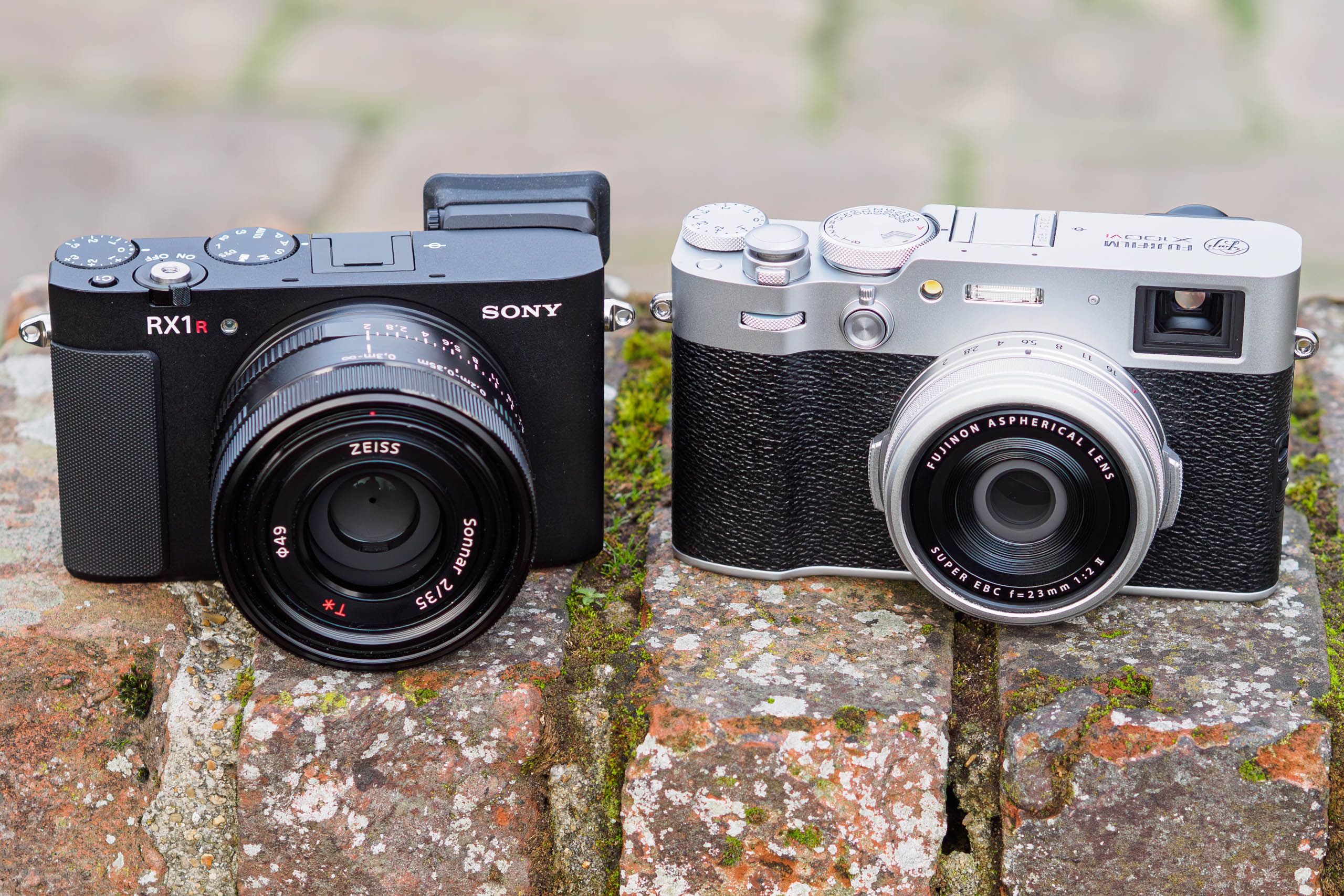
On the other hand, the RX1R III is an awful lot more expensive than the camera with which it will inevitably be most closely compared: the hugely popular Fujifilm X100VI, with its 40MP APS-C sensor and 35mm equivalent f/2 lens.

As we’ll see, the RX1R III comes with its fair share of compromises and idiosyncrasies, many of which can be directly attributed to its small body size. So the question is whether its unquestionable attractions offset the irritations and quirks that Sony has put in our way. Let’s take a detailed look.
Features
In many respects, the RX1R III counts as a marriage of very familiar components. Its 60MP full-frame sensor is presumably the same as that used by several other Sony cameras already, including the A7R IV, A7R V, and A7CR. It’s also likely to be the same unit that Leica employs in the Q3 and Q3 43. It delivers a standard sensitivity range of ISO 100-32,000, with extended settings covering ISO 50-102,400.

Meanwhile, the Zeiss Sonnar 35mm f/2 lens is apparently unchanged from previous RX1 generations. It’s an 8-element, 7-group design with internal focusing. The minimum focus distance is normally 30cm, but twisting a ring towards the front of the barrel moves the entire optical system forward by a couple of millimetres, engaging a close-up mode that covers 20-35cm. There’s a 49mm filter thread surrounded by a bayonet mount for a hood, although disappointingly given the price, this is an optional extra.
The camera employs a leaf shutter built into the lens, with the spec sheet declaring a fastest speed of 1/4000sec. But it’s a bit more complicated than that, as the maximum speed is limited by how quickly the shutter can open and uncover the entire aperture. This turns out to be 1/2000sec at f/2, increasing to 1/3200sec at f/4, and only hitting 1/4000sec at f/5.6.

In practice, 1/2000sec isn’t fast enough to shoot at f/2 and ISO 100 in bright sunlight without over-exposure. In principle, you can get around this using the electronic shutter, which allows 1/8000sec at any aperture. Unfortunately, though, the camera isn’t smart enough to switch modes when necessary, so you have to manually select electronic shutter in the menu every single time, and then remember to switch it off again afterwards, as rolling shutter effects with this sensor can be severe. There’s no switchable ND filter built into the lens, either.
Continuous shooting is available at 5 frames per second. While on paper that might look slow compared to its competitors, it be should plenty for the kinds of subjects you’re likely to use the camera for. I spent most of my time shooting single images at a time, and I suspect most users will, too. Indeed, Sony hasn’t even felt the need to assign drive mode to a physical button – usually it’s accessed using the left key of the d-pad.

When it comes to video, you get 4K recording at 30fps, and Full HD at 120fps. There’s a 3.5mm microphone socket onboard for higher-quality audio, and you can also fit Sony’s own microphones directly onto the hot shoe without needing a wire. Overall, though, it’s very clear that the RX1R III is primarily built for photography, not video.
Sony has reacted to the current obsession with in-camera colour modes by including three “Film Like” options on the RX1R III, labelled FL1, FL2 and FL3. Indeed, the firm has finally deigned to tell us what all the two-letter abbreviations used by its Creative Looks stand for. So now we discover that IN stands for Instant, and SH for Soft Highkey, for example. This doesn’t have quite have the same marketing flair as Fujifilm’s Astia, Reala Ace, and Acros etc.

As always, Wi-Fi and Bluetooth are built in for smartphone connectivity, using Sony’s Creators’ app. Initial pairing and setup is straightforward enough, with the camera prompting you through the process when you first turn it on. You can copy images to your smartphone for sharing and use your phone as a comprehensive remote control via either Wi-Fi or a USB-C cable, with the latter being quicker and more stable.
My main concerns with the RX1R III, however, lie with the features that Sony has missed out. There’s no space for either optical or mechanical sensor-shift image stabilisation, just electronic stabilisation for video shooting. The rear touchscreen is fixed, as opposed to the tilting design of its predecessor. And there’s no joystick for setting the focus area. These are all genuinely useful, and you get all of them on the X100VI.
Sony RX1R III: Key features
- Connectors: Behind a neat hinged door on the side, you’ll find micro-HDMI, USB-C, and 3.5mm stereo microphone ports. You can’t plug in headphones for monitoring audio.
- Remote release: The shutter is threaded for a mechanical cable release, but there’s no no Micro-USB port for an electronic release. You can also use a Bluetooth wireless release.
- Power: Sony’s familiar NP-FW50 Li-ion battery is rated for 270 shots using the EVF, and 300 with the LCD. Third party spares are cheap and easy to find.
- Storage: Files are saved to a single SD card slot, which shares the same baseplate compartment as the battery.
- Accessories: Sony will sell you the LHP-1 lens hood for £169, or the TG-2 thumb grip for £240. Thankfully, much cheaper third-party substitutes are available from online retailers.
- Hot shoe: There’s no built-in flash, but you can use Sony-dedicated or simple manual units on the hot shoe. It also has connections to use Sony’s microphones without a cable.

Build and handling
Without doubt, the RX1R III’s standout feature is its petite size. The body is essentially a rectangular box measuring just 113 x 68 x 30mm, with a lens on the front that’s approximately 65mm in diameter and 58mm long. But while the body’s frontal area is dramatically smaller than its rivals, the overall front-to-back depth of 88mm means it isn’t any more portable in practice – you’ll still need a small bag. In contrast, the Fujifilm X100VI’s slimline lens means I can slip it into plenty of coat pockets.

Sony hasn’t over-burdened the RX1R III with either styling or ergonomics. There’s a rather minimalist textured rubber grip on the front, and a small space for your thumb on the back. Unfortunately, I found the handgrip to be distinctly small and cramped, and I consider its larger rivals more pleasant to hold and shoot with. But this is very much personal preference; others may have a different opinion. I preferred to use the camera with a slim cross-body/neck strap, rather than attempt to carry it one-handed with a wriststrap.
One thing you can’t complain about is the build quality, with the metal body feeling solid and robust. It’s worth noting, though, that Sony doesn’t describe the camera as weather sealed, which feels like an oversight at this price. That stands in contrast to the IP52-rated Leica Q3 and Q3 34, while both the Fujifilm X100VI and GFX100RF can be sealed by the addition of a filter to the front of the lens.

Operationally, the RX1R III is an infuriating mixture of the brilliant and the obtuse. As before, you get direct access to the main exposure settings via an aperture ring around the lens and an exposure compensation dial on top, with an electronic dial beside your thumb for setting the shutter speed. ISO is changed using the rear d-pad/dial, or you can just leave it set to Auto.
Existing RX1 users may be disappointed by the loss of the focus mode switch that was on the front of previous models. But there’s actually a good reason for this. Now, pressing the AF-ON button on the back doesn’t just activate autofocus, but also engages subject detection and tracking with continuous AF. A half-press of the shutter button will still activate autofocus according to however you have it set up.
Focus mode selection is still readily accessible, via what used to be the video record button on the side of the handgrip, but is now labelled C2. This reassignment also means that you’re no longer likely to accidentally initiate video recording all the time. Instead, to record video you either have to set the mode dial to the movie position and press the shutter release, or use an onscreen touch button.

Most of the other major settings can be set via the Fn button, which pulls up a user-customisable set of options onscreen. Alternatively, swiping inwards from either edge of the screen activates a set of touch buttons which do many of the same things. You can also assign your most-used functions to the external buttons.
My biggest annoyance with the RX1R III, operationally, is the way the rear control dial/ d-pad has two distinctly different modes. In one, the buttons activate specific functions: Up cycles through the various onscreen information displays, while Right is used to change the ISO (Left and Down can be assigned as you wish). Pressing the centre button changes mode, so the buttons move the focus area instead.
The problem here is two-fold. Firstly, it means AF point positioning is inevitably slower and clunkier than using a joystick. Secondly, it’s all-too-easy to press a button expecting it to do one thing, only to discover you’re in the wrong mode. This also affects the C3/Delete key: in AF area selection mode, it quickly recentres the focus point, but otherwise it toggles touch operation on and off. This behaviour can make using the RX1R III an exercise in frustration.

d-pad/dial that’s used for a lot of different things. Image credit: Andy Westlake.
As a result, I think most people will find that the best way to set the focus point is using the touchscreen. But Sony hasn’t switched this on for viewfinder shooting by default, so you have to find and enable it in the menu (Setup – 5 Touch Operation – Touch Panel/Pad – Both Valid). You’ll probably also want to change the positioning mode from ‘absolute’ to ‘relative’, which is much more intuitive. As a left-eye shooter, I found the touchpad annoyingly prone to being activated by my nose, but most users won’t have this problem.
Another irritation comes with the design of the aperture ring. While it has ridged grips, they cover less than half its circumference. When it was set to f/2.8 or larger, I was often trying to grasp smooth, gripless sections of the ring that were indistinguishable by touch from the fixed parts of the lens barrel. This is not a mistake that Leica has made on the Q3. I also found my left and right hands jamming into each other while rotating the ring to larger apertures.

If you need to dive into the menu to change settings, you’ll find it’s vast and sprawling, with no fewer than 55 pages. This makes it hard to find anything you do want to modify. Luckily, you can easily place options into a custom My Menu by pressing the Delete key when they’re selected. The menu is also packed full of options most users will never, ever touch. It’s a bloated mess, but thankfully you can mostly ignore it.
Overall, if you’re prepared to use the RX1R III in a specific way, in manual or aperture priority with Auto ISO, and using the AF-ON button or touchpad for focusing, then it can work pretty well. But I think its Leica and Fujifilm rivals are better designed and much nicer to use.
Crop zoom function
As has become common on high-resolution fixed-lens compact cameras, Sony has provided a cropped-zoom function, which it calls “Step Crop Shooting“. It’s activated by pressing the C1 button beside the shutter release. This cycles through settings equivalent to 50mm at 29MP, and 70mm at 15MP (which is still plenty for an A3 / 16 x 12in print). You can disable any of these you don’t want to use in the menu, including (bizarrely) the standard 35mm full-frame option. The camera saves a cropped JPEG file with a full-size raw alongside, with the crop recorded into its metadata.


Personally, I quite like this feature – I don’t necessarily want to shoot at 35mm all the time, and it lets me visualise and compose for tighter crops. Sony’s implementation does, however, leave something to be desired. Firstly, the viewfinder display drops dramatically in resolution – it just enlarges the standard feed, giving little detail and ugly sharpening haloes. Secondly, any crop you set is retained when you switch the camera off and then back on again. This is surprisingly easy to miss, especially when you’re using the screen.
Viewfinder and screen
One of the most significant differences between the RX1R III and its predecessor lies with how you compose your images. Where the II had a pop-up viewfinder and a tilting screen, on the III both the viewfinder and screen are fixed in place. One is a good thing; the other really isn’t.

On the one hand, I like the fact that the viewfinder is now always available for shooting, and you’re never held up by having to pop it open. It’s also possible to fit a proper eyecup, with Sony supplying a deep rubber one in the box that secures in place using a screw, so it shouldn’t fall off and get lost. If, like me, you wear glasses, you may find it a little difficult to see right into the corners with the eyecup in place. But I’ll happily take that for the valuable extra shading it offers against stray light.
With its 2.36m-dot resolution and 0.7x magnification, the viewfinder is perfectly serviceable without being outstanding. But its Fujifilm and Leica rivals offer higher resolution displays and/or higher magnifications. Colour, white balance, exposure and depth-of-field are all previewed by default, and you can cycle through various display modes, including a live histogram and electronic levels. But as is Sony’s way, you’re not allowed to view both at the same time.

Reverting to a fixed rear screen is, however, a perplexing step backwards on Sony’s part. It means that if you want to shoot from low angles, you’re going to have to get down on the floor yourself, and that’s something I’ve got used to not having to do. Tilting screens are also really useful for portraits or street photography – both of which are subjects that the camera is likely to be used for. On other cameras I use tilting screens frequently, but with the RX1R III I rarely used the rear screen at all.
The screen itself is a 3in unit with an impressive 2.36m-dot resolution. It has a 4:3 aspect ratio, which allows key shooting data to be displayed on a black strip at the bottom for a nice, uncluttered view. But this also means that the preview image is noticeably just a little smaller than on the X100VI, with its 3in, 3:2 screen.
Autofocus
When it comes to autofocus, on paper the RX1R III is very similar to Sony’s other current cameras. It employs a hybrid phase/contrast detection system, with 693 selectable focus areas that cover almost the entire frame. Unfortunately, the focus frame is yet again drawn in Sony’s signature grey, which makes it invisible most of the time. You’ll want to change it to red in the menu if you’re interested in seeing what you’re actually focusing on.

Subject recognition is available courtesy of the AI co-processor, with options for Humans, Animals, Birds, Insects, Cars / Trains, and Airplanes. An Auto option is available, too, which I’m never going to complain about. The fixed 35mm lens means that much of this is practically irrelevant, though; you’re probably not going to use this camera to photograph such things as wildlife or motorsports. However, many users will be happy to have the option of telling the camera to focus specifically on their friends, family and pets, and even be able to recognise both at the same time.
In practice, the RX1R III’s autofocus performance is mostly limited by the lens. Despite its internal-focus design, it still has to move a lot of glass back and forth over quite a long distance, which inevitably means it’s not lightning-fast. But I’d still say it’s quick enough for the purposes the camera is most likely to be used for, and most importantly, it’s consistently accurate. In my side-by-side tests, the RX1R III and X100VI generally autofocus at very similar speeds; however in low light, the Sony can be a bit more decisive and less likely to hunt.

It’s lucky that the autofocus is very reliable, as I don’t like the RX1R III’s manual focus experience at all. Unlike the firm’s FE lenses, the focus ring doesn’t have a linear response, with the movement instead being dependent on how fast you rotate it. Here, that leads to a strangely dislocated experience. Manual focus operates with the lens stopped down to the taking aperture, too, so it can be difficult to judge critically when you’re shooting at smaller apertures, as everything appears to be in focus.
Performance
Operationally, the Sony RX1R III is a snappy performer. It starts up the moment you flick the power switch and then responds instantly to both the physical controls and the touchscreen. The in-lens shutter means it’s almost completely silent, too, so you shouldn’t disturb bystanders, even at quiet events.

Unfortunately, though, I’ve found the battery life to be disappointing. Sony’s spec sheet promises 270-300 shots per charge, but I’ve struggled to get close even to that. I’ve gone out several times, taken a hundred or so frames in an afternoon, and come back with the battery showing close to empty.
The problem here is that the CIPA standard ratings quoted by camera makers represent taking single shots at a time, while turning off the camera in between. But if you leave the RX1R III powered on between shots, even if that’s just waiting for the right light, or for someone to walk into the perfect place within your frame (which is a common technique for street photography), it will chew through batteries at an alarming rate. I’d certainly recommend getting a spare or two – thankfully Sony’s NP-FW50s have been around a long time and are easy to obtain.

As I said earlier, I don’t think the Sony RX1R III is a camera on which continuous shooting matters very much. But for the record, in my tests it met its advertised speed of 5 frames per second and kept going to 6 seconds (or 30 frames) when shooting JPEG and compressed raw. Switch to uncompressed raw, and the buffer is halved. But if you want to shoot faster or for longer, you’ll probably want a different lens anyway.
Lens optical quality
As for the Zeiss Sonnar 35mm f/2 lens, it’s been around for a long time, having first been used on the original 24MP RX1 in 2012. But it’s stood up pretty well to the subsequent hikes in resolution.

Unsurprisingly, it’s slightly low in contrast wide open, while the edges and corners are visibly just a little blurred if you examine them up close onscreen. But that doesn’t make the images unusable in any way, and much of the time it will be swamped by shallow depth-of-field effects.
Sharpness improves as you stop down, and at its optimum apertures of around f/8-f/11, the lens delivers impressive levels of detail right across the frame. I don’t think it’s quite as stellar as the Leica Q3 43’s remarkable 43mm f/2 optic, but the difference isn’t worth worrying about.

Sony enables in-camera compensation for chromatic aberration and vignetting by default, and personally I’d leave them that way. Oddly, though, distortion correction is turned off by default, which results in a noticeable barrel effect. I’d enable it in the menu and then forget it about it; that way, all your straight lines will look correct. (All the sample images in this review are corrected for distortion.)

Image quality holds up well when you switch to macro mode, too. Out-of-focus backgrounds are rendered with a particularly smooth blur, which remains very attractive as you stop down the aperture. Some green and purple fringing can be visible around high-contrast edges, but it can be suppressed in raw processing if necessary.
Image quality
We’ve seen the RX1R III’s 60MP full-frame sensor on a lot of cameras now. It’s very much a known quantity, and provides superlative image quality. It delivers stacks of detail, with huge scope for cropping into your image after shooting or making large prints. This is combined with immense dynamic range, especially at low ISOs, so you can manipulate the exposure and tonality sliders in your raw processing program pretty much as far as you like, without having to worry about noise.

High-ISO image quality is excellent, too, with barely any visible noise up to ISO 1600. As I’ve noted before, I’d still be quite happy shooting at up to ISO 12,800, or even ISO 25,600 at a push. This becomes more important on the RX1R III compared to the likes of the A7R V and A7CR, as in the absence of image stabilisation, you’ll need to keep shutter speeds high if you want to avoid any blurring due to camera shake.

On this note, if you use Auto ISO in aperture priority mode, then by default it maintains a minimum shutter speed of 1/125sec. This may sound high, but I think it’s actually a good choice, as it suppresses both shake and subject motion blur very effectively. But it does mean hiking the ISO in low light. With static subjects I was able to get some reasonably sharp shots hand-held at 1/13sec, but not really any slower.

Sony’s auto white balance is extremely reliable, which means out-of-camera colour looks right. I also rarely felt much need to correct it in raw processing.
Likewise, the standard Multi metering pattern does a good job of avoiding clipping highlight detail. Having said that, I also found that it consistently exposed a little darker than I’d like when there were no bright highlights to protect. That’s not a problem when you’re shooting in raw, but it can make out-of-camera JPEG (or HEIF) files look a little dull. You can see this in the comparison below.


I don’t find Sony’s in-camera colour processing to be especially inspiring, either, with the Standard look being quite muted. I spent more time shooting in Vivid, although personally, I’d reduce the contrast and saturation a little. Either way, there’s plenty of options here for tuning the colour to your liking. But if JPEG colour is really important to you, I think Fujifilm does it a great deal better.
Our Verdict
On paper, the Sony RX1R III should be a fabulous camera. It’s small, has some nice photographer-friendly controls, and promises superlative image quality from the highest resolution full-frame sensor around. If, like me, you’re a fan of the Fujifilm X100VI, then getting even better image quality in a smaller camera should be a no-brainer.

And let’s be clear about one thing – the RX1R III’s image quality is superb. The sensor delivers huge levels of detail and impressive dynamic range, while also performing well at high ISOs. The lens gives good results wide open, with attractive bokeh, and gets really sharp from corner to corner when stopped down. Autofocus is respectably fast, with Sony’s subject recognition working well for such things as portraits.
The problem, though, lies with all the genuinely useful features that Sony has left out in the process of making the body as small as possible. No image stabilisation. No tilting screen. No weathersealing. No joystick. No ND filter for shooting wide open in bright light. I would, in all honesty, much prefer a slightly larger, better featured camera with a less-cramped grip and controls – which is exactly what you can buy from Fujifilm and Leica. It’s not as if the RX1R III’s small body brings any great portability advantage, given the size of the lens.

Ultimately, the biggest problem facing the RX1R III is the fact that it costs more than twice as much as the Fujifilm X100VI, but lacks key features in comparison and in my opinion, simply isn’t anywhere near as nice to use. And the thing is, the X100VI has image quality to burn, too. Undoubtedly, some buyers will be willing to overlook the camera’s flaws, just to get a 60MP full-frame sensor in such a small package. But I’m afraid I just can’t see it myself.

Follow AP on Facebook, Instagram, YouTube and TikTok

Sony RX1R III: Full specifications
| Sensor | 61MP full-frame CMOS, 35.7 x 23.8mm |
| Output size | 9504 x 6336 |
| Focal length mag | 1x |
| Lens | 35mm f/2 |
| Shutter speeds | 30-1/4000sec (mechanical) 30-1/8000sec (electronic) |
| Sensitivity | ISO 100-32,000 (standard), ISO 50-102,400 (expanded) |
| Exposure modes | PASM, Auto, Movie, S&Q, 3x Custom |
| Metering | Multi, Centre, Spot, Average, Highlight |
| Exposure comp | +/-5 EV in 0.3EV steps |
| Continuous shooting | 5 fps |
| Screen | 3in, 2.36m-dot fixed touchscreen |
| Viewfinder | 2.36m-dot, 0.7x |
| AF points | 693 |
| Video | 4K 30p, Full HD120p |
| External mic | 3.5mm stereo, multi-interface shoe |
| Memory card | UHS-II SD |
| Power | NP-FW50 Li-ion |
| Battery life | 270 shots (EVF), 300 shots (LCD) |
| Dimensions | 113.3 x 67.9 x 87.5 mm |
| Weight | 498g with battery and card |