




Amateur Photographer verdict
It’s hard to admit, but it’s a lens that will cover everything, and without much compromise. In fact it’s so good it was even able to convert me, a long term superzoom sceptic
- Really convenient
- Great focal range coverage
- Very good image quality
- Surprising close-up ability
- Limited maximum apertures
- Not as sharp as the sharpest lenses
Sigma 20-200mm F3.5-6.3 DG Contemporary at a glance:
- Price $999/£799
- Lens mount: Leica L and Sony E
- Filter thread: 72mm
- Aperture: f/3.5-6.3
- Min. focus: 16.5mm
- Weight: 550g
The battle between convenience and quality is an on-going one, with troops permanently amassed on either side. You’ll hear people saying ‘Yeah, well, I know it isn’t the best quality but it’s easy to use’ while others labour for hours over a single shot and tell you the effort is worthwhile for the sake of the final result. Who do we believe?
I would aspire to be a perfectionist, but they just aren’t quite good enough for me. So I sit firmly in the camp espousing hard graft, the best tools and a job done to the best of my ability. For that reason, I sometimes shudder at the thought of the congelation of compromises that go into creating a super-zoom lens– there’s nothing super about them – and I go out of my way to avoid letting one get within ten paces of my camera.
This Sigma 20-200mm F3.5-6.3 DG Contemporary lens came to me by mistake, in the same delivery that brought the delightful Sigma 135mm f/1.4 and Sigma 35mm f/1.2 Art lenses. Those I was extremely keen to review, but I made my feelings clear about not wanting to review the 10x zoom. But it arrived all the same, and I left it in the box until its pitiful cries for attention finally got to me. So just how good – or bad – did this £799 lens turn out to be?
Sigma 20-200mm F3.5-6.3 DG Contemporary – Features
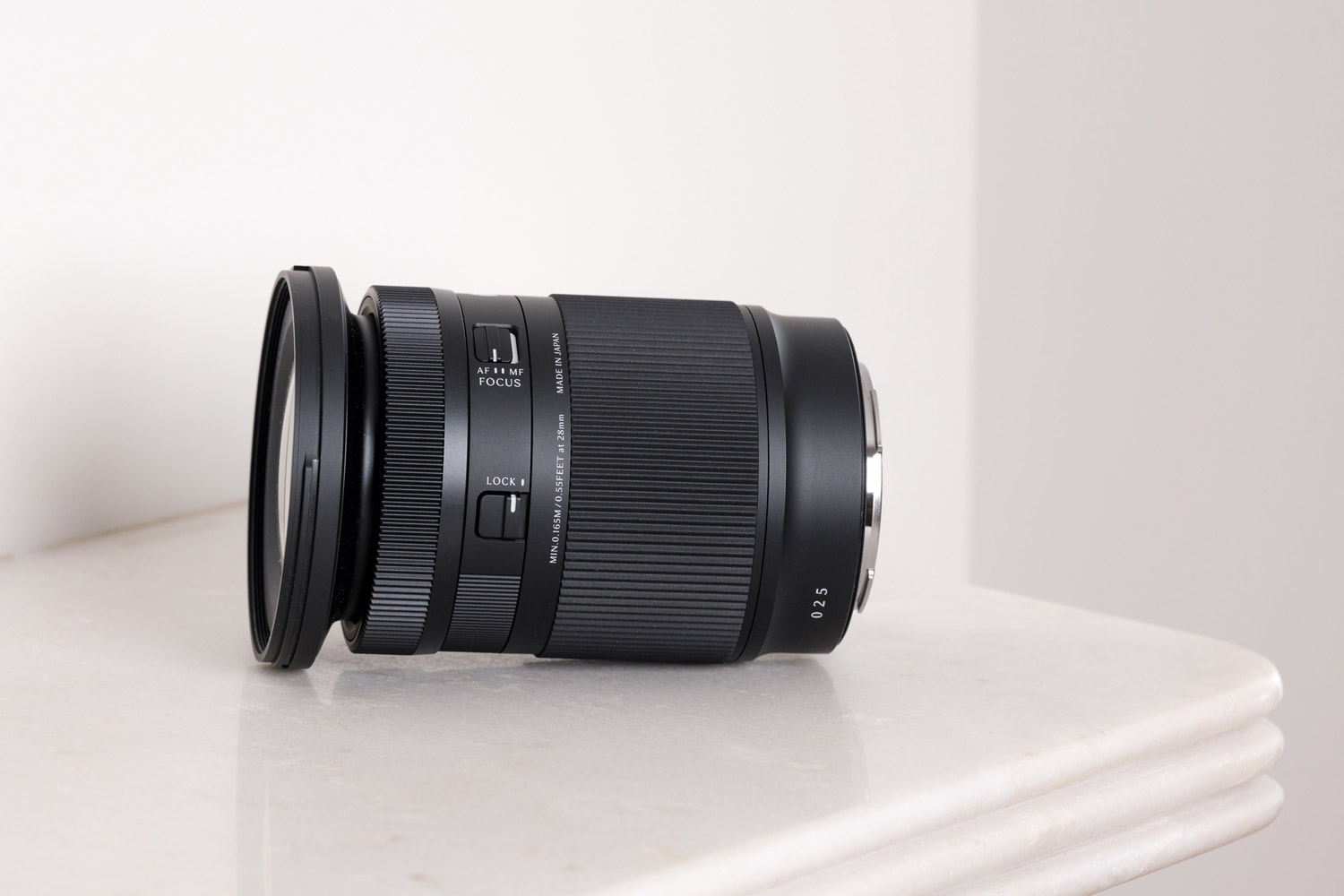
The Sigma 20-200mm F3.5-6.3 DG lens is a 10x zoom designed for general photography, and it sits in the company’s Contemporary range of ‘everyday’ lenses. The lens is remarkably compact, not only when we consider the maximum focal length it offers, but also when compared to other more ‘normal’ lenses. On my desk at the moment it is standing next to the Sigma 35mm f/1.2 Art lens, and is only fractionally taller and is a good deal less rotund about the barrel. The lens measures a diminutive 115.5mm x 77.2mm, and at 550g it weighs just enough to make us think we are getting something for our money.
Inside the barrel Sigma has placed 18 elements into 14 groups of glass, and uses 1 element in its Fluorite-like FLD glass, 3 Super Low-dispersion lenses and 4 double-sided aspherical elements. The FLD element is the second element in the construction and the one the image forming light passes through at the earliest part of its passage. It’s large and quite thick, and its fluorite-like properties allow it to be lighter than regular glass so the balance of the lens isn’t shifted forward.
But more importantly it allows a lot of light to pass and its lower refractive index allows the forward group of elements to be pushed some way from the rest of the groups when the lens is set to its 200mm position. Additionally, the high anomalous dispersion of this element, by which longer wavelengths pass more quickly than shorter ones, in some way compensates for the normal dispersion of the other 17 elements in order that chromatic aberrations might not impact image resolution and sharpness quite so much. And such a lack of sharpness has been the curse of super-zooms since they were invented.
Maximum apertures range from f/3.5 at the widest focal length to f/6.3 when the zoom is set to 200mm, and minimum apertures range from f/22 to f/40 under the same conditions. The iris uses 9 rounded blades to form its apertures and, despite the focal range, the filter thread is only 72mm.
A remarkable claim in the specification listing is that the lens offers up to 1:2 magnification – so half life-sized macro. That magnification can only be achieved between the 20mm and 85mm focal length settings, but that’s still pretty impressive. The closest focus is found at the 28mm zoom setting and is 16.5cm, while at 200mm it’s still a surprisingly close 65mm. At the 20mm widest setting we can get our sensor 25cm from the subject.
The lens comes in mounts for L cameras and for Sony E.
Sigma 20-200mm F3.5-6.3 DG Contemporary – Build and handling
This is a very nicely made lens. It feels both solid and rugged, and in the hand gives the impression that it has many years of service to give. I like the rubber of the large zoom ring that takes up over a third of the closed-barrel’s length, and the grip that the close-ribbed texture affords. The zoom and focus rings are covered in the same material and feel identical to the touch, but the distance between them makes it unlikely we’ll ever mistake one for the other.
There is no aperture ring on this model, so all aperture control is delegated to the host body. But we can switch between manual and auto focusing via the AF/MF switch between the zoom and focus rings. The only other physical control we have is a lock for the zoom ring that is designed to prevent the barrel creeping out while the lens is in transit. As on previous models, the lock is quickly opened when we turn the zoom, so we don’t have to spend time unlocking when a picture suddenly presents itself.
Light rain and dust won’t spoil your day as the lens is sealed against such perils, and the front element is coated to repel water and oil.
The balance of the lens is firmly centred about its back end, so it feels comfortable when mounted – and as the front elements are lightweight this doesn’t really change when the zoom is extended. It’s one of those lenses that’s easy to hold all day.
Sigma 20-200mm F3.5-6.3 DG Contemporary – Autofocus
We don’t have the dual motor AF system that more money buys us in the Sigma Art lenses, but with smaller and lighter elements perhaps two motors aren’t really necessary. I suspect too that fewer users of this lens will be creating movies through it, so the shape-shifting that the dual HLA system helps us to avoid during zooming will be less of an issue. I found the single motor more than sufficient during my tests, and wasn’t conscious that its solo efforts hampered my ability to get things in focus or to track moving subjects. At the 200mm end, where focus transitions can be scrutinised a little more easily I found the system perfectly adequate, and no different to that which I am used.
Sigma 20-200mm F3.5-6.3 DG Contemporary – Image quality
I like the people at Sigma UK and was a little concerned how our relationship would fare after a reading of this section of my review. My anxieties were not helped by the fact that the only camera I had free to shoot with for this test was the 44MP Panasonic Lumix S1R ll – a camera that would surely point an accusing finger at any minor fault it found and declare it loudly to the world.
It was a great relief then to discover that the images weren’t nearly as bad as I had expected, and that in fact they aren’t bad at all. They are actually really rather good. I am very pleasantly surprised, and slightly delighted.
While barrel and pincushion distortions are the traditional thorns in the side of zoom lenses, they can be corrected in software. My main concern was for the things that can’t be fixed and which would afflict image quality to such an extent that the lens would become unusable for anything worthwhile – detail rendering and coloured fringing. Both of these are born of an inability to focus colours in the same place, and as colours focus at different distances we lose sharpness – and as they spread across the sensor we grow coloured edges on high contrast transitions. But in the images I recorded with this lens, those characteristics appear to have been very well corrected.
I didn’t go out of my way to trip the lens up, but I was conscious to shoot subjects that might naturally cause it problems, such as leaves and branches against a bright sky. But I found the lens more than equal to the task.
I can’t tell you that this lens is as sharp or contrasty as a fixed focal length, or a zoom of more moderate range, but when stopped down a bit it is surprisingly good. I generally am not all that interested in stopping down a bit, and against my better judgement I shot a lot of images at the widest apertures for the zoom setting, expecting dismal results and a lot to write about. But the gamble played the other way and I’m glad to say that, while not tack-sharp, I’m rather pleased with the results at 200mm and f/6.3.
These particular settings are important, as I suspect they will be used a great deal by photographers trying to get as much light into the lens as possible at that longest focal length. It seems Sigma has anticipated that, and has put in a lot of effort to avoid tears and regrets. I’m not telling you that f/6.3 is the best aperture to use at 200mm, but that anyone who buys this lens will use it probably more than any other, and will find the lens performs surprisingly nicely.
When focused at a distance you’ll probably encounter a bit of fringing and some detail smearing at the edges of the frame, but nothing too dramatic. Close to f/11 and f/16 you’ll begin to get the best from it, and generally performance is better wide open than closed all the way down.
In the L-Mount version of the lens that I used, Sigma and Panasonic work hard to eliminate any sign of vignetting, and in JPEGs and automatically fixed RAW files you won’t see much distortion either. On closer inspection the wide end of the lens uses a wave-shaped distortion instead of a barrel to disguise the shapes it draws naturally, but that’s neither here nor there really, as in the end result straight lines close to the edges of the frame appear straight.
Sigma 20-200mm F3.5-6.3 DG Contemporary – Verdict
One of the irritating things about staying in the photographic industry for a while is that all the prejudices, biases, and partialities you build up and learn over the years gradually become eroded by clever engineering and technology. After a number of bad experiences of super zooms, and not one positive experience to re-set the balance, I gave up on these temples of ill-informed convenience a long time ago. I am now, though, in the difficult position of explaining to myself that they aren’t all bad.
Indeed, having completed the technical tests of this lens, and having shot enough illustrative images for these pages, I found myself fitting it to my camera in my own time to take pictures for my own pleasure.
The one area I will find difficult to overcome for ‘serious’ work is the limited maximum apertures, but I have fast lenses I can use in low light and when I especially need a shallow depth-of-field.
But when I want a lens that will cover everything, and which I know will give me results that are more than good enough for most things, I might turn to this very handy Sigma 20-200mm f/3.5-6.3 DG Contemporary 10x zoom. And I never dreamt I’d be saying anything remotely like that. It’s actually very good indeed.
Full specifications
| Filter Diameter | 72mm |
| Lens elements | 18 |
| Groups | 14 |
| Diaphragm blades | 9 |
| Aperture | f/3.5-6.3 |
| Min focus | 16.5mm |
| Length | 115.5mm |
| Diameter | 77.2mm |
| Weight | 550g |
| Lens mount | Leica L and Sony E |
| Included accessories | Lens hood, back and front caps |
Follow AP on Facebook, Instagram, YouTube and TikTok.