


It’s easy to forget some of the big names that once dominated the camera industry. Take Ricoh, for example. Launched in 1917 under the name Riken – an abbreviation of the Japanese for Institute for Physical and Chemical Research – the name was changed in 1963 to Ricoh Company Ltd. Today, Ricoh still maintains a range of digital cameras, some of which are direct descendants of the company’s R-series of film cameras.
They in turn marked the end of an era that saw the introduction of folding cameras, subminiatures, single lens reflexes (SLRs), twin lens reflexes (TLRs), 35mm coupled rangefinder cameras, compacts, half-frame cameras, Instamatic-types, clockwork motor drive models, bridge cameras… even the world’s first SLR interchangeable autofocus lens. Ricoh produced literally hundreds of different cameras, of which the following are just a few examples of the company’s tremendous versatility.
Subminiatures
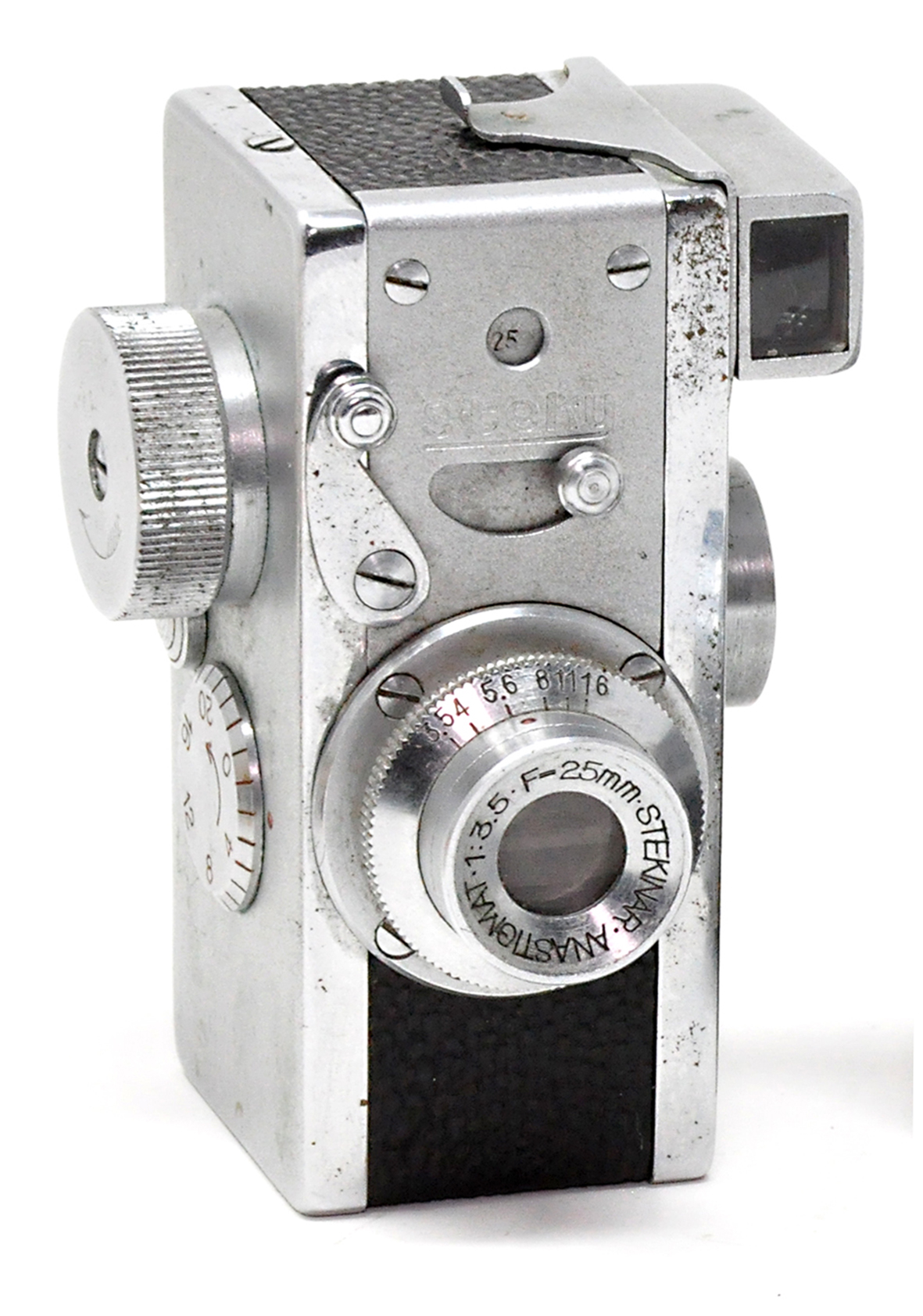
The Stecky, introduced in 1947, has an unusual upright body for 16mm film that runs from cassette to cassette. The fixed focus Stekinar 25mm f/3.5 lens offers apertures down to f/16 and a shutter speeded 1/25–1/100sec. More models followed with focusing standard lenses, wide-angle adapters and interchangeable telephoto lenses. In 1957 the Stecky was totally restyled to look more like a miniature 35mm camera, measuring a mere 7x4x4cm and electroplated with gold on the body and lens barrel. Called the Golden Stecky, it was later relaunched as the Golden Ricoh 16, and later still a chrome version was produced.
Folding cameras
(© Mark F. O’Brien)
Several Japanese manufacturers had a go at producing folding cameras partly inspired by Zeiss Ikon’s Ikonta series. Riken introduced a few folding models prior to World War II. But post-war, in 1952, the best of the cameras came in the shape of the Ricoh Six, actually built by a subsidiary company called Asahi Seimitsu. The Ricoh Six is a horizontal folding camera, in which pressing a catch on the top plate causes the bed to drop down from the body as the lens self erects on bellows. As its name implies, the camera takes 6x6cm square pictures, 12 to a roll of 120 film. But use of an internal mask, along with a second red window frame counter produces sixteen 6×4.5cm images. The viewfinder is moulded onto the top plate and contains a mask to indicate 6x6cm and 6×4.5cm formats. Standard lens is an Orinar 80mm f/3.5, shutter speeds run 1/25-1/100sec.
35mm coupled rangefinder cameras
(© Billy Thomas)
Ricoh’s first 35mm camera was the Ricolet in 1954, but it had no rangefinder. That refinement arrived the next year with the better-specified Ricoh 35. As with many cameras produced around this time, the Ricoh 35 shows design influences from the Leica, but adds a few refinements of its own. While maintaining a Leica-ish body shape it enjoys twin methods of film wind: with the traditional knob or with a trigger that folds out from the base for left hand operation, speeding up the wind and fire process. Unlike the Leica, the Ricoh lacks a focal plane shutter, relying on a Riken leaf type with speeds limited to 1/10-1/200sec. Rangefinder and viewfinder are combined in the same window and the standard Ricomat 4.5cm f/3.5 lens is non-interchangeable. An alternative version of the Ricoh 35 used an f/2.8 lens in a Seikosha-Rapid shutter that increased the speed range to 1-1/500sec.
In the years ahead, Rico continued to make variations on this early model with better lenses, added rangefinders, built-in meters and even, in one model, the use of Agfa Rapid cassettes which wound the film from one cassette to the other without the need for rewinding at the end of a roll.
Twin lens reflexes
(© John Katz via Wikimedia Commons)
Concurrent with its 35mm cameras, Ricoh entered the medium format TLR market in 1950 with the Ricohflex III, though strangely there was never a Ricohflex I or II. About 15 or so fairly conventional TLRs made for 120 size film followed, but in 1958 a slight change of direction resulted in a real beauty. The Ricoh Super 44 was one of a small breed of TLRs made to shoot twelve 4x4cm pictures on 127 film. It looks like a scaled-down Rolleiflex with a Riken Ricoh 6cm f/3.5 lens and shutter speeds of 1-1/400sec. Unlike its larger Ricohflex brothers, which used cogs to link the two lenses for focusing, the smaller Super 44 used a knob on the side to move the twin lenses back and forth in tandem. Just like a Rollei.
Half frame cameras
The half frame format of 18x24mm that results in 72 exposures on a 36-exposure roll of 35mm film was popularised by Olympus with the launch of the Pen camera in 1959. After that, many Japanese manufacturers took up the format, and Ricoh joined in with the Auto Half in 1960. This is a palm-size camera that adds a clockwork motor drive to wind the film after each exposure. With a fixed focus 25mm f/2.8 lens, the first model offers 1/125sec for daylight shooting and 1/30sec for flash, with apertures measured and automatically controlled by a selenium photo cell meter around the lens. Apertures can also be adjusted manually for flash photography. A dozen or so upgrades followed, each with slightly different specifications.
35mm single lens reflexes
By the start of the 1960s, Ricoh was enjoying success with 35mm rangefinder and medium format TLRs. But then came a sudden upsurge in demand for 35mm SLRs, and the company was caught off-guard. So they turned to Mamiya for help. The result was the 1962 Mamiya-built Ricoh Singlex. This was actually a rebadged version of the Nikkorex F, also built by Mamiya as a beefed-up version of the Mamiya NP. The Singlex uses a Copal metal, vertically-running focal plane shutter speeded 1-1/1,000sec and the option of a clip-on meter. The standard lens is a Rikenon 55mm f/1.4 and the mount is very similar to, though not quite the same as, the Nikon F. This gives the advantage of being able to mount Nikkorex lenses on the Singlex, although Rikenon lenses are less likely to happily mount with a Nikon. When Ricoh took back the manufacturing reins from Mamiya to build new Singlex SLR models like the TSL and II, an M42 screw mount, favoured at that time by Pentax and a few others, was introduced.
(© Alfred from Germany via Wikimedia Commons)
In 1975, Pentax introduced the bayonet-fitting K-mount, and in 1977 Ricoh followed suit by introducing the XR-1, the first of about 50 SLRs, mostly identified by ‘XR’ or ‘KR’ as a prefix to the model number and all designed to take K-mount lenses. At the time, Ricoh SLRs sat very much in the shade of the likes of Pentax, whose cameras the Ricoh SLRs very much resembled. Early models use match-needle metering, later models offer aperture-priority auto exposure. While most of the Ricoh XR and KR SLRs were good reliable cameras, their designs were very much redolent of the time and not particularly remarkable.
Then, in 1981, another peculiarity arrived, one which was very much ahead of its time. The Ricoh XR-S features two small solar panels, one on each side of the pentaprism. As light falls on them, they generate a current to charge an internal storage battery which runs the camera’s electronic functions that include aperture-priority through-the-lens (TTL) metering. The XR-S could also be powered by two 1.5-volt alkaline manganese or silver oxide batteries.
126 film cameras
In 1963, Kodak introduced the Instamatic system that simplified film loading by use of drop-in cartridges preloaded with film to produce 28x28mm images. Strictly speaking, the word ‘Instamatic’ should only be applied to Kodak cameras, but that didn’t stop a multitude of manufacturers making their own models for 126 size film cartridges. Ricoh made both reflex and non-reflex cameras.
The 1969 Ricoh 126C-Flex is an SLR that features shutter priority with speeds of 1/30-1/500sec. Apertures are indicated on a dial on the front of the body, and the automation happens when the dial is turned to its auto setting. Apertures can also be set manually, while a CdS meter powers a needle in a top plate window to suggest settings according to selected shutter speeds. The standard lens is a screw-in Rikenon 55mm f/2.8 which works in conjunction with a second lens inside the body. Wide-angle 35mm and medium-tele 100mm versions are also available.
The 1970 Ricoh Auto 126 is a non-reflex camera with a built-in clockwork motor drive, wound by a knob on the base. Exposure is fully automatic, while manual focus on the Rikenon 35mm f/2.8 lens is adjusted by a distance scale or pictograms. The flip-up flashgun built into the top plate takes tiny AG-1 bulbs.
35mm compacts
During the 1970s, Ricoh turned out a series of small, solidly-built compact cameras. Whereas other makers were producing black featureless designs that majored on automatic programmed exposure and, towards the end of the decade, autofocus, Ricoh trod a different path with a more attractive range of small compacts that combined black with faux chrome bodies. Fully auto exposure was discarded in favour of shutter-priority plus manual control and coupled rangefinders. This slightly offbeat range of compacts culminated in 1980 with Ricoh 500ME.
At a time when, Leica aside, coupled rangefinder cameras had died away and clockwork film winding had given way to electric motor drives, Ricoh took what seemed to be a few steps backwards and produced a 35mm coupled rangefinder compact with a bolt-on clockwork motor drive. The Ricoh 500ME has a mechanical shutter with a top speed of 1/500sec, the Rikenon f/2.8 lens closes down to f/16 and the coincident image rangefinder is incorporated into the viewfinder. Fully manual and shutter-priority automation is available. The now rare SP-Winder accessory screws to the base via the tripod socket and connects to the film wind mechanics. Winding a clockwork fold-out crank gives enough power to automatically advance ten frames after each exposure.
Bridge cameras
The late 1980s saw a craze for bridge cameras from companies that included Yashica, Olympus, Chinon, Canon and of course Ricoh. The concept behind this short-lived breed of cameras was to combine the versatility of an SLR with the ease of use associated with a compact. Ricoh’s offering, in 1988, was the Mirai, a Japanese word meaning ‘future’.
This is a big and heavy, auto-exposure SLR that resembles a large pair of binoculars with a handle that click-stops down in three positions to give a firm right-handed grip, leaving fingers in the right place for the shutter button. The lens is a 35-135mm f/4.2-5.6 zoom and shutter speeds run 32-1/2,000sec. Autofocus works down to 1.2m with a focus-aided macro option to 0.49m. Exposure is programmed with an automatic or manual shift capability plus AE lock and exposure compensation functions. The flashgun pops up from the front at the touch of a button and there’s another button for fill-in use. DX coding runs ISO 25-5,000 defaulting to ISO 100 with non-DX coded cassettes. An LED panel displays the focal length in use, set focusing distance, film loaded indicator, average metering, single or continuous film winding, self-timer, frame counter and battery condition.
The Ricoh Mirai was one of the better bridge cameras, with a range of accessories that included a data back, speedlight for attachment to the hot shoe under a cover on top, a 3x teleconverter that screws to the lens, an electronic cable release, UV filter and strap for attachment to the hand grip.
Autofocus lenses
The first autofocus camera was a 1977 compact called the Konica C35AF. It was followed in 1978 by the first autofocus SLR, the Polaroid SX-70 Sonar Autofocus. Three years later, in 1981,the Pentax ME F became the first autofocus 35mm SLR. Meanwhile Ricoh was planning its own entry into the autofocus world and, in 1980, a year before the arrival of the Pentax, the Rikenon 50mm f/2 AF was introduced. Using the popular K-mount, the Rikenon could turn a manual focus SLR into an autofocus camera. The lens used what was called solid state triangulation. This worked much like a traditional rangefinder, but with a sensor taking the place of the human eye. Onto this sensor were projected twin images from two rangefinder-like windows. As the lens was activated, one mirror swung so that one image on the sensor moved in relation to the other. The sensor recognised when the two coincided as a point where maximum contrast was detected and information was passed to a motor which rotated the lens for correct focus. Following the introduction of Ricoh’s lens, other companies including Canon, Cosina and Chinon introduced their own stand-alone lenses to turn existing SLRs from manual to automatic focusing.
Into the digital age
The glory days of Ricoh’s huge variety of film cameras are past. But even though Ricoh is no longer up there with the Big Boys when it comes to digital cameras, they still have a significant product line. The company’s first digital models, however, exhibited a typically Ricoh way of taking a sideways look at design.
(GXR courtesy of Park cameras)
The Ricoh RDC-i500, for example, launched in 2001, comprises a flat box with the lens and flash on the narrow side with a flip-up screen on top that can be orientated to face forwards, backwards or at an angle of about 45°. In its time it also had a rare ability to connect to the internet, meaning photographers could upload pictures by file transfer protocol (FTP) or as attachments to emails which the camera could also send and receive.
Then, there was the Ricoh GXR, launched in 2009. This has a body divided into two modules. One part incorporates the battery, pop-up flash and LCD screen. The second module holds the lens, image sensor and image processor all in a sealed unit. There are two versions of this, each of which fits the same body module: a 50mm equivalent lens coupled with a 12MP sensor, and a 24-70mm equivalent zoom coupled with a 10MP sensor.
(Courtesy of Park cameras)
In 2011, Ricoh acquired the Pentax camera division with the intension of building its consumer camera business by taking advantage of Pentax interchangeable lens technology. This has resulted in a small but well-respected range of Pentax badged DSLRs. Top of the pops right now, however, and with a sturdy cult following, is the compact and very pocketable Ricoh GR III announced in 2019. It’s very pricey but with its all-black body, f/2.8 wide-angle lens and pocketable design, it attracts a dedicated band of followers. What’s more, its successor the GR IV has just been released, along with a monochrome version. It looks like Ricoh might still have a few tricks up its sleeve ready to delight its fans.
What to pay
Stecky: £40-70
Golden Stecky: £180-220
Ricoh Six: £80-120
Ricoh 35: £60-100
Ricohflex III: £30-50
Ricoh Super 44: £40-60
Rich Auto Half: £70-90
Ricoh Singlex: £40-75
Ricoh XR-S: £80-120
Ricoh 126C-Flex: £50-70
Ricoh Auto 126: £20-35
Ricoh 500ME: £60-70 (with motor drive)
Ricoh Mirai: £20-40
Ricoh GR III (new): £600-700