Nikon ZR review – this small bodied cinema camera is astonishing value

Nikon's RED-branded compact cinema camera offers 6K RAW recording and a 4-inch screen at an entry-level price. Richard Sibley discovers what it means for creators.
Amateur Photographer verdict
Astonishing value with 6K60p RAW video, superb autofocus and class-leading screen, designed with a gimbal friendly body. It sets a new benchmark for aspiring filmmakers and hybrid shooters on a budget
- 6K 60p RAW at entry-level price
- Excellent 4-inch 1000 nit screen
- Internal 32-bit float audio
- Compact, gimbal-friendly design
- Based on proven Z6III technology
- No electronic viewfinder
- Electronic Shutter
- MicroSD backup slot can’t handle 6K RAW
- Micro HDMI connector
- 12-bit RAW (not 16-bit like RED cinema cameras)
Nikon ZR at a glance:
- $2,199 / £2,199 body only
- 24.5MP full-frame sensor
- 6K 60p RAW recording (R3D NE, N-Raw)
- 4in, 3.1m-dot touchscreen (1000 nits)
- 7.5EV in-body stabilisation
- Up to 120fps burst shooting
- Internal 32-bit float audio
- No electronic viewfinder
The story of the Nikon ZR all started when RED Digital Cinema sued Nikon for copyright infringement in May 2023. The case centred on the compressed raw video option in the Nikon Z9, which RED claimed infringed its patents. In the end, the lawsuit was dismissed after the two companies reached an agreement, but no one expected that, in April 2024, Nikon would go on to acquire RED. The move would give Nikon access to RED’s highly regarded cinema camera technologies.
Roll on to September this year, and the first fruits of the merger have been born in the form of the Nikon ZR – a Z-mount cinema camera with joint Nikon and RED branding on its body. But there is much more to the ZR than merely a marketing exercise.
Although the specification of the ZR is similar to the Nikon Z6 III, there are some very significant differences. The ZR can shoot RED R3D NE 6K raw footage, it has a large 4” 1000-nit rear LCD screen, and it can record audio with 32-bit float. All of these features are packed into a small cinema-style camera body. Rounding off these features is the $2,199 / £2,199 body-only price, making it the most competitively priced cinema camera on the market.

For photographers passionate about video, or filmmakers passionate about photos, it offers the same image quality as the Nikon Z6 III, shooting at up to 20 fps for full-resolution raw and JPEG files; however, the big caveat is that it uses an electronic shutter.
For the price and features, the Nikon ZR is a very compelling camera on paper, but, as we will see, it isn’t without its flaws. However, many initial criticisms of the camera stemmed from expectations of what a RED cinema camera should be, not what the Nikon ZR actually is.
Nikon ZR – Features
At its heart, the ZR uses the same 24.5MP partially stacked CMOS sensor as the Nikon Z6 III. It’s a full-frame sensor measuring 35.9mm x 23.9mm, with Nikon claiming a dynamic range of up to 15+ stops. When shooting photos, it has a sensitivity of ISO 100-51,200, extendable to ISO 204,800. The sensor has dual-native sensitivity, so the base ISO settings for video are ISO 800 and ISO 6400.

As mentioned, the camera has an electronic shutter with a maximum shutter speed of 1/16,000 sec, but a flash sync speed of just 1/60 sec. At the fastest standard shooting rate of 20fps, images can be saved in raw format. There is even the capability to shoot up to 120fps, but with image size reduced to less than 11MP and images saved as JPEGs.
There is 5-axis in-body image stabilisation, with Nikon claiming an ambitious 7.5 EV reduction. Digital stabilization iss available too, with the usual caveat that it relies on a cropped portion of the image, so it cannot be used when shooting in 6K modes, which depend on the full sensor width.
The autofocus system is the same hybrid phase-detection setup as the Z6III, with up to 299 AF points in photo mode and 253 in video mode. Subject detection is available for people, animals, vehicles, and planes, and the AF detection range spans an impressive -10 to +19 EV.

Where the ZR truly distinguishes itself is in video recording. The camera offers an almost bewildering array of codec and resolution options. In RAW, you can shoot 6K (6048 x 3402) at up to 60p in either R3D NE or N-Raw, with data rates ranging from around 780Mbps for N-Raw Normal quality up to 3780Mbps for R3D NE High quality. Apple ProRes RAW HQ is limited to 6K 30p but offers the highest data rate of up to 5000 Mbps.
For those who don’t need RAW, the ZR shoots excellent 10-bit H.265 footage. At 6K, you’re looking at 370 Mbps for 60p, whilst 4K 60p is 300 Mbps. The camera can also shoot 4K at up to 120p (with a 1.5x crop), and Full HD at an impressive 240p for slow-motion work.
The audio capabilities are equally impressive. The ZR features Nokia’s OZO spatial audio technology with a directional microphone system. Multiple patterns are available, including a super-directional mode for isolating dialogue and a stereo surround mode for ambient sound. Crucially, the camera can record 32-bit float audio internally – a first for any mirrorless camera. In practice, it means that you should be able to avoid audio clipping, as long as you aren’t shouting directly into the microphone.

Other video-friendly features include shutter angle control (a first for Nikon out of the box), time codes, waveform display, breathing compensation, Hi-Res Zoom, and preset user settings for Cinematic Video and Slow-motion Video. The camera can also record proxy files (1920×1080 MP4) simultaneously with RAW shooting, which helps with editing workflows.
For still photography, the ZR shoots 14-bit NEF RAW files with lossless compression or high-efficiency options, alongside JPEG and HEIF formats.
Nikon ZR – Key characteristics
- Audio: as well as a 3.5mm headphone and mic sockets, the hotshoe is digital, allowing for compatible Nikon microphones, such as the ME-D10 shotgun mic, to be used without connecting to the analogue sockets.
- Screen size: the 4-inch 3.07-million-dot vari-angle touchscreen with 1000 nits brightness is one of the camera’s standout features, offering excellent visibility even in bright sunlight.
- No EVF: the lack of an electronic viewfinder will disappoint photographers, but keeps the body compact and price down for the video-focused target audience.
- Battery: uses the familiar EN-EL15c battery with approximately 90 minutes of video recording time. The battery is compatible with older EN-EL15b and EN-EL15a variants, though these offer reduced capacity.
- Tally light: a small tally light on the front of the camera lets you to know when you are recording.
- No mounting points: unlike the Sony FX series cameras, the ZR has no additional mounting points aside from the tripod thread.
Nikon ZR – Build and Handling
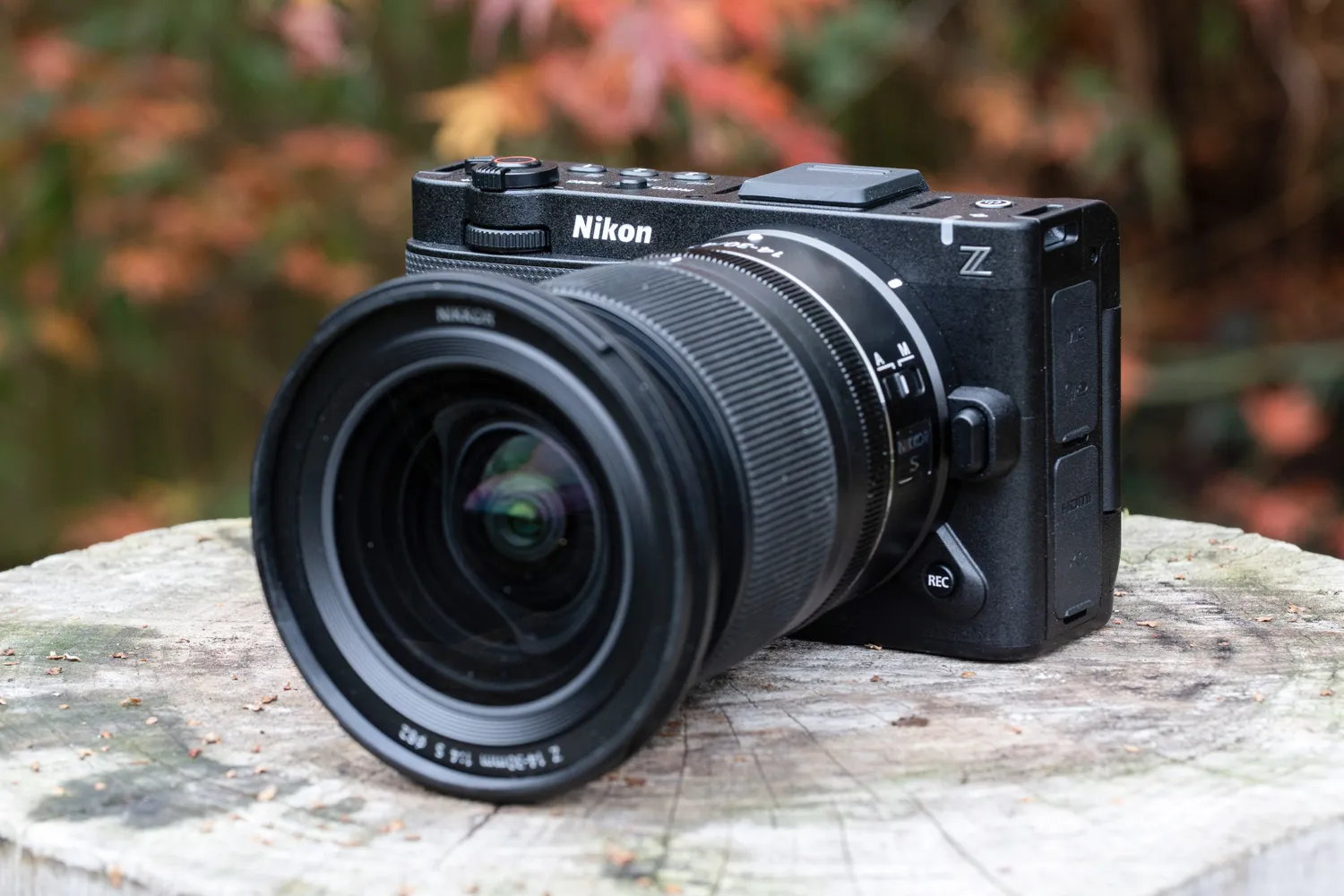
The first thing you notice about the ZR is its compactness. At just 630 grams with battery and card, and measuring 134mm wide by 80.5mm tall by 49mm deep, this is a small camera – especially given the sensor size and feature set. It’s basically a Z6 III that’s been stripped of its viewfinder and reshaped into a more video-centric form factor.
The body is constructed from fibre-reinforced plastic, which keeps the weight down whilst still feeling solid. The grip is minimal – particularly compared to traditional mirrorless cameras – and as a photographer, I noticed this immediately. However, for video work, especially when mounting the camera on gimbals or in tight spaces, that compact body is precisely what you want.

The standout physical feature is the screen. It’s a 4-inch vari-angle touchscreen with 3.07 million dots and a peak brightness of 1000 nits. To put that in context, the latest iPhones offer around 1000 to 1500 nits by default, and popular external monitors like the Atomos Ninja range are also in that 1000 to 1500 nit bracket. The screen is genuinely excellent – bright enough for use in direct sunlight, with a 16:10 aspect ratio that’s perfect for video framing. You quickly get accustomed to the size, and going back to a standard 3-inch screen afterwards makes you realise just how much of an advantage that extra real estate provides.
The screen is fully articulating, hinging out from the side of the camera, which is essential for vlogging and solo shooting. As a photographer who still prefers using a viewfinder, I did miss having an EVF for stills work. But for the target audience – videographers and content creators – its absence keeps the body compact and the price down.
A CFexpress Type B slot handles storage, but the backup is just a microSD UHS-I slot. Realistically, the MicroSD is more for separating video from stills; you obviously can’t record 6K raw footage to it, so the camera doesn’t have any backup for professional videographers. Also, the cards are accessed via the battery compartment, making access when using a tripod annoying.

Port-wise, you get USB-C, 3.5mm headphone and microphone jacks, and micro HDMI. The micro HDMI has drawn some criticism, and yes, it’s a more delicate connector than full-size HDMI. But – with the ability to record RAW internally and that excellent screen, there’s actually very little need to plug in an external monitor for most shooting scenarios. For the target audience, the micro HDMI is an acceptable compromise that keeps the body compact.
Controls are straightforward and typical. There’s a mode dial on top, a shutter/record button, and the usual array of buttons you’d expect. The touchscreen is responsive, making it easy to shift focus points or access the quick menu. Overall, the camera is easy to pick up and use.
Nikon ZR – Autofocus
Backed by Nikon’s AI, which helps subject detection and tracking, I found that the ZR autofocus worked well in both stills and video. Photographing my son on a beach, splashing in the waves, the camera tracked him flawlessly, which was made trickier as he often had his back to the camera, and the sun was going down. Birds in the park were tackled just as easily, with the camera quickly identifying the bird’s eye and switching to the bird’s body if the eye disappeared from shot.

It was a similar story when shooting video. During an attempt at vlogging, the camera stayed locked onto my face as I walked and moved around it at arm’s length, with no noticeable autofocus wobble or bounce. Without side-by-side comparisons, the Nikon ZR autofocus feels on par with its peers, though I didn’t test it on challenging, fast-moving subjects.
Nikon ZR – Performance
I used the ZR for a couple of weeks, including on a family holiday, when I captured some photos and video of my son at sunset on the beach. It’s been a good test of how the camera handles in real-world situations.
For video, the in-body stabilisation works well for static shots and gentle movement. However, with the in-camera stabilisation performing pitch, tilt and yaw correction, there was often noticeable motion in the corners of the video. Vlogging with the camera in 4K benefits from the additional digital stabilisation, but then you do get those micro jitters on each step. As usual, a faster shutter speed, say 1/125s when at 25fps, does improve the look. That said, if you want to make the most of 4K, and especially 6K, you will need a gimbal for any serious work. For photos, I had no issues shooting handheld.

I shot comparison footage in both R3D NE and N-Raw during a beach sunset. After converting both to Rec 709 colour space, there honestly wasn’t much between them. The R3D footage showed a slightly smoother highlight roll-off, but it was marginal. The real difference is in file sizes: at 60p, R3D NE is around 472.5 MB per second, whilst N-Raw Normal is roughly half that. Either way, you will need a significant amount of memory card and hard drive space if you plan to shoot 6K raw regularly.
All of the different recording combinations are complex, with 5.4K also an option for non-raw codecs. For most casual social shooting, I think 5.4K H.265 10-bit will get the most use, delivering good image quality with manageable file sizes. The 6K RAW options make most sense for studio work where you want maximum flexibility in post, or when you need to punch in digitally for reframing without losing 4K quality.

The shutter angle feature is a welcome addition, and it’s the first Nikon camera to have it out of the box. For those unfamiliar, shutter angle lets you set your exposure time relative to your frame rate, with 180 degrees being the favoured setting. It’s a small thing, but really useful when you’re regularly switching between different frame rates.
The Nikon ZR doesn’t have any active cooling fans like other cine cameras have. However, with only a 64GB CFexpress card, I was limited in how long I could record continuously in 6K RAW. That said, I had no heating issues shooting shorter clips.
I found that metering performs as expected, producing a nice balance between highlight and shadow detail when shooting landscape images. With a recognisable subject in shot, be it a bird or a human, the exposure remained confidently locked, which worked well for vlogging.

Colours have the familiar Nikon look, which I think works particularly well for landscape shots. It is worth noting that for video, you can download compatible RED creative LUTs to use on the Nikon ZR. Just make sure they are in the Rec. 709 colour space for correct display on the screen.
Nikon ZR – Verdict
The Nikon ZR isn’t the RED cinema camera that the branding might lead you to believe. It shoots 12-bit RAW rather than the 16-bit of proper RED cinema cameras. It has a micro-HDMI port rather than a full-size one. It lacks dual fast card slots. But rather than seeing these as negatives, they are positive trade-offs that allow the camera to cost £2,199. This brings cinema camera features to an entry-level price point, which is great for users and helps push the camera market in a new direction.
What Nikon have created is an entry-level cinema-style camera that has genuinely reset expectations for what we should get at this price point. The combination of 6K 60p RAW recording, internal 32-bit float audio, that brilliant 4-inch 1000 nit screen, and excellent autofocus – all in a compact, gimbal-friendly body – is remarkable value.

There aren’t many alternatives at this price point – the Blackmagic Cinema Camera 6K is around the same price but lacks in-camera stabilisation and the autofocus isn’t as good, whilst Sony’s cinema cameras around £2,000, like the Sony FX30, only shoot 4K. The Panasonic S1 II can shoot 5.8K at 30 fps in raw internally for £2,899. But if you want 6K RAW internally with built-in IBIS at a little over £2000, the ZR is pretty much your only option.
For photographers, it produces images with a lovely colour and dynamic range, matching the Nikon Z6 III. However, I did miss having a viewfinder. The camera’s size and shape make it great for throwing in a bag to shoot photos and video, particularly when paired with a small lens such as the Nikkor Z 14-30mm f/4 lens that I used for much of my time with the camera.
For content creators, YouTubers, aspiring filmmakers, and videographers who want to learn RAW video workflows without spending a small fortune on a cinema camera, the Nikon ZR is an excellent entry point. It’s not perfect – but it’s very, very good for what it’s designed to do.

Related reading:
- Blackmagic Design unveils Pocket Camera 6K G2 model
- Best Z Mount lenses for Nikon: high-quality mirrorless lenses for all budgets
- Best vlogging cameras: top cameras for YouTube and TikTok content creators
Full Specifications
| Sensor | 24.5MP CMOS, 35.9mm x 23.9mm |
| Output Size | 6048 x 4032 |
| Focal Length magnification | 1x |
| Lens Mount | Nikon Z |
| Shutter Speeds | 1/16000 to 30sec (electronic); extendable to 900s in M mode |
| Sensitivity | ISO 100-51200 (standard); ISO 50-204800 (extended) |
| Exposure Modes | P, A, S, M, Auto |
| Metering | Matrix, centre-weighted, spot, highlight-weighted |
| Exposure Comp | ±5 EV in 1/3 or 1/2 EV steps |
| Continuous Shooting | Up to 120fps (High-speed frame capture+) |
| Screen | 4.0in, 3.07m-dot vari-angle touchscreen |
| Viewfinder | N/A |
| AF Points | Up to 299 (photo mode); up to 253 (video mode) |
| Video | 6K 60p RAW; 4K 120p; Full HD 240p |
| External Mic | 3.5mm stereo; Digital accessory shoe |
| Memory Card | CFexpress Type B; microSD UHS-I |
| Power | EN-EL15c Li-ion |
| Battery Life | Approx. 380 images, 90 min video recording |
| Dimensions | 133 x 80.5 x 48.7mm |
| Weight | 630g (with battery and card) |
Follow AP on Facebook, Instagram, YouTube and TikTok.