

Why does Nikon keep getting chosen as most suited to photography in space? I must admit that, until the current Artemis II fly-by of the Moon, I was only vaguely aware of the brand’s on-going relationship with NASA – and that it had been a constant for more than 50 years. Nikon has been exploring the stars for almost as long as the US space program has existed. Incredible.
Equally impressive is that the first crewed deep space mission since 1972’s Apollo 17 is using off-the-shelf Nikon kit in the form of the mirrorless Nikon Z9 and 10-year-old Nikon D5 DSLR, rather than some specially developed tech out of the reach of most of us. Its Z9 is currently being deployed on the International Space Station too.
In space, however, it seems there is still no escaping the mirrorless camera versus smartphone debate.
In what must be one of the biggest product placement coups in recent memory, the crew has also been spotted with the iPhone 17 Pro. Some of the most striking shots – selfies of crew members silhouetted by Earth, fading into the background as they travelled towards the Moon – were taken on it.
Nikon shoots for the Moon
Back in the 1970s, Nikon first provided NASA’s various Apollo missions with modified film cameras to withstand the rigours of space travel.
Now everything is digital, the low light capabilities of the Nikon D5 DSLR – it’s no use trying flash in a cramped capsule – and its ability to handle the extremes of deep shadow and sunlight, is why it was chosen to accompany the crew of the Artemis II.
This ‘old school’ Nikon was also ‘mission ready’ in that it has long been NASA certified, a process that can apparently take years. This means 2021’s mirrorless Z9 only just squeezed in – and appears to have been a last-minute decision.
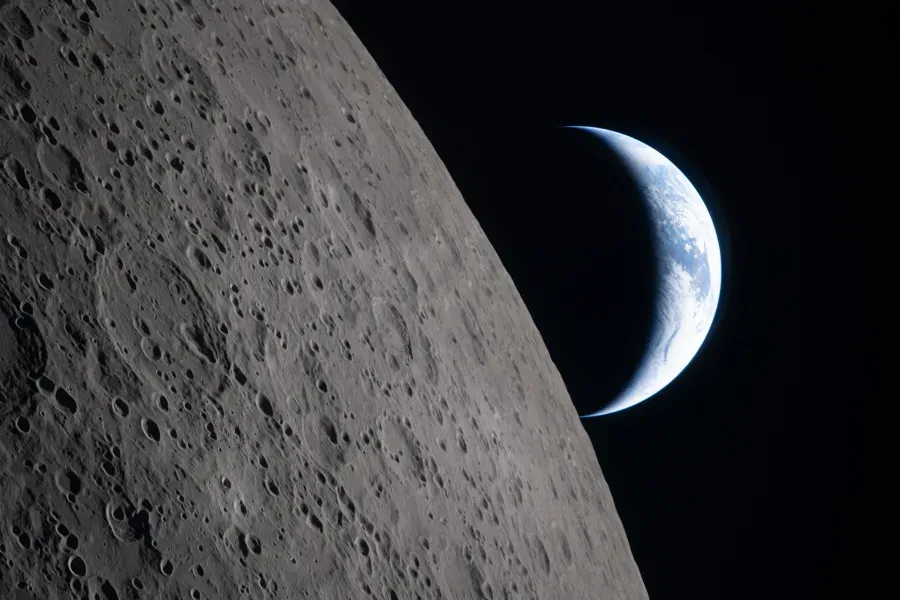
If interested you can go online and look at the EXIF data for various shots taken on the Artemis II mission, including sections of the Moon’s scarred surface taken with an 80-400mm f/4.5-5.6 zoom on the D5. An ISO400 light sensitivity setting has been consistently chosen for some incredible shots of the Earth peeking out from behind the Moon as the crew began to pass behind the latter, briefly losing contact with the former.
For fully illuminated views of the whole of the Moon – to reference a Waterboys’ song – the Z9 has been chosen, similarly equipped with a VR enabled 80-400mm f/4.5-5.6 G. Again, the EXIF data reveals ISO400 as the setting of choice.
At the time of writing NASA had not revealed which crew members had been taking the photographs. Naturally that’s far less important than the hitherto unseen details and views of the Moon – and the Earth – we’ve now been provided with.
So, the next time you see an awe-inspiring image from space, marvel both at our own relative insignificance – and that that it was probably taken on a Nikon camera.
For now, briefly, we’ll let others debate whether the best space shots were taken with DSLR, smartphone or mirrorless camera.
Related reading
- The Artemis Earth photo is incredible – but this will blow your mind
- Remastered photos shed light on Apollo moon landing
- Best Nikon Z Mount lenses – high-quality mirrorless lenses for all budgets
See the images on NASA’s Flickr page: Spaceship Earth | Flickr, Peeking at the Earth | Flickr, Orientale on Display | Flickr.