

Amateur Photographer verdict
A remarkably slim phone with very capable 50MP cameras, dedicated Macro mode for hundreds less than flagships that won’t compete with its battery life and screen specs.
- Strong 50MP main and ultra-wide cameras
- Capable Macro mode
- Excellent battery life for an ultra-thin phone
- Selfie camera has no autofocus
- Only 4K video
Motorola Edge 70 at a glance:
- £699 (512GB)
- 50MP wideangle camera, 24mm equivalent, with OIS
- 50MP ultra-wide camera, 12mm equivalent, autofocus, macro
- 50MP selfie camera
- 4K60p video
- 6.67” screen, 120Hz
- 4800mAh battery
- 6mm-thick aluminium frame
How I test
I review smartphones from the perspective of their photography and camera performance. I look at what the Motorola Edge 70 offers, and the features included for photography and video, paying particular attention to the cameras, photo editing capabilities, the output from each different lens, and the features offered.
We’ve come a long way from the brick sized Nokia’s of the 90’s, but I would argue mobile phones are already conveniently slim and lightweight in most cases. Yet the phone makers are outcompeting each other in the hope of creating the slimmest handsets ever. Motorola is no exception, with its Edge 70 becoming the thinnest mid-priced smartphone, measuring only 6mm thick.
The iPhone Air is slimmer at 5.6mm, but it only has one camera. Meanwhile the Samsung Galaxy S25 Edge measures 5.8mm and also has two cameras. But the second one is only a 12MP unit, and without support for macro.
When you slim down this much, you can expect some compromises to be made, as most manufacturers opt for only one camera and downgrade battery capacity to save space. But the Edge 70 features two very capable 50MP cameras on the back, and fuelled by a 4800mAh battery, it beats both iPhone and Samsung in this respect.
Motorola Edge 70 – Features
The Edge 70 features three 50MP cameras and uses a kind of pixel binning formula to output, by default, a roughly 12.5MP image.
The main (24mm) lens is backed by a large sensor that boasts a 2.0µm pixel size, and uses a type of pixel binning technology called Ultra Pixel. Combined with a bright f/1.8 aperture, this main sensor is designed to excel at low light and night photography, as well as video recording.
Optical Image Stabilisation (OIS) with Moto AI further supports this lens, as the Edge 70 relies on it for zoom in the absence of a dedicated telephoto unit. With this digital zoom, the phone essentially crops into the image the main sensor provides. This has obvious limitations, but thanks to the high-resolution sensor, the zoomed in images still look pretty good, especially when viewed on a phone screen.
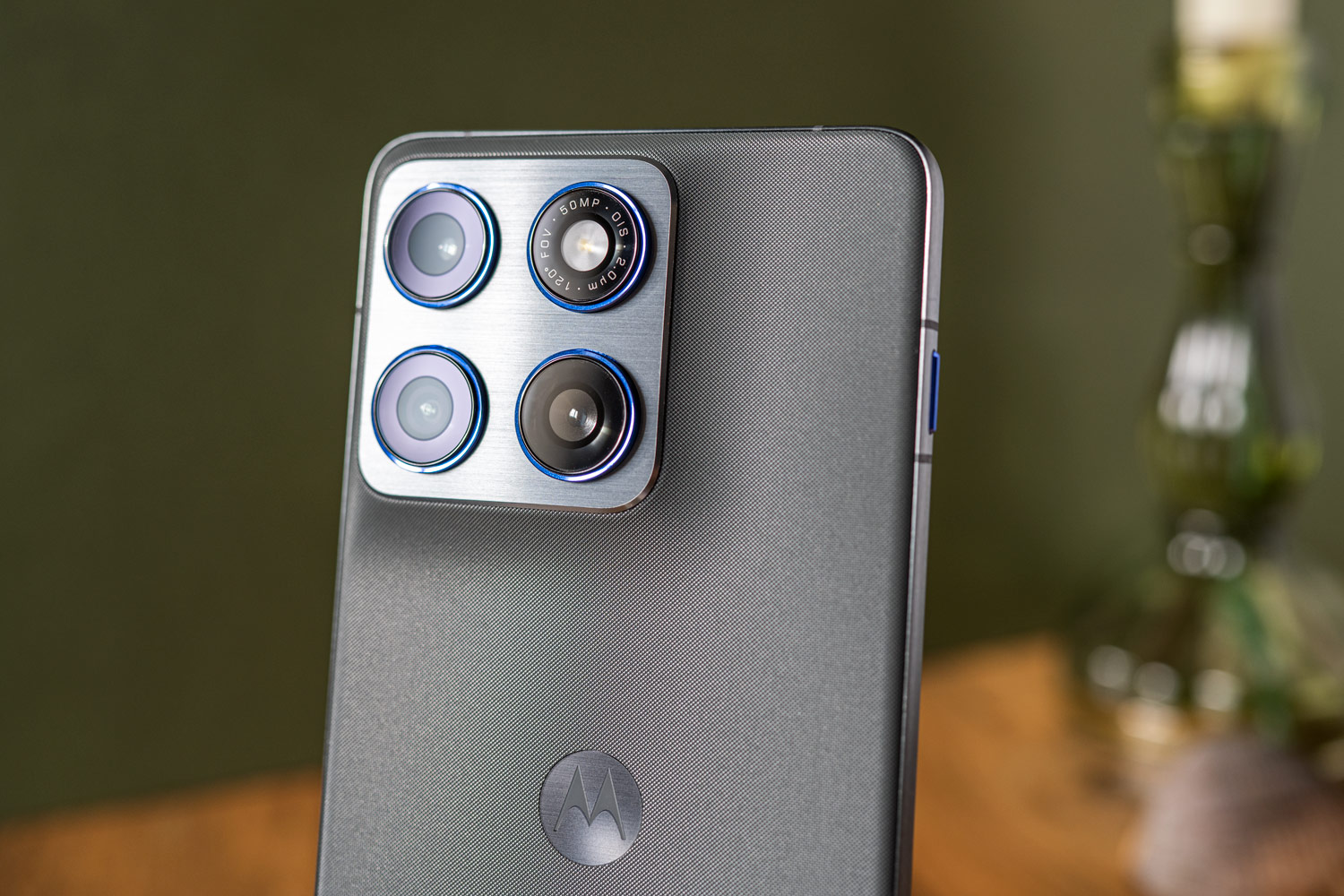
The 12mm equivalent ultra-wide lens has autofocus and a dedicated Macro focus option letting you get very close to your subject. Both the ultra-wide and selfie cameras have a generous 50MP resolution, which is pretty rare even in this price range. This is paired with a f/2.0 aperture and a more common 1.28µm pixel size.
With a 6.67” Pantone validated screen, the Edge 70 is on the large side. The 2712×1220 resolution makes it less detailed than the Samsung Galaxy S25 Edge, but almost identical to the iPhone Air’s screen. Considering that the Edge 70 retails way under both, it is only a small trade off.
4K 60p video capture is available from the main camera, while the ultra wide supports 4K 30p, and the selfie FHD 60p. There’s no 8K like you might find with the Samsung Galaxy S25 Edge, but 4K should cover what most people need.
AI is on board and can be used to create personalised editing templates depending on your editing preferences, freeze motion better in the “Action shot” mode and when taking group photos, correct for closed eyes and distortions after a photo is captured. In the absence of a telephoto camera it also improves images when zooming.
One of the aspects where the Edge 70 undeniably outperforms the competition is battery life. Compared to the iPhone Air and Samsung Galaxy 25 Edge with 3149mAh and 3,900mAh, the Edge70 is fitted with a 4800mAh battery which is the biggest for an ultra-thin phone for now.
To top it off it also supports 68W fast charging but to get this wired charging speed you need to purchase a charger separately. There’s also 15W wireless charging enabled.
Motorola Edge 70 – Handling and Design
In true Motorola fashion, even before opening up the little white box a strong perfume smell hits my nose. On the back the Motorola logo takes centre stage but as a new addition now you also have a tiny Pantone card too, denoting the colour used for the back panel. I must admit at first I thought this to be a sticker that could be removed.
Design-wise it’s a bit of a cross between the Motorola Edge 50 Ultra and the Edge 60, with a textile inspired finish covering most of the rear. But the camera plateau has a metallic sheen complementing the new aircraft grade brushed aluminium frame. That’s not just for looks but is also more durable too.
It houses two lenses alongside a light sensor and flash unit. Both of which are encased very similarly to the lenses, and could be mistaken as cameras. I tested the Gadget Gray version, which has blue accents around the cameras and sensors as well as the AI button.
As AI is prevalent in almost every new phone, including it in a flagship device is not surprising. But a specific AI button feels a bit of an overkill, as most won’t be using it often enough to warrant a dedicated button. That said if that’s the way forward, at least give the option to reassign its function. I would have preferred to open the camera app or add a specific shooting option to open when pressed. Although you still get the wrist twist option when you need to quickly launch the camera.
The large flat 6.67” screen has thin and even bezels, and is protected by Gorilla Glass 7i to better withstand scratches, but with no screen protector applied by default. It also has a high water and dust resistance rating at IP 68/69, which seems to be standard above the mid-range category.
In addition, Motorola claims military-standard durability. I’ll refrain from testing this out, but I can attest that the Edge 70 not just looks but also feels well put together, and definitely premium.
Motorola Edge 70 – Native Camera App
The camera app layout is pretty similar to other Android smartphones, launching the Photo mode by default. It gives the following zoom options: 0.5x (12mm equivalent), 1x (24mm), and 2x (which roughly corresponds to 50mm), and relies on the main camera to digitally zoom up to 20x. You can also switch to macro mode by using the leftmost flower icon which uses the ultra wide lens, but crops in to match the look of the 1x lens.
With the AI assist option ticked in the settings, the phone will automatically advise the best shooting mode. Night mode, or Night Vision as Motorola calls it, activates as the phone senses low light conditions, or you can force-open it from under the more tab.
There’s a button for action shots, which with the help of AI corrects for motion blur and helps freeze motion. You have an “active photo” button which when toggled on, records a short video and selects the best take from it.
Portrait mode gives you three focal length options, 24mm 35mm 50mm as well as letting you change the strength of the bokeh effect by tapping the “f” button. Pro mode lets you adjust focus, white balance, shutter speed and ISO, and enable raw image capture.
You get a natural and a signature colour option, but you can also customise your own image colour style. Some other shooting modes include Slow-motion, Video, Scan, Night Vision, Panorama, Ultra-res, Timelapse and Dual Capture Video and Photo Booth.
Motorola Edge 70 – Image Quality
The Edge 70 is capable of taking some great shots, with colour temperature well-matched between the two main cameras in most scenarios. However, the wide angle camera produced a somewhat colder tone in certain conditions.
In good lighting, both the main 1x and ultra-wide 0.5x camera delivers detailed results with a good dynamic range. Post processing is aided with a Pantone validated colour scheme so images look vibrant and appealing, especially when viewed on the phone screen.
The biggest challenge with the Edge 70 lie with is zoom capabilities. Without a dedicated telephoto lens, it uses the main camera and digitally crops into the image to create the zoom effect. So at and above 2x zoom you are just cropping into the 1x image. You get still useable results at 10x, but at 20x zoom, results start to look less than desirable, as you’d expect.
HDR is activated automatically when it detects a high contrast scene, retaining detail in the shadows and highlights.
Skin tones in portrait mode benefit from Pantone authentication, but I’ve found that with HDR switched on it brought out some unwanted red undertones. There’s a creamy background blur with natural looking outlines while it tackles fuzzy hair best if you don’t push it to its strongest setting. I’ve noticed some red undertone for skin when the HDR mode switched on for some of the selfies. After adjusting my position in relation to the light coming from behind me, this issue was solved.
For the selfie camera you need to get in the sweet spot for the sharpest results as it dean’t have autofocus, this is also a downside despite having 4K video recording. That said it generated very good and detailed results in low light, even if a little on the soft side without HDR turned on.
Night mode activates automatically in low light. The ultra-wide camera keeps up well and delivers a good amount of detail, being able to closely match the brighter and larger main sensor. But in truly dark conditions it clearly lags behind.
The Edge 70 handles macro subjects well, as the ultra wide camera has a dedicated macro focus mode, but you can get equally good results zoomed in from the main camera as it is supported by OIS. (This figurine is only 1” tall).
Motorola Edge 70 – Value for Money
You’ll find plenty of fold phones which are slimmer when opened. But for now the Edge 70 is the slimmest mid-range bar phone, retailing for £699 in the UK with 512GB storage. Not unusually from Motorola, the Edge 70 is not officially available in the US, as the company tends to offer a slightly clipped line-up overseas.
While the Motorola Edge 70 is by no means cheap in itself, if you want to get the slimmest thing out there that balances the compromises that had to be made, it beats Apple and Samsung with flying colours. Compared to the iPhone Air at $1,199/£1,199, or the Samsung Galaxy S25 Edge at £1,199 for the same storage option, it looks great value.
Verdict
The Edge 70 proves that Ultra thin phones doesn’t have to feel compromised. Its main camera and ultrawide cameras deliver consistently strong results, while low light performance and video is well supported by OIS and smart AI features.
The lack of telephoto lens limits how far you can zoom, but for most users it is a reasonable trade off. Consider its excellent battery life, bright and colour-accurate screen and the Edge 70 stands out as one of the best slim smartphones you can get right now.
Related reading:
- Motorola Edge 50 Ultra Review: does this mid-priced phone compete with a Samsung flagship?
- Motorola G86 review – budget phone for the casual snapper
- Motorola Razr 50 Ultra Review – Flip or flop?
Full Specifications
| Main, wide angle camera | 50MP (24mm) f/1.8, 2.0µm OIS, PDAF |
| Ultrawide camera | 50MP (12mm) f/2.0, 1.28µm, AF, macro, |
| Selfie camera | 50MP (21mm) f/2.0, 1.28µm Quad Pixel |
| Telephoto camera | N/A |
| Video | 4K UHD 30p, FHD 240/120/60/30p |
| Screen | 6.67” 120Hz pOOLED, 4500nits, 1.5K |
| Battery | 4800mAh battery (68W fast charge, 15W wireless) |
| Audio | Dolby Atmos stereo speakers |
| Chipset | Snapdragon 7 gen 4 |
| Operating system | Android 16 |
| Memory (RAM) | 8/12GB |
| Storage | 256/512GB |
| Dimensions | 159 x 74 x 5.99mm |
| Weight | 159g |
| Dust and water resistance | IP69/IP68 |
Follow AP on Facebook, Instagram, YouTube and TikTok.