

It was the autumn of 1979 and a new musical movement was sweeping the UK – 2 Tone. It was an explosion of ska, rocksteady and reggae musical styles fused together by bands like The Specials, Madness, The Selecter and The Beat at the forefront of it. Almost overnight many of the bondage trousers of punks and jeans of rockers were being swapped out for drainpipes, pork pie hats, white socks and Harrington jackets by fans who lapped up the energy of the music from the 2 Tone bands.
At the centre of it all was Jerry Dammers, the keyboard player in The Specials, who founded the 2 Tone record label in 1979 with a vision to have the UK’s equivalent of Motown. Dammers had the idea to combine reggae and punk and was very much about anti-racism and multi-culturalism – a fact mirrored in the multi-racial line-up of The Specials.
Turbo-charged
In a 2014 interview with The Guardian’s Dave Simpson, the Madness lead singer Suggs explained, ‘When we met with record labels, they thought what we were doing was really odd. Things started to change when we saw The Specials play live. They were like us, but turbo-charged. We were diesel at that time. After the gig, Jerry Dammers was talking about his new label, 2 Tone, which he said was going to be the new Motown. He told us he didn’t have anywhere to stay, so he kipped at my Mum’s flat. We made [the single] The Prince for 2 Tone, not thinking we’d ever do another song after it. Then it got to No. 16 [in the singles charts] and suddenly record companies were excited about Madness.’
Crazy wedding booking
The founder of Stiff Records, Dave Robinson, kept trying to see Madness live, but the dates never worked out. His solution was to book Madness to play his wedding. Suggs recalled, ‘I can still picture the shock on people’s faces when we started our set. His wife kept asking us, “Don’t you know any Hot Chocolate numbers?” When we noticed Elvis Costello was there, we jumped off the stage, grabbed him and got a big conga line going.’
Despite Robinson’s new wife’s preference for Hot Chocolate’s music, Madness signed to Stiff and set about recording the One Step Beyond… album. It was recorded in 10 days with production by Clive Langer and Alan Winstanley. It the first ever album produced jointly by Langer and Winstanley, who went on to produce more Madness albums and worked with artists such as Elvis Costello and the Attractions, Morrissey, Dexy’s Midnight Runners and David Bowie.
Biggest-selling album
One Step Beyond… was released on Stiff Records in mid-October 1979 and reached a peak of No.2 in the UK Albums Charts. It initially remained in the album charts for over a year and, to this day, remains the group’s biggest selling album. Suggs explained, ‘I think it was my idea to do One Step Beyond, the track. It was one of the old Prince Buster records we used to play on the pub jukebox. Chas Smash, our trumpeter, came up with the intro, “Hey you, don’t watch that, watch this. This is the heavy, heavy monster sound…”. It was inspired by the shouty, slightly preposterous “I am the magnificent” intros you got on Jamaican records.’
Madness were originally called the North London Invaders, but had to change the name because there was already another band with that monicker. The idea to rename themselves Madness came from guitarist Chris Foreman. The name Madness was also a neat fit with the One Step Beyond… track (They Call It…) Madness, which paid homage to a 1963 track by Prince Buster.
Yes – that duck walk
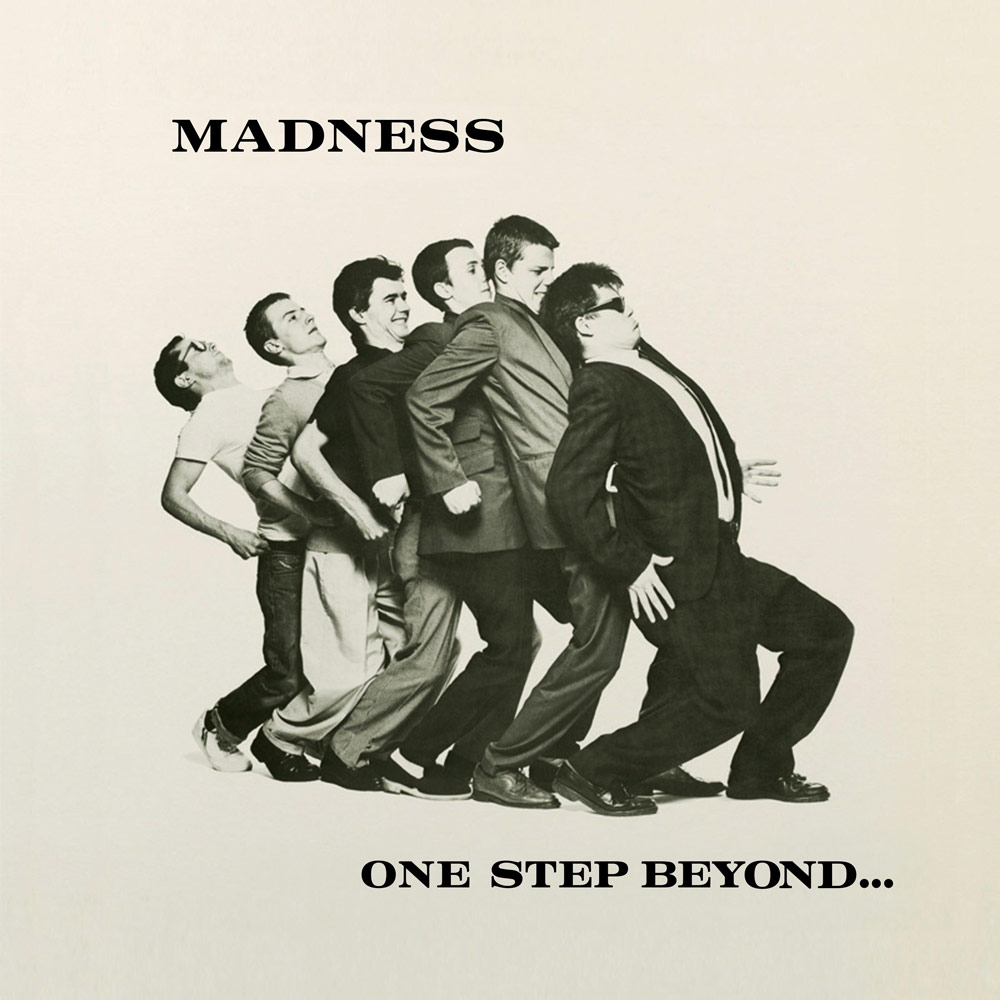
The classic ‘Nutty Train’ group photo on the cover of One Step Beyond… is instantly recognisable, even over 45 years since it was taken. Shot by Cameron McVey, it is said to be inspired by a photograph of the roadie Paul Tonkin on the 1975 album Handsome, by Kilburn and the High Roads who had a lead singer and songwriter called Ian Dury.
Suggs told The Guardian, ‘Because there were so many of us, it was hard to get us in the photograph for the album cover. We had to get really close together. Ian Dury’s old band Kilburn and the High Roads did the duck walk on the back of their album. So, we did the same for a laugh – and it became iconic.’
The front cover was designed by ‘Eddie and Jules + Stiff’, using the photograph shot by Cameron McVey. Eddie and Jules were Eddie King and Julian Balme respectively. One factor that may not be obvious at first glance is that only six of the band are featured on the cover of One Step Beyond. This is because Cathal Smyth (aka Chas Smash) wasn’t an official member of Madness at the time of the recording and the release of the album. Whilst McVey had shot the iconic image for the album’s front cover, the rear album images were shot by Chris Gabrin.
The cover for the One Step Beyond single shows another photograph from the same shoot, with different poses and in colour. It is visibly different to the image used for the One Step Beyond… album cover because the single cover had the heads of some of the band seemingly much closer together. Like the follow-up single, My Girl, it used the Orator font for the typography.
FACT FILE: MADNESS’S HIT ALBUM, ONE STEP BEYOND…
- Musicians: Graham McPherson (aka Suggs), Mike Barson (aka Monsieur Barso), Chris Foreman (aka Chrissy Boy), Mark Bedford (aka Bedders), Lee ‘Kix’ Thompson, Dan Woodgate (aka Woody) and Cathal Smyth (aka Chas Smash)
- Released: 19 October 1979 (Stiff Records)
- Best chart performance: No. 2 in the UK Albums Charts.
- Sales: Over 300,000 certified UK sales
- Fascinating fact: The album’s title, One Step Beyond…, derives from a song originally written by the Jamaican ska singer Prince Buster as a B-side for his 1964 single Al Capone. Buster’s original version of the song is mostly instrumental, save for the title being shouted at various intervals, whereas the Madness version of the song (the lead track on the One Step Beyond… album) features a spoken intro by Chas Smash and an almost inaudible background chant of ‘Here We Go’. The spoken lines added by Madness include ‘Don’t watch that, watch this’ (which comes from the Prince Buster song Scorcher) and ‘This is a heavy, heavy monster sound’ (lifted from the song Monkey Spanner by the Jamaican vocal duo Dave and Ansell Collins)
It’s the fashion
In a 2021 interview, with Killa Kela’s Kelavision channel on YouTube, Cameron McVey explained, ‘I used to be a fashion photographer. I worked for Vogue and I did work for Condé Nast, assisted for Vogue Studios. I worked all over the world as an assistant, then became a photographer. Then I started doing cheap commercials, which were called “rostrum photography”. Basically, you take a load of stills and then they film them with a camera, so people who can’t afford to shoot a commercial then run them in the old days.’
McVey worked closely with the legendary, late British photographer and filmmaker Terence Donovan, who produced his commercials, and shot monthly video updates on the London music scene for MTV in the US, even before MTV Europe had launched.
Bailey, Donovan and Duffy
McVey said, ‘Terence Donovan, who was one of the “great three’ from the ‘60s – [David] Bailey, Donovan and [Brian] Duffy – he was my producer, a really lovely man. So, Terence, God rest his soul, was my producer and he started off doing that and we directed commercials. Then the MTV people came along, via Miles Copeland, who was the brother of Stewart Copeland and manager of The Police. Basically, Miles [Copeland] was doing the reports from the London music scene.‘
School daze
McVey had been thrown out of school for burning down a geography classroom and chucked out of college for dropping acid, so he turned to photography. He explained, ‘I ended up wanting a job and I thought, “well, where am I going to meet the most girls? Photography.” I went through the Yellow Pages and found a guy who gave me a job… and that’s how it started. In those days, you used to be able to ring people up and say, “look, my name’s Cameron. Do you mind if I come round and see if I can blag you for a job?” 20 people would go “no”, but one person might [say yes], and then you could go in there and you just sort of found your way in.’
He added, ‘Back in those days you got taught to do things properly. In photography, you learnt all of the techniques. I worked at the darkroom that looked after Condé Nast, [Lord] Snowdon, and all those people. I learnt how to light properly. When I started making music all of those things were applicable in music as well… all of those same theories. The whole thing of focus and speed and parallax theory… all of those things that apply in photography are actually the same with audio as well.’
Massive Attack
McVey didn’t stay in the worlds of photography and filmmaking for too long as he went on to become a singer, songwriter and record producer for his wife Neneh Cherry, and produced albums for the bands Massive Attack, Portishead, All Saints and the Sugababes.
He told the Kelavision YouTube channel, ‘I suppose I got a keen eye because I was always describing stuff to my blind mother. That’s also where I learnt to tell stories and write lyrics, because Mum would listen to audio books all the time and I would be describing stuff to her. I figured early on to go and do the things that you want to do. Learn the process really fast. Get involved, do the research, study it, be the best you can be, even if it’s a menial task like sweeping up – have it done, so no one’s gonna tell you to do it [again].’
Melting pot
However, the fact that McVey shot the cover of One Step Beyond… was pretty much by accident. He recalled, ‘Music was becoming more of a melting pot. Hence the funk behind Spandau Ballet, hence the reggae music and the ska behind Madness. It was all just a melting pot. I was chasing this and that and I ended up being Madness’s road manager, and so did the [One Step Beyond…] picture by accident, just because I was following them around the country checking the music out. I was the road manager on the 2 Tone tour.’
One frame – summing up the ethos of Madness
The 2 Tone roots and sense of humour of Madness and the adroit photographic technical excellence of Cameron McVey had combined in a serendipitous way to give birth to an energetic image packed with fun. In just one frame it summed up the ethos of Madness and cemented the album cover as one of the most memorable of all-time.
Punk irreverence – Our panel of top music photography luminaries on the album
Jill Furmanovsky:
‘I’ve always loved this picture of Madness on the One Step Beyond… cover. The six guys invented the “Nutty Train”, inspired by an image of a roadie being silly. By the time Cameron McVey got them in the studio, on a classic white background, they’d perfected leaning into each other, often stepping on each other’s shoes to create a unit of oneness. It’s a feat of physical strength caught brilliantly and a wonderful hybrid of classic British humour, blended with punk irreverence for authority. Irresistible.’
Lee Gale:
‘This “Nutty Train” image by Cameron McVey – singer, songwriter, photographer and later husband of Neneh Cherry – epitomises the mayhem and schoolyard antics of Madness. It’s sensational. The coolest conga in history. Why I’ve never tried to recreate this on the many stag-dos I’ve attended, I will never know. Madness are performance artists.’
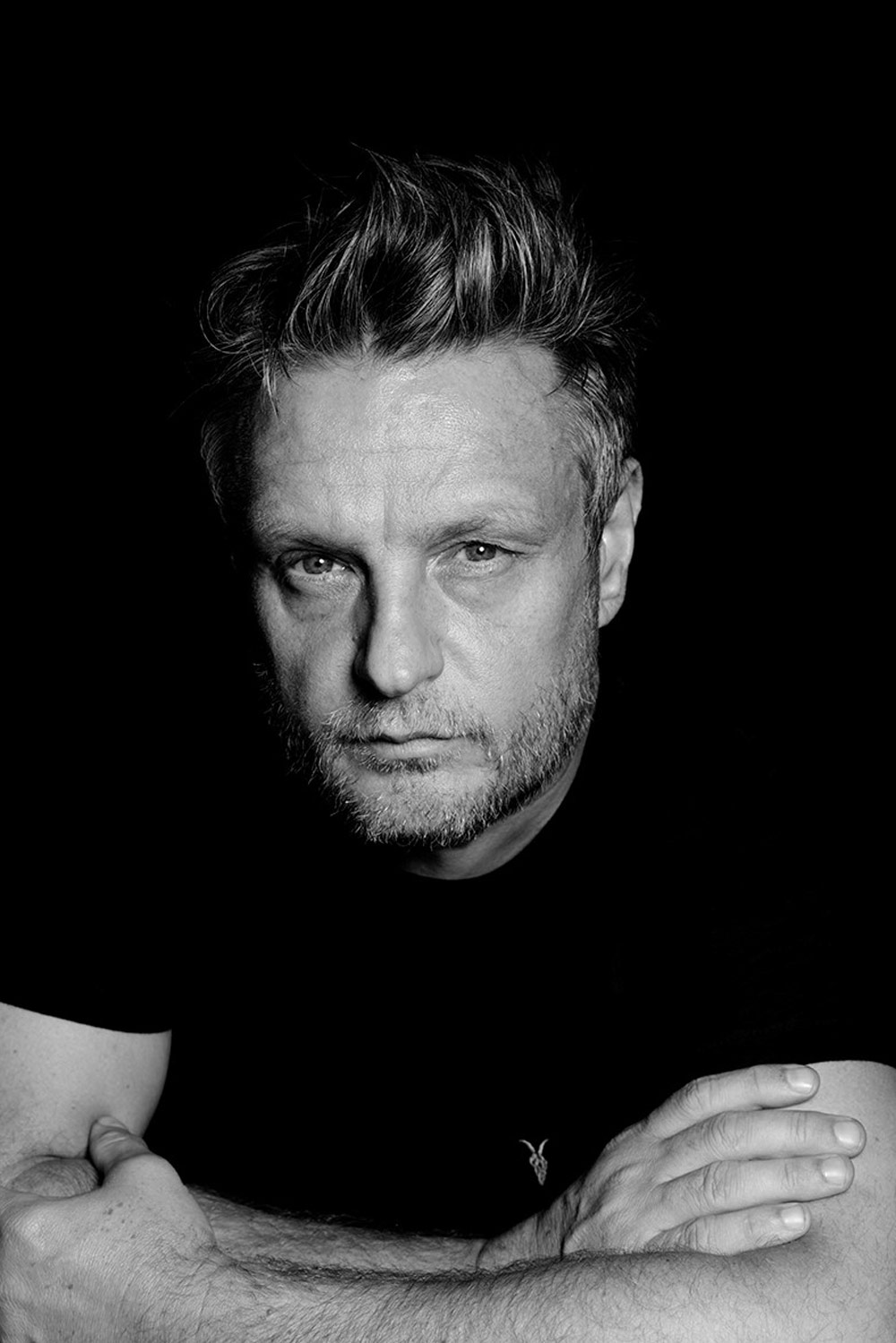
Rankin:
‘One Step Beyond, that album cover, with Madness leaning and laughing, feels like an old friend. Cameron McVey captured their spirit perfectly, that raw, joyful chaos that is so them. My Girl was actually the first single I bought, and seeing them so full of life on that cover just brings it all back. They’re more than a band; they’re part of who I am.’
Cameron McVey
Cameron McVey is an English singer, songwriter and record producer and former model and photographer. Born in 1957, he grew up in North London and started creating music in the early 1980s in the band Bim and later in the duo Morgan-McVey. His photography career included working for Vogue Studios and collaborating with Terence Donovan. He met and married the singer Neneh Cherry and became her producer and manager. His music production credits include the albums Blue Lines by Massive Attack, All Saints by All Saints and One Touch by the Sugababes.
Further reading
- Taylor Swift 1989 Story Behind The Album Cover
- Great Album Photography Pink Floyd
- Greatest album photography: Born to Run by Bruce Springsteen
- Nirvana Nevermind Album Cover