

Amateur Photographer verdict
The Lomo MC-A is a stylish, metal-bodied gem. Despite the cramped viewfinder it’s still a worthwhile purchase that offers proper manual controls and solid optics.
- Stylish, sturdy metal body
- DX-coding compatible
- Manual settings control
- Lens performs quite well
- Small, cramped viewfinder
- AF can be unreliable
- Some image bleed between frames
Lomography MC-A at a glance:
- Price: $549 /£449
- 35mm film camera
- 32mm f/2.8 lens
- Manual settings control
- DX coding
- Top-plate LCD screen
It’s fair to say there was a fair bit of excitement in the AP offices and beyond, when Lomography took the wraps off the MC-A. The Lomo MC-A was not just a brand new film camera, but was a lovely-looking, metal-bodied machine, with full manual control dials, a manual film winding lever, and a Minitar II-branded 32mm f/2.8 lens on its front. Could this finally be the modern analogue point-and-shoot boasting both style and substance?
At a starting price of £449 ($549), the Lomo MC-A isn’t a cheap camera, though it does notably undercut the similar Rollei 35AF, and comes at about the same level as the half-frame Pentax 17. Indeed, the retro throwback market has been rather rife with overpriced disappointments of late, not least of which is Fujifilm’s £699 ‘digital half-frame’ novelty item, the Fujifilm X-half.
So, the pressure was on. I was keen to see whether the Lomo MC-A would finally be the premium modern point-and-shoot that analogue shooters have been hankering after. So, I took it out to the streets of London and ran a couple of rolls of 35mm film through it to find out.
Lomography MC-A – Focal Points
- LCD screen: The top-plate LCD screen on the Lomo MC-A displays a shot counter, flash settings and self-timer settings. When the shutter button is half-pressed, it changes to show exposure settings, and it also plays a winding animation if the shutter is pressed without winding the film.
- Control dials: Using the top-plate control dials, the user can set the MC-A’s shutter speed to a specific value, or leave it in Auto mode. The exposure compensation dial allows the user to set up or down by up to 2 EV, in half-steps.
- AF/MF: With the switch set to AF, the MC-A will use its LiDAR autofocus to select an appropriate focusing zone. When it’s set to MF, the user manually selects their own focusing zone via a sliding switch on the front.
- Lens with aperture control: The five-element, multi-coated lens offers aperture control from f/2.8 to f/16. Its focal length of 32mm makes it well-suited to street and general-purpose photography.
- Wind-on lever: The long manual winding lever on the right-hand side has a spring-loaded action and a long throw. It sits nicely under the thumb and winds with a smooth action.
- Base-plate rewind crank: An unfolding crank on the base plate makes it easy to manually rewind film once the roll is completed. The rewind button must first be pressed to avoid damaging the mechanism or the film.
Lomography MC-A – Design
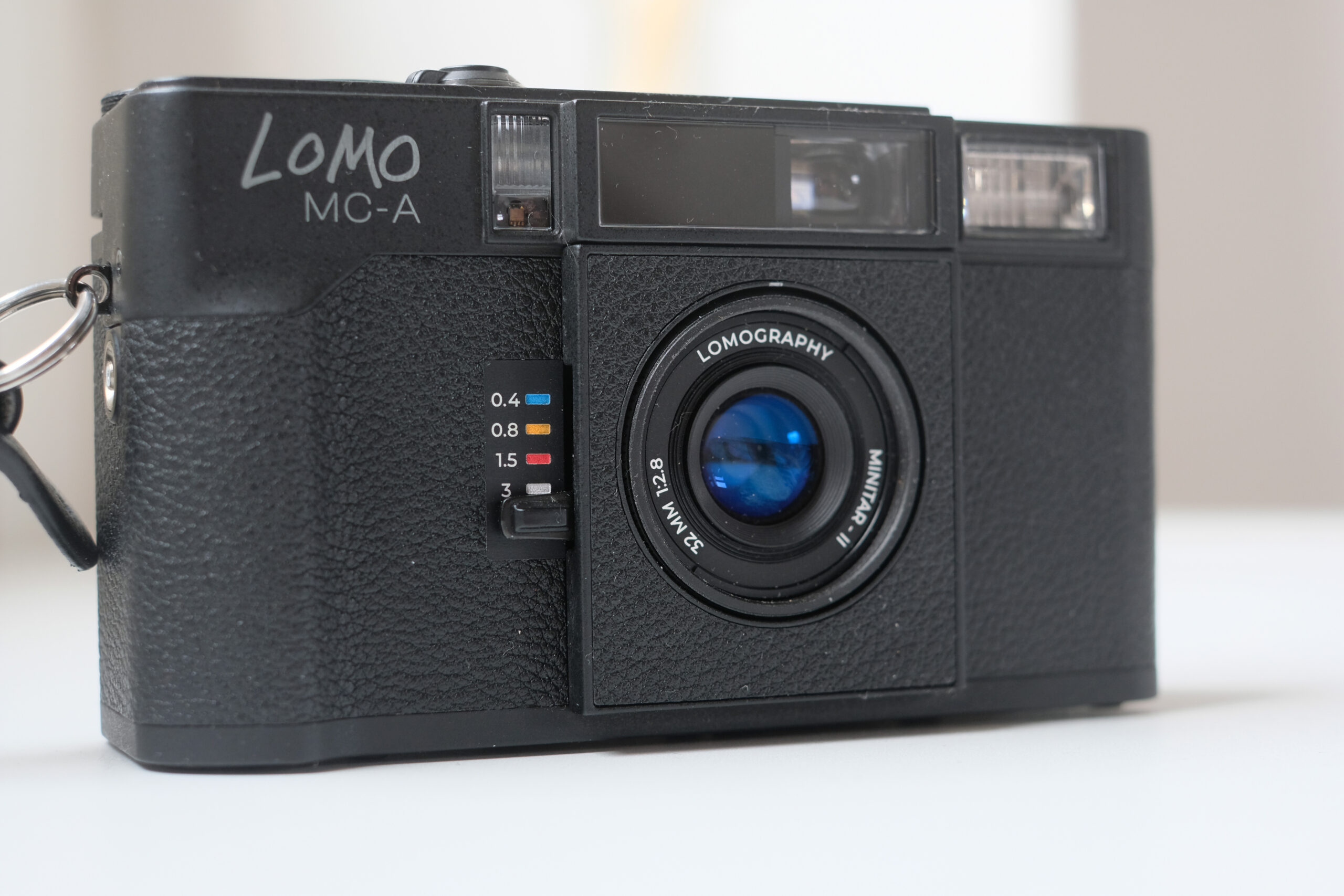
If you’re used to cheap modern film point-and-shoots like the Kodak Ektar H35N, then the first time you pick up the Lomo MC-A is going to feel like a wonderful breath of fresh air. Out, out cheap plastic – this baby is built around a chassis of solid metal, and has a gorgeously reassuring heft to it. It weighs 332g, measures 125.8mm x 69.5 mm x 42 mm.
On the top plate, you have most of your controls, including dials for shutter speed and exposure compensation, as well as buttons for flash, self-timer and manual ISO input. On the right-hand side is a dedicated ‘MX’ button, which you could be forgiven for not knowing refers to multiple exposures, and a ring-style switch around the shutter button serves as the AF/MF toggle, while also serving to power the camera on and off. Composition is accomplished via a small optical viewfinder, sitting above the lens. A bright top-plate LCD on the left side gives you a shot counter, remaining battery, as well as displaying the current focus and flash mode. It displays settings info when you half-press the shutter, and also plays a neat little reminder animation if you try to shoot without winding on.
On the subject of winding on, this is accomplished via a delightfully slick lever that sits nicely under the right-hand thumb. It has quite a bit of travel, and you may find yourself caught out a few times when you can’t capture your next frame because you didn’t quite push it to the full extent. Once you get used to it though, it feels very satisfying.
When the camera is booted up, the little 32mm f/2.8 lens extends very slightly, revealing a fiddly but serviceable aperture ring. To the right of the lens, you have the manual focus switch that allows you to select various focus zones, from 0.4m to infinity. The front of the camera is textured plastic, and there’s a little raised bump on the right-hand side that vaguely gestures towards the idea of being a handgrip. The camera is powered by a CR2 battery – though, in a nice touch, Lomo has included a rechargeable CR2 in the box, and this can actually be removed and topped up via USB-C.
Now, I’m going to talk about something that may seem a bit trivial, but was invariably the first thing commented upon by every single person I showed this camera to. On the top plate, unmissably centred, is a handwritten inscription, reading ‘Everybody is equal before the lens – and behind it.’ I don’t take any issue at all with that sentiment. All the same, I would happily pay a premium to get a version of the camera that did not have this written on it, and I suspect I’m not alone.
Or maybe I’m just being a grinch. Ultimately, the build quality of the Lomo MC-A is just what it needs to be. It’s small enough to be pocketable, but doesn’t feel cheap. It’s an attractive object that you want to pick up and use.
Lomography MC-A – Features
The star feature of the Lomo MC-A is its lens. A five-element optic with Minitar-II branding, this 32mm f/2.8 specimen is made with multi-coated Lomo glass. It can focus as close as 40cm, which you can let the LiDAR autofocus take care of, or handle yourself by putting the camera in MF mode, then using the switch on the front to select one of the focus zones – 0.4m, 0.8m, 1.5m, 3m, and infinity.
Indeed, in pretty much all aspects of the camera’s operation, you have the choice between auto and manual. Shutter speed can be left to its own devices, or dialled in from 1sec to 1/500sec, with a bulb mode also available. For this, you’ll likely want to make use of the tripod screw thread on the bottom, which is unavoidably tucked off to one side due to the base-plate rewind crank taking up most of the real-estate.
Aperture runs from f/2.8 to f/16. The camera can recognise DX coding, meaning it will read DX-coded film to set ISO automatically to the appropriate value, but you can manually override and set it to any value from 32 to 3200 if you want to shoot above or below box speed – great if you plan to push or pull your film in development. The MC-A also has the ability to create multiple exposures, and you can expose the same frame of film as many times as you like.
Elsewhere, you’ve got a built-in flash, with an auto mode as well as front-curtain and rear-curtain sync, and the option for PC sync flash connection for studio shots. There’s a self-timer function for selfies and group shots, with up to 30 seconds available. Lomography has also thoughtfully packed out the box with a few extras, including a wrist strap, a book of inspirational images and quotes (which, I admit, I did not read), some coloured gel filters for the flash, a protective wrap for transportation, and the ‘Splitzer’ lens attachment, which works with the multiple exposure function to create dramatic split-image effects.
Lomography MC-A – In use
One of the best compliments I can pay the Lomography MC-A is that it feels like you’re using a proper camera, which isn’t something you can take for granted when it comes to new film compacts. That satisfying metallic weight, that whip-snap wind-on lever, the real bona-fide aperture ring – all of it adds up to a camera that feels like a camera. I was testing this model at the same time as a new point-and-shoot – the Kodak Snapic A1, from Reto Project – and the MC-A made that camera feel like a child’s toy.
It’s not all plain sailing though; I wasn’t a fan of the MC-A’s viewfinder. It’s small and cramped, with pronounced distortion that sees straight lines becoming bendy. I would have loved a bigger viewfinder, not only to aid composition, but also because some more visual real-estate might have allowed Lomo to put some useful information in there. As I mentioned earlier, the top-plate LCD displays exposure settings when the shutter button is half-depressed – but when I’m half-depressing the shutter button, I’m only ever looking in one place: through the viewfinder. So, anything I need to know really should go there!
You do get some blue and orange lights in there, and referring to the manual will inform you that blue means the focus is set (it blinks if you’re too close), while orange is a warning that the shutter speed is below 1/30sec, meaning there’s likely to be image blur. Better than nothing, but if Lomography takes another crack at this camera, an improved viewfinder is going to be at the top of my wishlist.
The aforementioned visual wind-on reminder on the screen is a handy prompt, especially when you’re getting used to the camera. But – and I’m going to be vulnerable with you now – do you know what would have been a more useful reminder, for me personally? The damn lens cap. Laugh if you want. I did. But that tiny, adorable lens cap is so easy to forget about, especially when the only warning you get that it might still be on is a vague orange glow, obliquely saying: hey, your shutter speed is kinda slow for some reason.
Still, I was pleased overall with my images from the Lomography MC-A. I rattled through two rolls of color negative film, and the glass-elements lens produced a decent percentage of keepers. Exposures are accurate and well-balanced, and while there’s sometimes a little vignetting from the lens, it’s nothing to be overly concerned with – and in many cases enhances the retro feel of images.
My landscape-style images tended to be a lot more successful than my attempts at close-focusing – it pays to be aware of the limits of the LiDAR autofocus system. In complex scenes, it can get confused and focus on the muddy background rather than the pretty flower (or, apparently, on nothing at all). When dealing with fast-moving targets like cyclists and scooter-riders, I decided to use the MF switch and set the focus zone manually, and I reckon this is the best bet in situations where you want to focus on anything smaller than a building.
In a couple of my images, I noticed a slight image-bleed from one frame into another, on the right-hand side. I don’t think this is the result of light leak – given the sharply delineated nature of the bleed, I suspect that it might have been me not quite pulling that long-travel wind-on lever to its full extent, and the camera allowing the next exposure anyway. So, make sure you always give the lever a good firm pull, as far as it’ll go!
Lomography MC-A – Verdict
I enjoyed using the Lomography MC-A. Like any camera, you have to take some time to get used to its various quirks and eccentricities, but it looks beautiful and has a satisfyingly premium feel.
While the price tag is significantly higher than many other analogue compacts, the shooting experience is a good deal better, and I think Lomo has done a much better job of justifying the price tag here than the Pentax 17. I’d happily have traded the flashy but not-that-useful top LCD screen for a bigger and better viewfinder, though.
Otherwise, if you’re tempted by the Lomo MC-A, I think it’s well worth buying. It’s a fun camera to use, it produces solid results that will only improve as you get used to using it, and it feels well-built enough that it should last you many years of happy shooting.
Related reading:
- Rollei 35AF review: I so wanted to love this cute little film camera
- Pentax 17 review – a film camera worth the money?
- Alfie Cameras Tych+ review
- Best 35mm Half-Frame Film Cameras
- Lomography Petzval Art lens review
Full Specifications
| Film format | 35mm |
| Lens | 32mm f/2.8 |
| Lens elements | 5 |
| Minimum aperture | f/16 |
| Min focus distance | 40cm |
| Bulb | 1sec-1/500sec |
| Film speeds | ISO 12 – 3200 |
| Exposure modes | Manual, Aperture Priority, Auto |
| Exposure compensation | +/-2EV in 0.5 EV steps |
| Viewfinder | Optical |
| Power | 1x CR2 lithium battery |
| Dimensions | 125.8mm x 69.5 mm x 42 mm |
| Weight | 332g |