

Leica MP at a glance:
- $6415 / £5080 body-only
- 35mm rangefinder film camera
- Leica M mount
- Compact and unobtrusive
- Robust alloy-based construction
- Supports a range of Leica and third-party lenses
Sometimes, strange things happen. I was having a conversation with the PR folk for Leica UK, and they’d offered to send a couple of rolls of their new Monopan 50 film for evaluation. Almost as an afterthought, they then wondered whether I’d like to borrow a Leica to shoot the film with. It would seem appropriate, after all. It turned out that Amateur Photographer had never reviewed the MP, so were in the market for a write-up if I was interested. Well, what would you have said?
After carefully – very carefully – checking my insurance policy, I agreed, and a Leica MP and Summicron 35mm f/1.4 lens were dispatched by courier from a fashionable address in London. As I hovered expectantly near the front door, I wondered what sort of courier makes a delivery from Leica HQ. My overactive imagination pictured a late model European SUV with darkened windows drawing up in the lane, then a tall, smartly suited figure in dark glasses emerging with an aluminium briefcase chained to his wrist and striding purposefully up the path…
It turned out to be Dave, our regular courier, in his beat-up white van – but I did notice that he took extra care to get a phone picture of me holding the parcel. Opening the carefully wrapped package, I discovered that the Leica was additionally protected by a rather nice Billingham camera bag, which became my constant companion for the next week or so.
I’d already downloaded and studied the manual for the Leica MP, but I was still feeling very cautious when I first handled it. The replacement cost of the camera was eye-watering – about what I paid for my car. What if I broke it? How would I ever live it down? More to the point, what if someone saw me with it, beat me up and nicked it?
When I examined the MP in more detail, I was able to relax slightly. This was clearly “the loaner”, a camera set aside for evaluation purposes and loans for projects. It had clearly been around the block a few times, and not all the users had been as careful as I intended to be with it. As a result, the MP had a feeling of active use, with the black paint of the body nicely worn to show just a hint of brassing in the edges of the top plate. It was, in fact, a soundly used tool – and everything I believe a Leica ought to be.
Leica MP – Form and Function
After a century of continued development, I think I can safely say that the Leica 35mm film camera is a mature design. The Leica MP is the embodiment of the traditional 35mm rangefinder camera, with an impeccable pedigree and truly exceptional properties. The layout of the camera is, as you would expect, familiar to most folk who have used a 35mm camera of any sort, but especially a rangefinder. A few uniquely Leica design features, however, may need some explanation.
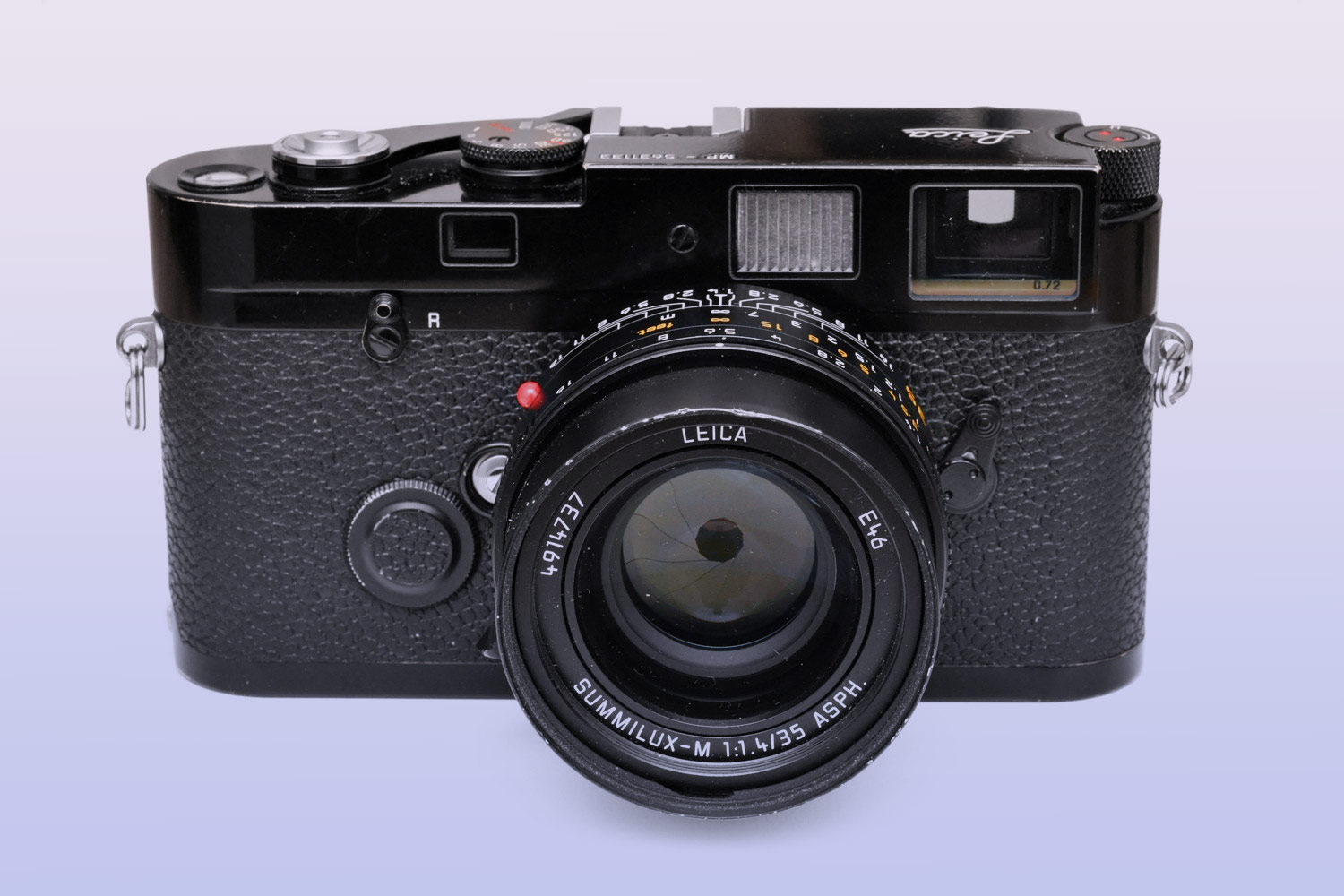
When I first picked up the Leica MP, my first impression was of solidity rather than weight. At 585g, the body is about half the weight of a professional DSLR, and is much more compact. But the heft of the largely metal design seems appropriate. The front panel is dominated by the long-standard Leica M bayonet mount, which gives a range of options for truly impressive optics of different focal lengths, including a good number of third-party lenses for those whose pockets aren’t quite deep enough for the Leitz equivalents.
Above the lens mount, three optical windows form the basis of the combined viewfinder and rangefinder system. Seen from the front, on the right is the viewfinder itself, in the middle is the window which illuminates the bright-line frames for different lenses, and the small opening on the left is the rangefinder. Naturally, all these need to be unobstructed in order to work effectively – something that actors in blockbuster films featuring Leica cameras really ought to be told.
To the right of the lens mount, a small lever allows you to manually select a viewfinder frame other than the one the lens itself choses. Predictably, the viewfinder image is bright and sharp, even in bad light – a major bonus of a rangefinder system – and automatically adjusts the viewfinder frame to account for parallax error. The second image projected by the rangefinder is clear and very well defined, making this by far the best rangefinder system I have ever used.
Below the rangefinder window, there is a rewind tab to release the clutch on the film transport and below this is a small battery cover guarding the two SR-44 batteries for the exposure meter. This is really the only nod to the twenty first century in the design, and it’s a subtle nod at that. The Leica MP is wholly mechanical and can operate perfectly well without the batteries in place. But the exposure meter adds useful assurance and removes the absolute necessity for a hand-held light meter, although this is still my preference for a variety of reasons.
The meter is a simple but effective silicon photodiode model which integrates the film speed, shutter speed and aperture you have selected, displaying a basic LED “over”, “correct” or “under” indication at the base of the viewfinder. Film speed is set with a dial on the rear panel – you will find no DX coding contacts here. Similarly, there are no options for aperture, shutter or programme priority modes, it is just a basic light meter. This is an unobtrusive addition which many people will appreciate, but it still feels to me slightly out of place.
The top panel has few surprises, and hosts the self-resetting frame counter, the film advance level with shutter release at the core, shutter speed selector, accessory hot shoe and rewind knob. These mostly operate as you would expect, but they reinforce that this is a truly mechanical camera. The shutter release is two-stage: the first press switches on the light meter, then the follow through releases the shutter.
Some users of modern cameras will find the long length of travel of this shutter release takes some getting used to. It isn’t just an electrical switch, it is a complex mechanical system doing real work to move cams, springs and levers, and once you have grasped this you can nod and move on. The same applies to the shutter speed dial: it takes mechanical effort to move it, but a change of position takes place with a pleasingly tactile “snick”. The shutter is of the focal plane type, with fabric blinds, and has mechanical timings between one second and one thousandth, plus brief time. Interestingly, the top speed for flash synchronisation is only 1/50th of a second, which is taking tradition to its limits.
Past the standard hot shoe, the gentle script of the Leica logo leads you towards the rewind knob, which has a special Leica trait. To rewind the film, first you move the rewind tab to the “R” position, where it latches, and then pull the rewind knob upwards and begin to turn it. This action will open the back of many film cameras, so may take some getting used to for some of us. However, the back of the Leica MP is another story.
Leica MP – Tradition, but at a cost
One traditional aspect of the Leica MP that I’d be happy to lose is the method of film loading. Unlike most 35mm cameras, the Leica M series has a removable base plate to facilitate loading. This, combined with a fold-down panel in the back plate hinged to allow access to the film gate, provides somewhat restricted access for loading. The film cassette is inserted through the open base and the film leader drawn across to seat in the three-pronged take-up spool on the opposite side. A diagram engraved on the inside of the camera base illustrates this clearly. The action of replacing the base plate pushes the film firmly into the take-up spool where it should latch.
As always with traditional 35mm cameras, it is important to check the film is actually advancing when you wind it on. The rewind knob includes an indicator to show this. When you replace the baseplate, it clicks into place with the satisfying “pop” of perfectly machined and aligned components.
The other traditional feature worth noting is that the tripod screw is not at the centre of gravity of the camera, but immediately beneath the take up spool. In design terms this makes sense, but it’s a real pain when using the MP on a tripod, as it has a huge desire to tip over to one side. Where it IS useful is when using a monopod, as the socket is directly beneath the shutter release, and you are pushing directly into it for solid support.
The Leica MP is a truly excellent camera, which I have found a delight to use as a daily choice for location photography. Everything beyond that is just detail, but some of the detail is significant and may influence whether the MP is right for you.
Leica MP – Practicalities
The MP is deliberately understated, lacking as it does the round red logo badge found on other models. Yes, it says “Leica” in its design, and in the panel engraving, but is too polite to shout it at passers-by. This is probably a useful security feature in certain robust environments, but you would be fooling yourself to think that folk won’t recognise the camera for what it is.
On one quiet autumn afternoon in an almost empty seaside resort, two people visibly noted the presence of the Leica. One, an elderly gentleman of military bearing, raised one bushy eyebrow in recognition – followed by a curt nod of acknowledgement. Shortly afterwards, a twenty-something bloke wandered past. “Wow! Did you see that? That’s a Leica! I’m having one of those one days…” he blurted to his bewildered companion. So, “red dot” or not, it is irrefutably a Leica.
In terms of handling, the Leica MP is up there with the very best cameras I have used, and I found myself comparing it with the operation of the almost equally manual Nikon FM3A. Both cameras have an almost perfect user interface, although with slightly different uses in mind. The MP sits in the hands as though it is an extension of your body, and you quickly forget that you have ever used any other camera.
Leica MP – Verdict
The Leica MP is a worthy flag bearer for the traditional style of Leica rangefinder film camera, and it has done everything I have asked of it while it has been in my care. A loan, however, is very different from ownership.
So, here is the question: Would I buy one with my own money? If you’d asked me before I had spent a week with the Leica MP I would almost certainly have said “no”, just on the grounds of cost, nothing else. Having now used one, my view has changed – if only for certain scenarios.
I would buy a Leica MP if I was able to negotiate commissions for any of a range of projects. These would include a (second) major roadtrip across the western USA travelling light by train and bus; recording a world tour with back-stage access to a major rock band – or an orchestra for that matter; or joining an off-grid polar research trip to chronicle environmental issues.
Maybe it’s just me, but this is the way using a truly impressive camera starts to make you think about your work. Why not? All that remains for me to do is convince various commissioning editors. You are all reading this, right?
Related reading:
- Leica Monopan 50 review
- Analogue street photography tips
- Leica film camera beats digital to North Pole