




Amateur Photographer verdict
In many ways, the Leica M EV1 is a more practical camera than the M11 rangefinder that it’s derived from. But without an optical viewfinder, a little of the M mystique is lost along the way.
- Large, clear viewfinder
- Superb raw image quality
- Sensor specifically designed to work with M lenses
- Robust build and simple operation
- Very slow start-up time
- No image stabilisation
- Fixed rear screen (awkward for manual focusing)
- Almost as expensive as Leica M11
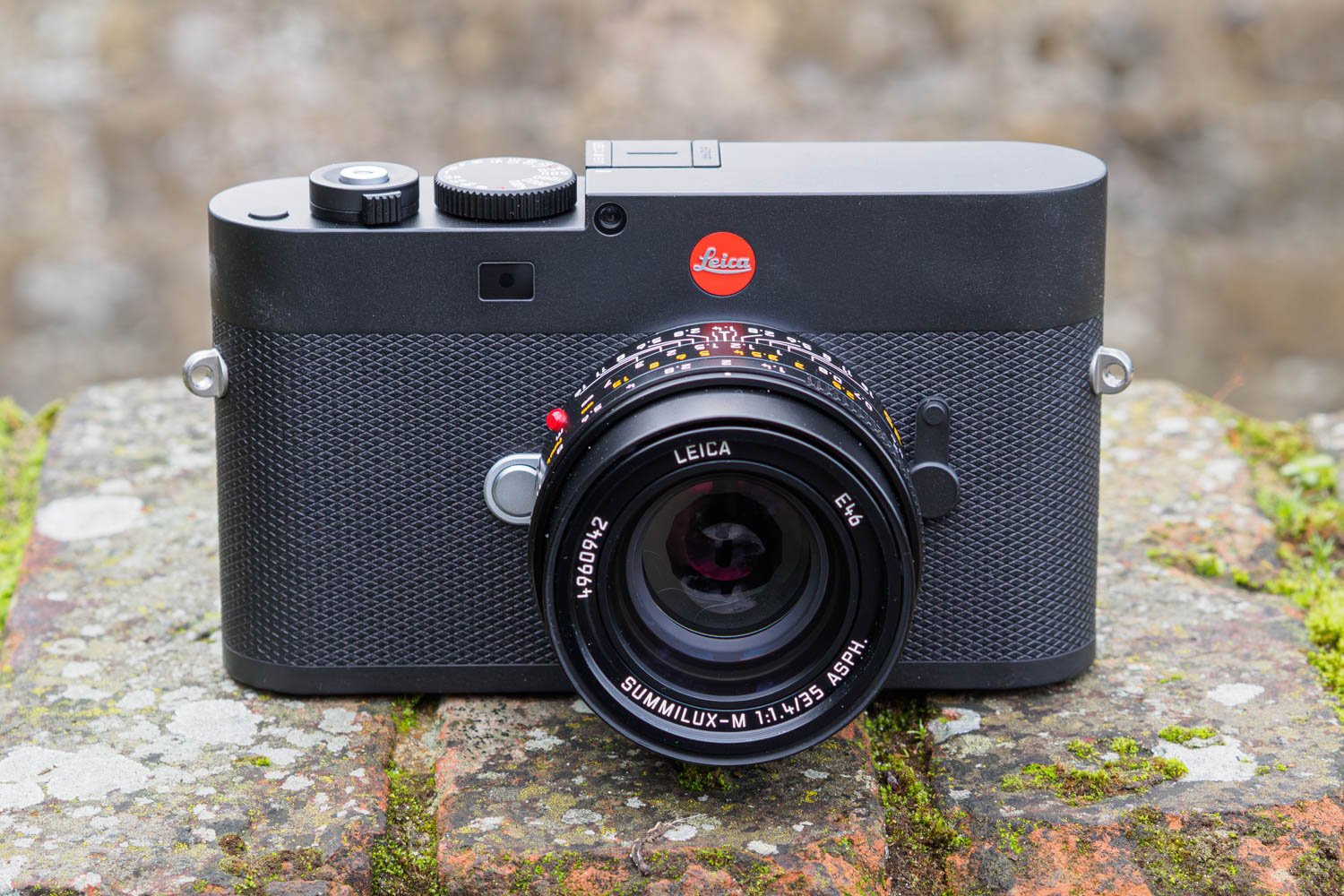
The Leica M EV1 is a full-frame interchangeable-lens camera that’s based on the Leica M11 rangefinder camera, but which swaps out its optical viewfinder for an electronic one. To those unfamiliar with the mystique that surrounds the M series, that may not sound like a big deal. But the M rangefinders have always been both Leica’s best cameras and their most revered, with the optical viewfinder fundamental to their appeal. Switching to electronic viewing counts as a significant and controversial change, in terms of the camera’s feel and operation.
Leica M EV1 at a glance:
- $8995 / £6480 body-only
- 60.3MP BSI-CMOS full-frame sensor
- ISO 64-50,000
- Up to 4.5fps shooting
- 5.76m-dot, 0.76x EVF
- 2.95in, 2.33m-dot fixed touchscreen
To get some more perspective on this, we need to consider the long and storied history of the M series. These cameras are among the most revered in all of photography, with the line running essentially unbroken for 70 years, since the original M3 in 1955. Along the way, it made the transition from film to digital while barely changing in size or design.
Leica rangefinders survived in an era when SLRs dominated the market because they offered specific advantages. The cameras and lenses are smaller, quieter and more discreet than SLRs, while Leica’s lenses are superb. Many photographers also find that the direct-vision optical viewfinder brings a more direct connection with their subject. But if the optical finder is a key reason to buy an M camera, then surely fitting an EVF makes no sense?
Of course, it’s not quite that simple, and rangefinder cameras also have significant limitations. The optical viewfinder has a specific angle of view (28mm on the M11), so if you want to go wider, you have to use an auxiliary viewfinder. With telephoto lenses, you compose using a small frameline in the middle of the viewfinder, which is inevitably imprecise. You can’t shoot close-ups, due to both limitations of the rangefinder mechanism and parallax effects. And with very large-aperture lenses, focus accuracy becomes distinctly hit-and-miss. All these problems can be solved at a stroke by using an electronic viewfinder that shows exactly what the lens is seeing. So maybe fitting an EVF makes perfect sense after all.
Like any camera with a Leica badge, though, the M EV1 isn’t cheap. It costs $8995 / £6480 body-only, and while that’s less expensive than the Leica M11 ($9840 / £7900), it’s still a lot of money. You could buy the Leica SL3 full-frame mirrorless camera plus the Leica M-Adapter L for using M-mount lenses for less money, and get useful extra features such as a tilting LCD and image stabilisation. Then there’s the Sony Alpha A7CR, which is also a compact, flat-bodied mirrorless camera with a similar 60MP full-frame sensor, but which is packed full of the latest tech, at well under half the price. Even taking into account the cachet of the Leica badge, why buy the M EV1?
Features
Like the M11 that it’s based upon, the M EV1 is an extremely simple camera, with barely any features. For a start, it’s designed purely for photography, and doesn’t record video at all. Because it’s built around a 70-year old mount, you have to focus the lens and set the aperture manually. This means that the only exposure modes available are aperture priority and manual.
While the M EV1 uses a very familiar-sounding 60MP BSI-CMOS full-frame sensor, Leica says it’s not identical to that used by other 60MP mirrorless cameras, including its own SL3. Instead, it’s been specifically tweaked to get the best possible performance from the many film-era M lenses that still exist today. These lenses often project light onto the sensor at much more oblique angles compared to modern designs, which can cause smearing and vignetting with conventional sensors. To address this, Leica employs such things as offset microlenses and ultra-thin infra-red blocking cover filters. That bespoke sensor is probably a major reason why the M EV1 costs so much.
As on the M11, the sensor offers a sensitivity range of ISO 64-50,000. The focal-plane shutter delivers timed shutter speeds from 60 minutes to 1/4000sec, while the electronic shutter offers 60 seconds to 1/16,000sec. If you want to select a shutter speed faster than 1/4000sec, perhaps for using a large-aperture lens wide open in bright light, the camera is smart enough to switch modes automatically for you. Not every brand does that.
Continuous shooting is available at 4.5 frames per second, with Leica specifying a 15-shot buffer for DNG raw. Metering employs the image sensor, with multi, spot, centre-weighted, and highlight modes available. And that’s about your lot in terms of photographic specs.
As with its other 60MP cameras, though, Leica has recognised that you may not wish to shoot at full resolution all the time. So if you prefer, the camera can output its DNG raw files at 36MP or 18MP instead. There’s also the option of using a 1.3x or 1.8x ‘digital zoom’ function, with the camera outputting a cropped JPEG alongside a full-size raw file with embedded crop data.
Thanks to the Leica M mount, the camera can accept a wide range of lenses going back to the 1950s. Crucially, the M EV1 includes built-in profiles for getting the best results from every Leica M and R-mount lens ever made, by correcting such things as vignetting and colour shifts. It can also automatically recognise which M-mount lens is being used, via a 6-bit optical coding system. This gets recorded into the metadata, so you know what lens you used for each shot, and software such as Adobe Camera Raw can apply the requisite lens corrections.
With lenses that predate this system, or ones that aren’t coded, you can specify them manually on the camera. Conveniently, you can build a shortlist of just those that you own to choose from. Unsurprisingly, though, no third-party lenses are included, so if you use them, you can either turn off lens detection, or perhaps select a nominal match from the Leica optics.
Another benefit of having the camera know which lens you’re using is less obvious. When you engage live view magnification for focusing – which on the M EV1, you’ll probably use a lot – the camera will stabilise the magnified image electronically, based on the lens’s focal length. That’s really useful with any lens, but it becomes especially helpful with telephotos.
Leica hasn’t entirely eschewed modern technology, though. The M EV1 joins the M11P in supporting Leica Content Credentials, for verifying that an image is genuine and hasn’t been excessively edited. That’s probably not something the average enthusiast will be too concerned about, but professionals will be pleased to see it included.
You also get built-in Bluetooth and Wi-Fi for connection to your smartphone, via the free Leica Fotos app. This provides the usual features, including remote control of the camera complete with a live view feed, and the ability to copy images across to your phone for sharing. It’s also possible to use a wired connection via the camera’s USB-C port, which in principle should be faster and more reliable.
Leica M EV1: key features
- Connectors: There’s just one external connector, a base-plate USB-C port that can be used for battery charging, data transfer, or connecting to your smartphone
- Storage: Leica has included a generous 64GB of internal memory, plus a single UHS-II SD card slot
- Power: The BP-SCL7 battery is shared with the M11, but is rated for a much shorter battery life of 244 shots using the LCD, and 237 with the EVF
- Self-timer lamp: In homage to the long history of the M-series, the self-timer lamp is placed behind a rectangular window where the M11’s rangefinder window would be
- Hot shoe: The hot shoe has contacts for Leica-dedicated flash units but unlike the M11, it won’t accept the Visoflex 2 add-on EVF
- Front lever: This is used to engage the crop-zoom function and toggle focus peaking on and off
Build and Handling
In terms of design and handling, the Leica M EV1 is very much hewn from the same block as the M11. The first time I picked it up, I instantly recognised the same heft and bombproof feel. Leica’s signature rounded ends and well-placed thumb hook make it feel comfortable and secure in your hand, although the lack of any front grip means that you can’t really carry it around one-handed.
Operationally, it’s very similar to the M11, although not entirely identical. If anything, it’s even simpler, as the ISO dial on the top left has disappeared – presumably the addition of the EVF means there’s no space. The result is an extremely clean, simple design that’s focused on putting the photographic controls you need right at your fingertips.
On the top of the camera, you’ll find the power switch surrounding the shutter button, a shutter speed dial, and a small button that engages magnified view. Focusing and aperture setting are both controlled by traditional rings on the lens barrel. On the back, there’s an electronic dial under your thumb that now operates both ISO and exposure compensation – clicking it inwards toggles between the two.
Below the dial, a 4-way d-pad is used to select and change other settings and reposition the focus area. Then on the left side of the screen, there are just three buttons, Play, Menu, and Fn, with the latter set to select between viewfinder/LCD display modes.
Leica has even retained the push-pull lever on the front, which on the M11 manually selects different framelines. Here, pulling it to the left cycles through the crop-zoom modes, while pushing it to the right toggles focus peaking on or off. You can swap those functions over, or use the lever to engage magnified view, if you prefer.
Pressing the Menu button first brings up an onscreen control panel, where you can change secondary settings such as drive mode, metering pattern, white balance and so on. Pressing again calls up a Favourites menu. Initially, Leica Content Credentials pops up here, as if to make a point of telling you that it’s on board. But this menu is fully customisable, so you can fill it with whichever settings you like.
Another press of the Menu button enters the main menu, which is pared right back to a minimum. There are just 5 pages with 28 headline options, plus various sub-settings arranged in logical groups. Almost everything here you’ll just set once and forget. Compared to the bloated, over-complicated menus on most mirrorless cameras, it’s a breath of fresh air.
And this, fundamentally, is the point of the M EV1. It’s a very straightforward tool that puts you, the photographer, in charge of making the image. There’s some automation on offer, of course, and I tended to shoot in aperture priority with Auto ISO. But ultimately, you still have to focus the lens and select an aperture for every single shot, which forces you to be firmly in charge of the image-making process.
Viewfinder and screen
Obviously, the electronic viewfinder is central to whether the M EV1 stands or falls as a photographic tool. Fortunately, Leica has just lifted the 5.76m-dot, 0.76x magnification unit from its Q3 premium compact. This means it’s sharp and detailed, and while it isn’t the biggest or brightest EVF around, it’s plenty large enough for composing your images accurately.
Leica previews colour, white balance and exposure by default. Alternatively, you can choose to activate exposure preview only when the shutter is half-pressed, or turn it off altogether, for example when using flash as the main light source. Because the aperture ring on M lenses operates the diaphragm directly, you get full-time depth-of-field preview.
Viewing aids include gridlines, an electronic level, a live histogram, highlight clipping warning, and a focus peaking display. Helpfully, Leica allows you to configure multiple Display Profiles with whatever combinations of these you want, cycled through using the centre button on the d-pad. I like to have one uncluttered display for clear composition, and another with gridlines and a level display for landscapes and architecture.
Below the viewfinder, you’ll find the fixed 2.95in, 2.33m-dot touchscreen. This works well for reviewing images and changing settings, but personally, I didn’t really use it for shooting at all. The problem is that its fixed design requires holding the camera out in front of you, and I found that really awkward for focusing manually. I’d much prefer to have a tilting LCD on this camera.
Leica provides several options for switching between the viewfinder and LCD using the eye sensor. You can set the camera to use only the EVF, only the LCD, or to auto-switch between them. I mostly used it in the “EVF extended” mode, where the EVF is used for shooting and the LCD is only activated when you press the Play or Menu buttons. To me, this suits the M ethos best – it’s effectively like using an M11.
On my review sample, the screen had a strange problem of going dark in the centre in near-freezing temperatures and becoming difficult to see. However, it always returned to normal after warming up again. This seems to be a defect that affects some M-series cameras, although judging from online reports, probably only a very small minority. Leica told me it was unaware of any other M EV1’s having the same problem.
Focusing
So the big question with the Leica M EV1 is, how does focusing using an electronic viewfinder compare to using a rangefinder? After using it for a couple of weeks, my conclusion is that it generally isn’t any quicker, and can often be slower. But the flip side lies with potentially increased accuracy, especially when shooting up-close or at large apertures.
Often, I found I could get the focus pretty close to correct simply by eyeballing it in the viewfinder. But for pixel pixel-perfect focus, you will need to use a focusing aid. For this purpose, Leica has included a peaking display and magnified view.
Peaking is turned on by default, which sounds like a good idea. But unfortunately, I found it to be both distracting and misleading. Often it just draws lots of bright red lines all over your preview image, including along edges that aren’t quite in focus. You can change the colour and adjust the sensitivity, but neither really helps. As a result, I preferred to keep it turned off unless I needed it, and even then, I only really considered it as a quick-and-dirty approximation.
For really accurate focusing, then, you’ll need magnified view. This can be set to engage automatically when you turn the focus ring, but unfortunately, it only kicks in after about a second, which is too slow. So you’re best off activating it manually.
Pressing the magnify button punches into the centre of the frame, and then it’s just a matter of tweaking the focus ring to get things perfectly sharp. You can move the focus point around the frame using the d-pad, but I found this control to be slow and clunky, and there’s no apparent way of quickly recentring, either. So in traditional M fashion, I generally preferred to focus and recompose instead.
What the M EV1 is really crying out for, though, are some more creative solutions for using manual focus with an EVF. For example, coupling magnified view with face detection, so the camera could automatically zoom in on your subject’s eyes, like some Nikon cameras can. It would also be nice to have a joystick for quicker repositioning of the focus area.
For certain types of subjects, though, you don’t actually need to focus like this at all. Unlike most modern optics, Leica M lenses all have traditional distance and depth-of-field scales. This means you can easily employ hyperfocal or zone focusing techniques, which can be really useful for such things as street photography.
Performance
My biggest frustration with the Leica M EV1 turned out to be the simplest thing of all. The camera takes two, maybe three seconds to fire up and show you anything in the viewfinder after you flick the power switch to On. That’s much too slow for any kind of camera, let alone an M, which traditionally is supposed to be all about quick-reaction shooting.
This is a real shame, as in every other respect, I found the camera to be quick and responsive. The shutter is pretty quiet, too, although many mirrorless models are every bit as discreet. In electronic shutter mode it can be completely silent, but rolling shutter effects with this sensor can be severe, so you’ll generally want to avoid using it.
Leica rates the battery life for less than 250 shots per charge, which doesn’t sound great, especially given that spares cost £150. But the good news is that I’ve found the camera consistently achieves that rating in real-world use. It’s not constantly driving such things as autofocus or in-body stabilisation, after all. I found it was perfectly sufficient for an afternoon’s shooting, and you can always top up via the USB-C port during breaks in shooting.
The shooting experience
The most important thing with the M EV1, at least compared to the M11, is how the EVF changes the shooting experience. You lose the sense of connection afforded by an optical finder, but you gain different benefits instead. To get the best feel for this, I made a point of using the camera with a range of different lenses.
Leica supplied the camera for testing with its superb Summilux 35mm F1.4 ASPH, which I used as the gold standard for making any judgements about operation and image quality. However, I also used a couple of cheap M-mount lenses of my own, the TTArtisan 28mm F5.6 and the Minolta M-Rokkor 90mm F4, along with an adapted manual-focus Tamron SP 90mm F2.5 Macro for close-ups.
These lenses don’t match the Summilux for outright quality, but they do give a feel for how the camera works with different kinds of optics. And I have to say, I liked the way that you can shoot with wide, long, and macro lenses while seeing exactly what you’re going to get in the viewfinder. And I appreciated the fact that I could see exactly what the lens was focused on. In fact, using the M EV1 feels much like using any other mirrorless camera with manual lenses. Whether that’s a good or bad thing, though, is up to each user to decide.
The elephant in the room here, perhaps, is the Leica Visoflex 2: an add-on electronic viewfinder that slots onto the hot shoe of an M11, and costs $955 / £630. It’s not as high resolution, at 3.69m-dots, and probably isn’t quite as large, but it can tilt upwards by 90°. Existing M11 owners could just buy that for a lot less money, and get the same benefits. But maybe the M EV1 is for those who’ve tried the Visoflex II and ended up using it all the time.
Image quality
As on the M11, Leica’s metering generally does a good job of protecting bright highlights from blowing out. But it can also veer towards underexposure with low-contrast images. The big difference, though, is that you can now see this in the viewfinder and apply a touch of exposure compensation when appropriate.
Auto white balance works perfectly well in bright conditions, but it can sometimes end up over-neutralising your colours, for example in warm light. I’m not a massive fan of Leica’s in-camera colour profiles, either; the standard setting is quite subdued, while Vivid can be overblown. And strangely, the M EV1 doesn’t support Leica Looks like the Q3 and SL3. As a result, it’s not a camera I’d choose for shooting colour JPEGs. However, Leica’s Monochrome High Contrast option gives lovely results for black & white shooters.
Overall, though, I think the M EV1 is a camera where you’re best off shooting in raw. The good news here is that Leica records DNG files, which can be processed in almost any software. On the other hand, they often need a bit more work in terms of boosting contrast, colour and saturation to get them looking as nice as other cameras.
We’ve seen this 60MP sensor many times before, and its raw image quality is as good as you can get from full-frame. Along with all that detail, it records vast dynamic range, especially at lower ISO settings. You can expose to protect highlights, and then pull up everything else in raw processing, without being troubled by noise. Its high-ISO image quality is also excellent, and I’d be entirely happy shooting at up ISO 25,600.
But is there really some kind of ‘secret sauce’ to the M EV1’s sensor that makes it different from other 60MP mirrorless cameras? To find out, I shot a series of quick brick wall tests side-by-side with the Sony A7R V using the Leica Summilux-M 35mm F1.4 ASPH, which has a rear element that protrudes deep into the camera. You can see the results in the slideshow below. The M EV1 records pretty crisp detail all the way into the corners, even at f/1.4, albeit with heavy vignetting. In contrast, the Sony A7R V can’t handle this lens at all, showing huge levels of corner blurring that only cleans up fully at f/8. The results couldn’t be more conclusive to me – the M sensor really is a different beast.
You won’t see such a large difference with every lens, though. With my 7Artisans 28mm F5.6, there’s perhaps a slight improvement in the extreme corners, while with the Minolta M-Rokkor 90mm F4, there’s no significant difference between the two sensors – indeed if anything, the Sony looks a little sharper. (This, by the way, rules out the possibility of my results being affected by a wonky adapter.) Overall, though, it’s clear to me that photographers with a cherished collection of M lenses will get the best results from them on M EV1 or M11.
Leica M EV1: Our Verdict
After a couple of weeks shooting with the M EV1, I’m still not quite sure what to think of it. I loved it when I first picked it up, with its classic styling and fabulous bomb-proof build. And I rather enjoyed shooting with it, too, thanks to that refreshing Leica simplicity. But I think it might be a tough sell to photographers who aren’t already Leica users.
The thing is, there’s something special about shooting with an M rangefinder. Using the optical viewfinder for framing and focusing is a unique experience. However, that part of the Leica appeal has disappeared with the switch to an EVF.
This means the M EV1 has to rely on its other attractions, although they’re not inconsiderable. You get Leica’s usual robust build quality and simplicity of operation, and it’s certainly more discreet than a big SLR-shaped camera. If you’re tempted by Leica’s small but superb lenses, it will give exactly the same image quality as the M11 – and crucially, better than mainstream high-resolution mirrorless cameras. And it’s more practical than the M11 to use with certain lens types; if you like shooting ultra-wides, for example, it makes a lot of sense.
This is also a camera that existing M owners might buy to help make using some of their lenses that bit easier. Those who own the legendary Noctilux-M 50mm f/0.95 might finally be able to get their photos consistently in focus. Equally, it could be attractive to those who shoot slower, more contemplative genres such as landscape photography, rather than the street and portrait work that M cameras are arguably better known for.
At the risk of stating the obvious, the M EV1 is very specifically a camera for photographers who really want a Leica, and who don’t want – or already own – a rangefinder. But then, essentially you’re buying a very expensive mirrorless camera with extremely limited features. And I think you have to buy heavily into the Leica mystique to justify that.
Follow AP on Facebook, X, Instagram, YouTube and TikTok.
Leica M EV1 full specifications
| Sensor | 60.3MP BSI CMOS, 36 x 24mm |
| Output size | 9528 x 6328 (60.3MP); 7416 x 4928 (36.5MP); 5272 x 3498 (18.4MP) |
| Focal length mag | 1.0x |
| Lens mount | Leica M with 6-bit encoding |
| Shutter speeds | 60min – 1/4000sec (mechanical), 60-1/16,000sec (electronic) |
| Sensitivity | ISO 64-50,000 |
| Exposure modes | A, M |
| Metering | Spot, Centre-weighted, Multi, Highlight |
| Exposure comp | +/- 3 EV in 0.3EV steps |
| Continuous shooting | Up to 4.5 fps |
| Screen | 2.95in, 2.33m-dot fixed touchscreen |
| Viewfinder | 5.76m-dot, 0.76x magnification |
| AF points | n/a |
| Video | n/a |
| External mic | n/a |
| Memory card | 64GB internal; UHS-II SD |
| Power | BP-SCL7 rechargeable Li-ion |
| Battery life | 244 (LCD), 237 (EVF) |
| Dimensions | 138.8 x 80.3 x 38.5mm |
| Weight | 495g inc battery |