

Amateur Photographer verdict
A cheap, pocketable, and easy to use digicam. Yes, images are snapshot quality, but at this price point, most users wanting to switch things up from a phone will be content
- Affordable price
- Lightweight and portably slender
- 5x optical zoom
- HDR capture option (at 8MP)
- Small 1/2.3-inch sensor
- Plastic-y construction
- Basic, frill-free menus and feature set
- Slippery surface means difficult to hold steady
Kodak Pixpro FZ55 at a glance:
- Price: $139/£114
- 16MP resolution from 1/2.3-inch sensor
- 28-140mm f/3.9-6.3 lens with 5x optical zoom
- 8cm minimum focus distance
- 2.7-inch LCD screen
- Full HD, 30fps video recording
- 106g body-only weight
High street shelves used to be full of easy to use and affordable compacts very closely resembling the Kodak Pixpro FZ55 some 15 to 20 years ago, as digital photography fired up public imagination, yet mobile phone cameras still left much to be desired in terms of output. Now it’s the opposite and cheap compacts fall short in comparison with smartphones.
Kodak, or rather its current license holder, has been one of the few consistently launching point-and-shoot digital cameras in recent years, long after nearly everyone else pulled out of the market. That makes it perfectly placed to make the most of the current social media / Gen Z craze for compact digicams.
However, is the popularity of its products down to canniness and innovation? Or simply from sticking at it long enough, without really changing anything, that eventually the market circled back around?
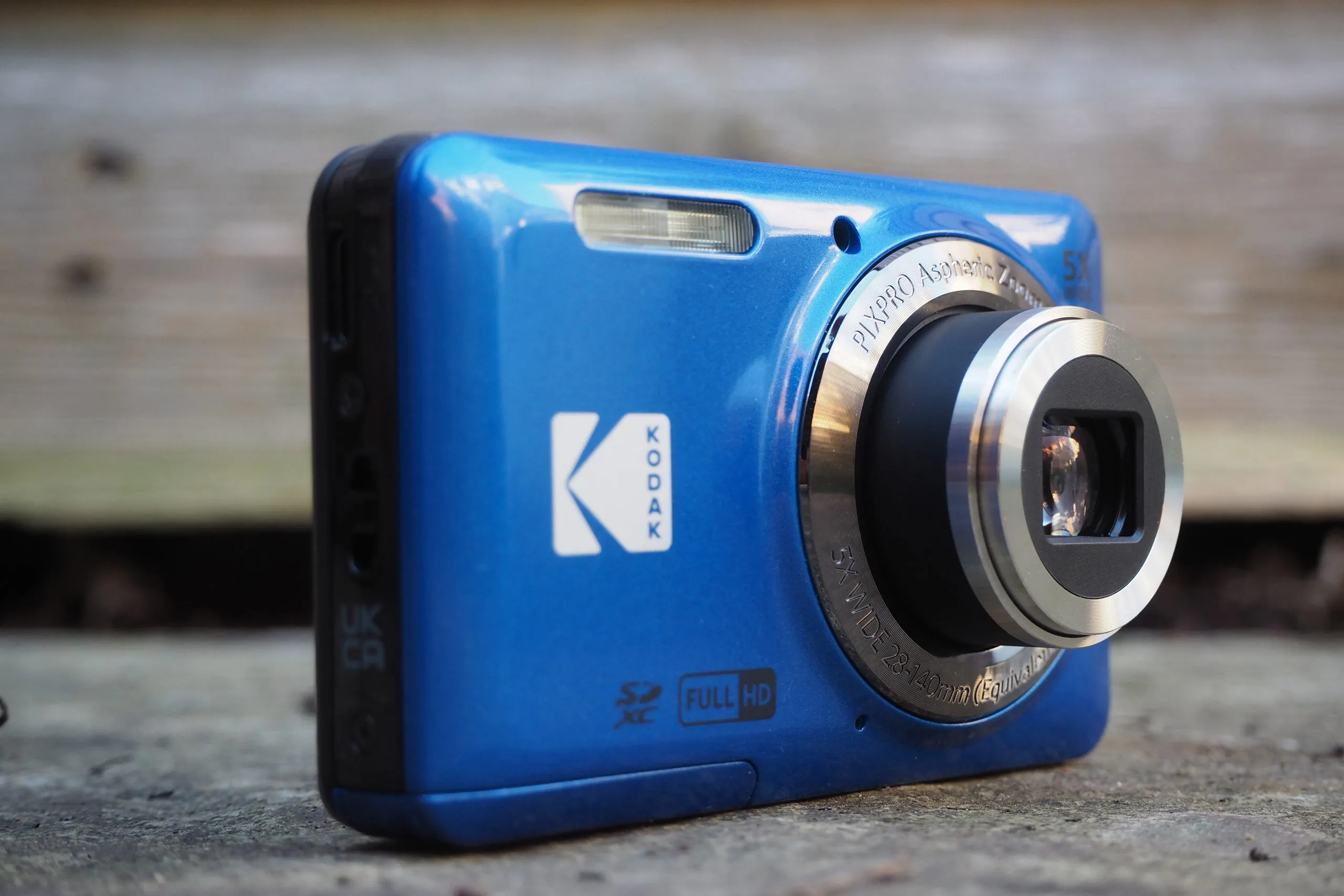
I suspect it’s the latter. And, at first glance, the Kodak Pixpro FZ55 does nothing to change my mind. Dinky and toy-like, with a shiny metallic faceplate to distract from its otherwise plastic-y build, the 5x optical zoom incorporating camera certainly feels constructed to hit a certain budget price point. One that will put it within the reach of TikTok viewers, or more likely their parents, at a reasonable £114 / $139. That price places it within gifting territory.
And it seems, from having an initial scroll through its drop-down menu, that someone seeking a simplistic, fuss free point-and-shoot for holiday or party snaps – which is where my teenage daughter most often uses her compact digicam – will potentially find a straightforward, non-threatening option here. For, in Kodak’s world, the ‘FZ’ in the FZ55 name literally means ‘Friendly Zoom’. Fortunately for the in-crowd, there is a dedicated party setting selectable from among the snapshot’s scene modes. Even if there’s no selfie mirror at the front, or flip up screen, to enable narcissism.
So does this pocket-sized almost pocket money point-and-shoot hit its target, or does it misfire when it comes to assessing handling and performance?
Kodak Pixpro FZ55 – Handling and design
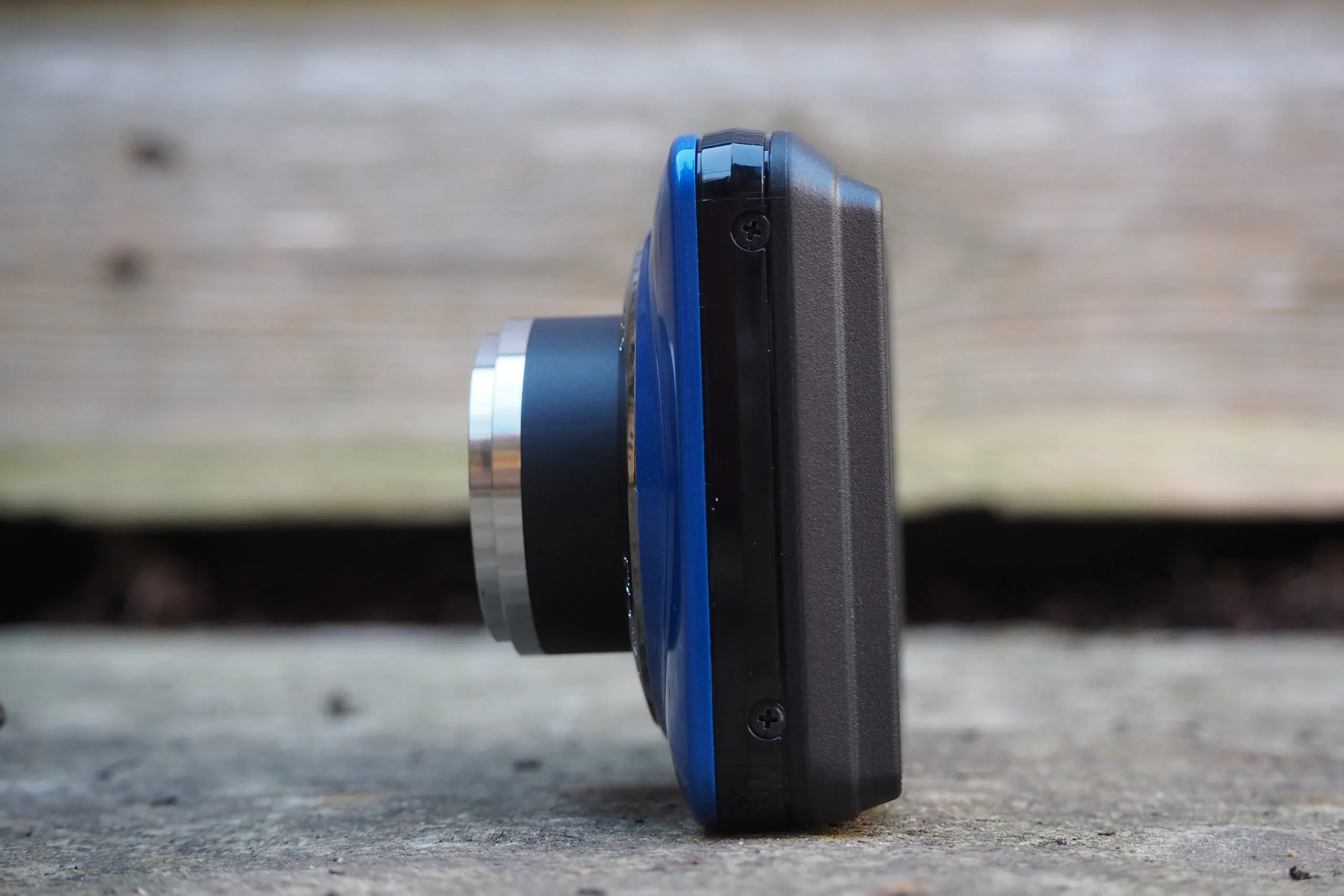
The Kodak Coolpix FZ55 very much resembles what anyone would expect of an inexpensive point and shoot pocket compact from anytime over the past two decades. Not much bigger than a credit card, though obviously with added depth due to its need to accommodate an optical zoom, time has stood still in terms of design. Whether through extreme laziness on the license holder’s part, or an ‘if it ain’t broke, don’t fix it’ approach, I don’t know. But it means the camera handles exactly as looks suggest. In being around half the size of an average smartphone, lacking anything in the way of a grip and featuring a shiny, slippery faceplate, there’s not much of it to provide a steady hold.
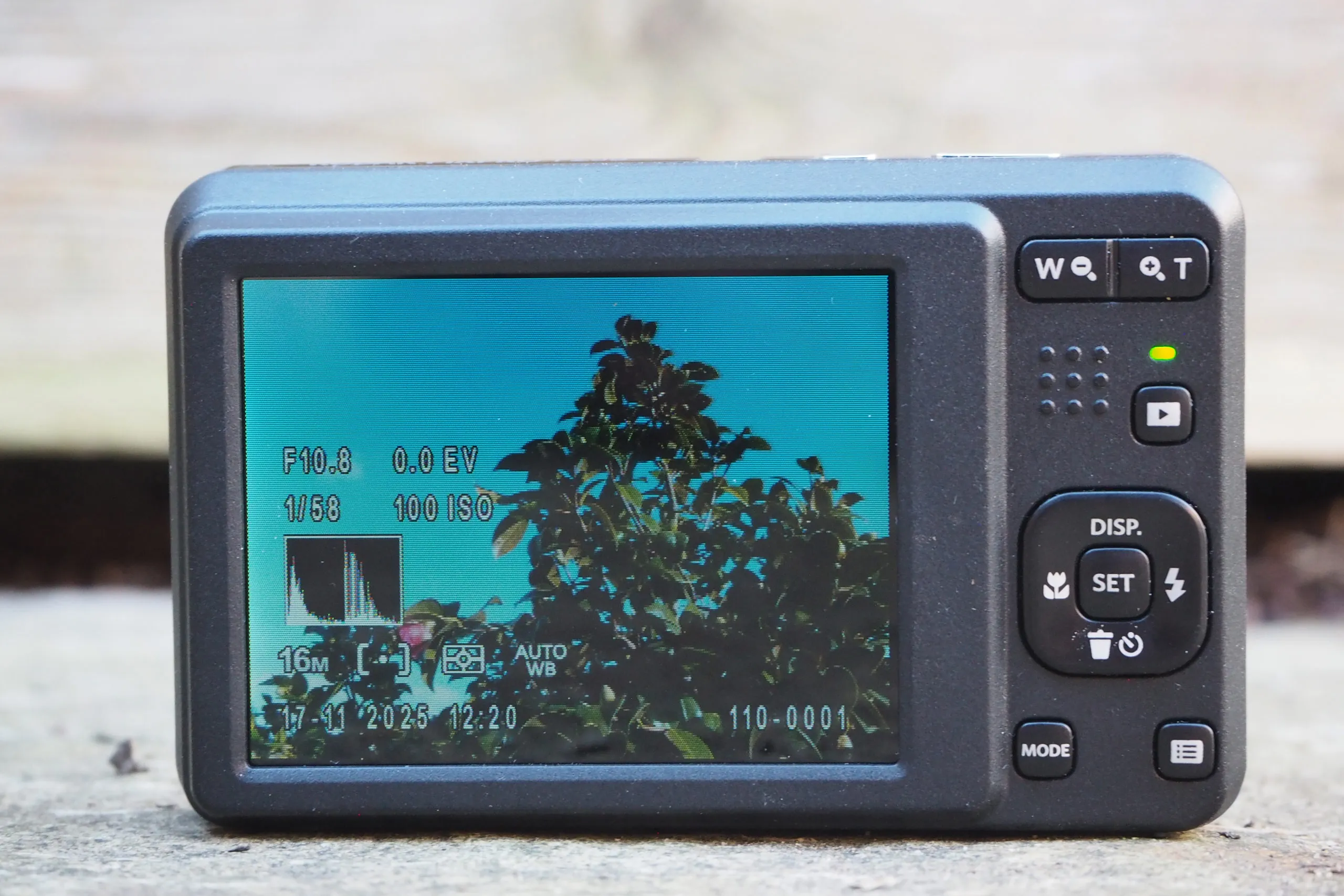
Yes, the left-hand edge of the camera’s baseplate features a screw thread for tripod attachment, but I feel carrying a tripod around would defeat the purpose of opting for such a small, portable snapshot.
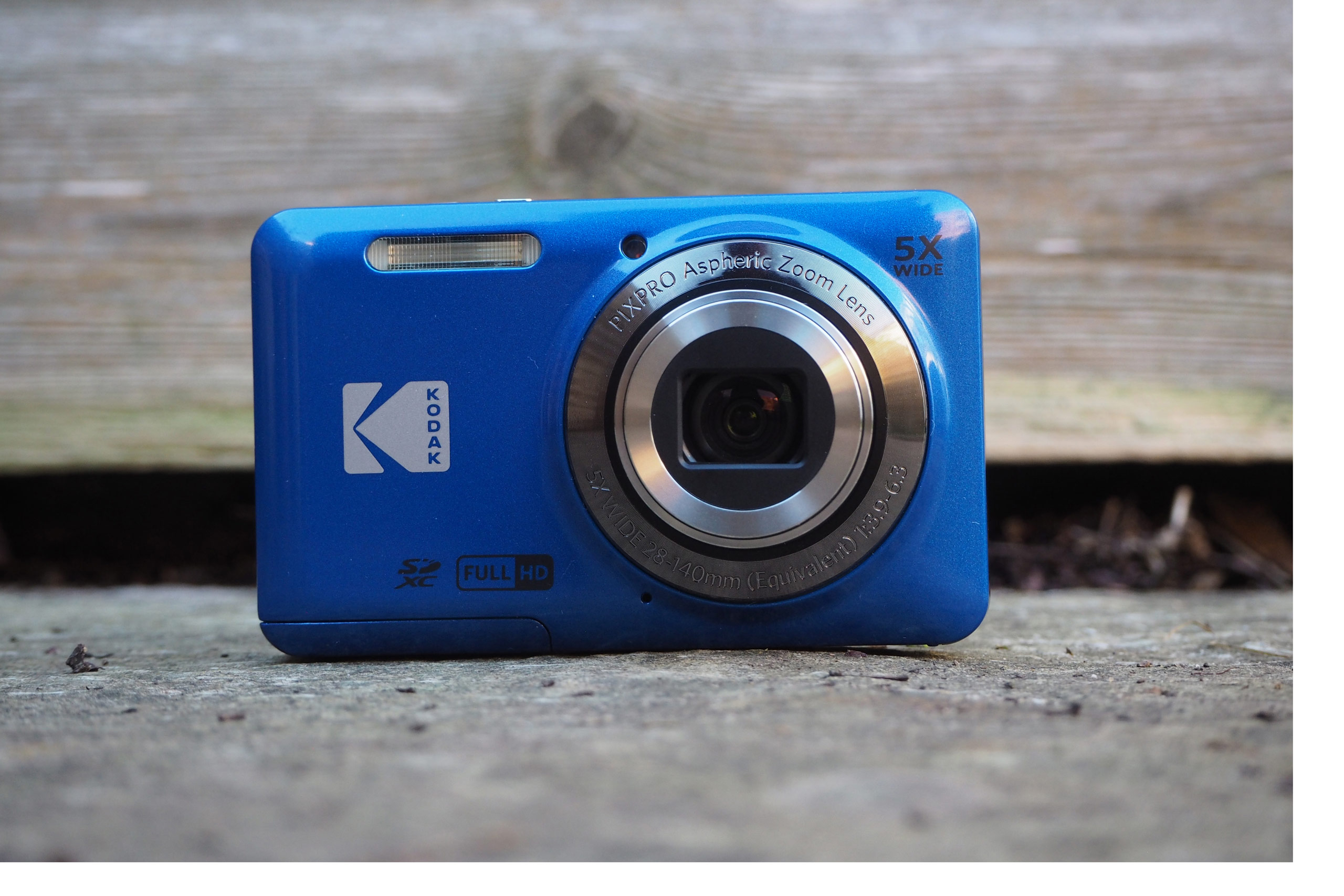
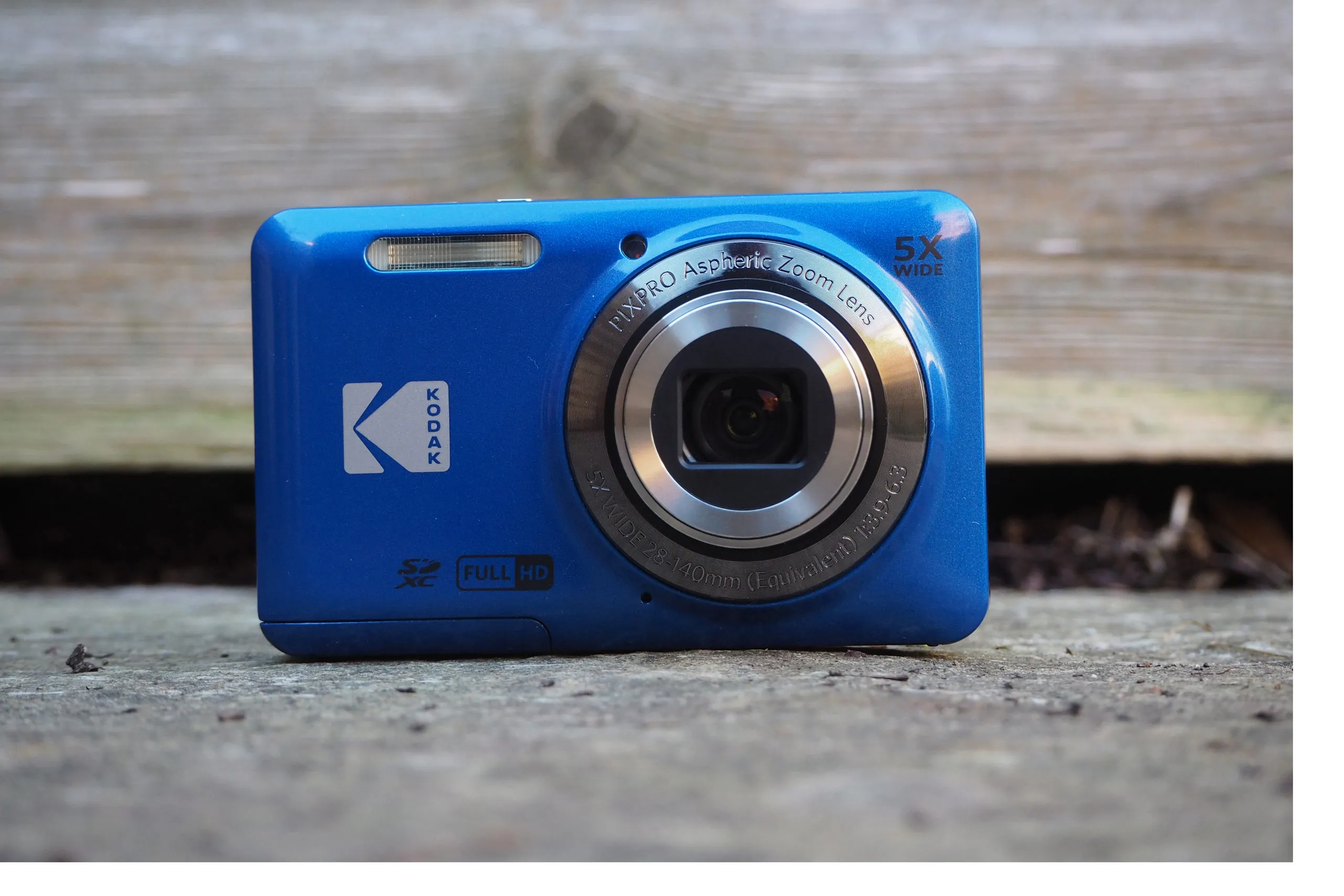
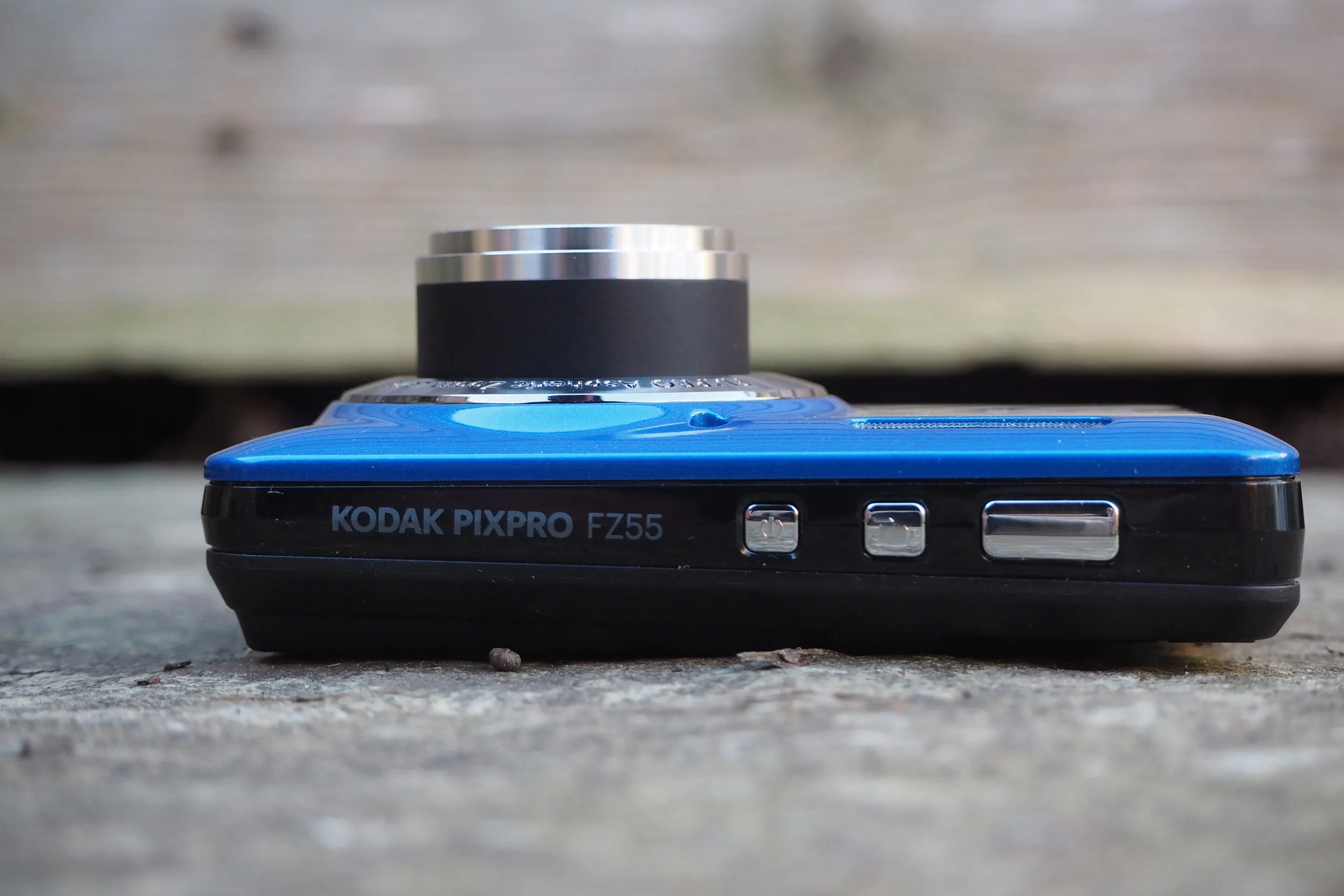
I had the deep blue metallic faceplate version of the camera in for review. Alternative red or black versions are also available. Keeping things simple, the top plate features a power on/off button, an adjacent ‘one touch’ button for recording Full HD video plus a larger lozenge shaped control by way of the shutter release button. With power up taking two to three seconds, the backplate layout keeps things familiar with a toggle switch placed under the thumb for adjusting the zoom and my framing, a playback button directly below for picture review, separate mode and menu buttons nearer the base and, sat between them, a four-way control pad. Ranged around the pad’s circumference are display, macro, flash and delete/self-timer settings, with a ‘set’ button in the middle for implementing whatever has been chosen.
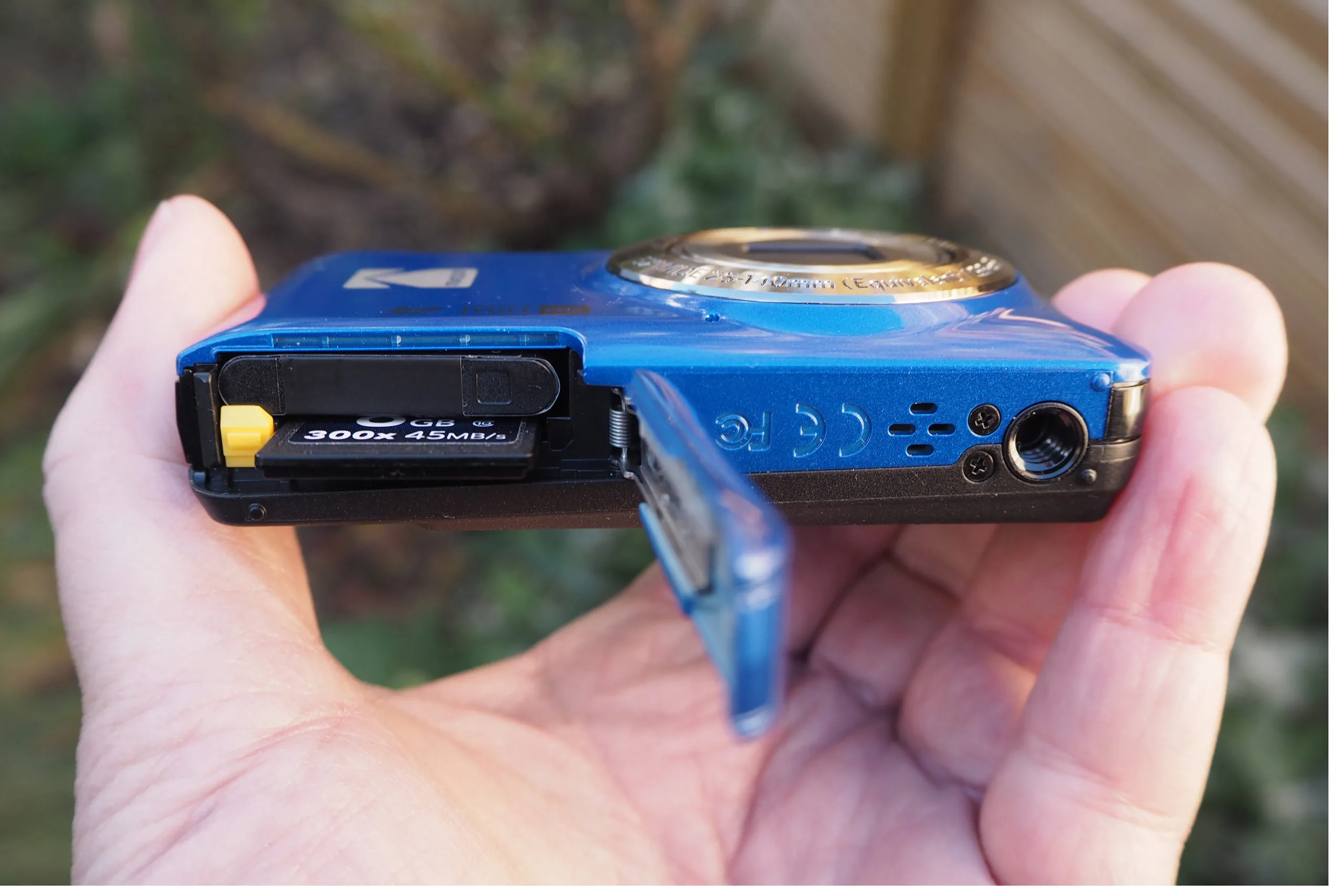
Like any old school digicam, the 2.7-inch screen is resolutely fixed to the backplate, meaning we can’t flip it to face subjects for selfies, as we can with the same sized LCD on the 13MP resolution fixed lens Kodak Pixpro C1. There’s no eye level viewfinder alternative, nor did I expect to find one and at a resolution of 230K, it’s not always obvious if the captured image is in focus or correctly exposed.
With unsurprisingly no Raw shooting option, there are instead three selectable JPEG compression levels to be had from digging further into the menus: Best, Fine or Normal. Naturally I went for the first option. While images are written straight to the inserted SD card, with up to 512GB varieties supported, in very, very old school fashion a miniscule 63MB of internal memory is provided to get newbies started straight out of the box.
Staying with the old school features, there’s similarly no on-board Wi-Fi or Bluetooth connectivity for the sharing of results. So, it’s a case of removing the card and placing it in a card reader or hooking the camera up to a PC via supplied USB cable, which is the most direct way to get images up on a desktop screen. The same cable is also used for recharging the removable lithium-ion battery in-camera. Once fully juiced, up to a maximum 200 shot performance is claimed, which is the same number of shots offered by its Pixpro C1 sibling, or an hour-and-a-half of Full HD, 30fps video.
All being said, in terms of handling, the credit card sized dimensions coupled with point and shoot operation make this camera a no-brainer option, suitable for pre-teens, families and pensioners alike. All major controls fall readily within reach of thumb or fingertip, allowing for spur-of-the-moment snapping and on-the-spot framing and function adjustments. The FZ55 is bare bones in terms of features, but in fairness sometimes less is more – particularly for anyone for whom this is a first camera.
Kodak Pixpro FZ55 – Build quality
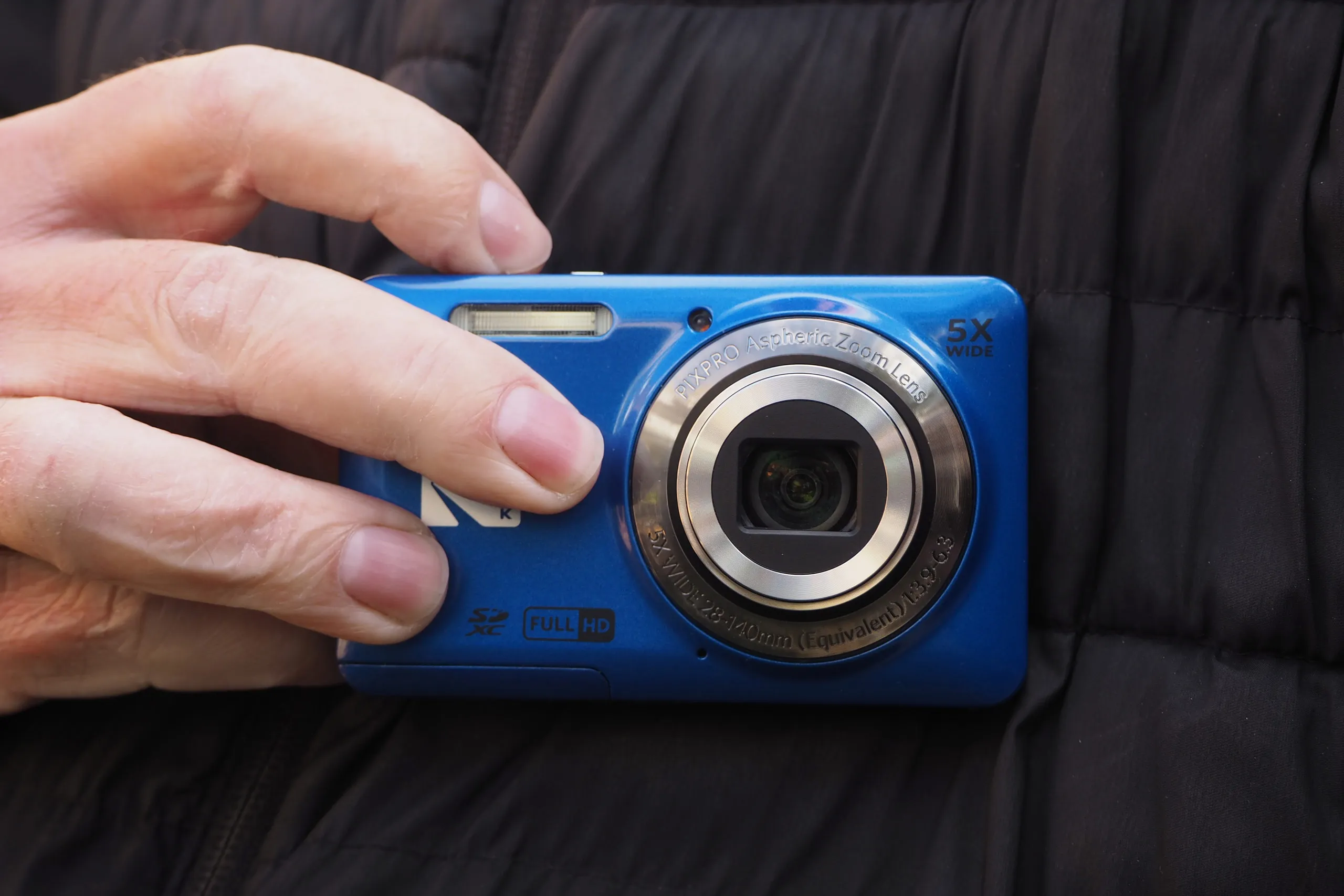
While typically plastic-y feeing and certainly lightweight at a body-only 106g, the Kodak Pixpro FZ55 has enough solidity to its construction that it doesn’t feel like it will splinter into a thousand bits of accidentally knocked or dropped. However, once again with a pocket-sized digicam, there is nothing here to get a good grip on. The shiny faceplate means fingers slide around and it’s all too easy to accidentally obscure the built in Xenon flash, while due to the thin bezel on the left-hand side of the rear 2.7-inch LCD it’s quickly smeared with thumb prints if attempting to steady the camera in both hands.
Sliding into the base of the device where it’s protected by a plastic cover is a LB-012 lithium-ion battery, good for around 200 photos from a full charge. Its compartment is shared with a slot for a standard SD card, rather than the microSD card favoured by the same brand’s Pixpro C1. The battery is charged within the camera, with a standard USB lead provided and an unprotected USB slot provided on the camera’s right-hand side, if viewing it from the back. Our UK review unit came without mains plug included, which is not atypical these days.
Kodak Pixpro FZ55 – Performance
With the beating heart of the Kodak Pixpro FZ55 comprising a 16.76-megapixel sensor delivering 16.35MP effective resolution, coupled with a 28-140mm equivalent optical zoom lens, the unassuming pocket snapper is suited to everything from wideangle landscapes to bring the faraway 5x closer. Which means most common subjects. An f/3.9 aperture at its widest setting means this is not going to be the best option for low light snaps however, built-in flash or not. Selectable light sensitivity tops out at a modest, maximum ISO3200. In terms of delivering a wider dynamic range, however, I was surprised to find an HDR option selectable from its screen-left dropdown menu.

Squeezing the shutter release fully with HDR active triggers three successive shots at different exposures. These are then automatically combined in-camera to form a single image. It’s tricky to determine much difference between results with HDR on or off, especially when viewed in situ on the camera’s basic 230K dot resolution LCD. Though when examined on a larger desktop, I did spot the HDR version occasionally clawed back some details otherwise lost to shadow.


Surprisingly, a Manual shooting mode is provided alongside Program, allowing for the adjustment of aperture, shutter speed and ISO, with the ability to tab between each via nudge of the control pad. In Program mode I can adjust exposure and ISO. Alternatively, there’s full Auto mode for the pure point and shoot experience, producing results best described as adequate rather than exemplary. Indicating its expected audience/s, a ‘Face Beautifier’ option is also provided among the virtual shooting mode selection, along with Panorama, Scene and dedicated Video mode, the latter also allowing for manual exposure adjustment for its maximum resolution 1080P clips at 30fps.

As with just about any snapshot camera, its best, most colour-rich results are to be had in the daytime with plenty of sunshine, indicating the FZ55 would be most positively viewed as a holiday companion for those times when we don’t just want to get the phone out. And for when having an optical zoom at our disposal might be useful for inching just that little bit closer, to fill the frame with our subject. The level of detail delivered is OK, if nothing special, with softness creeping in towards the corners of frame. I avoided using the built-in flash in the main, as its positioning top right of the lens meant that my middle finger often obscured it, simply in the act of trying to get a tighter hold on the camera’s slippery faceplate.




Here you can see the zoom range, from wide-angle to telephoto. In addition, examples with HDR switched on, which reduces the resolution to 8MP. When HDR is switched off, dynamic range is lower, but images are at the full 16MP resolution.
For more options, have a look at our guide to the 12 best second-hand classic compact cameras, or have a look at some vintage digicams.
Kodak Pixpro FZ55 – Verdict
The Kodak Pixpro FZ55 is another frozen in aspic point-and-shooter of the kind that were two-a-penny some 15 years ago. That’s not to suggest it’s not fun to use or doesn’t adequately fulfil resurgent demand for standalone snapshot cameras. It does. But I still got a distinct sense of déjà vu from handling this compact.
Plus, even if it does spoon-feed the public what they seemingly want, I wonder how long they’ll want it for, once the initial novelty of using something other than a smartphone wears off. For the price asked, however, there will undoubtedly be those willing to take a punt on this ‘Friendly Zoom’ if they don’t want to put a bid in online for something slightly better second hand.

Review sample kindly provided by Wilkinson Cameras.
Full specifications

| Sensor | 16MP resolution from 1/2.3-inch sensor |
| Lens | 28-140mm f/3.9-6.3 equivalent focal range |
| Zoom | 5x optical zoom |
| Focus range | 60cm to infinity focus range, or 8cm to infinity macro mode |
| Screen | 2.7-inch LCD screen |
| Viewfinder | No |
| Storage | SD card (max 512GB) |
| Video | Full HD, 30fps video recording |
| Battery | Removable lithium-ion battery (in-camera charging via USB) |
| Dimensions | 91.5×56.5×22.9mm in size |
| Weight | 106g body-only weight |