




In the digital world, where cameras are equipped with ultra-high resolution sensors and hyper-sensitive autofocus systems, loaded with clever AI-powered technology, it can be difficult to see how photography can get any better.
It is certainly a challenge to capture images which are truly original. After all, how can an image be one-of-a-kind when there are millions of files being created around the world each day, most likely of very similar subject matter? It’s a problem lamented by many photography purists, especially those with the drive to capture inspiring images that trigger an emotional reaction in their audience.
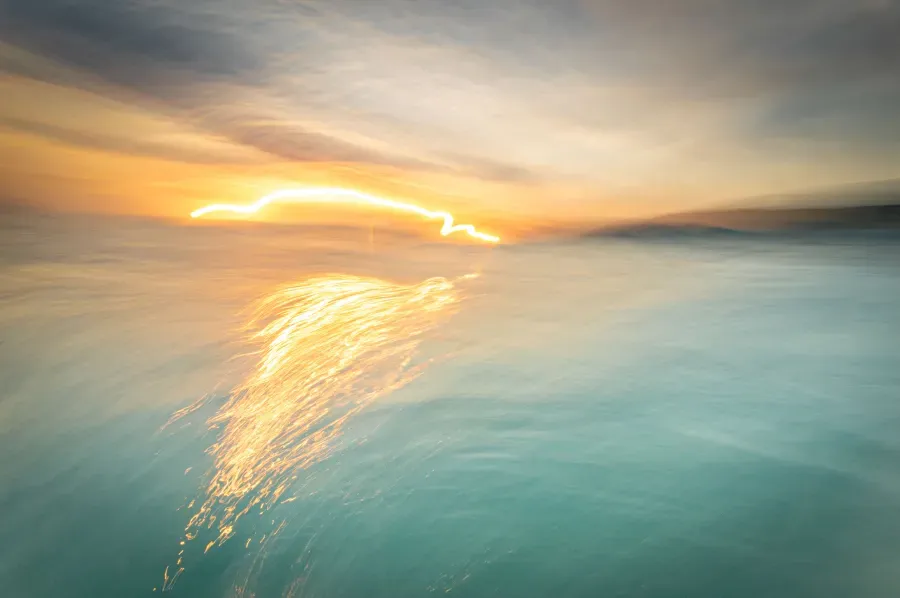
As is often the case whenever creative stagnation threatens to put the brakes on innovation, the best solution might be to do the unexpected. This is what photographer Bill Ward has made his signature style. His abstract seascape images trade sharpness for silky-smooth waves, captured using long exposures, and literal detail or painterly colour palettes drawn using an expert understanding of intentional camera movement (ICM). A professional actor by trade, Bill is also a passionate surfer, and so has spent a great deal of time in the water. It was this love of the coast that made a fascination with seascape photography inevitable.
“I do a lot of canoeing, sailing and bodyboarding. Water is my medium. I’ve always been drawn to the coast,” he explains. “I’ve surfed in Morocco, Portugal, the USA, France and beyond, so it’s no surprise that I now consider myself a coastal photographer.”
Bill’s photographic journey started in his twenties, first with a Kodak Instamatic and later with a Practika MTL5B, which he took travelling with him. This fully manual camera is what initially inspired him to adopt a see-and-shoot approach to photography, whereby he places less of a focus on planning a shot and more on using what the environment around him provides. These formative years are what would later inspire his Immersive project and the style for which he is now recognised internationally.
“In late 2009, I was working on a Pilot for a detective series in Montreal. We were waiting to see if the show would be picked up for a series, and during that four-month period, I was contractually obliged not to take on any other acting work. I wondered what I could do to fill the time, so I bought my first DSLR and a tripod, and set myself a photographic project,” he explains. “That’s how I became so project-based in the way I work”. The next stage was to combine his passions for water, photography and expression, culminating in his current body of work.
“As a surfer, my fascination is the transfer of energy between the sea and the land. I wanted to get a camera into that place, where I’d usually only use a surfboard. I started by getting as close as I could, either barefoot or wearing wellies. Then I went further in using a wetsuit. I would place the camera down as low as I could, wait for the wave, then pull the lens back and up over my head as it approached. I started to get photos that I’d never seen before.”
Into the water
From this point, Bill’s project became about experimentation and honing the recipe of camera settings and movements. “The next stage was to get the camera punching through a breaking wave, and that was the point at which I needed a waterproof housing. My interest was less in shooting huge sculptured waves. Mine was ICM – a moving camera, a moving body, and a moving wave.”
“For the images in my book, Immersive, my shutter speed varied quite a lot, ranging from as fast as 1/100sec to as long as three or four seconds. I like to try different combinations of exposure length with different movement types, as you don’t know what you’ll get until you try it. That is, of course, the beauty of ICM photography.”
As he began to work the waves, Bill developed a preferred method for shooting different water movements, based on the lighting and behaviour of the sea.
“When there is very little swell, and the setting sun creates a languid vibe, longer shutter speeds tend to suit this atmosphere better as they exaggerate the smaller movements. Meanwhile, shorter exposures seem to work more effectively with larger waves,” he says.
“I tend to shoot in Manual. I lock the camera off at a focus distance as it’s quite dark under the water, and lenses will start hunting, which isn’t ideal when it’s in a waterproof housing. I like to lock off the focal length and autofocus, then play with the other variables like shutter speed.”
Bill highlights that in ICM photography, the more control you take over each camera setting the more likely it is that you will discover a style of image that pleases you. He mentions aperture control, which raises an interesting point: when the intention of an image is to blur detail through long exposure, what effect can depth-of-field have, especially in the relatively flat terrain of a beach environment?
“Depth-of-field still has a big impact on the look of a shot,” emphasises Bill. “You still get a visibly selective focus even in a blurred scene, which impacts the contrast and contours of the breaking waves. You will get dark and light patches, and variable sharpness of these can help create separation between the centre and edges of the frame. I often shoot at f/16 for practical reasons, but I have shot my lenses wide-open at f/4, which makes shallow focus noticeable.”
Looking at the selection of Bill’s images that feature in Immersive, a pattern emerges – many are taken during the golden hours. Is this an aesthetic choice, as for many landscape photographers, or purely a practical decision?
“It started off practically because the ambient light is lower at these times,” he explains. “My first experiments were using a Ricoh GR3, which featured a built-in ND filter, making long exposures easier. Once I switched to a DSLR, I had to wait for the ambient light to drop and shoot later in the day. There’s actually a section of the book on stormy weather, so sunrise or sunset weren’t a prerequisite, but it is where the project started. The lower the light, the lower the shutter speed.”
Tools for the job
Neutral density filters still play a part in Bill’s repertoire, helping him to hold back the shutter speed just enough to hide or reveal the amount of detail he wants in his images. “I will often use a five-stop or three-stop circular ND to get the shutter speed down. Circular filters are needed as they are the only type that will fit in my camera housings. I do use variable NDs too, but for the images in Immersive, I simply controlled the exposure using ISO.”
“I’m using a Pentax K3 MKII, which is readily available on the second-hand market, so there is noise present, but I’m rarely above ISO800, and I quite like the extra texture it brings anyway.”
Bill feels that APS-C cameras suit his underwater work perfectly, not least because of their current affordability. “I started using a Pentax K1 full-frame model, but that’s not expendable. A waterproof housing will work until it doesn’t!” he jokes. “This type of work isn’t for the faint-hearted; you must accept that a housing failure is possible if not actually likely. I’ve broken two cameras doing this, so forward planning with your choice of camera is essential. The cameras I prefer are the cheapest!”
In line with the title of his book, Bill likes his viewers to feel immersed in nature through his images, and as such, he tends to favour wideangle lenses. “I tend to see wide, so I prefer shorter focal lengths. I shoot a lot on a Sigma 10-20mm lens [15-30mm in full-frame terms] as the wider I am, the more I feel that I’m surrounded by nature. This might be different for someone else, and I will then move through the focal ranges myself. I have a 55-300mm for detail, and the next iteration of the project is to move on to longer lenses.”
Bill’s top tips for ICM and underwater work
1 – Continuously experiment
Try everything. There is no right and wrong. The more variables you change – shutter speed, f-stop, camera movement – the more unexpected the results will be.
2 – Forget about ‘hit rate’
The nature of experimentation is that not all of it is going to please you, but use these misses to navigate towards what works. There is a reticence amongst people new to ICM about the number of images that don’t work. If you aren’t happy, change something. Use these to inform your direction.
3 – Develop your own taste
Decide if you prefer a completely abstract image or one that retains some detail so that the subject matter can be clearly identified.
4 – Prepare for housing failure
Accept that it’s at least a possibility and use this to keep you mindful of conditions. It only has to happen once for you to lose your gear.
5 – Stay safe at all times
This is far more important than any photography. Know your personal limits. Understand that Mother Nature can change sea states very quickly. Look at tide times and state. Look at rips and swells. Always assume the unexpected can happen.