

Photography has many benefits – depending on what you like to shoot and the camera or phone you use, it gets you out of the house and appreciating nature, or interacting with people. Photography can also help people cope with a major crisis.
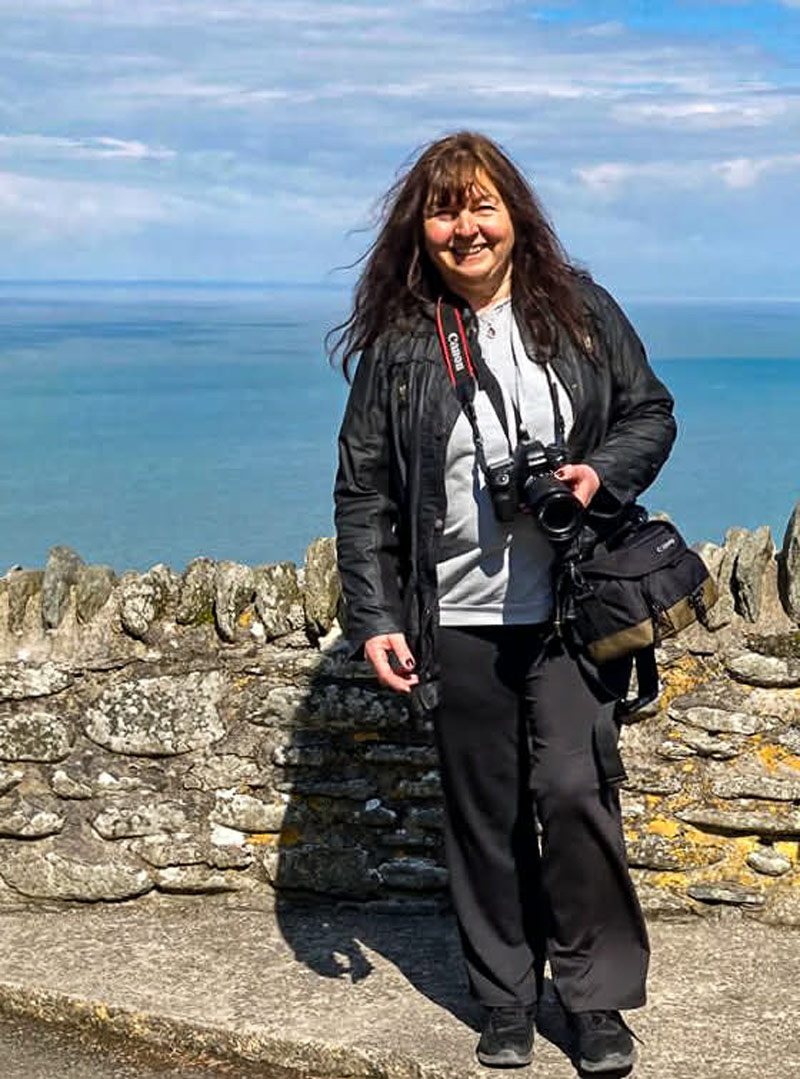
Take the example of Elaine Pratt, who found photography tremendously helpful following the suicide of her partner in 2019.
Elaine shares her story with Deputy Editor Geoff Harris below, highlighting the value of joining photography clubs to foster confidence and creative development.

Can you begin by giving us the background to what happened?
‘My partner, Geoff, took his life in February 2019. It was a massive shock that came totally out of the blue.
There was a lot to deal with, but photography definitely helped me because it was something I could do on my own. It didn’t rely on having to go out with somebody else… I could just walk with my camera in nature.
When you’re taking photographs, you enter into a space that takes you out of the ‘real’ world and you’re just so focused on what you’re shooting. For that split second, it’s just you, the camera and your subject.
After I got my own life together a bit more, I joined a photography club. This was a big deal, as it was the first thing I’d really done on my own since Geoff’s suicide.’

Were you nervous about joining a club?
‘Yes, I was definitely anxious about it. I thought, ‘what if it’s full of grumpy old men showing off about their equipment?’ I chatted to a friend and they advised me to just give it a go. If I didn’t like the club I could always make my excuses and leave.
As it turned out, the club, called Focus on Photography in Wells, Somerset, couldn’t have been nicer. They welcomed members of all abilities, and the other members were warm and friendly. I never felt people were judging me for my lack of ability, and the atmosphere was very supportive.
Just as I was getting back into the swing of things, however, the pandemic lockdowns hit the UK. It was a bit of a double whammy for me, because I was forced to give up this new social life that I’d found.
That was really hard, but fortunately I was able to keep on working in a supermarket, and got out with my camera and dog during my lunch hour. So I was able to get back into the zone, and carry on with the club through Zoom meetings.’
So how, specifically, can photography help people to deal with grief?
‘Well, photography is a lot like grief – you can’t hurry either of them. You wait for the bet conditions to take the picture, and there’s nothing you can do to hurry those conditions along.
You can’t make it stop raining, for example, and you can’t push people out of the way. Grief is similar. You have to wait for it to take its course. One day, things start to feel better, but you don’t know when that day will come.
I think that’s what kept me going. That, and getting out into nature, particularly at this time of year as we come into spring and you see new flowers coming through. I love taking photos of snowdrops, daffodils, crocuses, anything like that, because it reminds you that life goes on.
However sad you’re feeling it just reminds you that there’s hope and it’s not always going to be about the dark times. It’s not always going to be about death, because life comes back (though of course, it’s always going to be different life).
Photography gives you a reason to get out of the house, and you can’t be miserable when you’re looking at the beauty of nature.’

Had you been interested in photography before your loss?
‘Yes, I’ve always taken photos, because I’ve suffered with anxiety and depression for most of my life and it’s always helped me. I started off with a little compact camera and it grew from there. Also, I never did photography with my late partner, so it wasn’t like it brought back painful memories or anything like that.’
How has your photography changed over the years?
‘I’ve gone from mainly doing nature photography to being interested in still life and more ‘artistic’ photography. Now I like to experiment with still life, intentional camera movement (ICM) and multiple exposures – I really like to create artistic images and recently started to experiment with vintage lenses, too.
My photography’s developed as I’ve developed, as an individual, I think, because this terrible thing that happened changed me – I had the find the ‘new me’ in lots of ways.’

What advice do you have for a bereaved or depressed person who’d like to try photography, but lacks confidence?
‘Just start with baby steps. Most people have got smartphones now, so just get out there, just start snapping away. It doesn’t matter what you take a photo of.
If you suffer from a creative block or struggle to find inspiration, I find it helpful to go out with my camera, but without a plan. I’ll just snap anything and everything. Then when I get home, I will probably delete half of them, but it gets me back into the groove of it.
Remember too that photography is one of the best ways to practice mindfulness, because when you’re there with your camera, you’re so into it that everything else just fades away for that moment.
And as mentioned earlier, don’t be afraid of joining a camera club or photographic society. There are lots now, so find one that is inclusive. The best will support you and help you to develop as a photographer rather than expect you to know it all.’
If you are suffering from a mental health crisis help is available in the UK from The Samaritans by calling 116 123. In the USA, you can contact The 988 Suicide & Crisis Lifeline (simply dial 998)
Further reading
How photography boosts my mental health: real-life stories