


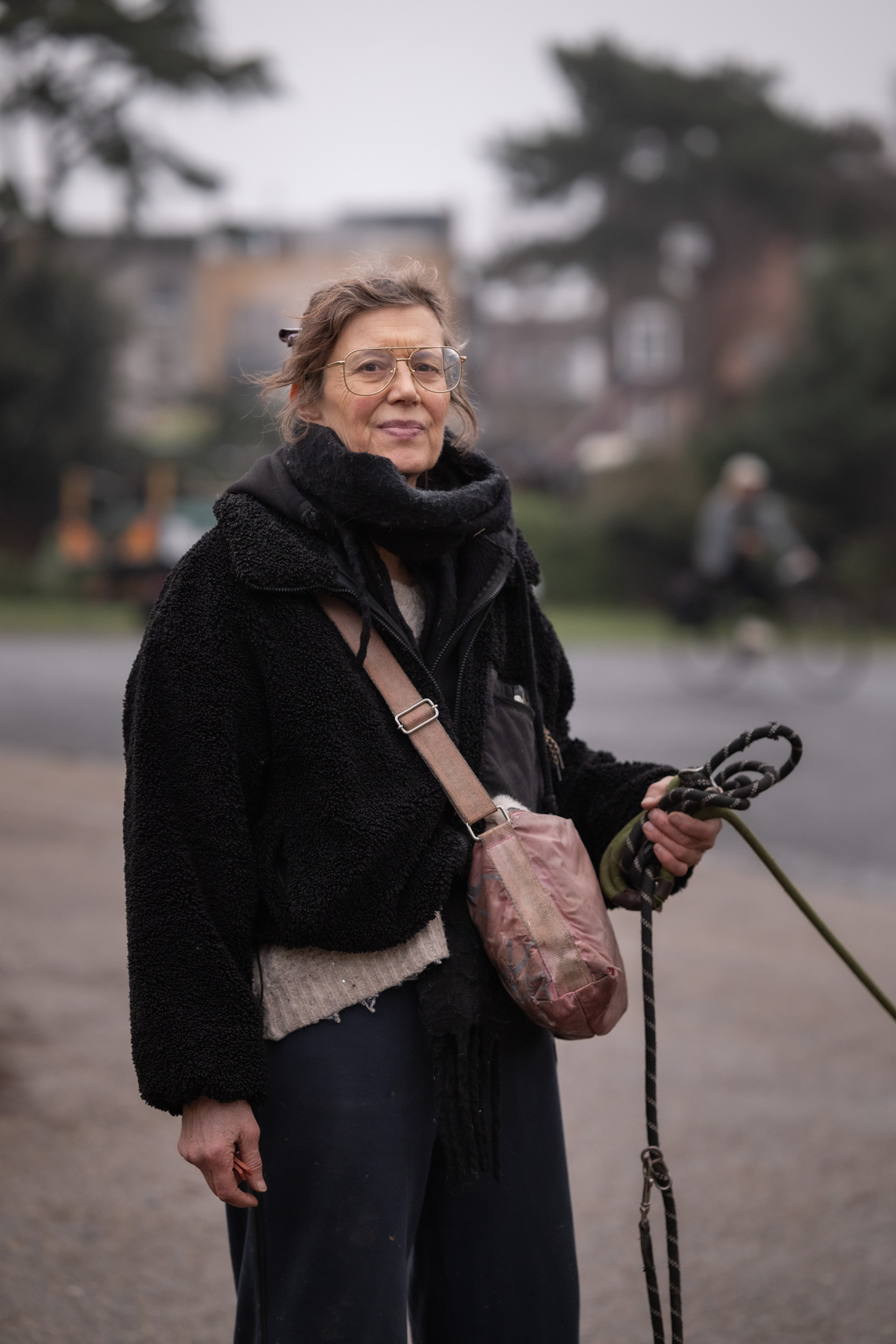
When you’re making a portrait, where are your eyes? Not your lens. Your eyes. I’ve been exploring this question in one of the most exposed forms of portraiture: approaching people I don’t know on the street and asking to photograph them. There’s no prior relationship, no safety net, and it takes place inside a culture that has made suspicion the default and connection the exception. I do it because it frightens me, and because fear met gradually and courageously becomes confidence, regardless of the outcome.
In front of you is just a person who may be battling their own uncertainty about being photographed, wondering why you chose them or how you might use that image. Running in parallel is the photographer’s interior battle: our doubts and the stories we tell ourselves about the person in front of us. We must let go of our preconceptions and ride whatever unfolds in the space between us. What that laboratory teaches applies to any portrait you make, of anyone, anywhere.
I’m more concerned with process than tools, but tools are clearly relevant to process. This is what happened when SIGMA commissioned me to make a series of street portraits with the Sigma BF camera and an 85mm Art f1.4 lens, and how that changed the way I make them.
Background
I came to photography through moving images, working first as an editor and an analogue colour printer, and later as a colourist in cinema. The background I have in psychology and therapeutic photography shows up in how I look, how I listen, and how willing I am to stay present.
These portraits are a new chapter in a larger body of work, A Fear of People. I began it in 2019 as an intentional, daily practice; a personal experiment to face social anxiety and a fear of rejection. Habit, I have learned, is the mother of creation. It changed more than my photography.
What the BF Forced
For many people, especially those with neurodivergence, the world is too loud. The camera quiets that noise and focuses your attention literally and metaphorically. For this reason, the viewfinder has always been central to how I work. The camera to my eye, composition my primary concern, everything outside the frame falling away. Surfers talk about the barrel, that brief, silent enclosure inside the ‘green room’ of a breaking wave. Looking through a viewfinder feels similar. I hadn’t fully confronted how dependent I’d become on one until SIGMA removed the option entirely.
The BF is an unusual-looking camera: a solid seven-hour machined aluminium alloy unibody with no viewfinder, not even as a possible accessory, no articulating screen, 230GB of internal storage and, from the front, not much larger than a phone.
I’m farsighted, so even with bifocals, it’s hard to resolve a face or read an expression on the screen. I learned to compose the frame, trust the touch-focus precision, lower the camera, and stay present for the moment rather than the image being made. The person in front of my lens wasn’t looking at a machine anymore. They were looking at me. And I was looking at them. Removing the viewfinder did not just change how I framed; it changed how I related.
The Encounter Changes
Susan Meiselas said the camera gives you both a point of connection and a point of separation. A person who sees a machine rather than a face has nothing to locate themselves against. It’s a kind of snowblindness. When someone can see your eyes and read your face, they feel seen rather than watched, and they respond differently. What follows feels less like a void and more like an embrace. We can forgive a compositional failure more readily than a failure of connection.
A photographer who looks at life experiences it. Confine your experience to a viewfinder or a screen, and you get a facsimile. Without a camera between us, I returned to my body and the person in front of me, but the frame was no longer my primary concern. The person was. Counterintuitively, it is restriction, not freedom, that summons creativity.
Dunbar’s Radius
I’m calling this body of work Dunbar’s Radius. It takes its name from Robin Dunbar’s idea that the human brain has a cognitive limit on the meaningful relationships it can sustain, roughly one hundred and fifty, shaped less by choice than by repeated exposure. Beyond that number, people stop being individuals and become categories. It has a spatial equivalent: the walkable neighbourhood, roughly fifteen to twenty minutes on foot, the scale at which daily life creates repeated, ordinary contact.
Frequent exposure to diversity makes difference familiar. To an underexposed nervous system, difference registers as threat. Every screen hands you a virtual world but withholds the physical encounter, familiar enough to feel like exposure, insufficient to do its work. Our tolerance for difference is shaped by what our nervous systems have encountered, firsthand and repeatedly.
So I walked within a twenty-minute radius of my local shopping centre and made portraits of whoever daily life placed before me. The diversity I encountered was not exceptional. It was Tuesday.
What The Lens Gives
Looking at life through a SIGMA 85mm Art f1.4 is seductive in a way that makes the viewfinder habit even harder to break. But our eyes see more than any screen. What I lost in how the world looks through the glass, I found in what I can transmit through a photograph.
Transcendence belongs to the act of seeing beyond the surface. Edward Weston understood this when he spoke of his peppers, ordinary objects transformed not by their unusual nature but by the sustained attention of the photographer, moving beyond illustration into something felt rather than merely recognised. The lens interprets, translating a three-dimensional living person onto a flat plane, but it doesn’t author the encounter.
A portrait reveals more about the photographer than the photographed. It is a composite of a moment in time between two people, both projecting, drawn by light, witnessed by a machine. Which is why connection is essential, and why so many portraits feel empty, awkward, or both. I am not simply documenting a likeness, but transporting that moment of connection between us to you.
Shot wide open at f1.4, the rendering on the 85mm is luminous. It offers a depth of field that separates a face from the world behind it with something close to tenderness. I was surprised by how much of a face stayed in focus and how rarely I lost the eyes by mistake, which is owed as much to the lens as to the auto-focusing system and full-frame sensor. I usually photograph with a 50mm-equivalent lens on an APS-C sensor but avoid shooting wide open. Full frame has clear advantages and my attention.
Technical Honesty
When I want to fine-tune the plane of focus, I switch to manual, helped by the BF’s magnification and peaking. The aperture ring de-clicks, enabling seamless movement between marked stops, allowing me to ease in more depth of field when needed. The focusing system is strong. But if I could change one thing, it would be finer, more transparent control over autofocus modes: a way to move quickly between a single point, a wider area, and face or eye detection without stepping into the menu system.
I value the ability to preview an in-camera image through SIGMA’s tastefully built native profile modes. Most of the time, I used Warm Gold, which offers a gentle, honeyed tone. Because I shoot RAW, I’m not locked into it. There is a persistent idea that cameras have a distinctive look baked into the sensor, but what most people are responding to is a camera’s JPEG engine: the in-camera interpretation of the RAW data, not the data itself.
The difference is in how the RAW files behave in post-production. With some cameras, files feel loose. A small movement of a slider produces a disproportionately strong change. By contrast, SIGMA’s RAW files respond in a controlled way, making grading more precise and allowing me to achieve the deliberate look I want. One feature I’d love: the option to load custom profiles into the camera so the in-camera preview reflects my taste.
The Close
Thousands of photographers share the same cameras and lenses and make entirely different images with them. What varies is the person using the equipment: where they stand, where they look, when they press the shutter, and whether they are present enough. We create the conditions for encounter; a camera can nudge our mindset toward it or away from it. The BF, in its simple insistence that I show up rather than retreat behind my equipment, proved to be exactly the right camera for this moment in my practice.
SIGMA named the BF well: beautiful foolishness. Something beautiful returns when you loosen your grip on the frame, lower the camera, and meet a person without using it as a shield. I would recommend it to any photographer willing to let go of the comfort and weight of a viewfinder, especially if you are curious and courageous enough to step out from behind it.
Prime Examples, a SIGMA-commissioned exhibition at the Royal Birmingham Society of Artists Gallery, is on view from 31 March until 11 April. It brings together six photographers, each working with a SIGMA BF and a different Art lens.
Related reading:
- These tender portraits of the Queer community in 60s and 70s New York deserve your attention today [NSFW]
- These striking portraits by American photographer Catherine Opie are bold and beautiful
Follow AP on Facebook, Instagram, YouTube and TikTok.