

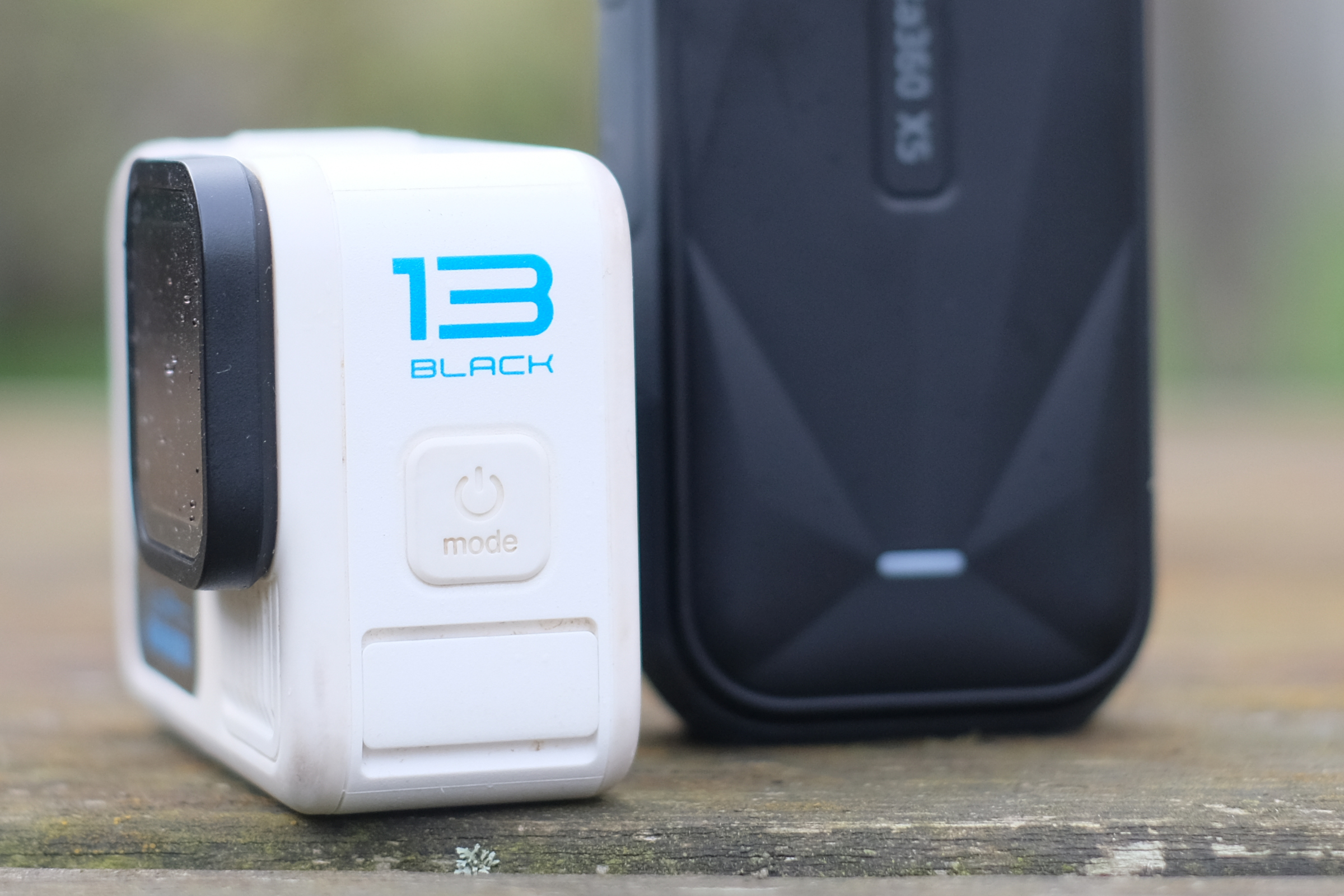
If you’re deciding between a 360-degree camera versus an action camera, you may well be looking at the top market leaders like the Insta360 X5 and the GoPro Hero 13 Black. But which to choose?
Before we get into it, I’ll say up front that this is going to work a little differently to most of our other ‘X vs Y’ pieces. We’re not here to decide which is ‘better’, since action cameras and 360-degree cameras are different tools that work in different ways. Action cameras are tough little waterproof devices that capture stills and video from a fixed perspective; 360-camera use dual lenses and sensors to capture a wide, immersive field of view, which can either be exported as fully navigable interactive content, or converted into conventional footage using editing software to frame in on the most interesting action.
This guide is here to help you figure out which one of these cameras is right for you, and the answer to that is going to depend on your individual priorities. I’ve taken the Insta360 X5 and GoPro Hero 13 Black as representative examples of each camera type, from the two most popular manufacturers on the market in their respective fields. Let’s take a closer look at how they perform.
At a glance
| Insta360 X5 | GoPro Hero 13 Black | |
| Sensor | 1/1.28-inch CMOS (x2) | 1/1.9-inch CMOS |
| Lens FOV | 180° (x2) | 156° |
| Lens aperture | f/2.0 | f/2.5 |
| Max. video resolution | 8K 30p (360°) | 5.3K 60p |
| Max. stills resolution | 72MP | 27MP |
| Battery | 2400 mAh | 1900 mAh |
| Built-in storage | No | No |
| Waterproofing (without case) | 15m | 10m |
| Dimensions | 46 x 124.5 x 38.2mm | 71.8 x 50.8 x 33.6mm |
| Weight | 200g | 159g |
Price & availability
The prices of action cameras and 360-degree cameras are not hugely dissimilar. While there is plenty of variance between individual brands and models, in general, a top-line flagship action camera is going to be cheaper than a top-line flagship 360-degree camera. The GoPro Hero 13 Black currently goes for a starting price of $329 / £279, while the Insta360 X5 currently goes for $559 / £409.
Granted, the GoPro is a year older. But if we look at a more contemporary flagship action camera like the DJI Osmo Action 6, that still goes for a lower starting price of £329 in the UK (it isn’t currently available in the US due to ongoing trade/tariff issues). So for a comparable level of performance, you are likely going to spend more on a 360-degree camera.
Design and waterproofing
Design-wise, while the GoPro and Insta360 cameras look quite different at first glance, in practice they are a similar size and weight, and tend to be used in similar ways – usually on the end of a handheld grip, or mounted to a helmet, handlebars or other such sporting paraphernalia.
It used to be the case that action cameras ruled the roost when it came to waterproofing and general hardiness. However, Insta360 has started kitting out its flagship cameras with native waterproofing, so now, while the GoPro Hero 13 Black can survive down to depths of 10m, the Insta360 X5 can go beyond it to depths of 15m. Both can also be kitted out with separately-sold dive cases to significantly extend their waterproof rating to depths of 60m.
While both cameras are reasonably tough, for extreme sports shooting and dangerous situations, a GoPro is the safer choice. These little cameras have been truly tried and tested over the years, and have survived close encounters with lava and freefalls from skydives. Our former Deputy Tech Editor Tim Coleman reported that his GoPro Hero 13 Black hit a go-karting track at 35km/h when a mount came loose, and suffered only minor scuffs.
Whereas a 360-degree camera like the X5 has a vulnerability that is baked into the design – those two big, bulbous lenses that each capture a 180-degree field of view. The X5’s lenses have been upgraded with newly toughened glass, however they’re still going to be vulnerable to scratches and other damage – to the point where Insta360 offers a cheap lens replacement kit to give users a bit more peace of mind.
So, while 360-degree cameras aren’t exactly fragile, if it’s ultra-toughness you’re looking for, an action camera is going to be the best choice.
In use
When you’re filming an action camera, you want it to be pointed towards your subject of interest. That may sound a bit obvious, but it’s the key difference here, because it’s not the case with a 360-degree camera like the Insta360 X5. A 360-degree camera captures just that – a full, panoramic view of the camera’s entire surroundings (I mean, technically it’s more than 360 degrees since it operates in three dimensions not two, but let’s not get into that or we’ll be here all day).
This means that filming with a 360-degree camera can be incredibly easy. As long as you’re holding the camera up, it’ll capture everything that happens around you. They’re great for travelogues, bike rides and similar kinds of videos, as you can simply set the camera up and not worry about where you’re pointing it.
I captured a short video on a walkthrough of London’s Chinatown. All of the camera movements were achieved in editing, using keyframes – you simply manoeuvre to the particular 16:9 slice of the footage you want to focus on, then mark it with a keyframe. The software will smoothly transition from one keyframe to the next, giving the impression of a moving camera, and you can select different transition styles for fast or slow movements. So, in this case, when some funky costumed characters turned up, I was able to manoeuvre the frame to focus on them even as I kept walking past, without having to reorient the camera.
This isn’t terribly difficult, but it’s not straightforward either, especially for someone who’s new to video. Working with the footage also requires a fair amount of computing power – though I had downloaded the Insta360 app, my knackered Android phone was singularly unable to cope, and even on desktop, my newish M4 Mac Mini coughed and spluttered a few times.
With the GoPro, it’s a different story. Using the well-named GoPro Quik app, I was able to view my footage and quickly trim out a short walk-through of the Covent Garden Christmas Market, and within minutes I had a short clip ready for sharing. Alternatively, I could simply offload the footage onto my computer, and easily tinker with it in my editing software of choice (DaVinci Resolve) – no special programs required.
It’s a similar story with photos. The Insta360 X5 captures an immersive, wrap-around still frame of everything in the camera’s purview, which you can then navigate through at your leisure in software to pick out a standard aspect-ratio still of your choice.
Whereas the GoPro captures a single still from a fixed perspective – less versatile, but much quicker to edit and share.
It’s worth noting that most 360-degree cameras like the Insta360 X5 do offer single-camera modes, allowing them to function much more like a conventional action camera – arguably giving you the best of both worlds. However, if you’re mostly going to be using this mode, then you might as well save yourself some cash and just get an action camera.
Verdict
Get an action camera for… affordability, toughness, quick shareability, and ease of use in the edit. If you want something to point and shoot photos or capture quick vlogs, something that’s going to allow you to share content when you don’t necessarily have access to your top-end tech, then an action camera like the GoPro Hero 13 Black is going to suit you perfectly, at an affordable price.
Get a 360-degree camera for… quality, versatility, and ease of use on the shoot. These cameras tend to offer impressive raw video quality and higher native resolution than action cameras, and the nature of 360-degree video means you can be confident you haven’t missed the moment. If you want to be able to capture moments on your travels without worrying about framing up, then a 360-degree camera like the Insta360 X5 is the perfect choice – as long as you don’t mind having some work to do in the edit.
Some of the equipment for this article was kindly supplied by Wex Photo Video.
Follow AP on Facebook, Instagram, YouTube and TikTok.