

The perfect camera doesn’t exist and neither does the perfect format. That sounds contentious, but the fact is we are all different, whether that is in physiology, expectations, budget, personal preferences or what we like to photograph. What’s important, though, is to have kit we enjoy using and that delivers great results and is as close to perfect as we can manage, and the camera format has a big role to play.
What you prefer depends on where you are in your photographic journey. Newcomers to system cameras will probably have a different outlook on the four digital formats – Micro Four Thirds, APS-C, full-frame and medium-format – from shooters who have been around the block a few times. Furthermore, experienced shooters will also have existing kit and the benefit of hindsight and will only change format for a compelling reason or specific purpose.
Format background
MFT (Micro Four Thirds) is a relatively young format, uses a 17.3x13mm sensor size, and the Micro Four Thirds lens mount. The first Micro Four thirds camera was the Panasonic Lumix GH1 which came out in 2008. Panasonic still has a serious presence in MFT but it also has a major full-frame commitment too. Another big MFT player is OM System (formerly Olympus) and it’s notable that it’s committed to just one format.
The full-frame sensor measures 24x36mm (the same size as 35mm film), and the full-frame format has been around for much longer with film cameras having been around for over a century, although the first full-frame digital camera, the Contax N Digital, came out in 2002, only six years before the Lumix GH1.
The 35mm format’s long history is what puts it in the position of being considered the ‘standard’. So when it comes to discussing the crop factor of other formats, the base is full-frame and it’s the same when it comes to illustrating the effect of focal lengths in different formats.
The crop factor of MFT is 2x that of full-frame, so a MFT 300mm lens gives the same field of view as a full-frame 600mm lens. It’s worth pointing out that while the view might be same, the amount of depth-of-field, aperture for aperture, is not. As a guide, shoot at f/2.8 on a 25mm MFT lens and the depth-of-field is the roughly same as that at f/5.6 on a full-frame 50mm lens.
In the benefits column, having more depth-of-field on tap in MFT has advantages in landscape where you want lots of sharpness, and close-up photography where depth-of-field gets shallower the closer you get to the subject. But this works against you when want a shallow depth-of-field for selective focusing and blurry backgrounds, and if you want a similar look on MFT you need fast lenses. In this scenario, a 100mm f/2.8 lens on full-frame behaves like an MFT 50mm f/1.4 in respect of depth-of-field.
Luckily, there are plenty of fast aperture MFT lenses around including several with super-fast f/0.95 and f/1.2 apertures. Voigtlander has the remarkable 29mm f/0.8 Super Nokton, the world’s fastest camera lens in production; f/0.8 is 2.5 stops faster than f/2.
Long and the long of it
Continuing with lenses, it’s with telephotos where MFT holds a significant advantage. Focal length for equivalent focal length, they are often smaller and lighter and because less raw material is used, they are also generally less expensive. The smaller lenses also have an advantage when it comes to buying filters.
Nowhere is this more pronounced than with telephotos. The OM System 300mm f/4 weighs 1.27kg and costs $2999 / £2399, which plays against the Nikon Z 600mm f/6.3 which weighs 1.47kg and is double the price at $4197 / £4799. For a direct f/stop comparison, the Canon RF 600mm f/4 costs $14,499 / £14,179 and tips the scales at just over 3kg.
There are exciting optics such as the new OM System ED 50-200mm f/2.8 IS Pro which is a 100-400mm equivalent in full-frame, weighs 1075g and costs $2999. The nearest full-frame equivalent in terms of maximum aperture is probably the Canon RF 100-300mm f/2.8 and that comes in at 2.59kg and $10,599 / £11,499. Just to show that it’s not straightforward when it comes to making this sort of comparison, the Canon RF 100-400mm f/5.6-8 weighs 635g and is a budget $749 / £627.
Long lenses in practice
Photographing commercial airplanes as they come into land is not an exact science, especially when you are literally miles away, but these shots of the same plane type were taken roughly at the same point in the flightpath.
We are comparing format, not the lenses, because the OM System 150-400mm f/4.5 is $9000 / £6695 so roughly 2.5x the price of the Sony FE 400-800mm f/6.3-8 G OSS at $3299 / £2549.
The quality of the edited Raws is impressively good but close inspection showed that the OM System shot had a lovely clarity, and fine detail looked wonderful. The Sony image was obviously very good but the detail of the undercarriage was less crisp than the OM’s. Both images scrubbed up nicely with noise-free skies thanks to Adobe Lightroom Denoise. (Click to view larger versions)
Onto cameras
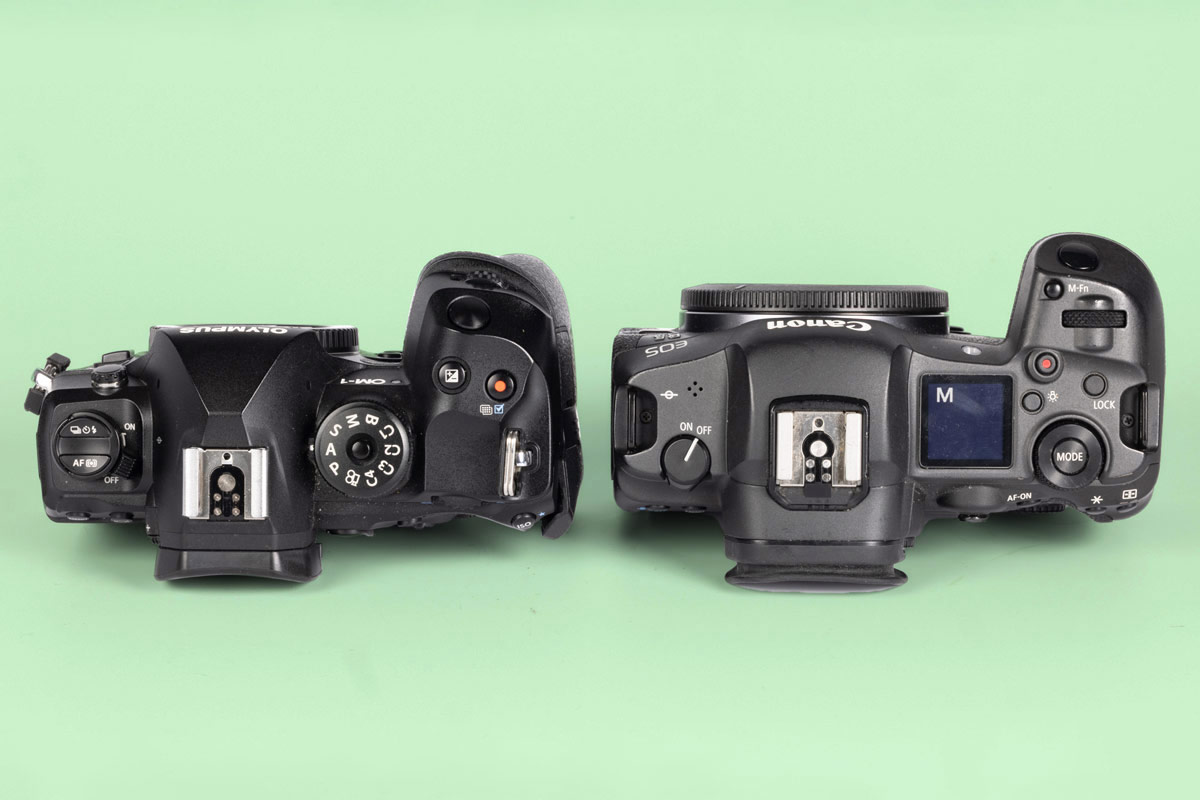
Our emphasis so far has been on lenses, so perhaps it’s time to turn our attention to MFT cameras. Of course, making direct comparisons, just as with lenses, is trappy but let’s look at popular high-end models. The OM System OM-1 Mark II body is in the shops at $2100 / £2049 and the Panasonic Lumix G9 II is $1498 / £1689. By comparison, the Canon EOS R5 Mark II is $4099 / £4500 body only and the Sony Alpha A1 II is an eye-watering $6998 / £6298.
From this, the simple conclusion is that a larger format camera is typically more expensive than a smaller format version. With more raw materials used, the higher cost of larger sensors and greater shipping costs, that is probably no surprise but of course less expensive models are available in both formats and there’s the chance of saving cash by buying used.
Feature overview
In respect of camera features, MFT and full-camera models can be directly compared. You would expect advanced exposure and autofocusing systems with eye/subject detect AF and you won’t be disappointed if you invest in one of the high end models. Fast burst shooting rates and in-body image stabilisers are also almost standard fixtures.
However, there are several standout MFT features worth a special mention. OM System was the first brand with in-body focus stacking, raw format pre-capture, high res shooting, Live Composite, Live B and in-camera ND filters. It’s an impressive list and not only was OM System first, but its implementation of these features was also excellent from the start and has won it many devotees.
The full-frame brands are playing catch-up and some are doing better than others. For example, pre-capture was initially thought to be a gimmick but in some subject genres it has proved invaluable. The Nikon Z8 only has it for JPEGs while the Canon EOS R5 Mark II can shoot Raws but it’s limited to buffering for 0.5sec while Sony has cracked it on the A1 II and A9 III and its implementation is excellent with a flexible buffer working in fractions of a second up to 1 second. The benefit of the Sony system is that the number of identical shots where there’s nothing changing can be kept to a minimum.
With focus stacking, a few non OM cameras have it but implementation is not as slick and most camera brands seem content with focus bracketing, leaving it to their users to do the post-capture work.
Of course, the situation with camera features can change quickly with firmware updates and new releases.
It’s all about the image
The ultimate consideration when it comes to cameras is image quality and resolution. For comparison the OM System OM-1 Mark lI is 20.4 megapixels while the Panasonic Lumix G9 II is the highest resolution MFT camera with 25.2 megapixels under its bonnet giving 5776×4336 pixel images. In full-frame, 24 megapixels is a starting resolution but if you want more full-frame currently tops out at 61 megapixels with many models in the 45-megapixel region.
Resolution is only a factor if you need lots of megapixels for large prints or if you want to crop deeply into a picture and emerge with a large file. If you aspire to produce large prints from a 20 megapixel camera with its 5184×3888 pixels you can get a print of 17.2×12.9in / 43.8×32.9cm at 300ppi assuming the whole frame is used, while a 45 megapixel full-frame camera gives a 27.3×18.2in / 69.3×46.2cm enlargement. These are base figures sidestepping the topic of software interpolation (resizing) where big prints can easily be produced from small files.
A close look at imaging performance on MFT and full-frame
If there is a potential limit to picture performance, it’s noise, a grainy, gritty, blotchy effect that can mar image quality especially in areas of smooth midtones and shadows.
Noise is caused by many factors including poor light, using high ISOs and long exposures (shot noise), then there’s the sensor and the camera’s circuitry. Without getting too embroiled in the topic, MFT sensors have a very high pixel density, roughly four times more than full-frame and having lots of pixels working in close proximity can lead to increased noise.
How acceptable noise is in your work is a personal matter and much depends on what you shoot. If all your MFT shots are captured in good light at ISO 200, noise levels are minimal and probably not evident even on large prints. Ascend the ISO scale and noise is much more evident by the time you reach ISO 1600 and 3200.
To check out image quality and ISO performance on the two formats, we shot daylight and evening scenes.
Staithes Harbour in North Yorkshire was photographed from the same spot with the MFT OM System OM-1 and 25mm lens and the full-frame Canon EOS R5 with 50mm focal length. The Raws were processed in Adobe Lightroom Classic with no denoising applied and then cropping into the boat gave a rough magnification of 200%.
It is no surprise that the OM’s files showed more noise than the Canon’s but results were still acceptable at ISO 3200 and bear in mind that no denoising had been applied.
ISO 200
ISO 1600
ISO 3200
ISO 6400
ISO 12800
Noise is more of an issue when there is less light around so we took shots of a village pub scene at twilight using the same two cameras and again, Raws were processed without any denoising.
There’s a difference in noise levels between the two formats which of course is no surprise, but it’s only from ISO 3200 that the full-frame format has a clear advantage. However, it should be stressed that these shots have not been denoised and that we are taking a very close look at the files.
ISO 1600
ISO 3200
ISO 6400
ISO 12800
The benefit of denoising high ISO shots
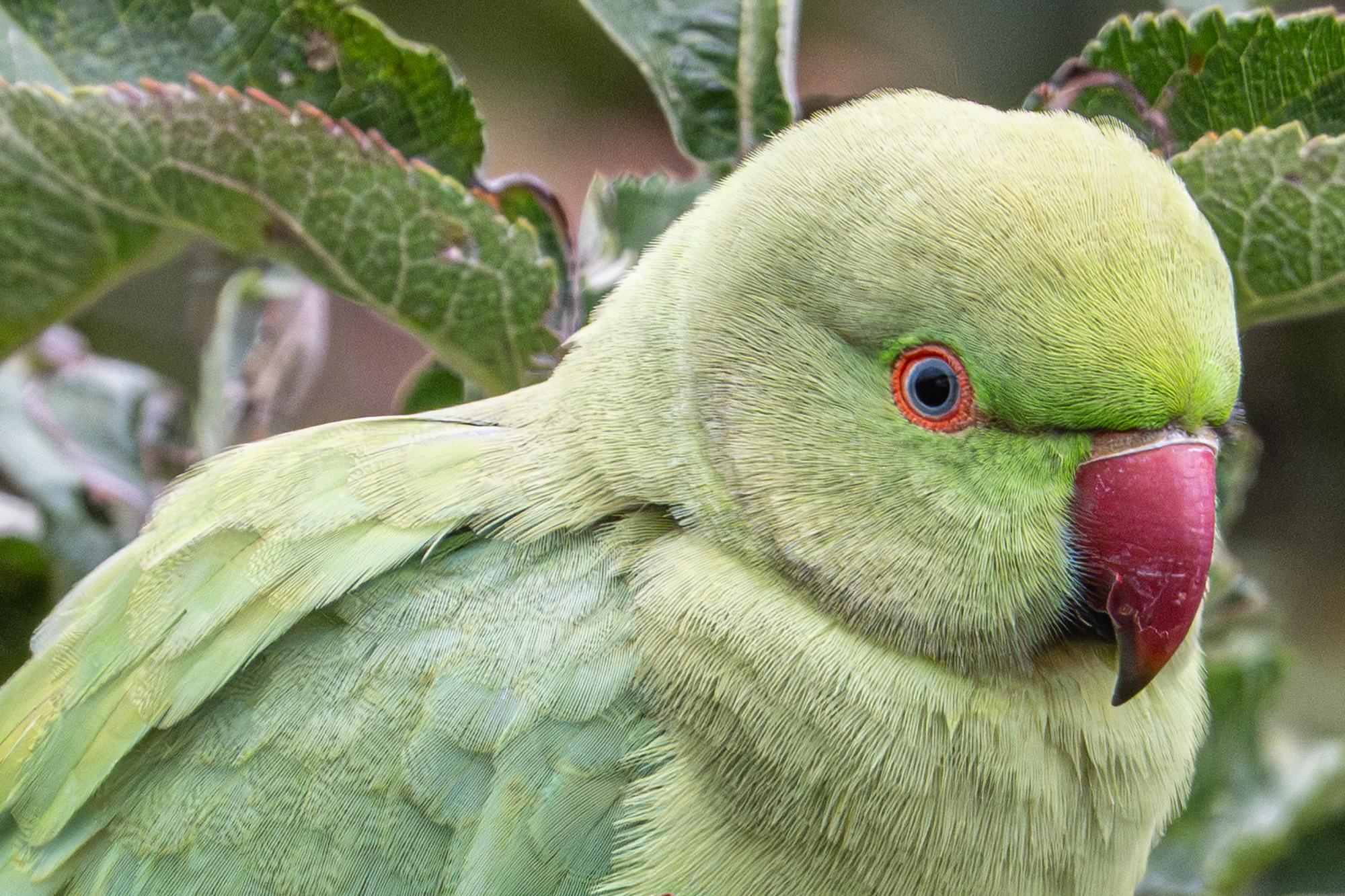
To see how far we could go with ISO with the help of denoising, this parakeet was photographed at ISO 6400 with the OM System OM-1 Mark II with the OM System Digital ED 150-400mm f/4.5 zoom at 400mm, and with the Sony Alpha A1 II with the Sony FE 400-800mm F/6.3-8 zoom at 800mm.
The raw files were processed in Adobe Lightroom Classic, with and without denoising.
The OM-1 Mark II’s ISO 6400 shot showed a great deal of noise but it had a neutral filmic look and the detail rendition of the feathers was impressive. Lightroom’s Denoise made an incredible difference producing a very clean result – no artefacts, noise almost gone and high frequency details remained excellent.
The Sony’s ISO 6400 also showed noise but it was less intense than the OM-1 Mark II’s result and fine detail looked well resolved. Lightroom Denoise again did a wonderful job.
In this practical test, both formats can deliver impressive results at ISO 6400 with denoising, and MFT deserves extra recognition given its smallness.
Summary
Full-frame kit dominates the photography market. There’s a huge number of DSLRs out there in regular use and Canon, Leica, Nikon, Panasonic, Sigma and Sony continue to major on full-frame mirrorless cameras. They are ably supported by the legions of third party lens brands where again full-frame is dominant.
The smaller APS-C and MFT formats have their place, though, and as we’ve seen here the latter is very capable. That won’t shock current MFT users but might surprise those committed to full-frame.
MFT is perfect for those photographers who can’t (or don’t want to lug) a heavy outfit around. There is also the pleasure of using a smaller camera and those who shoot nature, street and travel, among other genres, will appreciate the many upsides. There is a compromise on image quality but it’s not as great as you might think, and that is confirmed by the many experts and professionals using the smaller format.
So, should you trade-in your full-frame kit and go MFT? Well, as we said right at the beginning any format change is a massive decision to make. Perhaps the most comfortable path if the smaller format appeals is to take a softly, softly approach rather than go all in and invest in a used model with kit lens and go from there. Trying the format for yourself and then working on the files will soon tell you the right path for your photography. Good luck!
Related reading:
- Does sensor size matter for video?
- These are the best Olympus cameras (and best OM System cameras)
- Micro Four Thirds vs Full Frame for Wildlife and Nature Photography