

Professional photographer Edmond Terakopian recounts how he’s fallen in love with Fujifilm’s medium-format compact, the GFX100RF.
Fujifilm GFX100RF at a glance
- $5599 / £4699
- 102MP CMOS sensor, 44 x 33mm
- Fixed 35mm f/4 lens
- ISO 80-12,800 (standard)
- Up to 6fps shooting
- 0.84x, 5.76m-dot electronic viewfinder
- 3.15in, 2.1m-dot tilting touchscreen
I’ve always had a camera with me. My reality has had a seismic shift though, from one extreme of choosing smaller sensor cameras as a carry around, to the other extreme of considering a medium format camera for that role. The GFX100RF is so well designed and so compact for what it is, that it could very easily become my everyday carry. If someone had ever told me that my EDC camera could be a medium format camera, I really would have questioned their grasp on reality!
No other digital medium format camera has opened up the format to such a wide audience. The best camera is the one that you have with you, so why not have the best EDC camera with you?! Do read on, as I know my intro may sound surreal!
A few days after the camera was launched, around the streets of Southwark in London, a young man approached me when he spotted me working and made conversation:
Him – Oi, mate, is that a Leica?
Me – Nope, a FUJIFILM.
Him – Oh, is it an X100?
Me – No mate, it’s a GFX100RF.
Him – Blank stare back.
This little marvel, is definitely misleading, as it doesn’t look like a medium format camera. Easily mistaken for a smaller format camera. For me, discretion is key and this camera is absolutely discreet, in all but its performance, in which, it thunders like the bass notes from the pipe organ at the Royal Albert Hall.

The design philosophy of the GFX100RF harks back to a time when there were medium format film camera with a fixed, single focal length lens, from the likes of FUJIFILM themselves, Rolleiflex, Bronica and Plaubel.
A single fixed lens can be a hindrance in certain genres of photography. If you need a telephoto or a macro for example, of course this isn’t going to be a suitable camera; but for those purposes there are interchangeable lensed medium format cameras to consider instead. However in other genres of photography, the simplified approach actually speeds up and even improves the quality of work. Street photography, documentary photography, photojournalism, travel photography and even wedding photography. We explore the scene, looking visually with one mental focal length to compose with and so react quicker to finding suitable scenarios, in these more fluid genres of photography.

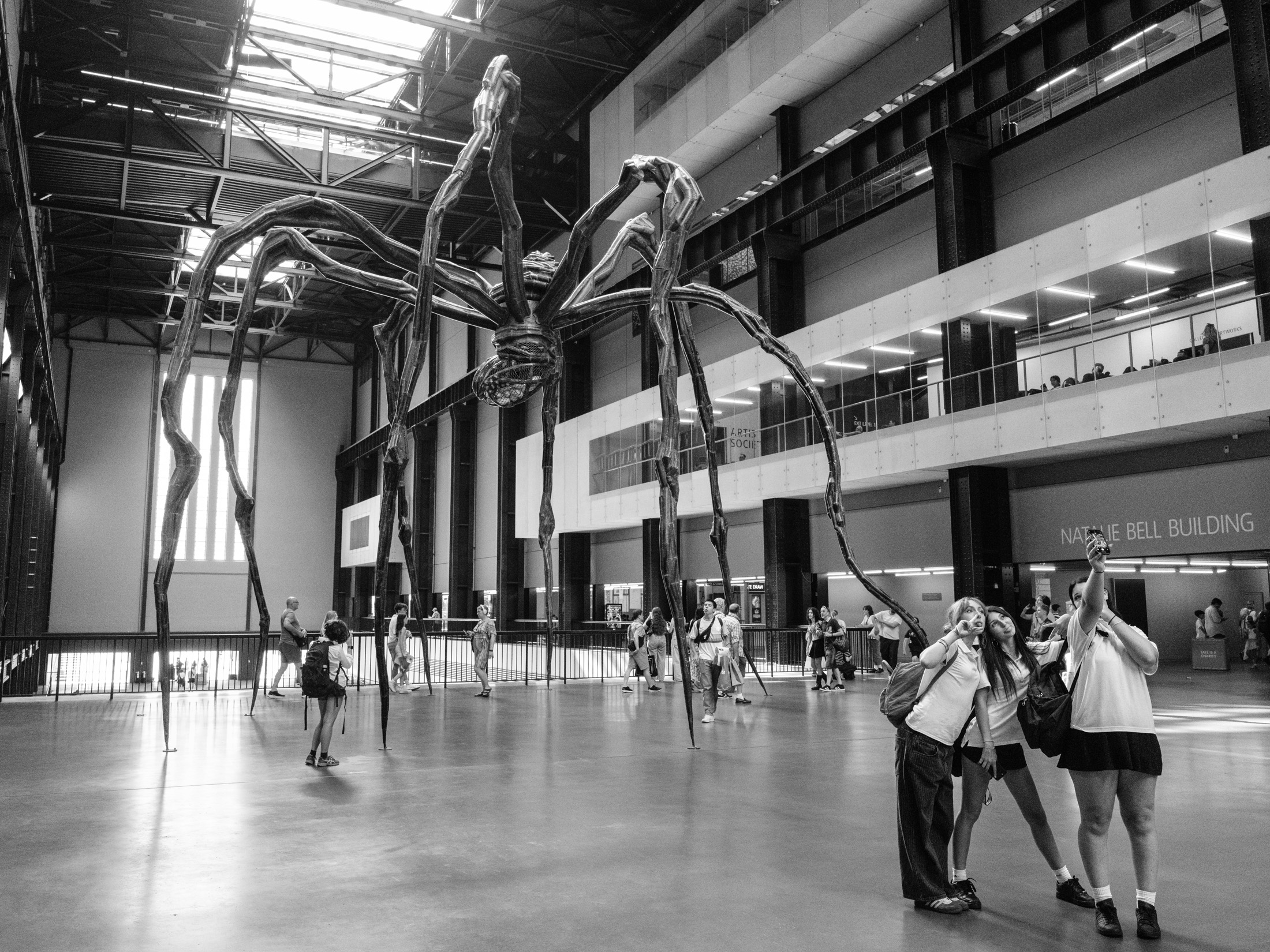
I’ve never been a pixel peeper or someone who has chased huge pixel counts. What I did find as I got to know the GFX100RF, was a change in how I was sometimes composing photographs. The huge 102MP resolution, alongside the great lens, which resolves detail so well, was allowing me much more complex compositions. Rather than having one protagonist, I found I was creating images with multiple points of interest, forming tapestries of interesting segments, making large mosaics of scenes from the street. After 36 years of professional photography, it really is something to pick up a camera that opens an entirely new chapter in one’s creativity. Never too old!

When I first held the GFX100RF, my reaction came as a pleasant surprise. “It feels just right. It just fits” I expressed with a smile. It’s uncommon to pick up an entirely new camera and immediately feel comfortable with it. This shows just how much thought has gone into the design. “It feels just right”. Four simple words indeed, but less simple to achieve a design that poses no obstacles to someone who tries it for the first time. It takes tremendous vision and understanding from the design team involved.
I’m a big fan of the rangefinder style of design, which means that with the camera to the right eye, it leaves a good portion of the face uncovered. I’ve found over the years that this really helps people be more at ease. The DSLR style ends up covering all the face and that human connection gets severed.

This past summer was our fourth annual Passionate Photographer London Summer Street Photography workshop, with my friend and colleague Steve Simon. It was a solid week of street photography, starting in the morning and not ending until the very late hours. It culminated in 87,584 steps for the week and 6699 photographs made on the Fujifilm GFX100RF. The camera didn’t take a single wrong step. The camera’s Li-ion battery went well above FUJIFILM’s 820 shots estimate. I was getting the red battery icon coming on after over 1100 exposures. I can’t recall any camera in my career lasting that long on a single battery! Surprisingly, I only needed a second battery on a few days.

But it’s f4.0
A common cry on the internet, made mainly by people who have perhaps never shot with a medium format camera, where an aperture of f/4 is quite common. If one is constantly working in low light environments, where a faster aperture than f/4 is an absolute low light driven necessity, then the GFX100RF wouldn’t suit. The low light excellence of the sensor and performance at higher ISOs made the camera extremely usable for me, especially in low light scenarios where one wouldn’t imagine the setup ideal.

Even the fastest aperture available to medium format, which at the time of writing has a small handful of f/1.7 lenses, seems too ‘slow’ when compared to full-frame cameras, where we even go up to f0/.95. Go smaller still and for M43, Voigtlander even has an f/0.8 lens. Going the opposite direction however, large-format camera lenses get smaller apertures, and the relevant technique often involves stopping down these lenses further to achieve a usable depth-of-field. Thus these comparisons are of course redundant, as each format has its own technique and technical criteria.

The leaf shutter
Whilst I have never really got interested in shutter mechanisms, the leaf shutter, or as Fujifilm calls it, the lens shutter, is of huge interest! It’s extremely quiet and it also introduces less camera vibration. It allows flash photography all the way up to a shutter speed of 1/4000th. With the addition of a built-in neutral density filter (if needed), flash can be used in bright sunlight, with full flash sync available at 1/2000th and with some loss of the flash’s burst (depending on how fast the flash unit is) at 1/4000th. This is regular flash, too, not high-speed sync which relies on much lower power output with dedicated flashguns. This opens up many options for shooting outdoors with balanced lighting, including action photography.

That leaf shutter is so quiet that a portrait subject I was photographing from around a meter away had to ask if I had taken any pictures yet! It’s so quiet, that I would say the GFX100RF is not only the quietest digital medium format camera, but from memory, probably also medium format film camera too. In quiet moments, especially when making candid photographs from close up, which the 28mm field of view lends itself too, being so exceptionally quiet is so extremely welcome.
ISO sensitivity
The camera has a standard ISO range of 80-12,800 (expandable to 40-102,400). Throughout my use of the camera, I stuck to the standard range. Whilst I love carefully crafting light in a studio environment, at heart I’m an available light photographer, so low-light performance is of importance for me. One wouldn’t think an f/4.0 lensed camera would be a contender, but I was left extremely impressed by the GFX100RF’s raw files all the way up to 12,800 ISO, so I kept shooting and pushing boundaries.

There is noise of course at this level, but the noise is more akin to film grain and is very pleasing. Importantly colour and tonal range is still rendered beautifully. In really dark scenes, at ISO 12,800, the noise is more of an issue when shadows are recovered and I found needing to use LightRoom Classic’s Denoise feature. I never needed to go above a strength of 24 though, which ensured keeping image detail and not making the image look plastic. Most of the time in these extreme scenarios, Denoise was in the range of tens.
The majority of the time however, other ISO 12,800 images had no need for Denoise and only some colour noise reduction. The camera produces clean results up to around ISO 5000.

It goes without saying that at the lower ISO ranges, this camera produces just astonishing results, with mind blowing dynamic range. The colour fidelity and rendered detail is smile inducing, time and time again. Every time I thought I had got used to the quality, it would impress again.
A new approach to photography
One of the reasons I never took to the Leica Q range is that firstly 28mm isn’t my favoured focal length and worstestill, cropping to get a tighter composition around a person, was never a work around. The wide angle drawing of a 28mm lens, elongates and distorts anything close to the lens and pushes back items further back within the scene. So regardless of megapixels available, cropping, especially to a 50mm field of view, never look natural.

The GFX100RF though has a 35mm lens, which on the medium format sensor gives a field of view of 28mm, so one has much less optical distortion. So cropping to a field of view of 36mm or 50mm, is much more natural-looking and thus usable. Add to this the fact that the crop is coming from a 102MP sensor, then there are no issues with file size either. These digital crops provide full-frame equivalents fields of view of 36mm at 62 MP, 50mm at 31 MP and 63mm at 20 MP. Translated to pixel dimensions, the GFX100RF has an astonishing 11648×8736 pixel count when set to its default 4:3 aspect ratio. At a crop of 50mm equivalent, one still gets a healthy 4836 × 6448 pixel image.

At the full view of 28mm, there’s also a change in image aesthetic compared to full frame. I’m generally not a 28mm photographer as I don’t like the rendering of objects in relation to each other, but on medium format, the field of view of 28mm, has the distortion and rendering of a 35mm lens, which is very pleasing. It’s a different look.
I decided the 63mm equivalent crop, specifically for close up frame filling portraits, was too severe, as facial features distorted too much for my tastes when filling the frame with a face. However, environmental portraits at the 36mm and 50mm equivalent, worked perfectly well. I began working mainly at the 28mm and 36mm settings, happily also reaching for 50mm, flicking the perfectly placed lever on the front with my index finger, with the mental approach of shooting with three focal lengths. This approach quickly became second nature.

I chose to configure in the settings for the crops to fill the viewfinder, so I still composed with purpose, old school. One can also choose to still see the full sensor frame, with a crop box shown around the actual crop. It’s important to realise that this is different to shooting loosely and cropping on a computer, as one is still composing properly, resulting in better photography.

The menu system
The GFX100RF has a well thought out and presented menu system, which thankfully doesn’t need a PhD or Enigma Machine to decipher. One thing initially puzzled me; why was face and eye detect on a separate menu to the subject and animal detect options? The button by the shutter release is set to rapidly enable or disable this function as needed, making for a very fast operating camera. Well thought out indeed.

Autofocus
Previously, autofocus on all medium format cameras was quite leisurely, with glacial being the preferred speed of movement. Not so on the Fujifilm GFX cameras, which have very impressive AF, with performance and function increases on the latest generations, of which the GFX100RF is the newest addition. A pocketable camera wielding a monstrous 102MP sensor with Intelligent Hybrid AF (TTL contrast AF / TTL phase detection AF) is quite a thing.

To really push the camera, I decided to go to a dimly lit skatepark, with the previously unthinkable idea to photograph skateboarders, randomly moving around, jumping, going in and out of the light. On continuous AF no less. To my pleasant surprise, the camera locked on and continued to focus, behaving impeccably.
With people on the street, or set up portraits, in AF-S with face and eye detection, the camera was exceptionally capable, nailing the focus time after time.

Dynamic range
I’m never really interested in technical minutia, concentrating more on how a camera works in real-life situations and the image quality from actual work. For me the feel of the image is paramount. I got curious though, as I was in disbelief when looking at the quality of the results.
Expose intelligently and you will get rewarded with a phenomenal range of detail, subtle gradation and stunning colour rendition. Fujifilm doesn’t publish an official figure for stills photography, but having asked the question, there is a general consensus amongst their technical people that for stills photography, shooting single frame, lossless or compressed raw, the camera can produce a 16-bit file that records around 14 stops of dynamic range! Switching to a continuous drive sees a small drop to 14bits, with an incrementally lower dynamic range. It’s worth noting that I never shot single 16-bit raw files, always preferring the lower continuous drive mode, which gave me 14-bit raw files. It’s these relatively speaking ‘lower quality’ files which have impressed me so much!

Is medium format for everybody?
Aspiration pushes us and can inspire. The GFX100RF has made it much easier for photographers to get into digital medium format photography. It’s an easy to use and well-priced camera, although costly. However, as with everything more esoteric, there are considerations. If one’s technique isn’t on point, this medium-format camera will magnify the photographer’s flaws. Improve your game and you’ll be rewarded. Slow down a little and be more thoughtful about decisions made. Good photographs are made, not taken. What this camera brings to one’s work is huge!

My biggest learning point was finding out what shutter speed I can get away with for street photography. The 102MP sensor really demands your best technique and not having IBIS also means that there is no safety net. I started experimenting at 1/125th and found my hit rate suffering with too much camera movement. I decided that 1/250th was my default minimum. I ended up shooting mainly at 1/500th when walking around more vigorously, looking for pictures. Situations where I was still and had time, going down to 1/80th worked perfectly well.
I found my preferred technique was to use auto ISO and manually choose my aperture and shutter speed, which is so straightforward with a proper shutter speed dial and aperture ring. I would then work the exposure compensation dial as needed, with the camera’s excellent EVF to my eye.

Conclusion
Personally, I would ideally prefer a 40mm to 50mm field of view. I’ve been so impressed though, that I find myself constantly compromising, to adapt to the 28 and 36mm fields of view primarily, occasionally cropping up to 50mm. I’m so taken by this camera, that I find myself organically changing how I look at things. This reminds me of stories my dear friend and colleague Ian Berry from Magnum Photos would share, of passionate discussions with Henri Cartier-Bresson who loved the 50mm focal length, to Ian’s beloved 28mm focal length. The reality is there isn’t a correct answer, only great photography matters.
At a current price point of £4699, one gets access to a 102MP medium format camera, with a stellar lens included. At the time of writing, the closest alternative option is the Fujifilm GFX100SII which costs £300 more, body only. Getting a lens that is close in focal length would require adding the Fujinon GF30mmF3.5 R WR at £1649.00, or the cheapest option of the Fujinon GF35-70mmF4.5-5.6 WR at £849.00. Whilst the GFX100SII is technically a much more versatile option, bringing with it the ability to change lenses, it is also a bigger and heavier outfit, and works out to be more costly.
I’ve had to ask myself, would this GFX100RF be as appealing to me if it were thicker, heavier, nose-heavy and costlier? I wish it had IBIS, but this would have negatively affected the form factor. Same goes for a faster aperture lens. Holding the camera, I know why f/4.0 was chosen. So, having used the camera extensively, I can attest that these compromises have resulted in an absolutely fantastic camera, as these are not compromises that detract, but ones that add up to a great user experience. A camera that you just pick up and want to always have with you, as opposed to a niche tool to only take specifically when needed.
I was having a discussion with a close photography friend and commented that the GFX100RF was one of my absolute favourite cameras. What I was saying came out so naturally, that it caught me off guard. I analysed what I had just said, as it was quite a statement to make. However, my comment stood. You can try to imagine how many cameras I’ve used in 36 years of professional photography and countless camera reviews. It is one of my favourite cameras. It’s amazing that an entirely new camera, fits so effortlessly into one’s work and produces stunning imagery from day one of use. It feels just right. It just fits.
You can see more of Edmond’s work on Instagram @terakopian