

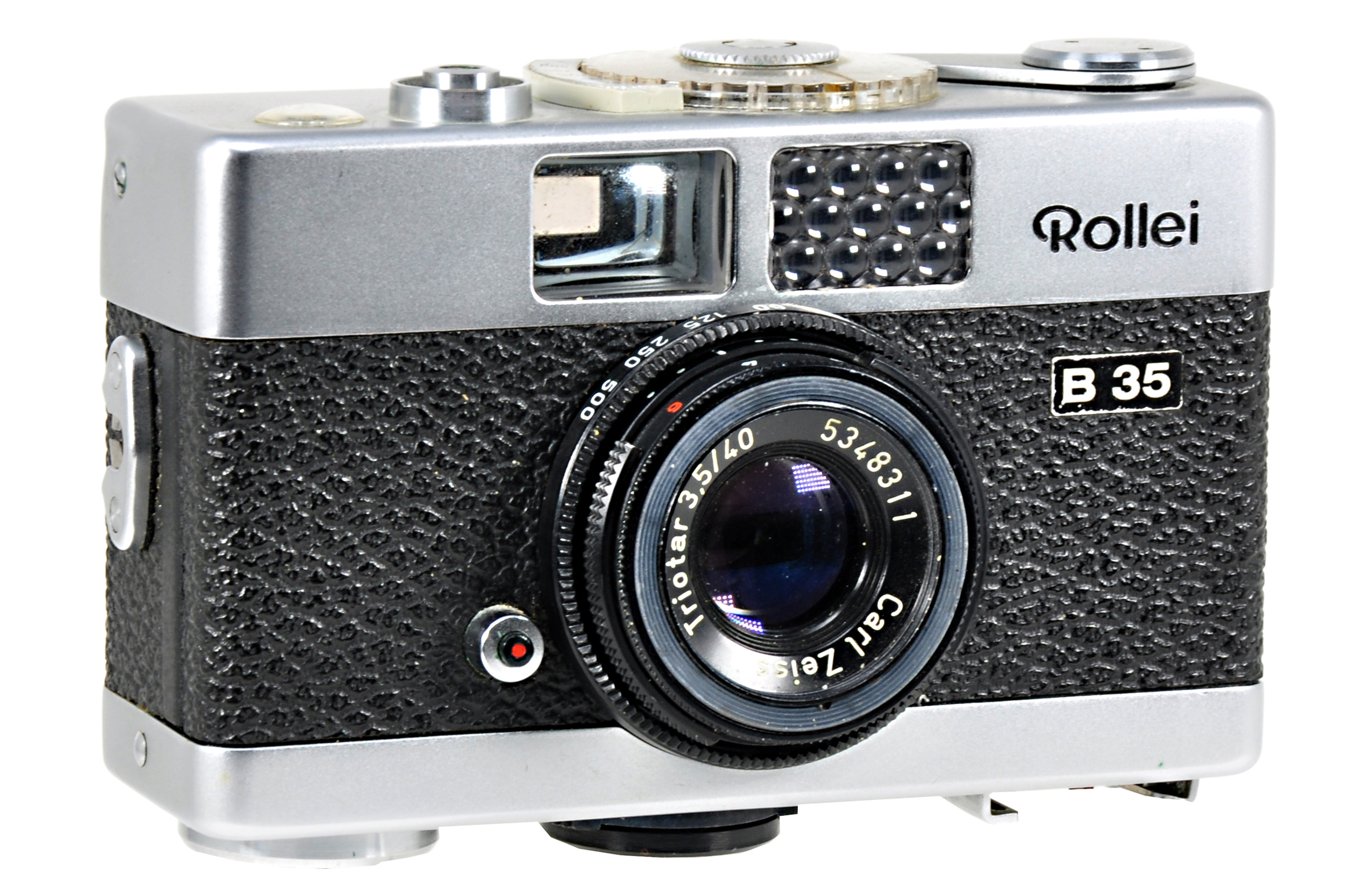
If you fancy a small, palm-size film camera with classic styling, don’t mind buying from Germany and waiting around for delivery – and you happen to have a little over £800 in your back pocket – you might like the latest Rollei 35AF. If you’d prefer to pay about 30 quid for something similar, try a Rollei B 35, also known as the 35 B.
- Launched: 1969, Price at launch: approximately $25 / £20, Guide price now: $35-55 / £25-40
The original Rollei 35, launched in 1966, was at that time the world’s smallest full-frame 35mm camera – a claim later challenged by the Olympus XA in 1979. This first camera had a Tessar lens and CdS meter coupled to a match needle system for setting shutter speeds and apertures via twin dials on the front of the body.
The B 35/35 B is a stripped-down version using an uncoupled selenium meter plus a Triotar 40mm f/3.5 lens, with apertures and shutter speeds of 1/30-1/500sec set more traditionally around its rim. The specs are similar, but the prices are very different, with the Rollei 35 still commanding as much as £150-200 or even more. Comparing spec with price, the B 35/35 B is the better bet. Fully mechanical, the camera was originally made in Germany, before production shifted to Singapore.
In use, the lens pulls out from the body on a short tube. Front to back, rings around the lens are for focusing, apertures and shutter speeds. The meter cell above the lens feeds a calculator on the top plate. This involves first setting the film speed, then adjusting a dial for the required shutter speed, watching as a needle swings across a scale to indicate a suggested aperture. These are then set manually.
Strangely, the accessory shoe is on the base, which means that if flash is used, the subject is lit by light from below the lens, which is very unflattering for portraiture. The solution of course is to use the camera upside down.
What’s good
- Easily pocketable, large viewfinder with bright frame for 40mm lens.
What’s bad
- Film must be advanced and shutter tensioned before retracting the lens, meaning the camera is always stored with a tensioned shutter.
Related reading
- Best fixed lens 35mm compact film cameras
- Best 35mm film cameras (all types)
- Classic film cameras: the clever Olympus OM-2N