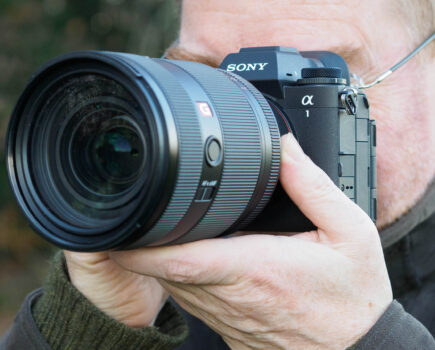
Canon EOS R6 Mark III review – this feature-packed 32.5MP all-rounder is a seriously impressive camera


Andy Westlake tests Canon’s latest camera for enthusiast photographers, with its new 32.5MP sensor
Amateur Photographer verdict
Canon’s enthusiast all-rounder is a superb camera that can do almost anything users might need. With its 32.5MP resolution, excellent autofocus and fast shooting, it’s right at the top of its class.
- 33MP sensor gives increased detail and flexibility
- Superb autofocus system
- Excellent control layout and handling
- Super-fast continuous shooting
- Works well with EF lenses via mount adapter
- No third-party full-frame autofocus lenses available
- Doesn’t work with older LP-E6-type batteries
The Canon EOS R6 Mark III is a full-frame mirrorless camera that’s designed for serious enthusiast photographers. It employs a near-identical body design to its predecessor, the Mark II from 2023, but gains a new, higher-resolution 32.5MP sensor, rather than 24MP. With an impressive all-round spec sheet, it’s capable of tackling almost any kind for task, for both photography and video. Without doubt, it’s one of the best Canon cameras yet made.
Canon EOS R6 Mark III at a glance:
- $2799 / £2799.99 body-only
- $3149 / £3149.99 with 24-105mm F4-7.1 IS STM
- $4049 / £3899.99 with 24-105mm F4 L IS USM
- 32.5MP full-frame sensor
- ISO 100-64,000 (standard)
- Up to 40fps shooting
- 3.69m-dot, 0.76x OLED viewfinder
- 3in, 1.62m-dot articulated screen
- 7K 60p, 4K 120p video recording
- 8.5-stop in-body stabilisation
As it happens, the R6 III’s sensor isn’t entirely new, having first appeared in the Canon EOS C50 cinema camera in September 2025. In fact, the two cameras share many or their specs and features. But they use different processors and are very different in terms of design, with the EOS C50 described as a video-first hybrid, while the EOS R6 III is first and foremost for photography.
Costing $2799 / £2799.99 body-only, $3149 / £3149.99 with the basic Canon RF 24-105mm F4-7.1 IS STM lens, or $4049 / £3899.99 with the premium Canon RF 24-105mm F4 L IS USM, the Canon EOS R6 Mark III will be going head-to-head with some pretty formidable competition. This includes the Nikon Z6III, Panasonic Lumix S1II, and the Sony A7 V. The existing Canon EOS R6 Mark II will also remain on sale for at least the whole of 2026. But as we’ll see, the new model brings enough to the table to move straight to the top of its class.
Features
Let’s look at the EOS R6 Mark III’s specs in more detail. The new sensor provides a maximum still image size of 6960 x 4640 pixels, representing a 16% increase in linear resolution over the Mark II’s 6000 x 4000, and 27% over the original 20MP Canon EOS R6. One point worth noting is that unlike its more expensive EOS R1 and EOS R5 Mark II siblings, Canon doesn’t describe the sensor as stacked.

While the resolution has received a handy boost, this does comes with a small drop in high-ISO range. The sensor offers ISO 100-64,000 as standard, plus extended settings covering ISO 50-102,800 (the upper limits were ISO 102,400 and 204,800 before). I don’t think this counts as a significant step back, though; you’ll rarely, if ever, need such high settings in practice.
In many other respects, though, the major photographic specifications remain much the same. Using the mechanical shutter, you get shutter speeds of up to 1/8000sec and continuous shooting at up 12 frames per second. Switch to the silent electronic shutter, and those figures increase to 1/16000sec and up to 40 frames per second. That’s as fast as most photographers are ever likely to need – in fact, probably considerably faster.

Like a lot of recent cameras, you also now get a pre-capture mode for moments when you otherwise wouldn’t have time to react. In this case, it continuously buffers 20 frames while the shutter button is half-pressed, and then records them when it’s fully depressed. I find this can be particularly useful for shooting such things as sports and wildlife.
Autofocus employs Canon’s Dual Pixel CMOS AF II system, with no fewer than 6097 selectable points covering all but the extreme edges of the frame. Canon’s usual subject detection system is available, covering humans (eyes, face, head, and body); animals (dogs, cats, birds, and horses); and vehicles (racing cars or motorbikes, airplanes, and trains). An Auto option is also available, so you don’t have to select your subject type in advance. One thing you don’t get, though, compared to Canon’s higher-end models, is eye-control focus for selecting between multiple possible subjects.

Other features are inherited from last year’s Canon EOS R5 Mark II. This includes the in-body image stabilisation system, which promises up to 8.5 stops of shake reduction at the centre of the image, and 7.5 stops at the periphery. You can also register faces for the camera to prioritise focusing on. It can recognise 10 at any given time, and you can save 10 groups (so up to 100 faces in total). This could be useful for applications such as sports or weddings.
It’s the video specs that get the most eye-catching boost, though. The R6 III can record raw video internally at 7K resolution and 60fps in 17:9 aspect ratio, or 30fps in Open Gate mode that capture the full sensor area. Alternatively, 4K can be shot at 120fps using the full sensor width, and Full HD at 180fps, for slow-motion playback. The camera can also output ProRes RAW to external recorders at 7K30. It provides false colour and waveform displays to help judge exposure, and includes Canon’s C-Log2 and C-Log3 modes that produce neutral footage for colour grading in post-production.
Connectivity
Wi-Fi and Bluetooth connectivity is on board as usual, and with all the typical features via Canon’s free Camera Connect app (although annoyingly, you now have to create an account to use it). You can use your phone as a simple Bluetooth shutter release, or a comprehensive remote control via Wi-Fi. Naturally, it’s also possible to copy images to your camera for sharing.

One small irritation comes if you also want to use a Bluetooth remote control, such as the Canon BR-E1 or a third-party clone. It seems like the camera can only pair with one device at a time, so you have to switch back and forth in the menu all the time. I just left my phone paired instead.
Canon EOS R6 Mark III: Key features
- Vertical grip: The camera accepts the same BG-R20 vertical grip as the EOS R5 II. The BG-R20EP variant will work too, but its built-in ethernet port won’t function.
- RF mount: Canon now has 44 full-frame lenses in its RF lineup, covering 10mm to 1200mm. But there are no third-party RF autofocus lenses. However, you can use EF-mount SLR lenses via an adapter.
- Storage: There’s one CFExpress Type B card slot and one UHS-II SD slot, rather than dual SD slots as before.
- Power: The camera comes with the LP-E6P battery. It can also be used with the LP-E6NH and LP-E6N, but it won’t work with the original LP-E6.
- Connectors: Users of external monitors and recorders will be pleased by the inclusion of a full-size HDMI socket. There are also USB-C, headphone and microphone, and 2.5mm remote release ports.
- Hot shoe: Canon’s multi-function shoe supports both external flash units and some digital audio accessories.

PIN code protection
Unusually, when you switch on the Canon EOS R6 Mark III for the very first time, it demands that you set a 6-digit passcode, like a smartphone. It then asks for this whenever you subsequently turn it on. While it’s good to see manufacturers start making steps towards deterring the theft of expensive cameras, I don’t think this approach is the answer. I can’t imagine many photographers will accept missing a shot while they’re tediously keying in a PIN code, so they’ll just immediately turn the feature off, like I did. What we really need are biometric measures, such as face or fingerprint recognition instead.
Build and Handling
In terms of its physical design, the new camera is externally almost indistinguishable from the EOS R6 Mark II, with all the same controls in all the same places. That means it’s also very similar in operation to the EOS R5 II and R1. It’s also directly evolved from the firm’s older DSLRs, meaning that existing Canon users should be able to pick it up and feel right at home, more-or-less straight away.

Thanks to a large, sculpted handgrip, the camera feels great in your hand. The body is absolutely covered with buttons, giving direct access to all the most important shooting settings, often in more than one way. Three electronic dials provide control over the main exposure settings, and most of Canon’s lenses have a control ring, too. Personally, I particularly like how Canon gives you a dedicated ISO dial that lets you temporarily shift the setting when using Auto ISO, which I find very useful.
New users might find the layout slightly overwhelming at first, though. For example, there are no fewer than 10 controls placed for operation by your right thumb. Thankfully, though, you’re only likely to be using three or four of these at any given time.

In one notable change, the ‘Rate’ button on the camera’s shoulder is also now labelled ‘Color’. This allows you to select between the different types of colour mode, namely Picture Styles, Color Filters (which can’t be used when shooting raw), and Custom Picture settings (which are only available in video). Pressing the info button then allows you to select between the different styles or filters.
You also get some useful extra functionality in playback. Pressing the record button toggles between viewing still images and videos, while the M.Fn button works as a shortcut for sending the displayed image to a smartphone. These are small changes, you have to give Canon credit for adding them.

There are a couple more significant developments under the covers. Firstly, rather than taking two SD cards, the EOS R6 III gains a CFexpress Type B slot to keep up with high-speed, high-resolution stills shooting and faster video recording bitrates, with a single UHS-II SD slot alongside. Secondly, its hybrid credentials are bolstered by the adoption of a full-size HDMI socket for connecting an external video recorder or monitor. Both of these are sensible updates, but if you’ve been using two SD cards in backup mode in a Mark II, you’ll now need to buy some expensive CFexpress cards.
Viewfinder and screen
Canon has used essentially the same viewfinder and screen as before. You get a 3.69m-dot OLED EVF with 0.76x magnification, meaning it’s a good size and nicely detailed. It’s decently bright too, working well on sunny days.

Meanwhile the screen is a 3in, 1.62m-dot LCD touchscreen with Canon’s usual side-hinged articulation, which allows it to face almost any direction for shooting at awkward angles, or for filming yourself. I find this works very well. However, Sony’s ‘4-axis’ unit on the A7 V is even nicer, as it can also tilt up and down behind the camera.
Out of the box, Canon previews colour and exposure, with a press of the button on the front plate required to activate depth-of-field preview. But you can change this so you either get DOF preview by default, or engage exposure preview only when pressing the DOF button. Canon has also included its obscurely titled ‘OVF sim. view assist’ option, which aims to give a neutral view that replicates the experience of using a DSLR.

Pressing the info button cycles through display modes with different levels of overlaid information. You can tailor these views independently for the viewfinder and LCD. I particularly like the way Canon allows you to view both an unobtrusive dual-axis level and a small RGB live histogram simultaneously.
Autofocus
On paper, there’s not much difference between the Canon EOS R6 Mark III’s autofocus system and its predecessor’s. It can focus pretty much anywhere within the frame, aside from the extreme edges, with Canon’s signature Dual Pixel CMOS AF enabling phase detection from every single pixel. Subject detection is available, with settings for people, animals, and vehicles, plus auto.

Click on any sample image to see the full resolution version
Using the conventional AF system, you have a choice of focus area sizes, including three custom options where you specify set the height and width. This can be useful if you know that everything you’re interested in will take place within a specific space – a stage or a racetrack, perhaps. Single-area options all come with two different modes: one where the AF point stays fixed where you put it, and another where a press of the SET button activates tracking, so the camera will follow your subject if it moves or you recompose.
These AF area modes are selected by first pressing the AF point button on the camera’s shoulder, and then repeatedly pressing the tiny M-Fn button beside the shutter release (which, yet again, is much too small). If you only use a few of the 12 available options, you can minimise this button pressing by disabling the others.

Using single-shot AF mode with static subjects, the autofocus is fast, decisive and consistently accurate. But of course, the bigger test comes when tracking fast, erratic subjects in continuous AF mode (which Canon calls ‘Servo’), especially during high-speed burst shooting. For this, I generally used subject detection set to auto, and it combined with the full-screen AF area mode.
To stress-test the AF, I photographed local wildlife using the Canon RF 100-500mm F5-7.1 L IS USM telezoom, and was extremely impressed by how well the camera performed. For example, it was perfectly able to maintain focus on a pigeon flying directly towards me at high speed while shooting at 20fps – and let’s be clear here, pigeons are small and fast. It also did a great job tracking an extended burst of a swan taking off – something that requires a long runway and a lot of effort. You can see three selected shots from a 125-frame burst below.


It’s difficult to not to see this camera as being another step forwards from its predecessors, and on essentially the same level as its peers such as the Nikon Z6III and Sony A7 V. Once you work out how you want to set it up and use it, it’ll track focus on pretty much anything.
Performance
In practical use, the EOS R6 Mark III never gets in the way of you shooting. It powers up near instantly, being ready to go almost the moment you flick the power switch. That switch is, perhaps, a little awkwardly placed compared to having one around the shutter button, but its size makes it easy to operate. The camera also responds immediately to all the physical controls and the touchscreen.

Note: The RF 24-105mm F4 L IS USM lens that Canon UK loaned me for reviewing the camera sometimes gave noticeably soft results on the right-hand side of the frame. That’s a problem with the lens, not the camera.
The shutter noise is soft and unobtrusive, and if you need to shoot silently, you can switch to the electronic shutter with relatively little risk of subject distortion.
Battery life
I’ve been perfectly happy with the battery life, which is rated for 390 frames using the EVF, and 620 with the LCD. That seems like a reasonable reflection of what I’d consider normal use, and you’ll get many more frames than that if you shoot a lot of bursts. Canon engages some aggressive power saving when you’re not actively using the camera, including dimming the screen and slowing its refresh rate right down, which helps conserve the battery.

This stamina is welcome as, at least in the UK, spare LP-E6Ps are obscenely expensive, costing about £110 apiece (they’re quite a lot cheaper in the US, at $80). You can top up the battery via the USB-C port, but Canon is quite picky about the charging source and you’ll need to use a 3V USB-C output, at least. Unlike some other cameras, you can’t just plug in any small powerbank in an emergency.
Continuous shooting
You might think the higher resolution would put a dent in the continuous shooting performance, but that’s not really true. You will, however, need to use a CFexpress card to get the most from it. But then, the performance is phenomenal. In my tests, using the mechanical shutter at 12fps, and shooting in raw + JPEG, the camera just kept on going indefinitely until I ran out of card space (using a CFexpress Type B with a 1600MB/s rated write speed).

To get the fastest 40 frames per second rate, you have to take a trip into the menu to engage the electronic shutter – annoyingly, you can’t just access it as a faster drive mode. The camera will then shoot for about 3 seconds, before pausing to write to card. Drop the speed down to 20fps, and the camera will keep going for 11 seconds before slowing down. That should be more than enough for most purposes. By the way, at no point does the camera indicate the frame rate for the drive mode you’ve selected – you just have remember.
Pre-capture shooting
One significant update comes with the inclusion of a proper pre-capture mode, in place of the R6 II’s Pre-Burst Shooting. The difference is that the camera now records normal image files, rather than requiring you to extract your favourite frame after shooting. The camera buffers a half-second’s worth of frames when you half-press the shutter, and then records them to card when you fully press the button.

Other brands offer much more customisation of the pre-capture time, but if we accept that the fundamental aim is to overcome the typical human reaction time of about 0.3 seconds, Canon’s implementation works just fine.
Again, though, the main irritation is that by default, you have to dive into the menu to enable pre-capture. What’s more, you can only do so if you’ve already selected the H+ continuous shooting mode and electronic shutter. For a function that’s all about being able to react quickly, that’s infuriating. If I were using it frequently, I’d set up a Custom shooting mode specifically for the purpose.
Image stabilisation
I’ve been especially impressed by the EOS R6 Mark III’s image stabilisation system, which I’ve found to be very effective with both telephoto and wideangle lenses. Using the RF 100-500mm F5-7.1L IS USM at its long end, I was able to get sharp hand-held shots at just 1/50sec. Meanwhile with the RF 24-105mm F4L IS USM, I frequently got usable images at 1 second. And while it’s the ability to shoot at these extremes that’s most eye-catching, the bigger picture is that you don’t really have to worry about image blur due to camera shake in most situations (subject motion blur is a different matter, of course).

One point worth noting is that, like all EOS R cameras, the R6 Mark III works perfectly with EF-mount lenses, via the EF-EOS R mount adapter (or cheaper third-party clones). I tested it with my EF 100mm f/2.8 Macro and EF 70-300mm f/4-5.6 IS USM and they worked every bit as well as they previously did on DSLRs. This means that photographers who are still using Canon DSLRs can upgrade to mirrorless but continue to use their existing lenses. It also goes some way to offsetting the fact that there are no full-frame autofocus RF lenses available from third-party makers.

Canon’s evaluative metering is very strongly linked to where you place the focus point. So it’s worth paying attention to this and applying exposure compensation if there’s a risk of highlights blowing out. Auto white balance is generally well judged, though. This means you don’t often get unpleasant colour casts in JPEGs, and have a reliable starting point for raw processing, too.
Image quality
Out-of-camera image files (JPEG or HEIF) tend to be bold and punchy, with bright, warm, and saturated colours. As a result, I’d be quite happy to share the camera’s files without much further editing. If you want to print them large, I’d recommend using the Fine Detail picture style, which offers essentially the same colour rendition as Standard, but uses more refined sharpening settings.

Chances are, though, that most users will be shooting and processing raw files. Thankfully the EOS R6 Mark III’s are very good indeed, with the 32.5MP sensor giving just that bit of extra detail compared to its predecessor. That gives you scope to print a little larger, or crop tighter, than before.
There’s no significant penalty for the increased resolution in terms of high-ISO performance. I saw very little drop in quality from ISO 100 to ISO 3200, and I was perfectly happy shooting at up to ISO 12,800, especially with AI noise reduction such as Adobe Denoise. As with most full-frame cameras, I’d say ISO 25,600 is probably the limit of usability, but with a noticeable fall-off in quality. Personally, I’d avoid going any higher.

I’ve found the files also stand up well to significant tonal manipulations during raw processing. For example, when shooting at sunrise, I was able to expose to retain highlights and then use shadow adjustments to bring up dark foregrounds, without being unduly concerned by noise. I’m not convinced there’s quite as much latitude here as with the best of the R6 III’s peers, though, with maybe four stops of additional usable shadow detail, rather than five. But it’s pretty rare that you need even that.
In the image below, I exposed to maintain cloud detail in the sky at the top left, leaving most of the JPEG file dark and featureless. But in raw processing I was able to generate a natural-looking, well-balanced image without any problem from noise.

It’s worth noting that if you use Canon’s CRAW mode, you can see some artefacts in very deep shadows, that appear to be due to noise reduction and/or compression. This means it’s best to use the standard raw format for subjects where you might be making extreme tonal adjustments in raw processing. Personally, though, I’d still use CRAW much of the time, as the files are significantly smaller.
Our Verdict
Reviewing the Canon EOS R6 Mark III has felt very much like a case of deja vu. As with its predecessors, it’s an extraordinarily accomplished all-rounder that can do pretty much anything you ask of it. But now, it comes with even higher resolution to go with its blisteringly fast speed. As a result, it’s just as much at home shooting detail-rich landscapes as it is with fast-paced, unpredictable action. For many potential buyers, those extra pixels may well alleviate any residual longing for the pricier 45MP EOS R5 II.

Naturally, the EOS R6 III faces stiff competition from the likes of the Nikon Z6III, Panasonic S1II, and Sony A7 V. Each of these has its strengths and weaknesses, and I don’t think any of them can be declared an outright winner. But even in this exalted company, it’s a very strong contender. Each buyer’s choice is likely to narrow down to any established brand preference and a few specific, relatively niche features.

For existing Canon users, though, the EOS R6 Mark III is an easy recommendation. It’s a massive step up in capability for anyone still using a DSLR, while owners of older full-frame mirrorless models such as the EOS R and R6 will find plenty to tempt them, too. And I can’t imagine that anyone who buys it will be disappointed.

Follow AP on Facebook, Instagram, YouTube and TikTok

Canon EOS R6 Mark III: Full specifications
| Sensor | 32.5MP Dual Pixel CMOS AF II, 35.9 x 23.9mm |
| Output size | 6960 x 4640 |
| Focal length mag | 1.0x |
| Lens mount | Canon RF |
| Shutter speeds | 30-1/8000sec (mechanical), 30-1/16,000sec (electronic) |
| Sensitivity | ISO 100-64,000 (standard), ISO 50-102,400 (expanded) |
| Exposure modes | PASM, Fv, B, S&F, 3x Custom, Scene, Auto |
| Metering | Evaluative, partial, spot, centre-weighted |
| Exposure comp | +/-3 EV in 0.3EV steps |
| Continuous shooting | 12fps (mechanical shutter), 40fps (electronic shutter) |
| Screen | 3in, 1.62m-dot fully articulated touchscreen |
| Viewfinder | 3.69m-dot OLED, 120fps, 0.76x magnification |
| AF points | 6097 |
| Video | 7K 17:9 60p internal RAW, 4K 120p, 2K 180p |
| External mic | 3.5mm stereo, Multi-Function shoe |
| Memory card | CFexpress B, UHS-II SD |
| Power | LP-E6P Li-ion (also accepts LP-E6NH, LP-E6N) |
| Battery life | 390 with EVF; 620 with LCD |
| Dimensions | 138.4 x 98.4 x 88.4 mm |
| Weight | 699g with battery and card |