


One of the genres that the best smartphones for photography excel in is landscape photography. It makes sense when you think about it – when I’m shooting landscapes, I’m normally doing it in good light, with a wide-angle lens, and these kinds of conditions are perfect for smartphones. It’s certainly much easier than carrying a big full-frame camera and a bag of lenses.
But which to pick? I’ve chosen an array of the best of the best across the board – these are the smartphones that I’ve tested and I think deliver something really excellent for landscape shooting. You can see my sample images throughout to make up your own mind about which you prefer.
As you might expect, given that these are also flagship models, they do cost a fair amount. I’ve given alternative suggestions throughout where I think you could make a saving on an older model and get something almost as good. It can be useful to make a list of all the features you really want and see which smartphones match up – sometimes you’ll be surprised by the savings you can make.
For now though, read on to discover my picks of the best smartphones for landscapes.
Best phones for landscape photography – a quick list
- Apple iPhone 17 Pro Max – Buy now
- Samsung Galaxy S25 Ultra – Buy now
- Google Pixel 10 Pro – Buy now
- Honor Magic 8 Pro – Buy now
- Xiaomi 15 Ultra – Buy now
Why you can trust Amateur Photographer
We spend many hours testing every product we recommend, in detail, in a variety of situations and shooting scenarios, and only use experts for our reviews, so you can be sure that you’re getting the best products. Find out more about our expert writers.
Apple iPhone 17 Pro Max
Amateur Photographer verdict
Apple’s best iPhone ever made – the 17 Pro and Pro Max with new higher resolution 4x telephoto camera, and the Max version’s huge screen wil appeal to landscape shooters
- Pictures / videos look great on the huge screen
- Option to shoot in RAW
- Triple 48MP array
- Camera control button
- Weak macro performance?
- Low resolution telephoto camera
| Rear cameras | 48MP wide camera, f/1.78 aperture, 24mm equivalent 48MP ultrawide camera, f/2.2 aperture, 13mm equivalent 48MP 4x telephoto camera, f/2.8 aperture, 100mm equivalent |
| Selfie camera | 18MP f/1.9, with AF |
| Video | 4K video up to 120fps |
| Screen | Pro Max: 6.9inch Super Retina XDR OLED screen Pro: 6.3inch Super Retina XDR OLED screen |
| Battery | Pro: 3998mAh battery, Pro Max: 4823mAh battery (more on eSIM versions) |
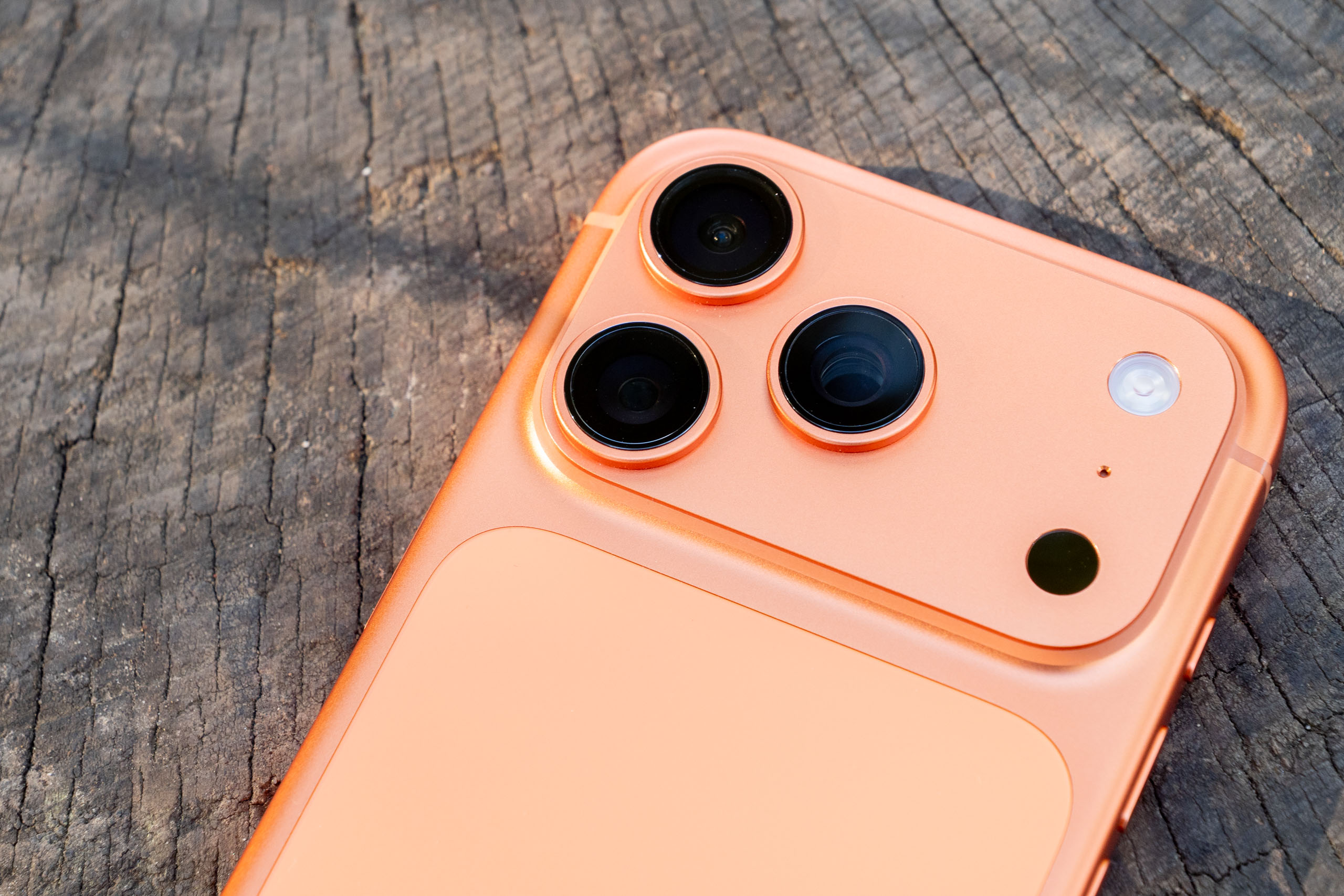
The most recent iPhone flagship model, the iPhone 17 Pro and Pro Max, has a number of features that make them particularly useful for landscape photography. First off is the main sensor (1x lens, 24mm f/1.78 equivalent) with a high 48MP resolution. By default, images are output at 24MP – a significant boost from the 12MP standard output of most other smartphones. You can also shoot at the full 48MP resolution if you prefer.
That high-resolution sensor gives you some interesting options for shooting at ‘different’ focal lengths, which make use of different areas of the sensor. So, not only can you shoot at the default 24mm, there’s also 28mm and 35mm options, as well as a 2x, 48mm equivalent. It’s also possible to shoot in Apple’s ‘ProRAW’ format with all three lenses, which gives you DNG files that you can work on in software either on your computer or on the phone itself.
An ultra-wide lens opens you up to 13mm equivalent, and has an f/2.2 aperture. While not quite as good a performer as the main lens, it’s great for capturing wide vistas and demonstrates plenty of detail even in low light. You can also shoot in raw format with this lens.
What stands out in the 17 Pro compared to previous models is the higher resolution and physically larger telephoto sensor. Boasting a 48MP 4x optical zoom lens equivalent to 100mm and up to 8x ‘optical quality’ zoom, which covers up to 200mm. This lens is ideal for creating “compressed” landscape shots, that make distant mountain peaks and objects look larger and more dynamic.
Just like the iPhone 16 series the 17 Pro and Pro Max house the same camera specs, so there’s no trade-off if you opt for the smaller screen. That said, it is more convenient to frame and review your landscape shots on the 6.9-in OLED display in the Pro Max. With an improved, 3000nits display it is also much easier to see outdoors in bright sunlight than the previous models.
There’s a “Camera Control” button, which is designed to give you the experience of shooting with the iPhone as if it were a “real” camera. The improved Apple A19 Pro chip helps it deliver wider dynamic range and retain detail in highlights and shadows better without looking overly processed.
If you would like to save a bit of cash – you can plump for the iPhone 16 Pro/Pro Max instead.
Read our iPhone 17 Pro review.
Samsung Galaxy S25 Ultra
Amateur Photographer verdict
Samsung has done it again – the S25 Ultra is one of the best Android camera phones, ideal for landscapes with raw support and a beefed up ultrawide sensor.
- Three high-res sensors
- Improved 50MP ultrawide camera
- Consistently excellent image quality
- Fairly minor camera upgrade from last model
- Very high price
- Screen only available in one size
| Rear cameras | 200MP f/1.7 main camera, with OIS, 1/1.3inch, 23mm 50MP f/1.9 ultra-wide-angle camera (0.6x), 13mm 10MP f/2.4 3x telephoto camera, with OIS, 69mm 50MP f/3.4 5x telephoto camera, with OIS, 115mm |
| Selfie camera | 12MP f/2.2 PDAF selfie camera (same on all S25 models) |
| Video | 8K 30fps video, 4K 120/60/30fps |
| Screen | 6.9-inch 3120×1440 pixel AMOLED, 2600 nits peak brightness, Corning Gorilla Armor 2 |
| Battery | 5000mAh battery with wireless charging |
Samsung’s S series range has been our go-to recommendation for the best smartphone for photographers for quite some time now, so it’s no surprise to see the latest flagship on the list here for landscape photography.
The S25 Ultra sits at the top of the range. It’s not a huge update from the previous year’s S24 Ultra, but it does add a number of new features that are of interest to landscape photographers. Spoilers up top – if you’ve already got an S24 Ultra (or, to be honest, an S23 Ultra) it’s not really worth the upgrade, but it is undoubtedly the best of the bunch.
First up is the impressively performing ultra-high resolution 200MP ‘main’ sensor, which is fronted by a 23mm f/1.7 equivalent lens. This is joined by three additional lenses for a total of four – that’s one more than the majority of smartphones, so you’ve got even more flexibility there. You get an ultra-wide, plus two telephotos (3x and 5x).
All this was also the case for the S24 Ultra, but the S25 Ultra has upgraded the ultrawide sensor from a 12MP sensor to 50MP, giving you more detail in the kinds of sweeping vistas that are so popular in landscapes. In day-to-day shooting you probably won’t notice much of a difference, but for printing images, blowing them up or cropping in, the extra pixels can be a real lifesaver.
Elsewhere, it’s got all the smoothness we’ve come to expect from Samsung phones. The native camera app is well featured, offering the ability to shoot in raw format, and there’s a high-resolution shooting mode for those moments where you want to take advantage of all those megapixels.
Read our full Samsung Galaxy S25 Ultra
Google Pixel 10 Pro
Amateur Photographer verdict
The 10 Pro has some of the best cameras and shooting features on a camera phone, but so does the 9 Pro, and it’s considerably cheaper. Great in low light landscapes, including astrophotography.
- Excellent camera setup with effectively 5 rear cameras
- Lovely colours produced in images
- Really useful shooting features
- Only 128GB on base model
- Video Boost for 8K video is dreadful
- Chunky camera protrusion
| Rear cameras | 50MP main camera, f/1.68, OIS 48MP ultra-wide, f/1.7, with macro AF 48MP telephoto, f/2.8, 5x telephoto, OIS |
| Selfie camera | 42MP f/2.2 selfie camera with AF |
| Video | 4K video recording, up to 60fps |
| Screen | 6.3inch screen, 1-120hz, 3300nits (peak), Gorilla Glass Victus 2 |
| Battery | 4870mAh battery with wireless charging |
The Pixel 10 Pro is the latest flagship from the company. Essentially, there’s slightly increased battery life compared to the Pixel 9 Pro, slightly improved screen, and better speakers, as well as Bluetooth v6.0, and it’s slightly heavier. If you already have the 9 Pro, there’s little reason to upgrade to this model.
There’s a triple camera setup on the rear of the phone, with an ultra-wide angle, wide-angle, and 5x telephoto cameras. The 1x lens offers 2x “optical quality” zoom, whilst the 5x lens offers a 10x “optical quality” zoom, as seen on the previous model, and I was impressed by the results, even finding it a match for a phone with a true 10x optical lens.
The Pixel 10 Pro offers a lot of cameras for the price, yet the inclusion of just 128GB storage is disappointing for the price. (For those who regularly record 4K video, this would run out fast.)
The cameras give consistent results, whether you use the ultra-wide, the wide, or the telephoto, and the 2x and 10x options also give impressive results. The 5x telephoto camera is a periscope design, albeit not optimised for macro or close-up photography.
Night photography remains a major strength of this phone, as it did its predecessor the Pixel 9 Pro. When light is low, night mode will activate automatically. It can be used with any camera; be it the ultra-wide, wide-angle or telephoto camera, and results are quite impressive. Viewed at full size, images can look soft. Results will vary depending on a number of factors, with worse results in darker conditions, as expected.
Put it on a solid surface such as a wall, a beanbag, or a tripod with phone adapter, and the astrophotography features become incredibly impressive offering exposures in the minutes rather than seconds.
Excellent astrophotography shooting options are available if you want to shoot landscapes in very low light – which could be enough to tip the balance from another model to the Pixel if you like to head out after dark. Google also claims there have been improvements to low-light shooting in the Pixel 9 Pro with some new functionality including Night-sight panoramic photos.
Read our full Google Pixel 10 Pro Review.
Honor Magic 8 Pro
Amateur Photographer verdict
The Honor Magic8 Pro offers a great triple camera setup with the 3.7x telephoto offering both good low-light night photography, and lovely close-up photos too
- Updated telephoto night camera (3.7x)
- IP69K protection rating
- 6270/7100/7200mAh battery (region dependant)
- UK only gets the smaller battery
- Not available in the US
| Rear cameras | 50MP f/1.6 main camera with AF, OIS, 23mm 200MP f/2.6, 3.7x telephoto with AF, OIS, with close-focus, 85mm 50MP f/2.0 ultra-wide with AF (and macro), 12mm |
| Selfie camera | 50MP f/2.0 selfie, fixed focus |
| Video | 4K 120fps video |
| Screen | 6.8inch screen, 1-120Hz, 2600nits,6.71inch OLED 120Hz, 1800/6000nits (HBM/peak) |
| Battery | 6270mAh (Europe), 7100mAh (International), 7200mAh (China) Silicon Carbon Li-ion battery |
The Honor Magic 8 Pro is Honor’s flagship device with a 50MP main camera with OIS, and a bright f/1.6 aperture and a relatively large sensor. There’s an ultra-wide-angle camera that is wider than most and an improved telephoto unit that excels in low light.
While the ultrawide and wide lenses can display some noise towards the corners, this is something you likely won’t notice unless you go pixel peeping. The 200MP telephoto camera with an f/2.6 aperture on the other hand, is a star performer, supported by optical image stabilisation (OIS), and a larger-than-normal sensor it tackles low-light and night scenes with ease.
There’s a Pro mode available to precisely control ISO, shutter speed, and focus (AF-S, AF-C, or MF), which is useful for setting up manual long-exposure landscape shots. A dedicated long-exposure mode, “Silky Water” lets you capture beautifully blurred waterfalls without the use of a tripod.
AI technology is included to help with taking photos as well as editing photos, with editing features that rival other brands on this list. The phone also offers an IP69K rating.
The main processor in this phone is currently one of the fastest available, and you can even use the phone as a desktop computer when connected to a monitor, great if you want to edit your photos on a large screen.
Presenting a significant saving over rivals like the Samsung S25 Ultra or the iPhone 17 Pro, the Honor Magic 8 Pro is definitely one to consider – though it can be difficult to find in some territories.
Read our full review of the Honor Magic8 Pro.
Xiaomi 15 Ultra
Amateur Photographer verdict
A 1-inch sensor puts the Xiaomi 15 Ultra well ahead of the pack photographically. It’s expensive and can be hard to find, but it’s superb for landscapes.
- Class leading one-inch type sensor
- 4x high-resolution lenses
- Leica partnership
- Great photography kit available
- Very high price
- Not available in all markets
- Main lens aperture no longer variable
| Rear cameras | 50MP main camera with 1inch sensor and f/1.63 aperture 50MP f/2.2 ultra-wide (14mm equiv) 50MP f/1.8 3x telephoto (70mm equiv) 200MP f/2.6 4.3x telephoto (100mm equiv) |
| Selfie camera | 32MP f/2.0 camera without AF |
| Video | 8K 30fps / 4K 120fps video |
| Screen | 6.73-inch LTPO AMOLED, 3200 x 1440 pixels, 120Hz, 3200nits (peak) |
| Battery | 5410mAh battery (international) |
Smartphones have a reputation for having tiny sensors – but the Xiaomi 15 Ultra is something different. With a 1-inch imaging sensor for its main camera, it’s more in the realm of a premium compact camera than the phones it rubs shoulders with, and when you see this paired with a selection of Leica-made lenses, you begin to understand why so many publications (us included) have started describing these phones as the best smartphones for photography.
There are caveats of course. Xiaomi’s phones are expensive, and they can also be hard to get – the Chinese manufacturer’s products are not available in all territories. With that out of the way – if you can get it and you can afford it, this is a hell of a phone for landscapes, and is one of the most impressive I’ve ever tested.
The 50MP Sony LYT-900 one-inch type sensor on the main camera delivers sumptuous images, full of punchy colours, vibrant detail and excellent dynamic range – I came away seriously impressed. The ultrawide also puts in a good shift, which is good news for landscapes. Blue skies in particular look absolutely dazzling.
The Leica-made lenses do an excellent job across the board. My small nitpick is that on previous versions, the main lens had a variable aperture that could stop down to f/4. This one doesn’t, and that makes it harder to get images that are fully in focus front-to-back, as is generally desirable for landscapes. It’s not a dealbreaker though – most people won’t notice when viewing the images on a phone screen – and doesn’t detract from one of the most capable smartphones for landscapes.
Read our full Xiaomi 15 Ultra review
How we test smartphones for landscape photography
We have reviewed and tested every single phone on this list, thoroughly, using them extensively for at least 2 weeks (often longer), so you can trust our recommendations when deciding which phone to buy.
We review smartphones from the perspective of choosing a smartphone for its photography and camera performance, so we test every phone by looking at what it offers in terms of the cameras and what features are included for photography and video, and how it performs in real world use in a variety of different shooting situations. We look at video quality for both picture quality, smoothness of zoom, as well as the audio quality on offer.
We test each camera on the phone, whether that’s the ultra-wide angle, the main camera, telephoto camera(s), and selfie camera, as well as the additional “lenses” (the extra zoom levels) and zoom modes on offer (whether that’s real or digital/AI generated), plus any additional modes these lenses offer, whether that’s macro or telephoto macro. These premium phones should be putting in a stellar performance with every camera on the phone, including the selfie camera.
We use the phones for photography in a range of lighting conditions, including low-light, where camera phones can struggle, and this will highlight any weaknesses from smaller sensors. We shoot in bright conditions, where cameras can struggle with bright and dark areas, and this tested the dynamic range of the cameras as well as how well the phone handles high-dynamic-range (HDR) processing
We also look at specialist shooting modes on offer, including the portrait modes on offer, looking at how well it deals with the subjects, background blur, and areas of detail like around the hair. We also look at AI features, for example, when shooting photos, and when it comes to editing, what AI editing tools are on offer and how do they perform.
In addition to all of this, we look at how good the overall phone is, in terms of battery life so you can keep shooting throughout the day, the screen quality and brightness (testing this in bright outdoor light and checking visibility), and overall build quality.
Recent updates
- 2026 February: the iPhone 16 Pro Max was replaced by the iPhone 17 Pro Max, while the Magic 6 Pro was also updated to the recently reviewed Magic 8 Pro that impressed us with its low-light performance.
Related content: