The first mirrorless model to put itself forward as a comprehensive replacement for pro full-frame DSLRs and it delivers impressively on its promise
Pros
Excellent continuous shooting
Superb subject detection and autofocusing
Great build quality
Cons
A little unwieldy
Needs expensive memory cards
At a glance:
Professional-level flagship mirrorless
30fps shooting (120fps at 11 megapixels)
45.7 megapixel full-frame sensor
6-stop in-body image stabiliser
8K video
AI subject-detect autofocus
£4,999 / $4,999 (body only)
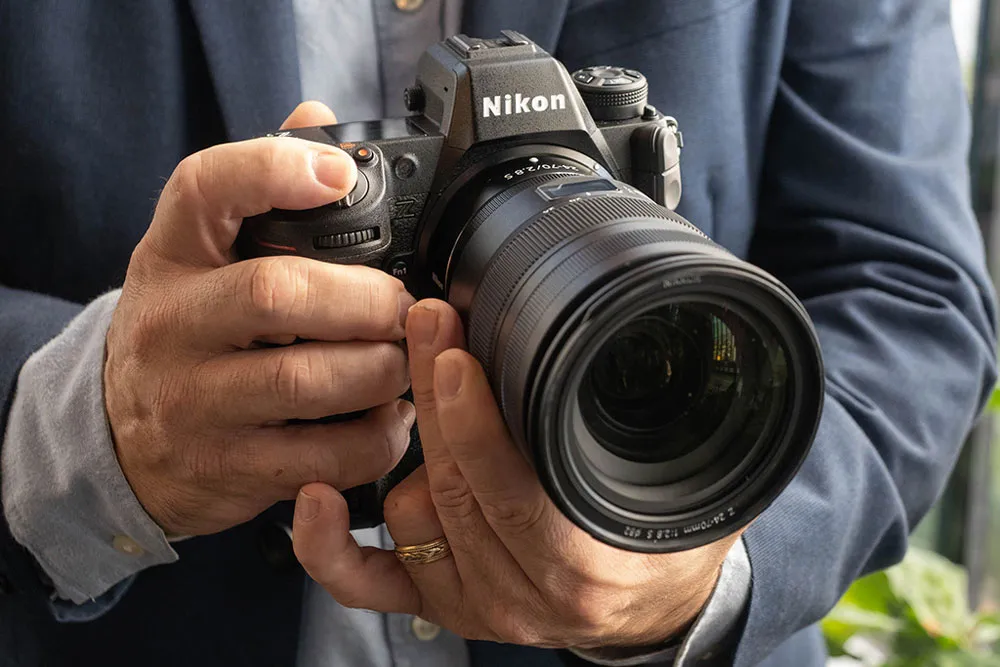
The Z9 is an excellent all-rounder for professional photographers, but it’s especially good for wildlife, sports and action photographers. Being able to record at 20fps in raw format with continuous autofocus means that you’ll be able to capture those split-second moments. And if that isn’t fast enough, you can even opt for 30fps (so long as you’re happy to only shoot in JPEG), or 120fps if you record at 11 megapixels.
In the past, speed has usually come at the expense of resolution, but the latest breed of top flagship cameras manage to excel at both. As such, you get a 45.7-megapixel sensor here with the Z9. Our review of the Z9 described it as “the final nail in the coffin for the pro DSLR”, which speaks volumes.
Further good news comes from Nikon’s decision to eliminate a mechanical shutter entirely, relying instead on an electronic shutter which is enabled by using a stacked CMOS sensor. The upshot here is that the Nikon is available at a cheaper price than its closest rivals from Canon and Sony – pros might want to put that extra saving towards additional glass.
During our time with the camera, we were also impressed by the camera’s handling, particularly the vertical grip, though it is arguably a little unwieldy at times – especially if you’re used to shooting with something smaller.
Best camera for professional sports photographers: Canon EOS R1
The R1 feels particularly secure in-hand thanks to its grippy covering. Image credit: Amateur Photographer
Amateur Photographer verdict
A superb camera in its niche at the top-end of sports and action photography. Super-fast, built like a tank and very expensive, it’s one for the pros.
Pros
Excellent control setup
Superb viewfinder
Lightning fast shooting
Eye control focus
Cons
Heavy
Slightly compromised dynamic range
At a glance:
$6,299 / £6,999 body-only
24MP stacked CMOS sensor
ISO 100-102,400 (standard), 50-409,600 (extended)
40 frames per second shooting
6K 60fps video
9.4m-dot, 0.9x viewfinder
Fully articulated touchscreen
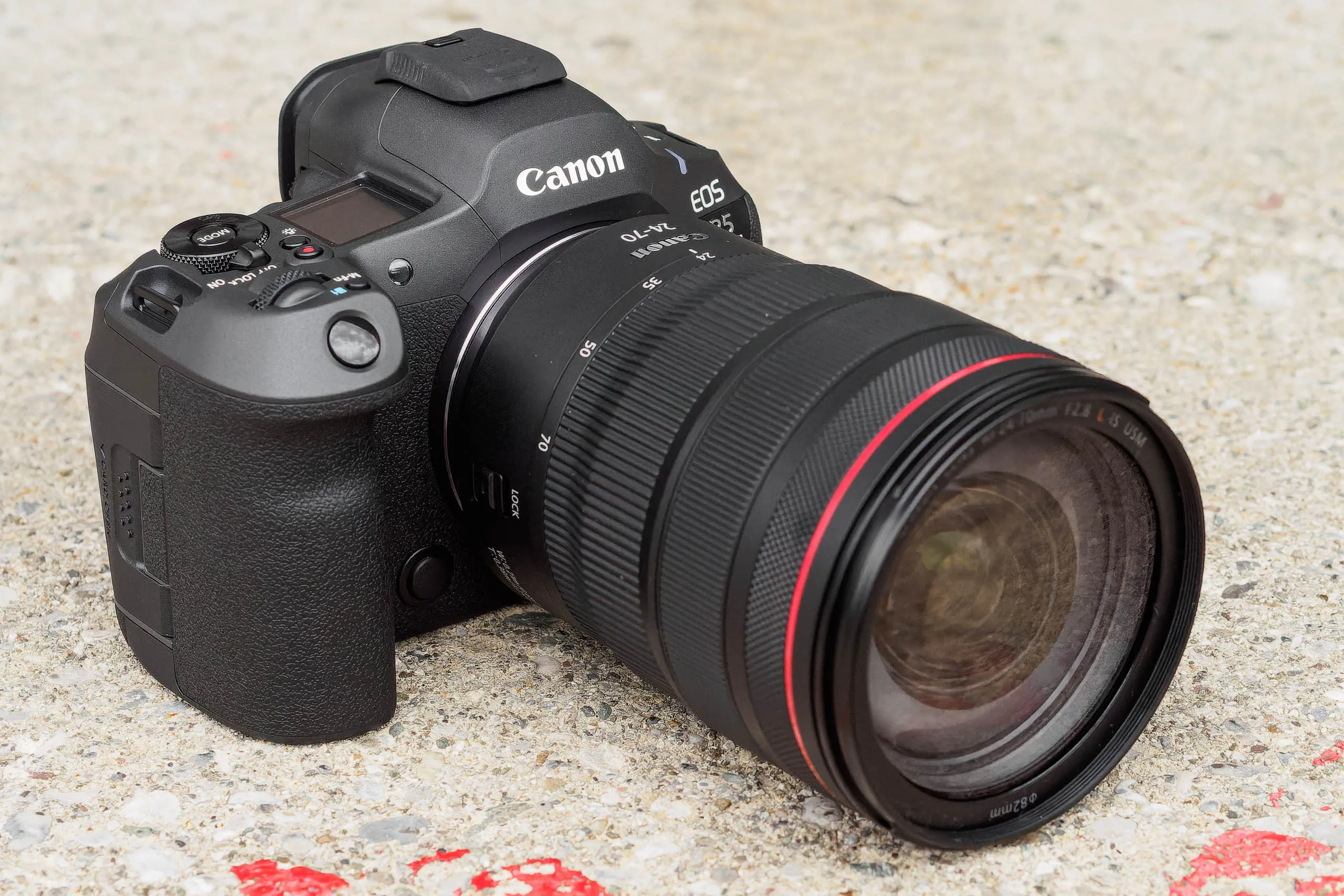
Designed for professional sports and action photography, the Canon EOS R1 is the firm’s first mirrorless model to sport its flagship “1-series” designation. Announced in mid-2024 alongside the 45MP EOS R5 Mark II, it can shoot 24MP stills at up to 40 frames per second, record 6K raw video at 60fps, and has a large body with an integrated vertical grip. In many ways, it can be seen as a fully pro-spec update to the EOS R3 from 2021.
The EOS R1 employs a 24MP stacked-CMOS sensor, yet differs from the unit in the EOS R3. The big first difference is in its implementation of Canon’s dual-pixel CMOS AF, where every sensor pixel is split into two for phase detection autofocus. In Canon’s other cameras, each pixel is split into left/right pairs, but in the R1, alternate green pixels are split vertically instead. This enables cross-type focusing, which should help the R1 to focus in certain situations where other cameras might fail.
Some new autofocus features reflect the EOS R1’s particular specialisation for action and sports. The Action Priority mode, which initially works for football, basketball, and volleyball. It employs ball tracking and an understanding of certain ‘action poses’ to determine when to switch focus between the players. With soccer, for example, it’s designed to recognise and prioritise such things as ‘save by keeper’ and ‘sliding tackle’. This defines it really as one for professionals.
Best camera for professional landscape photographers: Sony A7R V
Best professional Sony camera, the Sony Alpha A7R V or Mark V, as tested by Andy Westlake
Amateur Photographer verdict
We love the Sony Alpha A7R V for its all round prowess. Its sensational viewfinder, superb screen design, and multitude of interface improvements are very impressive – as they should be for its price.
Pros
High resolution sensor
Fantastic autofocusing and subject recognition
Multi-angle screen and large detailed viewfinder
Cons
Small body can make pro lenses feel unbalanced
At a glance:
Mirrorless camera
61MP full-frame sensor
693-point autofocus
AI subject recognition
ISO 100-32000 (standard)
10fps shooting
8K 24fps video
£3,249 / $3,499 (body only)
Building on the success of the A7R IV, the A7R V employs the same sensor as its predecessor but adds interesting and useful new improvements including enhanced subject detection AF, which is powered by a new AI processing unit.
There’s also a raft of body design and interface improvements making it a better all-round experience to use it compared to the older model.
This is a camera which is well-suited to those who crave high-resolution capabilities, so professional landscape and studio photographers will appreciate it. Although at 10fps it’s not the most amazing camera in our list for sports and action, for pros that only shoot such subjects occasionally it’s not too bad an option.
The best all-rounder camera for professionals: Sony A1
Sony Alpha A1 Review. Photo credit: Andy Westlake
Amateur Photographer verdict
The Sony Alpha A1 has astounding capabilities that will serve even the most demanding of professional photographers’ needs. Its shooting speeds, autofocus, and resolution power are unrivalled.
Pros
Superlative burst speeds
Incredible viewfinder
Fantastic all-rounder for all genres
Cons
High price
At a glance:
Professional-level flagship mirrorless camera
50.1MP full-frame Exmor RS CMOS sensor
30 frames per second shooting
ISO 50-102,400 (extended)
8K 30p video recording
£5,099 / $4,999 body-only
One of the most advanced cameras ever made, the Sony A1 is a superb all-rounder that can tackle pretty much anything you’d care to throw at it.
Indeed, in our review of the camera, we discovered it to be one of the best cameras ever made. With this model, you don’t need to choose between speed and resolution as you get up to 30 fps shooting, with 50 megapixels for super-fine detail. That makes it adept at all manner of subjects, including landscape and portraits, but also sports and action. A real workhorse of a camera, it’s ideal for pros who want or need to shoot a bit of everything.
Video specifications are also impressive, so if you’re one of the increasing number of pros expected to deliver both still and moving images, it should suit you well there too.
Build and handling is on-the-whole very good, with our review highlighting one small gripe in the shape of the somewhat fiddly buttons can become a bit problematic in cold weather when wearing gloves. The viewfinder and screen are superb however and make viewing your subject and your images a real joy.
Of course, none of this comes cheap, making the A1 a hefty investment, but for Sony shooters, it’s a real winner.
With its world-first global shutter sensor, the A9 III is designed for professional sports photographers. Credit: Andy Westlake
Amateur Photographer verdict
The Sony Alpha A9 III’s global-shutter sensor brings amazing speed and unique advantages for sports shooters. However, its image quality lags behind its peers, making it very much a niche product.
Pros
Impressive autofocus and continuous shooting
No rolling shutter distortion
No colour bending in artificial lighting
Flash sync at any shutter speed
Cons
Minimum ISO 250
Over complicated menu
Sony Alpha A9 III at a glance:
Mirrorless camera
24.6MP full-frame stacked-CMOS sensor with global shutter
ISO 250-25,600 (standard), 125-51,200 (expanded)
120fps continuous shooting
4K 120P video recording
9.44m-dot, 0.9x viewfinder
3.2in, 2.1m-dot articulated touchscreen
$5,999 / £5,199 body-only
If you’re a Sony lover and your main concern is sports and action, it arguably makes more sense to go for the A9 III rather than the A1. The global shutter sensor brings numerous benefits to sports photographers, as it eliminates the phenomenon where parts of LED advertising boards can appear blacked-out, and you can also say goodbye to subject distortion and any flickering or colour banding of artefacts in artificial light. You can also use flash at any shutter speed.
The A9III offers a shutters speed up to 1/80,000sec, making it the fastest shutter speed camera on the market, however this option is limited to single-shot mode. All in all it is ridiculously fast, even when shooting full sized RAW files, and it offers a jaw dropping 120 fps continuous stills and video. With 4K video recording, fantastic autofocus and decent build handling, the A9 III is a worthy choice for those who make their living from shooting sports, especially if high resolution is not their primary concern.
Best Canon all-rounder camera for professionals: Canon EOS R5 II
Canon EOS R5 Mark II with RF 24-105mm F4 L IS USM lens. Credit: Andy Westlake
Amateur Photographer verdict
The Canon EOS R5 Mark II stakes a strong claim to be the best professional high-resolution, high-speed all-rounder on the market. The addition of eye control focus elevates it from its rivals, too.
Pros
Excellent handling
Incredible subject detection AF
Eye Control Focus
Great image stabilization
Cons
not compatible with some third-party LP-E6 batteries
Eye control may not work well for everyone
At a glance:
45MP stacked CMOS sensor
30 fps shooting
8K 60fps internal raw recording
8.5 stops built-in image stabilisation
Eye Control Focus
$4,300 / £4,500 body only
The R5 has been one of Canon’s best high-resolution full-frame mirrorless cameras. It boasted impressive specs but had some issues with overheating during high-res video recording. The EOS R5 II addressed this problem and further improved the video specs and overall performance of this otherwise stellar full-frame powerhouse.
The R5 II has the same megapixel count as its predecessor, but now it’s equipped with a new back-illuminated stacked-CMOS sensor, that is said to reduce rolling shutter by 60%. It also received a new DIGIC X processor thatenables new autofocus features, faster video shooting, and more responsive operation.
The impressive Eye Control Focus technology, previously seen in the EOS R3 detects where you are looking in the viewfinder and then automatically focuses on that subject. Another new autofocus feature ‘Action Priority’ autofocus has ball tracking and recognises ‘action poses’ in football, basketball, and volleyball. It also registers up to ten faces that it will prioritise focusing on, and it even lets you arrange them in order of priority.
Now, for the video specs, Canon made sure to bulk up in this area, fixing the overheating issue by adding an internal heat dissipation channel and for those who plan to put it through even more demanding use there is an additional cooling fan grip. The R5 II records internally in 8K 60fps using Canon’s proprietary SRAW format. Another new feature is proxy recording where a low-resolution file can be simultaneously recorded to the second memory card for easier editing. There’s also a new dual still/video shooting function, in which it’s possible to record Full HD video to one memory card and still images to the other at the same time.
In our full review we’ve found that “for any photographers still using 5D-series DSLRs, the EOS R5 Mark II is a massive step forward. Even for existing EOS R5 users, there’s plenty here to make it worth considering upgrading.”
Best Nikon for professional landscape and portrait photographers: Nikon Z7 II
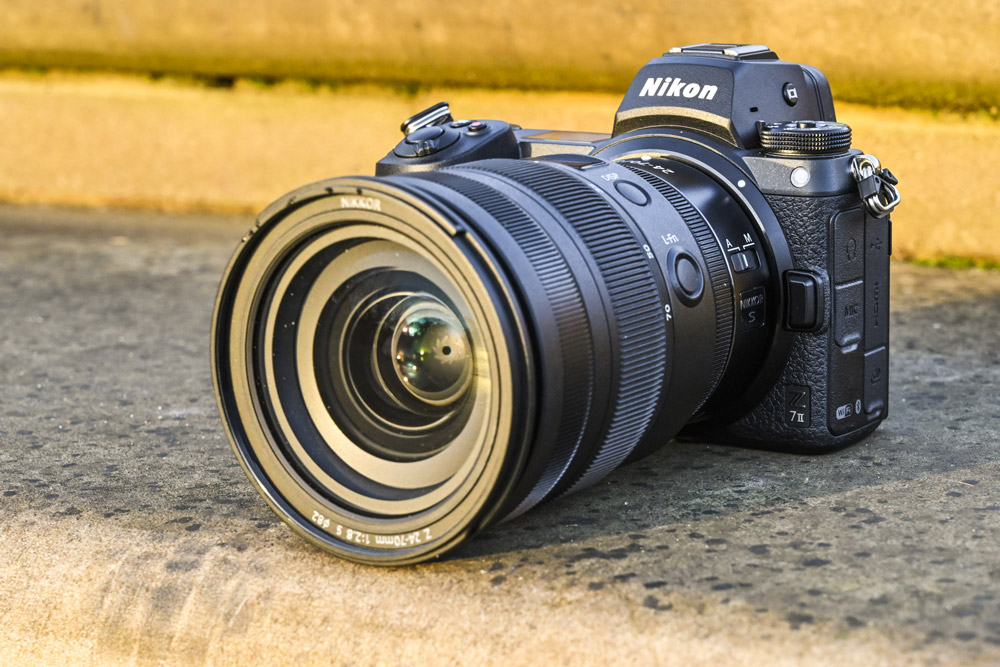
Nikon Z7 II with 24-70mm f/2.8 lens (MT)
Amateur Photographer verdict
One of Nikon’s finest high resolution mirrorless cameras, it is remarkably impressive and offers magnificent latitude when processing Raw files.
Pros
Dual card slots
Good face and eye detection
Excellent image quality
Cons
Tilting-only viewfinder
At a glance:
Mirrorless camera
45.7 megapixel full-frame sensor
Up to 10fps shooting
4K video
5-stop in-body image stabiliser
£2,949 / $2996 (body only)
Although Nikon’s Z7 II camera is capable of producing excellent stills and video, it’s best for those who primarily seek to capture subjects such as landscapes or portraits, rather than fast-moving subjects.
You get a very high-resolution 45.7-megapixel sensor which is capable of delivering beautiful detail, but with only 10fps shooting and far less impressive AF tracking than the Z9, it’s much less of an ‘all-rounder’ than some of the other models mentioned in the round-up. However, this also means that it costs a lot less than the Nikon Z9, or even than the slightly stripped-down Nikon Z8. So, if you like the idea of having all those pixels but don’t need the blistering burst speeds because you’re primarily working on landscapes or studio portraits, then the Nikon Z7 II is going to be a much more cost-effective buy.
Our Nikon Z7 II review found the Z7 II to handle excellently, though the lack of a fully-articulating screen is potentially an issue for those who want to shoot in portrait format, or record pieces to camera for video. On the plus side, the chunky handgrip and well-placed buttons impressed us when we used it. A vertical grip can be picked up as an optional extra, too.
There’s now a good selection of lenses available for Nikon Z mount, and, unlike Canon, you can also pick up third-party optics if you want to save a bit of cash.
Best hybrid camera for professionals: Panasonic Lumix GH7
Panasonic Lumix GH7 with DMW-XLR2 microphone adapter. Credit: Panasonic
Amateur Photographer verdict
Designed for professional content creators and small production teams, Panasonic’s first true ‘cinema camera’ delivers outstanding video performance and great image stabilisation
Pros
Internal 5.7K ProRes RAW recording
Huge range of video codecs
Excellent 5-axis in-body image stabilisation
No recording time-limit
Cons
Not weather sealed
Battery life could be improved
Heavy body for a MFT
At a glance:
Micro Four Thirds flagship mirrorless camera
25.2MP CMOS sensor
5.8K 30p; 5.7K 60p; 4K 120fps; FullHD 240fps
Internal Apple ProRes Raw recording
Enhanced in-body image stabilisation
Subject recognition for humans, animals, and vehicles
Phase detection autofocus
$2199 / £1999 body-only
This is the only camera on our list for professionals to feature a smaller than full-frame sensor. Although Micro Four Thirds has dropped in popularity in recent years, for video-centric users, the Panasonic Lumix GH7 is an enormously impressive hybrid model that other rivals struggle to match. By opting for a small sensor, you get a range of impressive specs in a small, portable and flexible body that doesn’t cost the earth.
The reason for being such a fantastic option? It’s the sheer flexibility it offers to pro video shooters. It gives video creators pretty much every conceivable codec that they might crave, including 240fps Full HD and 5.7K 60fps. There’s also a slew of other useful video functions including V-Log and the ability to record in the Apple ProRes format.
All of that comes at a price that won’t dent the budget anywhere near as much as most of the other models in this roundup, making it ideal for videographers who likely need the cash for a host of other video-related accessories.
In our full review, we happily noted that Panasonic has moved away from “DFD” Panasonic (Depth From Defocus) autofocusing technology used in the previous GH6 model and implemented Phase-detection autofocus in the GH7 which results in faster and more accurate autofocusing. This more than anything makes it into a true hybrid powerhouse, and cements its status as very possibly the best camera you can buy if you want to shoot both photos and videos to a professional standard.
The final model in our round-up is something special indeed, being the only medium-format camera to feature here. It certainly answers the question as to whether professionals use Fujifilm cameras, as this medium-format camera is aimed directly at professionals!
The GFX100S II features the same pixel count as the firm’s other medium format flagship, the pricier GFX100S, meaning you get 102 megapixels of goodness in a larger than full-frame sensor for the ultimate detail and gorgeous image quality. Of course there are some sacrifices to be made – this really isn’t a camera for speed freaks, but if that’s not something you need to shoot then it’s worth considering. Even though pixel count remained the same the sensor lost its HS credentials compared to the GFX100 II, this means you can expect the same image quality, but at slower continuous shooting speed, and somewhat slower autofocusing. Nonetheless Fujifilm compenstaes for this by making the ISO expandable to ISO 40-102,400 and adding 5-axis in-body image stabilisation system (IBIS) providing 8 stops of compensation.
In the past, medium format cameras were huge and unwieldy, and the idea of carrying one around to use handheld was pretty much unheard of. Fujifilm changed everything with the GFX 50S and has built on that ever since. The 102MP GFX 100S II brings ultra-high resolution medium format shooting at a not-too ridiculous price – its cost is roughly in line with plenty of other models in our list.
If you want the best possible image quality and aren’t too worried about having something for action, the Fujifilm GFX100S II is most certainly worthy of consideration.
When choosing a camera to use for professional purposes, there’s quite a few things to think about.
If you’ve already invested in a camera system before, the chances are that you’ll want to stick with the brand you’re already familiar with – especially if you have lenses already. However, if you’re fairly new to photography, or perhaps are upgrading to mirrorless after using DSLRs, then the choice is a little bit more open. That said, if you already have Canon or Nikon DSLR lenses, you can continue to use them with each company’s mirrorless options via an adapter.
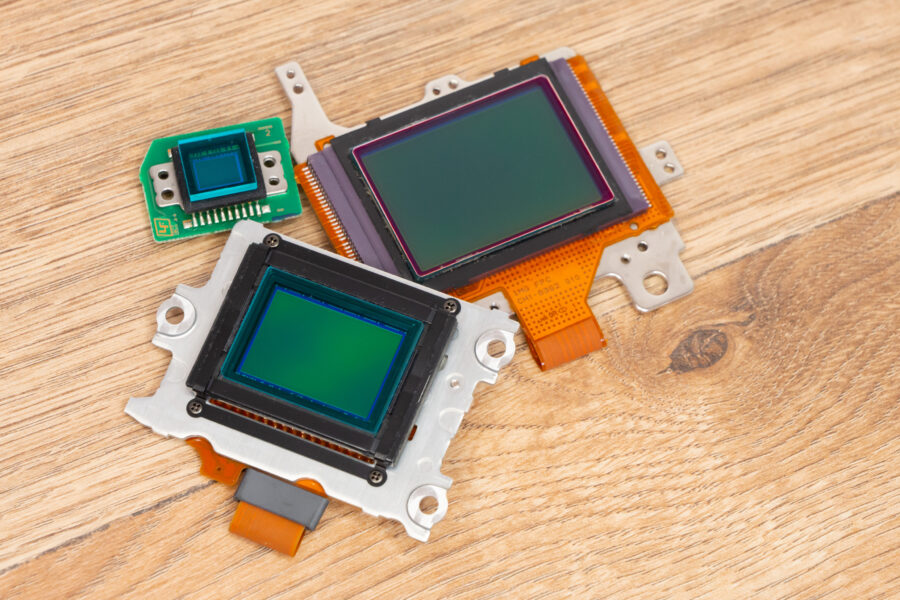
Next up, you might want to think about choosing the best sensor size for you. Most of the cameras in our list use a full-frame sensor, which is a pretty common choice for professional photographers. You can go smaller and still be a professional, of course, and there are some advantages to doing that – mostly to do with portability and so on. However, for the highest possible image quality, full-frame tends to be a good choice. Bigger than full-frame, in the shape of medium format, is also an excellent choice.
Canon’s EOS R1 employs a 24MP full-frame sacked CMOS sensor. Image credit: Andy Westlake
Every professional is different, but taking a look at a camera’s key specifications will help you decide if it’s the right choice for you. Say, for example, you’re a sports photographer, you might need something with fast burst shooting. Sophisticated autofocus systems also come in handy for tracking objects around the frame. A high resolution might be most favoured by landscape and portrait photographers.
Another important aspect to think about – especially for modern working professionals – is video specifications. Although this list is mainly aimed at stills shooters, we’ll still give plenty of information about how good each camera is for video.
Lastly, you might want to consider how a camera handles. Does it have lots of direct access controls, or is it customisable to exactly how you want to work for example. Does it have a built-in vertical grip, or the option to add one for portrait-format shooting.
How we test professional cameras
We test professional cameras primarily by using them to take photographs and video in a wide range of real-world situations. We evaluate their control layouts and handling, and the usability of their viewfinders and screens. We assess their autofocus across a range of different subjects and shooting scenarios and check their continuous shooting capabilities.
We also examine the effectiveness of their image stabilisation systems. Last but by no means least, we critically evaluate the image quality, in both JPEG and raw, including resolution, high-ISO noise, and dynamic range. We then take all these factors into account, along with such things as portability and lens systems, when giving our final conclusion and score.
Amy is a highly experienced photography and technology journalist who has been working on AP since 2018, having been working in the industry since 2009. She is a graduate of the magazine journalism course at Cardiff University and has written for a wide range of publications and websites. As Features Editor, she is responsible for commissioning an eclectic mix of features connected to general photography, along with interviews. She is also a very experienced reviewer of cameras and associated technology, with her reviews featured on multiple sites including TechRadar, Digital Camera World, Trusted Reviews, ePhotozine, Stuff, Expert Reviews, T3, Photography Blog and more. She is also an expert on smartphone photography and smartphones generally.