




I help you find the right Canon camera to buy, from beginner models to top-end professional choices.




The Canon PowerShot V1 is very capable as a high-end compact camera for video and vlogging. But its ultra-wideangle zoom limits its attraction for general-purpose photography.
Specifications at a glance:
| Sensor | 22.3MP 1.4in-type sensor |
| Continuous shooting | 30fps |
| Autofocus | 3431 autofocus points |
| ISO | ISO 100-32,000; ISO 51,200 extended |
| Image stabilisation | 3 stops |
| Video | 4K 30p video (unlimited recording) |
| Viewfinder | None |
| Screen | 3in 1.04m-dot vari-angle touchscreen |
As the ‘V’ designation suggests, Canon’s latest compact on the market is geared towards video capture. With its extremely wide 16-50mm f/2.8-4.5 equivalent lens, the V1 is clearly designed for video, and especially well suited for vlogging. You can hold it at arm’s length at the widest, 16mm setting and record yourself with a good amount of background included in the frame.
It relies solely on its 3in 1.04m-dot vari-angle touchscreen, as there is no viewfinder. A nice touch is the added countdown timer, so when filming yourself or someone else, you can factor in a few seconds to settle down for the recording.
The dual pixel autofocus puts in a good performance in terms of tracking both during video and stills capture, and the 3,431 selectable focus points cover the entirety of the sensor. Moreover you get autodetect subject recognition for people and animals
Like other compacts from Canon, the V1 includes a built-in 3-stop ND filter, which makes it ideal for filming with larger apertures while still using slower shutter speeds. A headphone socket is included as well as a windshield which you can mount on the hotshoe. You also have the option to record in C-Log3, allowing for more flexibility in post-production colour grading, and thanks to the built-in fan, overheating won’t be a limiting factor for recording times. But you still need to keep an eye on battery charge and SD card space.
With an asking price $899.99 / £959.99, the Canon PowerShot V1 is pretty good value for an all-in-one vlogging camera. It’ll blow your smartphone away in terms of image quality, and while it’s a little more expensive than the vlogging-focused EOS R50 V, it’s easier to use, and will probably better suit the majority of independent content creators.
Read our full review of the Canon PowerShot V1


While the EOS R8 isn’t aimed at advanced users, you just can’t argue with the results. For the price especially, the autofocus is class-leading.
Specifications at a glance:
| Sensor | 24.2MP CMOS full-frame sensor |
| Continuous shooting | 40 fps with electronic shutter |
| Autofocus | Subject detect AF |
| ISO | 50-204,800 (extended) |
| Image stabilisation | No |
| Video | 4K 60p |
| Viewfinder | 2.36m-dot, 0,7x, 60 or 120 fps |
| Screen | 3in, 1.62m-dot fully articulated touchscreen |
Canon provided a welcome upgrade for the ageing Canon EOS RP in the form of the Canon EOS R8. At first glance, it looks much the same, with a similar body size, and a full-frame sensor of about the same resolution. So what’s the difference?
Well, Canon packed in the fantastic subject-detect autofocus system from the high-end Canon EOS R6 Mark II, giving it one of the most reliable autofocus systems of any camera around its price. It uses Canon’s Dual Pixel CMOS AF sensor to lock on quickly and accurately anywhere in the frame. And thanks to that AI-powered subject-detection, it can recognise subjects like humans, animals and vehicles and keep hold of them even as they move. Focusing basically becomes something you no longer have to think about, which can really improve your hit-rate for tricky subjects like wildlife and street scenes.
The Canon EOS R8 really is just a camera that nails the shot, again and again. Thanks to Canon’s well-judged in-camera processing, it produces JPEGs good enough to share straight out of camera, punchy and sharp with fantastic colours. Again, it gives you less to think about, resulting in a camera that just gets out of your way and lets you focus on the business of composing and shooting.
As we found in our review, the compromises with the EOS R8 mostly concern build and handling. The EOS R8 skates by with very few physical controls, necessitating some menu fiddling to get to grips with its settings. There’s only one card slot, and the LP-E17 battery is unusually small for a camera in this class, rated to just 220 shots (in practice you’ll probably get a few more, but you’ll still definitely want a spare). Also, be aware that there’s no in-body stabilisation, so you’ll be relying on the systems built into the lenses.
The Canon EOS R8 has been out for a little while now, and discounts are not uncommon. Currently you can get this mirrorless body for $1,299/ £1,499, which is pretty competitive in the crowded full-frame market, and makes it a compelling option for anyone looking to make the jump to a larger sensor format.
Read our full Canon EOS R8 review
Best for: upgrading to full-frame


A seriously impressive jack of all trades, with a large, deep handgrip, extensive external controls and excellent image quality.
Specifications at a glance:
| Sensor | 32.5 MP full-frame sensor |
| Continuous shooting | 12 fps (mechanical)40fps (electronic shutter) |
| Autofocus | Subject recognition AF |
| ISO | ISO 100-64,000 (standard) ISO 50-102,400 (expanded) |
| Image stabilisation | 8.5 stops at centre, 7.5 at periphery |
| Video | 7K 17:9 60p internal RAW, 4K 120p, 2K 180p |
| Viewfinder | 3.69m-dot OLED, 120fps, 0.76x magnification |
| Screen | 3in, 1.62m-dot fully articulated touchscreen |
The original Canon EOS R6 was a big hit with a lot of users and reviewers, including us. It was a quieter launch than the Canon EOS R5, but arguably a more successful one, fielding a lower-resolution sensor for a more reasonable price tag. It was the quintessential full-frame all-rounder – and the EOS R6 Mark III very sensibly builds on that formula to deliver an even better jack-of-all-trades for enthusiast photographers and videographers.
The biggest addition is the new 35.2MP Dual Pixel CMOS AF II, which ups the resolution from a slightly stingy 20MP on the original, giving you more latitude to crop into your images without losing details and for making high-quality prints. This sensor is not a stacked type as with the sports-focused cameras like the EOS R1, so you don’t get those ultra-fast readout speeds. However, it is optimised to deliver exceptional low-light performance, with a standard ISO ceiling of 100-64,000, extendable to 50-102,400, which means the EOS R6 III can go on shooting and get useable images even in exceptionally poor light conditions, especially if you’re willing to put some time into post-processing. This is complemented by the highly capable autofocus system.
The EOS R6 Mark III does inherit one thing from the top-end sports cameras, however – that freakishly powerful subject-detect autofocus that can lock onto specific targets: everything from humans and animals to cars and trains. This provides real versatility to a photographer, allowing you to try your hand at different sorts of subjects and consistently come away with sharp, high-quality images.
In our review, we were particularly impressed by the video specs that get the most eye-catching boost from the Mark II predecessor. The R6 III can record raw video internally at 7K resolution and 60fps in 17:9 aspect ratio, or 30fps in Open Gate mode that capture the full sensor area. Alternatively, 4K can be shot at 120fps, and Full HD at 180fps, for slow-motion playback.
While you couldn’t call it a cheap camera, with a current starting price of $2799 / £2799 body-only, the EOS R6 Mark III definitely represents excellent value for how much functionality you get. I can safely say that the Canon EOS R6 Mark III is one of the best cameras for amateur and enthusiast photographers who want to capture all kinds of different subjects.
Read our full Canon EOS R6 Mark III review
Best for: enthusiast photographers

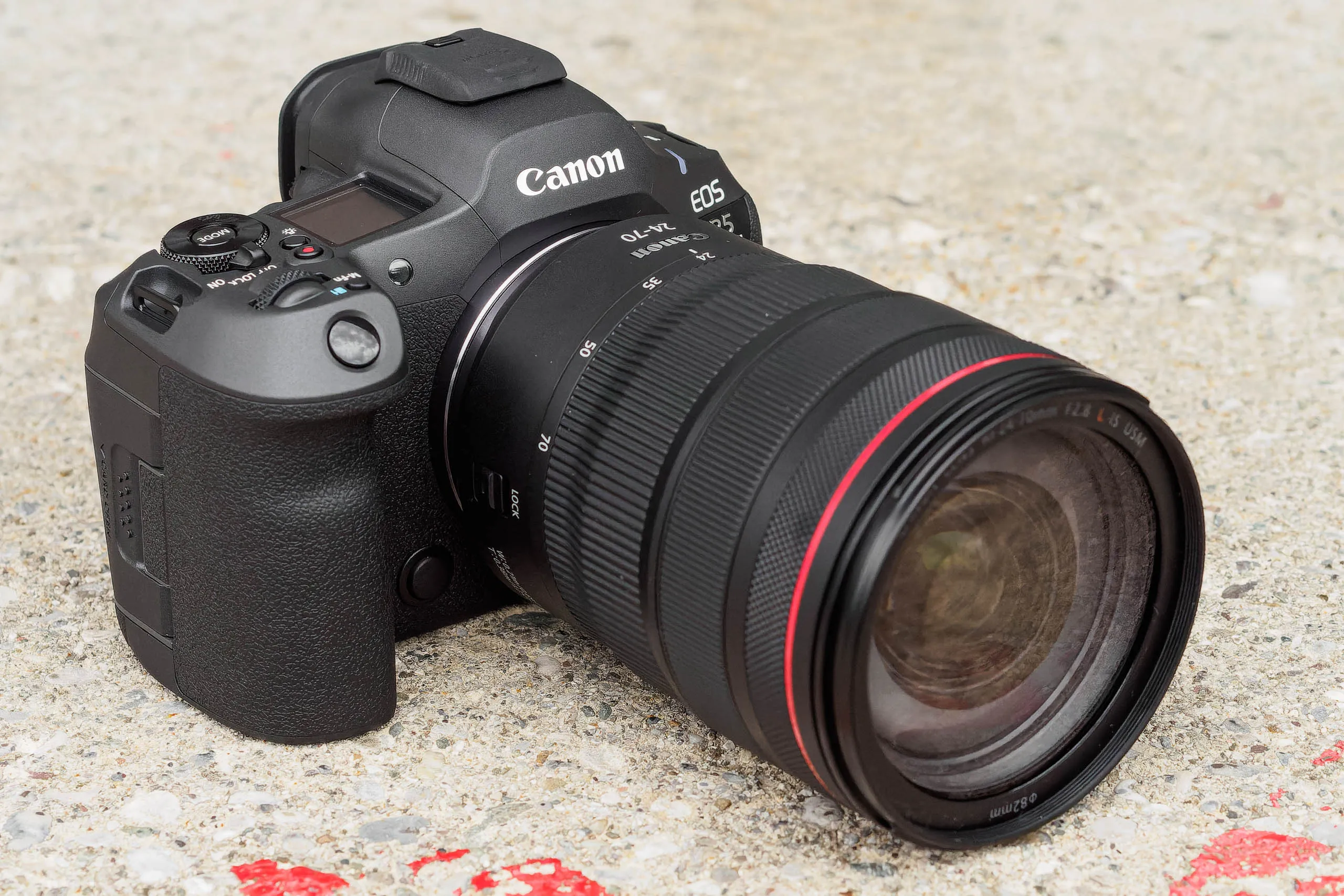
The Canon EOS R5 Mark II stakes a strong claim to be the best professional high-resolution, high-speed all-rounder on the market. The addition of eye control focus elevates it from its rivals, too.
Specifications at a glance:
| Sensor | 45MP stacked CMOS sensor |
| Continuous shooting | 30 fps |
| Autofocus | Eye Control Focus |
| ISO | 50-102,400 (extended) |
| Image stabilisation | 8.5 stops |
| Video | 8K 60fps internal raw recording |
| Viewfinder | 5.76m-dot, 0.76x OLED |
| Screen | 3.2inch, vari-angle, 2.1M-dot touchscreen |
The R5 has been one of Canon’s best high-resolution full-frame mirrorless cameras. It boasted impressive specs but had some issues with overheating during high-res video recording. The EOS R5 II addressed this problem and further improved the video specs and overall performance of this otherwise stellar full-frame powerhouse.
The R5 II has the same megapixel count as its predecessor, but now it’s equipped with a new back-illuminated stacked-CMOS sensor, that is said to reduce rolling shutter by 60%. Rolling shutter is an undesirable effect caused when a subject (or the camera) moves during the short amount of time that the sensor is being read, resulting in it appearing distorted. This can make even the most high-quality video look cheap and amateurish, so it’s always welcome when manufacturers take steps to deal with it.
The EOS R5 II has also received a new DIGIC X processor, which powers many of its exciting new features, as well as delivering faster and more responsive operation. It inherits some tech from Canon’s high-end sports cameras, such as the impressive Eye Control Focus technology, previously seen in the EOS R3, which detects where you are looking in the viewfinder and then automatically focuses on the subject you’re looking at. Another new autofocus feature ‘Action Priority’ autofocus has ball tracking and recognises ‘action poses’ in football, basketball, and volleyball. It also registers up to ten faces that it will prioritise focusing on, and it even lets you arrange them in order of priority. All this is designed to make you a faster and more responsive photographer, able to keep up with demanding subjects and complex scenes.
Now, for the video specs. Canon made sure to bulk up in this area, fixing the overheating issue that plagued the original EOS R5 by adding an internal heat dissipation channel. If you plan to put it through even more demanding use, there is an additional cooling fan grip. The R5 II records internally in 8K 60fps using Canon’s proprietary SRAW format, delivering ultra-high resolution video with a great deal of latitude for post-processing. Another new feature is proxy recording where a low-resolution file can be simultaneously recorded to the second memory card, creating clips that can be quickly edited and shared ahead of the high-res stuff. There’s also a new dual still/video shooting function, in which it’s possible to record Full HD video to one memory card and still images to the other at the same time.
In our full review we found that “for any photographers still using 5D-series DSLRs, the EOS R5 Mark II is a massive step forward. Even for existing EOS R5 users, there’s plenty here to make it worth considering upgrading.” Of course, with starting price of $4,099 / £4500 body only, the Canon EOS R5 Mark II sits exclusively in the professional realm. If you don’t need all of its class-leading features – and most users don’t – you can afford to spend less and pick up one of the other options on our list.
Read our full review of the Canon EOS R5 II.


A superb camera in its niche at the top-end of sports and action photography. Super-fast, built like a tank and very expensive, it’s one for the pros.
Specifications at a glance:
| Sensor | 24MP stacked CMOS full-frame sensor |
| Continuous shooting | 40 fps with electronic shutter |
| Autofocus | Eye control focus |
| ISO | 50-409,600 (extended) |
| Image stabilisation | 8.5 stops |
| Video | 6K 60p |
| Viewfinder | 9.44m-dot OLED, 0.9x magnification |
| Screen | 3.2in, 2.1m-dot fully articulated touchscreen |
Designed for professional sports and action photography, the Canon EOS R1 is the firm’s first mirrorless model to sport its flagship “1-series” designation. Announced in mid-2024 alongside the 45MP EOS R5 Mark II, it can shoot 24MP stills at up to 40 frames per second, record 6K raw video at 60fps, and has a large body with an integrated vertical grip. In many ways, it can be seen as a fully pro-spec update to the Canon EOS R3 from 2021.
The EOS R1 employs a 24MP stacked-CMOS sensor, yet differs from the unit in the EOS R3. The big first difference is in its implementation of Canon’s dual-pixel CMOS AF, where every sensor pixel is split into two for phase detection autofocus. In Canon’s other cameras, each pixel is split into left/right pairs, but in the R1, alternate green pixels are split vertically instead. This enables cross-type focusing, which helps the R1 to focus in certain situations where other cameras might fail. What this means in simple terms is that the EOS R1 is a rugged, shot-getting machine. It practically sics itself onto subjects and keeps hold of them, allowing you to make use of that powerful burst mode to fire off reams of ultra-sharp images.
Some new autofocus features reflect the EOS R1’s particular specialisation for action and sports. The Action Priority mode, which initially works for football, basketball, and volleyball. It employs ball tracking and an understanding of certain ‘action poses’ to determine when to switch focus between the players. With soccer, for example, it’s designed to recognise and prioritise such things as ‘save by keeper’ and ‘sliding tackle’. We tested it out on a basketball game and were simply blown away by its ability to keep up with the action and produce exactly the shots we wanted, time and again.
At its top-tier price of $6,799 / £6,799 for just the body, however, this is a camera exclusively for professionals. This is the best Canon camera for sports and action – but if you’re not shooting sports and action for a living, you don’t need it.
Read our full Canon EOS R1 review
Best for: action and sport photography

Canon make mirrorless cameras, DSLRs, and compact cameras. Of these, the mirrorless camera is the most versatile, as well as the newest, and is what we’d recommend for most photographers and videographers. Picking a Canon mirrorless camera can be a daunting task, particularly if it’s your first. So let’s run through the key specs to consider when choosing the best Canon camera for you.
Sensor and resolution: Canon’s mirrorless cameras contain either a full-frame or an APS-C sensor. Essentially, full-frame tends to give better image quality in a range of situations, especially low light, while APS-C makes for an overall smaller system and can be beneficial for certain subjects such as wildlife. See our guide to full-frame versus APS-C for more on the key differences between the two. Resolution is also worth thinking about – it’s not necessarily true that more pixels are better. Whether you need a very high resolution likely comes down to the type of subjects that you photograph.
Screen and viewfinder: All of the cameras in our list include a rear screen, while most (but not all) include an electronic viewfinder too. Think about whether you would like an articulating or tilting screen (which can be handy for composing from awkward angles, as well as for video). For the viewfinder, pay attention to the resolution and size.
Image stabilisation: Canon’s first mirrorless cameras with in-body stabilisation arrived in 2020 – the EOS R5 and the EOS R6. Since then, the sports flagship EOS R3 has also included it, though you don’t get IBIS with Canon’s APS-C format cameras. Image stabilisation is not essential, since many Canon lenses have IS (Image stabilisation) built in too. But it is definitely beneficial for those who prefer to shoot handheld rather than on a tripod.

Frame rate: For photographing fast-moving subjects like sports and wildlife, you need a camera with a fast frame rate. Some cameras in the EOS R and EOS M ranges give you up to 30fps (frames per second). This will be less important to you if you mainly shoot static or near-static subjects, such as landscapes or portraits.
Video: All the cameras on this list can record 4K video. Other video-related specifications to consider include whether a crop is applied to 4K, frame rates and special video modes.
Lens choices: Canon’s two mirrorless lines (R and M) use different lens mounts, and as such, the lenses between them are not interchangeable. Despite being much older, the EF-M lens range for the M series never really took off, there are just 8 available optics. By contrast, there are currently 30 native lenses for RF-mount, though only three are designed specifically for the smaller APS-C models.
You can use the best EF-mount zoom lenses made originally for Canon DSLRs, with either the M or the R mount cameras, via adapters. Take a look at our guide to DSLR vs mirrorless: which is best for more on the differences between the two types of camera.
Yes. Canon no longer develops cameras or lenses for the EF-M mount, meaning the EOS M system is effectively dead – hence why we haven’t included it in this guide. You can still buy EOS M cameras and lenses on the second-hand market, and for what it’s worth, some of them are quite likeable cameras, like the nifty EOS M50 Mark II. But for all intents and purposes, the system is finished.
While the range of Canon DSLRs still includes some fantastic cameras, we haven’t seen a new Canon DSLR hit the market since 2020. This seems unlikely to change. Canon’s focus on developing its mirrorless range and the system’s obvious advantages are convincing more and more Canon DSLR users to switch to mirrorless. This means for most users, mirrorless is the better buy.
While the objectively correct answer is a professional sports camera like the Canon EOS R1, practically this is not an option for most people. So, we’d say a camera offering a good balance of wildlife-friendly features is the Canon EOS R7, which is much more affordable and punches above its weight with impressive speeds. Plus, its APS-C sensor produces a crop that extends the effective focal length of your lenses.
Absolutely. Canon is one of the most popular brands among professional photographers and videographers, along with Nikon and Sony. Canon’s full-frame mirrorless and DSLR cameras are a common sight in the photography pits at pro sports events, and its cine cameras are in demand for professional film and TV productions.
Yes. Despite its high popularity, Canon officially discontinued the PowerShot SX740 HS zoom compact in 2025. If you’re looking for a similar zoom compact experience in a current camera, your best bet is the PowerShot G7 X Mark III, a hugely popular compact that Canon has kept in circulation. It only has a 4x zoom, which is a far cry from the SX740 HS’s 40x optic, but it offers similarly slim and pocketable dimensions.
‘EOS’ (pronounced ‘e-os’) is short for ‘Electro Optical System’. Essentially, it’s a fancy term for a camera that has autofocus, dating back to a time when that wasn’t common; it originates with Canon’s EOS 650 film SLR, which was released in 1987. While Canon’s naming conventions have changed in various ways over the years, the ‘EOS’ moniker has endured, and modern ‘R’ series mirrorless cameras still bear the EOS name. It is exclusively reserved for interchangeable-lens cameras, with Canon designating its compacts as ‘PowerShot’.
Talking purely in terms of new cameras, the cheapest Canon mirrorless camera you can buy in 2026 is currently the Canon EOS R100. Eagle-eyed readers may notice that the EOS R100 has not been included on our list – this is because while it’s a decent enough camera, our reviewer felt it was too limited, with too many corners cut, to really be worth the asking price. The EOS R50 or EOS R10 can be picked up for not much more money, and both offer much greater value.
We test Canon cameras by putting them through a wide range of real-world shooting scenarios, from street and travel photography to sports, landscapes, and video. We use each model over several weeks to gain a true sense of its usability and performance in a variety of conditions you will encounter as a photographer. Our assessment begins with handling, design, and controls, paying close attention to ergonomics, the viewfinder, and the rear screen.
We also consider special features, such as Canon’s Dual Pixel CMOS AF, or touchscreen functionality, and how user-friendly menus are. On some models, like the beginner-focused Canon EOS R50 we also look at guided interfaces and creative assist features. Autofocus is tested alongside continuous shooting speed and buffer performance across a variety of subjects, from static scenes to fast-moving action. However, when a camera is designed for a specific purpose, such as the EOS-1D X series, built for high-speed sports and wildlife photography, we test it extensively in fast-action scenarios to see how well it locks on and tracks subjects as well as evaluating burst performance.
Most Canon cameras on this list feature In-body image stabilisation (IBIS). We evaluated its effectiveness in handheld stills as well as video, particularly how well it fares in low-light and at longer focal lengths. Finally, we critically assess image quality in both JPEG and raw formats, focusing on resolution, high-ISO noise, and dynamic range. All of these factors — combined with considerations like value for money and lens ecosystem – are used to form our final verdict and score. You’ll find the full breakdown of how each Canon camera has performed in our full reviews.
Text by Amy Davies, with contributions from Jon Stapley.
Related reading:
Follow AP on Facebook, Instagram, YouTube and TikTok.