



Our expert camera and lens tester, Andy Westlake, looks back at the at the cameras and lenses that have made the biggest impression on him in 2025.
As with the past few years, full-frame mirrorless cameras dominated the market in 2025. But other formats are still going strong, with notable releases from Hasselblad, Fujifilm and OM System.
And while there’s been an increase in video-first models, we’ve also seen a re-emergence of photography-focused compacts.
In the full-frame sphere, the Canon EOS R6 Mark III and Sony Alpha A7 V both arrived late in the year as all-rounders for serious enthusiasts. For those on a tighter budget, the Nikon Z5II offers an unprecedented feature set at a very attractive price.
Panasonic gave us not just one, but three high-end S1-series models with different feature sets, while Sigma created the stunning, if left-field BF. And Leica unveiled its first M-mount camera with an electronic viewfinder. Fujifilm continues to offer the best APS-C system, with its stunning rangefinder-style X-E5 and attractively priced X-T30 III.
Meanwhile, OM System championed in-camera creativity with the delightful OM-3. At the other end of the scale, Hasselblad’s medium format X2DII-100c harnessed LiDAR technology for autofocus.
Both Canon and Nikon launched cameras designed specifically for video. Canon’s PowerShot V10 and EOS R50 V go head-to-head with Sony’s ZV-series vlog cameras, while the EOS C50 and Nikon ZR both take on the Sony FX2 cinema camera.
Compact cameras enjoyed a real resurgence. Enthusiast photographers were treated to the latest generation of Ricoh’s perennially popular GR-series compact, the GR IV, while Sony unexpectedly revived its full-frame line with the RX1R III. Fujifilm expanded on the success of its X100VI with the 100MP medium-format GFX100RF, while also making the quirky ‘digital half-frame’ X half.
Lots of noteworthy lenses, too
Well over 50 new lenses were released, of almost every imaginable type. One recurring theme was ultra-fast apertures, with Canon’s RF 45mm F1.2 somehow coming in at under £500. Laowa even introduced the first new DSLR lenses for a couple of years, although this seems to be mainly about selling EF-mount lenses with an RF adapter, to get around Canon’s reluctance to sanction third-party full-frame autofocus RF lenses.
One of the most notable themes, though, has been Viltrox’s emergence as a serious player. The firm now offers 25 AF lenses, ranging from its compact and affordable Air series to high-end ‘Pro’ and ‘Lab’ models. We’ve tested quite a few of these and been impressed by their quality and value for money.
Below, I’ll look back at the most interesting cameras we got our hands on during the past year. Note that several models, including the Sony Alpha A7 V, Leica Q3 Monochrom, and the exciting-looking Lomo MC-A 35mm film camera, arrived too late to be included in this comprehensive round-up.
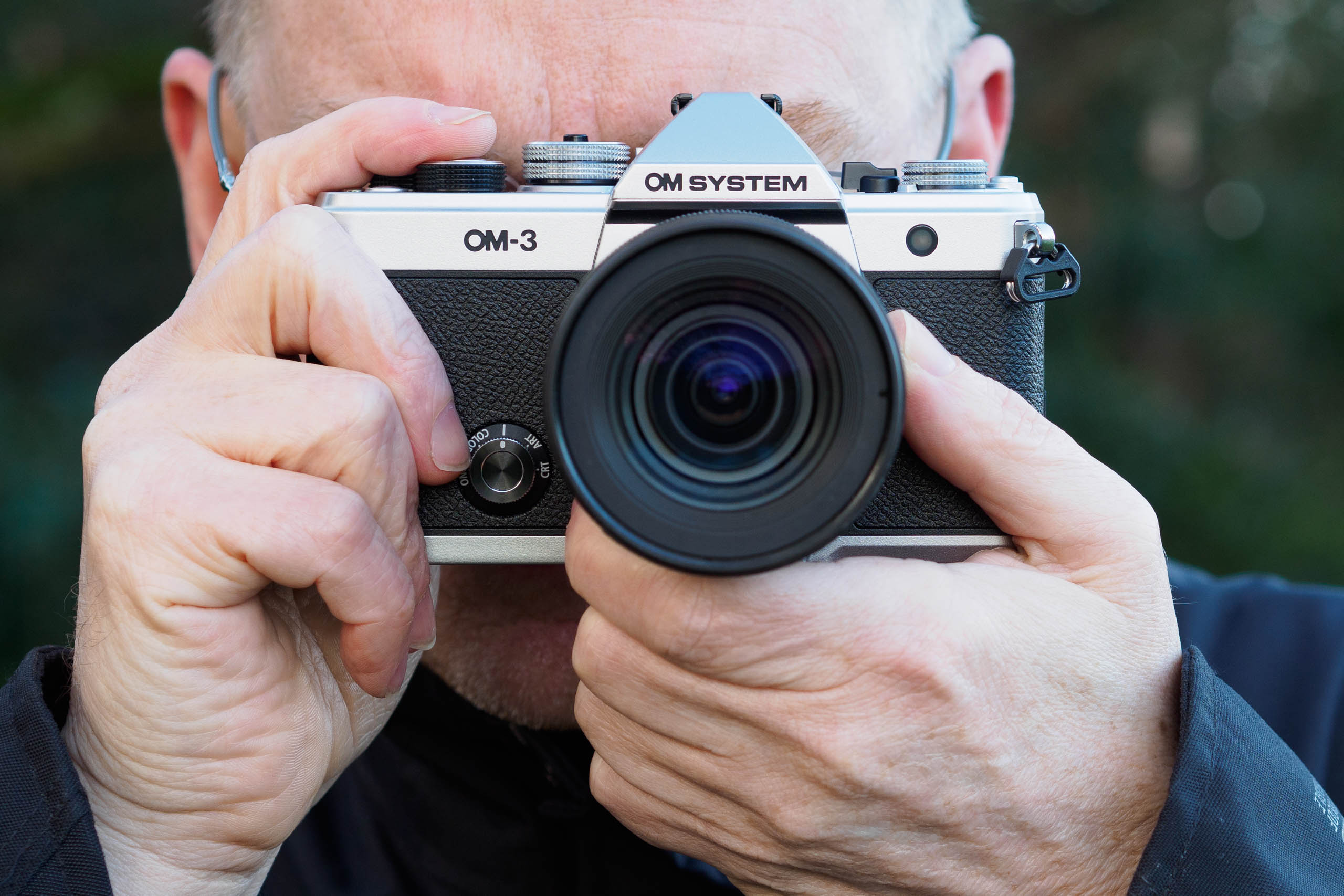
OM System OM-3
At the start of 2025, OM System created a new tier in its model lineup, with the OM-3 slotting in between the flagship OM-1 Mark II and the compact-bodied OM-5 line. Most of its technology is inherited from the former, while the body design borrows heavily from the latter. And it’s gorgeous.
That classic two-tone design is styled after Olympus OM 35mm film SLRs from the 1980s, and the body is almost exactly the same size, too. Don’t be fooled by the retro looks, though. Inside the OM-3 is a thoroughly modern camera that’s kitted out with all of OM System’s unique computational photography tricks, plus some compelling creative options, too.
In fact, the OM-3 is the most affordable camera yet to employ a stacked CMOS sensor. This employs a quad-pixel design enabling cross-type phase-detection autofocus anywhere in the frame. The result is quick and reliable subject-recognition autofocus, backed up by blazingly fast shooting at up to 120 frames per second.
There’s a handy CP button on the back, which gives direct access to computation photography functions such as high-resolution multi-shot and OM’s unique Live ND and Live GND filters. Meanwhile, a colour dial on the front inherited from the classic PEN-F encourages experimentation with in-camera colour processing.
Most importantly, the OM-3 performs well and delivers excellent image quality. Battery life is excellent and the image stabilisation system is so good it feels like witchcraft. There’s a huge range of small, relatively affordable, and high-quality lenses available, too. It’s a really fabulous camera.
Why we like it
- Lovely retro design
- Creative colour control
- Computational photography features
Canon PowerShot V1
Canon got everyone excited at the start of the year with its first high-end PowerShot camera since 2019. But while the V1 resembles the firm’s G7 X Mark III advanced compact, it adopts a very different approach, being substantially focused on video. Even so, some enthusiast photographers might find it interesting.
The V1 is built around a 22.3MP sensor that measures 18.5 x 12.3mm, which is unusually large for a zoom compact. This is paired with an ultra-wideangle 16-50mm equivalent f/2.8-4 lens, which has clearly been designed with vlogging in mind. The camera can record 4K video at 30fps with no hard limit to the recording time – a built-in fan helps prevent over-heating.
Design-wise, the V1 owes a lot to the photo-focused PowerShot G series, with a chunky body and a good range of external controls. Most key functions can also be operated using the comprehensive touch interface. Viewing is via a 3in, 1.04m-dot fully articulated touchscreen, but there’s no electronic viewfinder. You get a hot shoe on top, but it’s not for flash – instead it has a digital audio interface for microphones.
Autofocus is snappy thanks to the firm’s Dual Pixel AF, complemented by subject detection for humans and animals. Image quality is very good for both stills and video, thanks to the relatively large sensor. The lens is pretty sharp, too.
For photographers, the PowerShot V1 could be an interesting choice for those who want a point-and-shoot for travel. However, the 50mm focal length may be too limiting, and we’d love to see a photography-focused G1 X Mark IV using the same sensor.
Why we like it
- Good image quality
- Useful built-in ND filter
- Effective stabilisation
Sigma BF
Take just one look at the Sigma BF, and it’s clear that this is a camera unlike anything else around. With a minimalist body that’s crafted from a single block of aluminium, it’s almost as much an object of art as it is a tool for creating photographs. It looks especially striking in its natural silver finish, but an all-black version is available too.
In essence, the BF is supposed to be a small, simple camera for everyday use. To this end, Sigma has entirely re-thought the user interface, with the aim of doing away with film-era concepts and over-complicated menus. As a result, there are just four buttons on the back and a single dial, while viewing is solely via a fixed LCD screen.
In place of an SD card, it has 230GB of built-in memory. It’s about as far away from conventional designs as you can get.
The BF is also specifically designed to be used with Sigma’s I-series primes. These employ beautifully machined metal barrels that match the camera perfectly, along with tactile aperture rings. They’re lovely lenses that, like the camera, inspire a slower, more considered approach to shooting.
In your hand, the camera feels great and is surprisingly secure to hold. Its one-piece aluminium body is beautifully finished and has lots of neat design touches.
All the controls are placed under your right thumb, and a small status screen highlights whichever setting you’re currently changing. Image quality is broadly in line with other current 24MP full-frame cameras – which is to say, very good indeed.
Fundamentally, photography is a creative pursuit. Sometimes it’s fine to buy and use things just because they are pleasing and inspirational, and the BF is precisely this kind of camera.
Why we like it
- Uniquely stylish design
- Super-simple operation
- Small and light by full-frame standards
Panasonic Lumix S1R II
The Lumix S1R II is Panasonic’s first high-resolution camera since the 47MP S1R from 2019. It’s designed to meet the needs of both professional photographers and demanding enthusiasts, for both stills and video.
A brand-new 44.3MP sensor brings some impressive capabilities, including continuous shooting at 40 frames per second and 8K video recording. Yet this comes at a rather lower price than other high-resolution, high-speed models.
Key specs include a standard sensitivity range of ISO 80-51,200 that’s extendable to ISO 40-102,500. In-body image stabilisation promises up to 8 stops of shake reduction for hand-held shooting.
As we’d expect from Panasonic, you get pretty comprehensive video features, too. Alongside 8K at 30fps, the camera can record 5.9K at up to 60fps, C4K at 120fps, or Full HD at 120fps. A built-in fan provides active cooling for extended video recording times.
Panasonic has used a body design evolved from the older S5II, that’s been beefed-up for more demanding use. The exterior is covered in buttons, dials and switches, giving direct access to all the most important settings. You get a large, detailed viewfinder and a particularly versatile articulated screen.
That 44MP sensor delivers plenty of detail, with images being entirely usable at up to ISO 12,800 at least. Raw files have plenty of dynamic range, too. Overall, the S1RII offers an impressive feature set at an extremely competitive price. It’s one of the finest high-end still/video hybrid cameras around, and it may very well be the best value.
Why we like it
- Excellent build and handling
- Highly refined control layout
- Impressive raw image quality
Fujifilm GFX100RF
Fujifilm has achieved huge success with its X100-series APS-C compacts, while dominating the medium-format market with its GFX system. So it is, perhaps, no great surprise that the firm should decide to combine the two.
The GFX100RF employs a 102MP medium-format sensor and a fixed 28mm equivalent lens, in a rangefinder-style body design that’s reminiscent of the popular Fujifilm X100VI. What’s not to like?
Of course at £4,700, the GFX100RF is anything but a mainstream product. Instead, it’s designed for serious photographers who’d like a camera that delivers exceptional image quality in a portable body. Indeed, it’s strikingly compact given the large sensor; it’s not ‘pocketable’, but it’ll fit into a small bag.
Design-wise, the GFX100RF is like a grown-up version of the X100VI. Analogue dials are used to set the aperture, shutter speed, ISO, and exposure compensation, giving an engaging shooting experience.
But there are now a couple of extra controls for digital zoom and aspect ratio. Build quality is superb: the top plate is machined from a single block of aluminium, and all the dials are milled too, giving a pleasingly tactile operational experience. You get an impressively large and detailed viewfinder plus a tilting rear screen.
It should come as no surprise to hear that image quality is sensational, with the GFX100RF capable of surpassing any full-frame model. As always, Fujifilm’s Film Simulations give excellent colours directly from the camera. For some photographers, it might just be the ultimate travel companion.
Why we like it
- Superlative image quality
- Engaging analogue controls
- Aspect ratio dial
The Nikon Z5II follows on from 2020’s Z5, with plenty of improvements and updates. To go with its 24MP full-frame sensor, it’s got a range of enticing features including a fully articulating touchscreen, a bright, high-resolution viewfinder, dual card slots and uncropped 4K 30fps recording.
Yet all this comes in a body that costs less than £1,500, redefining what we can expect to get at this price point. Primarily, this is a camera aimed at enthusiasts looking for full-frame on a budget.
It has all the latest features, including subject detection autofocus that will now pick up on people, animals, birds and vehicles (cars, motorbikes, trains or airplanes). Continuous shooting is available at up to 15fps when shooting in raw, or 30fps if you’re happy to stick with JPEGs. In-built image stabilisation gives you up to 7.5-stops of shake reduction at the centre of the image, and 6 stops at the edges.
While the viewfinder remains large and detailed, at 3.69m-dots and 0.8x, it’s now brighter at 3000nits, which makes a significant difference when shooting in sunny conditions. The screen is likewise the largest and highest resolution in its class, at 3.2in and 2.1m-dots. Its fully articulated design now allows it to face forwards for selfies or vlogging.
Image quality is every bit as good as we’d expect from the tried-and-trusted 24MP BSI-CMOS sensor. Overall, you get an extremely capable full-frame camera that delivers well across a wide variety of different situations.
Whether you’re a beginner, new to full-frame, or someone who just wants a good, solid, capable camera without necessarily needing super high-powered functionality, the Niko Z5II is a real winner.
Why we like it
- Fantastic value for money
- Excellent feature set
- Multiple subject detection focusing
Ricoh GR IV
Ricoh’s GR series compacts have always offered something a bit different. By combining an APS-C sensor and a fixed prime lens in a truly pocket-sized body, they’ve won the hearts of photographers seeking high image quality in a super-portable package.
The latest model, the GR IV, represents evolution rather than revolution. It now has a 25.7MP sensor, which represents a slight boost from 24MP before. Again, it employs a 28mm equivalent f/2.8 lens, but now with a revised construction that promises improved optical quality. The in-body image stabilisation has also been upgraded to a 5-axis system, which should give better results for close-ups.
Internally, the camera boasts 53GB of built-in storage, a massive jump from the GR III’s 2GB. However, it now has a microSD card slot, instead of the usual full-size SD. But this has in turn created space for a slightly larger, longer-lasting battery.
Ricoh has also tweaked the control layout. There are twin control dials, and the GR IV regains the exposure compensation rocker that was omitted from the III. One thing that hasn’t changed, though, is the fixed (rather than tilting) rear screen, which helps keep the body as slim as possible.
You can tap the screen to select the focus point, and face/eye detection is on board too. There are no other subject detection options, but that’s not really a problem here.
Image quality is excellent, with the camera recording DNG files which can be easily edited in almost any raw processing program. JPEGs straight out of camera produce true, natural colours and noise is well-controlled, too.
And the huge attraction of the GR IV is that you get this quality from a camera that you can take anywhere almost as easily as a smartphone.
Why we like it
- True pocket-friendly dimensions
- Excellent image quality
- Discreet design
Fujifilm X-E5
In many respects, the Fujifilm X-E5 can be seen as an interchangeable-lens version of the firm’s hugely popular X100VI fixed-lens compact, to the extent that it comes complete with a new slimline 23mm f/2.8 lens.
As such, it combines an impressive feature set and excellent image quality in a compact, rangefinder style body. This makes it a great choice for such things as street, travel and social photography.
Internally, the X-E5 uses the same 40MP APS-C format X-Trans CMOS 5 sensor and X-Processor 5 as many of the firm’s other current models. It offers ISO 125-12,800 as standard, can shoot at up to 30fps, and includes subject recognition for autofocus that covers people, animals and vehicles. Notably, it becomes the first in the X-E series to include in-body image stabilisation.
You get a small but serviceable corner-mounted electronic viewfinder, plus a screen that tilts up and down, and can even face forwards over the top of the body. Like many of Fujifilm’s other cameras, the X-E5 includes analogue shutter speed and exposure compensation dials on the body, which are complemented by aperture rings on most of the firm’s lenses. This makes it really enjoyable to use.
Another dial on top is used to select between Fujifilm’s Film Simulation modes, which now includes three customisable positions for user ‘recipes’. Simply by its presence, this dial encourages you to experiment with the colour looks more than you might do otherwise.
In a market dominated by full-frame mirrorless cameras that all look the same, the X-E5 is a breath of fresh air. It’s not often that we get small cameras that are so unashamedly designed for serious photographers, and it’s difficult to see who wouldn’t fall for its charms.
Why we like it
- Small, enthusiast-friendly body design
- Engaging analogue controls
- Film simulation dial
Sony RX1R III
Sony took everyone by surprise in July with a new full-frame fixed-lens compact camera, the RX1R III. Appearing a decade after its predecessor, it employs a fixed Zeiss Sonnar 35mm f/2 lens, but now with a 60MP sensor.
This means it promises stunning image quality in a body that, if not exactly pocketable, will certainly fit into a small bag. In many respects, the new model counts as a marriage of familiar components. Its 60MP full-frame BSI-CMOS sensor is shared with several other Sony cameras and delivers a standard sensitivity range of ISO 100-32,000. Continuous shooting maxes out at 5 frames per second.
Meanwhile, the 35mm f/2 lens is apparently unchanged from previous generations. Its minimum focus distance is normally 30cm, but engaging the close-up mode drops the focus range to 20-35cm. However, there’s no optical stabilisation.
Sony has refreshed the body design, with a neater flat top-plate. The viewfinder is now fixed in place, rather than pop-up, which means it’s always available for shooting. But disappointingly, the screen is also fixed and doesn’t tilt.
The body itself is remarkably small, although the relatively large lens barrel means the camera won’t slip into a pocket. You get an aperture ring on the lens and an exposure compensation dial on top, plus a thumb dial for the shutter speed. However, there’s no joystick to set the focus point, and the rear controls can be fiddly.
One thing you can’t complain about is, though, the image quality. That 60MP sensor delivers loads of detail and plenty of dynamic range, while also keeping high-ISO noise well under control. So if you want superlative output from a small camera, and can live with the hefty price tag, the RX1R III is worth a look.
Why we like it
- Superb raw image quality
- Excellent Zeiss Sonnar lens
- Compact design
Hasselblad X2DII 100C
Hasselblad’s updated medium-format mirrorless camera is completely dedicated to stills photography, which is very much a rarity these days. It records 100MP still images, but it doesn’t have anything to do with video. It’s not stuck in the past, though, with some exciting new features that you won’t find anywhere else.
This includes the addition of LiDAR for autofocus, and the first ever implementation of ‘end-to-end HDR’. As before, the X2D II uses a 100MP medium-format sensor measuring 44 x 33mm, with a sensitivity range of ISO 50-25,600. Leaf shutters are built into each lens, which allows flash to be used at all speeds. Files can be stored either to a 1TB internal SSD or to a CFexpress Type B card.
Thanks to the addition of Light Detection And Ranging (LiDAR) technology from parent company DJI, continuous autofocus is available on a Hasselblad for the first time. More generally, this brings significant improvements to the focusing speed, even in AF-S mode.
Hasselblad claims the sensor can capture 15.3 stops of dynamic range, and with the Hasselblad Natural Colour Solution High Dynamic Range (HNCS HDR) mode activated, it’s possible to record raw, JPEG and HEIF files in HDR. The 3.6in, 2.36m-dot rear screen can display these files perfectly too, thanks to its peak brightness of 1400nits.
Once you get your photos off the camera, though, you’ll need an HDR-compatible device to view them properly. What you really buy an X2D ll for, though, is the quality of the images it produces, and they’re absolutely stunning. Yet somehow this comes with a drop in price of almost £1,000 – it’s not often we can say that.
Why we like it
- Produces incredible levels of detail
- Really nice handling
- Price has dropped significantly
Leica M EV1
The M EV1 is a camera that a lot of Leica users have been waiting for. In essence, it takes the firm’s M11 and replaces the optical viewfinder with a high-resolution electronic viewfinder. In effect, this means it becomes a mirrorless camera – but one that’s built around the 70-year-old M mount.
What this means is that you now see exactly what the lens sees, rather than using a separate optical viewfinder. This brings all the same practical benefits that once allowed film SLRs to supplant rangefinders as the camera type of choice.
You can focus large-aperture lenses precisely, use wideangle lenses without needing a supplementary viewfinder, compose more accurately with telephotos, and shoot close-ups with macro lenses.
On top of that, you get many of the benefits that mirrorless cameras bring over DSLRs. This includes an accurate preview of colour, exposure and depth-of-field, plus magnified view and a peaking display for focusing.
But why not just get a mainstream mirrorless model for much less money? One key point here is that the M EV1 includes built-in profiles for getting the best results from every Leica M lens ever made, by correcting such things as vignetting and colour shifts. It can also automatically recognise which lens is being used via an optical coding system on the mount.
Leica has set out to provide just those features you need for shooting with manual-focus lenses, without any distractions. The user interface is simple and intuitive, and the menus are stripped right back.
It’s pretty much the definition of a ‘photographer’s camera’. It’s not quite the same thing as a traditional rangefinder, but for Leica M users, it could add a powerful new string to their bow.
Why we like it
- Uniquely pared-back, focused design
- Excellent electronic viewfinder
- Works with almost all Leica M lenses
Canon EOS R6 Mark III
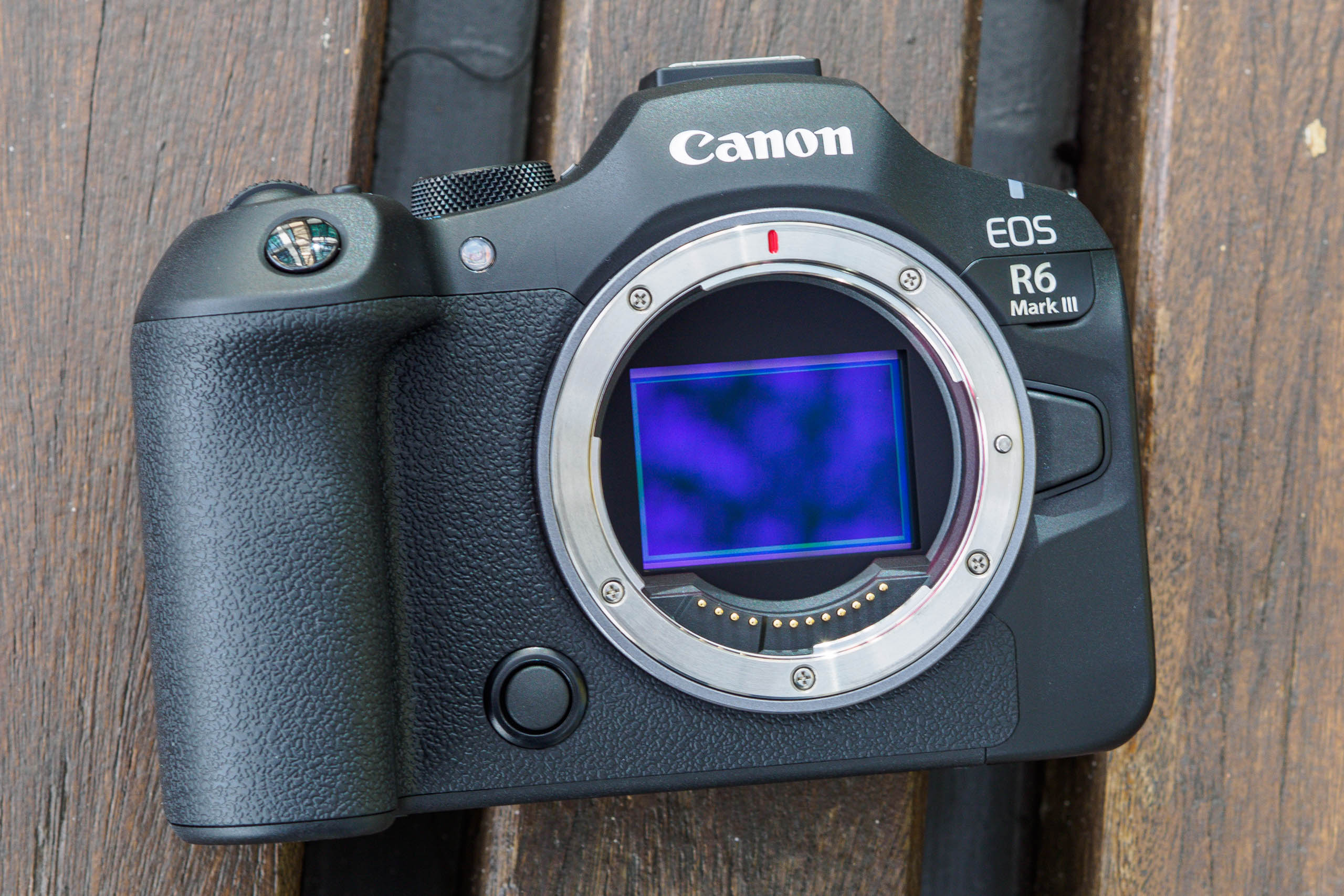
Canon’s EOS R6 Mark III is a high-end full-frame mirrorless camera that’s designed for serious enthusiast photographers. It employs a near-identical body design to its predecessor, but gains a higher-resolution 32.5MP sensor (up from 24MP) that’s shared with the EOS C50 cinema camera.
With an impressive all-round spec sheet, it should be capable of tackling almost any task for both photography and video. Indeed, it’s difficult to spot any area where the camera might be lacking. The sensor offers ISO 100-64,000 as standard, which is extendable to ISO 50-102,800.
Using the mechanical shutter, you get continuous shooting at up 12 frames per second; switch to the silent electronic shutter, and that increases to fully 40fps. There’s also a pre-capture mode.
Canon’s usual subject detection system is available for autofocus, covering humans, animals and vehicles. An Auto option is also available, meaning you don’t have to select your subject type in advance. If you want to set the focus area manually, there are no fewer than 6,097 selectable points.
It’s the video specs that get the most eye-catching boost, though.
The R6 III can record raw video internally at 7K and 60fps in 17:9 aspect ratio, or 30fps in 3:2 (Open Gate) mode. Alternatively, it can shoot 4K at 120fps, and Full HD at 180fps.
In terms of its physical design, the EOS R6 Mark III is externally almost indistinguishable from the Mark II, with all the same controls in all the same places. Existing Canon users should be able to pick it up and feel right at home, more-or-less straight away. Overall, it feels like a well-judged evolution of the R6 line.