


Death and decay are natural states, and yet we rarely take the time to notice how these stages might contain moments of rare beauty. Our eyes are often drawn to flowers at their peak, polished paintwork and flawless fur, but the truly observant know that just as much beauty can be found in decomposing petals or insects wrapped in suffocating blankets of spider silk. Refusing to look away from moments of ageing, fragility or decomposition can lead to powerful photographs that draw attention to our natural life cycle, urging us not to shy away from subjects that remind us of our transient nature.
For the latest CUPOTY CHALLENGE our subscribers chose Death and Decay as the theme. The callout was answered with photographs of parasitic wasps, tree stumps, wilting flowers and fishing spiders, among many other things. Congratulations to Willem Kruger for taking the top spot with his emotive image of a hyena carrying its prey back to its den.
If you would like to stay up to date with the latest CUPOTY news, including details of this year’s main competition, please sign up to the CUPOTY newsletter. To see the shortlisted and winning entries for the CUPOTY CHALLENGE: Death and Decay, visit www.cupoty.com.
Overall Winner
Name: Willem Kruger
Title: Hyena Portrait Zebra
Nationality: South African
Website: willemkruger.wordpress.com
‘Early one morning during a game drive in Kruger National Park, South Africa, my wife and I came across three spotted hyenas walking along the road. One was carrying the head of a zebra, presumably from a nearby lion kill, and was heading straight towards us. We parked at the roadside as the hyena approached and then walked past our vehicle. We followed for a while, hoping it would lead us to the den. After a short distance, the hyena left the road and melted into the bush. In nature, almost nothing goes to waste – even hyenas have a family to feed, and they do so with remarkable commitment.’
Technical information: Nikon Z6, Nikkor 600mm f/4 ED AF-S VR, 1/2000sec at f/4, ISO 800
Top tips
- Go on early morning game drives – the golden hour produces amazing light, and animals tend to be active during this time.
- Know the behaviour of your subject. Understanding how an animal is likely to move allows you to anticipate the shot.
- A long lens and window mount allowed me to photograph the hyena without disturbing it’s natural behaviour. Respecting wildlife must be your first priority.
Second Place
Name: Juan Jesus Gonzalez Ahumada
Title: True Love
Nationality: Spanish
Instagram: @jjgahumada
‘When the breeding season arrives, common toads congregate in ponds to mate. Often, several males court a single female, and sometimes she can die from suffocation, unable to surface for air amidst the throng of males surrounding her. In this case, several males had courted the female unsuccessfully and when tragedy struck, they all abandoned the scene. Only he remained, embracing her body – his true love.’
Technical information: Canon EOS 6D, Canon 70–200mm f/2.8L USM, 1/640sec at f/6.3, ISO 200
Top tips
- Luck plays a large part in nature photography, but you have to be out there to get lucky. Visit breeding ponds regularly during spring.
- Take the time to observe before you shoot. Watching how animals behave helps you to anticipate moments and find the most compelling subjects.
- Master the controls on your camera until operating it become second nature. When a fleeting moment presents itself, you need to react instantly.
Third Place
Name: Gaël Modrak
Title: Dead Chick of the Pond
Nationality: French
Instagram: @oceanographismes
‘We were diving in a pond near Paris, and I was searching for interesting subjects in this rather barren setting when I discovered the body of a waterfowl chick lying on the bottom. The scene, though macabre, inspired me. I used a wide-angle lens to capture the sombre atmosphere, positioning myself to incorporate rays of light filtering down through the murky water, lending a mystical quality to the image. There’s a strange beauty in finding something so small and still in such an unexpected place.’
Technical information: Nikon D300s, Nikon 10.5mm fisheye, 1/60sec at f/13, ISO 640, Accessories: Hugyfot underwater housing, two Ikelite underwater strobes
Top tips
- Explore unusual underwater environments. Freshwater ponds, lakes and rivers can yield extraordinary subjects.
- Beauty can be found everywhere, even in death and decay. Stay open to subjects that might seem unpromising at first glance.
- Place your subject within a wider scene to tell a story and create atmosphere.
Finalist
Name: G Ramaprasad
Title: The Fly Wing Trophy
Nationality: Indian
Instagram: @ramprasad.g_photography
‘While searching for interesting insects to photograph in my backyard in Honnavar, Karnataka, I came across a fascinating trashline orb weaver spider. These spiders have always captivated me with their intricate and uniquely designed webs. On this occasion, the spider had incorporated the delicate wing of a fly into its web, almost as if it were a trophy from a recent hunt. The scene felt like a natural work of art, showcasing both beauty and predation in perfect harmony.’
Technical information: Canon EOS M50 Mark II, Canon EF 100mm f/2.8L Macro IS USM, 1/200sec at f/10, ISO 200, Accessories: Godox TT520II flash with Radiant diffuser
Top tips
- Mount your camera on a tripod. Trashline spiders are tiny and require high magnification, which makes keeping them in focus extremely difficult, with any movement amplified.
- Use flash with a diffuser for even, balanced light on small subjects. Without flash, you’ll struggle to get enough light at the small apertures required to maximise depth of field.
- A shutter speed of 1/200 to 1/400sec (with flash) will render the background black, perfectly isolating the spider and its web against a dark canvas.
Finalist
Name: Juan Jesus Gonzalez Ahumada
Title: The Souls of the Swamp
Nationality: Spanish
Instagram: @jjgahumada
‘On the edge of the Zahara de la Sierra reservoir in southern Spain, the remains of a fallen tree take on the appearance of a gnarled, talking face. Beyond it, standing in the dark water, another dead tree rises like a ghostly apparition – its counterpart on the shore seemingly praying for its soul. To capture this image, I employed a complex in-camera technique, combining two focal lengths in a single long exposure. Working on a completely dark night with no moon or light pollution, I began at 70mm, using a halogen flashlight to illuminate the foreground wood. Then, in total darkness, I zoomed to 200mm and lit the distant tree for a few seconds, giving it greater prominence in the frame.’
Technical information: Canon EOS 6D, Canon 70–200mm f/2.8L USM, 33 seconds at f/4, ISO 100, Accessories: Tripod, halogen flashlight
Top tips
- Master the technique before you go out. Combining focal lengths in a single exposure requires practice.
- Plan around the lunar cycle. A moonless night with no light pollution is essential for this kind of work – check the phase and weather forecast before heading out.
- Let your imagination guide you. Look for shapes, faces and narratives in natural forms – a gnarled stump can become a character in a story if you frame it with intention.
Finalist
Name: Alex Pansier
Title: A Warning from the Wild
Nationality: Dutch
Website: alexpansier.com
Instagram: @alexpansier
‘I was photographing the structures and textures of old fishing nets in Iceland when I noticed a crow’s foot emerging from the tangled ropes. At first glance, the scene appeared as an abstract composition of lines and patterns, but the dark claw revealed a more unsettling detail. The contrast between the sharp black foot and the pale woven nets transforms the image from a study of texture into a subtle reminder of how wildlife and human activity intersect in unexpected ways.’
Technical information: Sony A1, Sony FE 24–70mm f/4, 1/400sec at f/14, ISO 5000
Top tips
- Look closely at textures and patterns. Strong stories are often hidden in small details that are easy to walk past.
- Explore man-made environments near nature. They can reveal unexpected and powerful interactions between wildlife and human objects.
- Keep the composition simple so that one key element draws the viewer’s attention. In this case, the single dark claw against the pale nets says everything.
Finalist
Name: Emanuele Biggi
Title: Eyed Food
Nationality: Italian
Website: anura.it
Instagram: @emanuele_biggi
‘I was photographing tadpoles and froglets around a shallow stream pool on the island of Nosy Komba, Madagascar when I caught a rapid movement out of the corner of my eye. I turned to see this large fishing spider (Nilus sp.) clutching a freshly caught froglet. I began shooting this tiny but dramatic scene of predation in the middle of the Malagasy forest. The spider fed from the back of its prey, so the lifeless eye of the froglet remained visible almost to the end of the feast.’
Technical information: Nikon Z8, Nikon Z 50mm Macro, 1/100sec at f/22, ISO 64, Accessories: Flash with custom diffuser
Top tips
- Stay focused on what you’re doing, but be aware of what’s happening around you. This photograph only happened because I saw a flicker of movement in my peripheral vision.
- Follow the action and be patient. Stay with your subject long enough to find the best angle.
- Use a large diffuser with bounced flash. It makes all the difference on tiny, shiny subjects like spiders – you get soft, even light instead of harsh specular highlights.
Finalist
Name: David Silsbee
Title: The Grip of Winter
Nationality: American
‘Walking along a river on a cold January morning in Connecticut, I had planned to photograph the icy water. Instead, my attention was drawn to swirling patterns of ice in woodland pools away from the river. The ice was unsupported in places where the water had receded and was extremely fragile – I couldn’t step on the edge or even slide a tripod out without it cracking or collapsing. The challenge was to lean out as far as I could over the ice to photograph it from above without breaking anything. I couldn’t compose carefully in that awkward position, so I shot wider and cropped afterwards.’
Technical information: Canon EOS R5, Canon 24–70mm, 1/80sec at f/11, ISO 1600
Top tips
- Go out regardless of the weather. A cold, grey January morning might not sound promising, but such conditions can deliver interesting subjects.
- Keep your eyes open and don’t fixate on what you think you’re looking for. I went out to photograph a river and came home with a picture of a leaf in a pool of water.
- If you can’t get into the perfect position, shoot wider than you need to and crop later.
Finalist
Name: Jacek Hensoldt
Title: Parasite
Nationality: German
Website: macrobyphotojack.de
Instagram: @macro_by_photojack
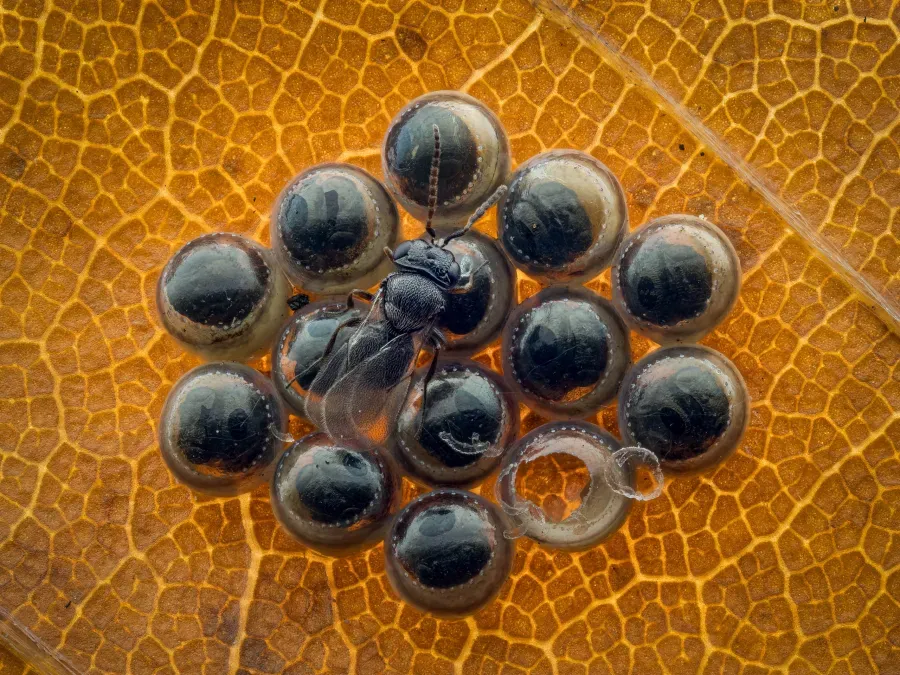
‘This is a cluster of shield bug eggs parasitised by the wasp Trissolcus semistriatus. The females lay their eggs inside the host eggs, where the larvae feed on the contents – the death of one becoming the prerequisite for the life of another. Through the translucent eggshells, the tiny heads of the developing wasps are already visible; in some, you can even distinguish compound eyes and antennae. One adult has already emerged but seemed in no hurry to leave without its siblings, which allowed me to photograph the scene at a relaxed pace. The adult wasps are only 0.9–1.3mm long and completely harmless to humans. What fascinates me most is how symmetrically the eggs are arranged. The final image is a focus stack of 32 frames merged in Helicon Focus.’
Technical information: Olympus OM-D E-M1 Mark III, M.Zuiko Digital ED 90mm f/3.5 Macro IS + MC-20 2x teleconverter, 1/50sec at f/13, ISO 200, Accessories: Godox V860III flash with diffuser
Top tips
- Slow down, observe and be patient. Rather than frantically searching for subjects, let them reveal themselves to you.
- Interesting subjects can be found almost everywhere, often right outside your front door. I found these parasitised eggs in my garden in Solingen, Germany.
- Stay curious and take time to learn about your subjects. Understanding the biology behind what you’re photographing helps you to tell a richer story.
Finalist
Name: Jason Gilbody
Title: Feathers in the Wind
Nationality: American
Instagram: @jgwildphoto
‘This American kestrel and its family reside in a cemetery in Massachusetts. It habitually hides its prey in the flowerpots placed at the gravestones. On this occasion, the kestrel pulled a sparrow from one of those pots and brought it to a nearby gravestone to feed. It was a windy day, so as it plucked the sparrow, the feathers floated away in the breeze, a fleeting, almost poetic scene set against the stillness of the cemetery.’
Technical information: Canon EOS R5, Canon EF 600mm f/4L IS II USM, 1/4000sec at f/4, ISO 320
Top tips
- Be patient and don’t rush in on your subject, let it come to you. This kestrel was accustomed to its routine, and waiting quietly allowed me to capture a natural moment.
- Regular visits to the same location build familiarity. I knew this kestrel’s routine of stashing prey in flowerpots, which meant I could anticipate the action.
- With natural light and a fast-moving bird, there’s no time to adjust, get your position right from the start.
Finalist
Name: Ken Bluma
Title: Marionette Serenade
Nationality: American
Instagram: @kbmacroart
‘While exploring my local state park in Illinois, I noticed a small object hanging in the vegetation at the edge of the trail. After a closer look, I could see it was an acorn weevil, or rather what remained of one. Looking through the macro lens revealed it had died some time ago and all that was left was its hollowed-out exoskeleton, suspended on a strand of silk. The scene slightly resembled a string puppet performance, the tiny body twirling gently in the breeze. I kept my lighting low, which I felt matched the sombre mood of the picture.’
Technical information: Olympus OM-D E-M1 Mark III, M.Zuiko 60mm Macro, 1/160sec at f/10, ISO 200
Top tips
- Explore, explore, explore. The best macro subjects are often things you stumble upon rather than things you set out to find.
- Experiment with lighting. It’s probably the most important element in macro photography and can transform the mood of an image.
- Check old, abandoned spider webs for interesting objects left behind. Webs are natural collectors of tiny treasures that most people walk straight past.
Finalist
Name: Martin Malies
Title: Crazed Paint
Nationality: British
‘This is part of an abandoned shipping container on Dungeness Beach, Kent. I was fascinated by the chaotic, abstract patterns of the dilapidated paintwork, which were conveniently and very effectively framed by the dark metal edges of the container. The cracked and peeling surface had taken on a life of its own, with layers of colour and texture that felt more like an abstract expressionist painting than the side of a rusting box.’
Technical information: Nikon D750, Nikkor 70–200mm f/4G, 1/125sec at f/8, ISO 100
Top tips
- Devote plenty of time to exploring and experimenting with all the potential photographic opportunities a location offers. Don’t rush to take the obvious shot.
- Photograph in soft, overcast lighting to maximise detail and preserve natural colour saturation.
- Use a tripod and cable release, this will slow down the process, encourage more considered compositions.
Finalist
Name: Pete Burford
Title: Bee Meal
Nationality: British
Instagram: @pbmacro
‘Near the beach by my hotel in Crete, I discovered a cluster of flowers inhabited by several flower crab spiders (Thomisus onustus). These spiders can change colour to match their surroundings, and bees were constantly visiting the flowers for nectar, giving the spiders the perfect opportunity to ambush any that ventured too close. When I found this particular spider feeding on a bee, I wanted to capture the moment from the bee’s point of view as most crab spider predation shots focus on the spider, not the prey. Because both spider and bee were hanging downward, I flipped out my LCD screen and positioned the camera directly underneath, shooting upward to frame the bee head-on. The Cretan sunlight was so intense it blew out the background completely, so I used a card behind the flower to control the backdrop. Focus stacking was challenging in the sea breeze, and I had to time each burst carefully between gusts.’
Technical information: OM System OM-D E-M1 Mark II, OM System 60mm Macro, 1/200sec at f/5.6, ISO 200, Accessories: Godox V350O flash with Cygnustech diffuser, background card
Top tips
- Change your shooting angle. Getting underneath this spider and bee gave a completely different perspective from the usual top-down macro shot.
- Cover your subject with your own shadow to block direct sunlight, then light it with flash and a diffuser. This gives you far more control than fighting harsh natural light.
- Be patient and wait for the subject to settle into the perfect position before starting a focus stack.