


Best phones for low light – capture detailed night photos
Many top-line smartphones have well-performing Night modes – but which are the best?


The best smartphones for photography are also some of the best for low light. Small sensors have a hard time in the dark, yet many recent smartphones are equipped with powerful night modes that yield surprisingly decent results. It’s something that many smartphone manufacturers have highlighted in their marketing material, so there’s been a big drive from all the major producers to outdo each other in this field – great news for us.
Almost all of the current smartphones on the market have some kind of Night or Low Light mode, which often kicks in automatically when there’s not much light detected in the scene. In this guide, we’ve rounded up the phones that stood out during testing and offer the best performance in the dark. While great for low light, these devices also offer a solid all-around shooting experience, making them a good value for money.
Our list rounds up the best phones for low-light photography at the moment. All the phones on this list are ones our team has tested and reviewed – we’re only recommending products with which we have hands-on experience. Read on for our full list, and scroll to the bottom of this page for an explainer on how low-light modes work in smartphones, with tips on how to get the best out of them.
Best smartphones for low light at a glance:
- iPhone 17 Pro – Buy Now
- Samsung Galaxy S25 Ultra – Buy Now
- Google Pixel 10 Pro – Buy Now
- Xiaomi 15 Ultra – Buy Now
- Honor Magic 8 Pro – Buy Now
Why you can trust Amateur Photographer
We spend many hours testing every product we recommend, in detail, in a variety of situations and shooting scenarios, and only use experts for our reviews, so you can be sure that you’re getting the best products. Find out more about our expert writers.
Apple iPhone 17 Pro

Amateur Photographer verdict
The 17 Pro delivers excellent low-light performance, capturing sharp, detailed, and vibrant night shots with ease thanks to its advanced sensors and intelligent Night mode.
- Improved selfie camera
- Triple high-resolution sensors
- Tough body
- Relatively minor upgrade overall
- Availabe in a limited range of colours
- High price
iPhone 17 Pro at a glance:
- 48MP wide camera, f/1.78 aperture, 24mm equivalent, OIS
- 48MP ultrawide camera, f/2.2 aperture, 13mm equivalent
- 48MP 4x telephoto, f/2.8 aperture, 100mm equivalent, OIS
- 18MP “Center Stage” selfie camera, f/1.9 aperture
- 4K 120p video recording
The iPhone 17 Pro excels in low-light photography thanks to its upgraded camera system, which includes three high-resolution 48MP sensors. These larger sensors capture more light, helping to produce sharper and more detailed images in dim conditions. Night mode automatically activates in darker environments, and intelligently adjusts exposure to retain detail in shadows without overexposing bright areas. Even at higher zoom levels, the phone maintains a surprising level of clarity thanks to the “optical quality” digital zoom, which crops the central portion of the high-resolution sensor.
The ultrawide lens captures more detail than the human eye can see, allowing you to photograph complex scenes in very dark settings. The improved A19 Pro chip further enhances performance as it processes images faster and optimises noise reduction for cleaner, crisper shots. This makes the 17 Pro especially capable for shooting handheld at night or in low-light indoor environments without needing additional equipment.

Additionally, the improved selfie camera supports low-light shooting with its higher 18MP resolution and larger square sensor. It can automatically widen the field of view and adjust exposure for multiple subjects in darker scenes, making it far easier to capture night selfies or group shots.
Like the 16 Pro before, the 17 Pro features a dedicated Camera Control button on the right side, designed to give photographers quick access to key functions. It can be used to switch between lenses, adjust zoom, change photographic styles, and even take a shot without opening the camera app. While some may find it a bit fiddly, especially with a case on, it offers a tactile alternative to touchscreen controls, making it easier to capture spontaneous moments.
Samsung Galaxy S25 Ultra

Amateur Photographer verdict
With a new telephoto camera and AI-powered editing tools, the Samsung Galaxy S25 Ultra is the best Android phone for night-shooting, even with a few quirks in its handling and operation.
- Night mode can be activated manually
- Clean results from main camera
- 3 high resolution sensors
- Expensive
- S Pen no longer works as remote release
Samsung S25 Ultra at a glance:
- 200MP wide camera, 24mm, f/1.7, 1/1.3” sensor, PDAF, OIS
- 50MP ultrawide camera, 13mm, f/1.9, PDAF
- 10MP telephoto camera, 67mm, f/2.4, 1/3.52” sensor, PDAF, OIS, 3x optical zoom
- 50MP periscope telephoto camera, 111mm, f/3.4, 1/2.52” sensor, PDAF, OIS, 5x optical zoom
- 12MP f/2.2, 26mm selfie camera with AF
- 8K 24/30fps, 4K 30/60/120fps video recording
Samsung’s newest flagship is the best Android phone you can currently buy for night photography. It’s expensive, but its camera array now includes a 50MP f/1.9 ultrawide sensor, rather than the 12MP in the S24. There’s also a 50MP f/3.4 5x periscope telephoto and a 10MP f/2.4 3x telephoto camera and let’s not forget the brightest 200MP f/1.7 stabilised main camera, of course.
Night Modes are present and correct on this flagship phone. Unlike on the iPhone, this mode can be toggled when you want to use it, rather than just automatically activating when the phone thinks you should use it, which is immediately attractive. It produces clean and punchy results, and can also be used in conjunction with Portrait mode for night-time people pictures.

Of course, you can’t really talk about the Samsung Galaxy S25 Ultra without talking about AI. With the S24, Samsung declared that users were entering the “Era of AI” (the added implied message being, “whether they want to or not”) and accordingly the S25 Ultra comes with a selection of AI-powered tools too, including AI Generative Fill, or a tool to move objects or people around in a scene.
This is all powered by the “AI ProVisual engine”, which is designed to boost noise performance and colour production, both things that are helpful for night-time photography.
Overall, we found the Galaxy S25 Ultra to be very good in low-light with the best results obtained from the 200MP main lens, but the 50MP ultrawide lens also delivers a good performance and thanks to the higher resolution sensor it renders more details in the shadow areas than previous Galaxy phones.
All that said the S25 is not a huge update over the S24, so if it is too expensive for you, it’s worth considering the previous Samsung Galaxy S24 Ultra, especially given that you can use the S Pen as a remote shutter release, a feature that comes especially handy when shooting in low light and trying to stabilise your shot as much as you can. You might even want to look at the Samsung S23 Ultra. You can pick up solid bargains on both, especially if you are willing to shop second-hand.
Google Pixel 10 Pro

Amateur Photographer verdict
The 10 Pro offers some of the best cameras and shooting features on a camera phone, and gives you images that are genuinely pleasing.
- Excellent camera setup with effectively 5 rear cameras
- Lovely colours produced in images
- Really useful shooting features
- Only 128GB on base model
- Video Boost for 8K video is so bad I never want to use it
- Seriously chunky with camera bump
Google Pixel 10 Pro at a glance:
- 50MP f/1.68 wide, 1/1.3inch, OIS, 24mm equiv.
- 48MP f/1.7 ultra-wide with AF, 1/2.55inch, 12mm equiv.
- 48MP f/2.8, 5x telephoto, 1/2.55inch, OIS, 110mm equiv. (up to 100x Pro Res Zoom)
- 42MP f/2.2 selfie with AF
- 4K video front/rear (8K powered by Video boost upscaling)
Night photography is one aspect in which the Google Pixel 10 Pro really shines. The advanced Night Sight mode automatically activates in low light and works across all three rear cameras—the ultra-wide, wide, and 5x telephoto. The ultra-wide lens also supports autofocus, great for capturing close-ups as well as broader landscapes and street scenes at night. The phone combines high-resolution sensors with pixel-binning technology, producing 12MP images from the main cameras while preserving detail, reducing noise, and balancing exposure for more natural-looking results.
The Pixel 10 Pro’s computational photography and AI enhancements further boost its low-light capabilities. Above the 5x optical zoom, the AI-enhanced ProRes Zoom kicks in to add detail to the image.
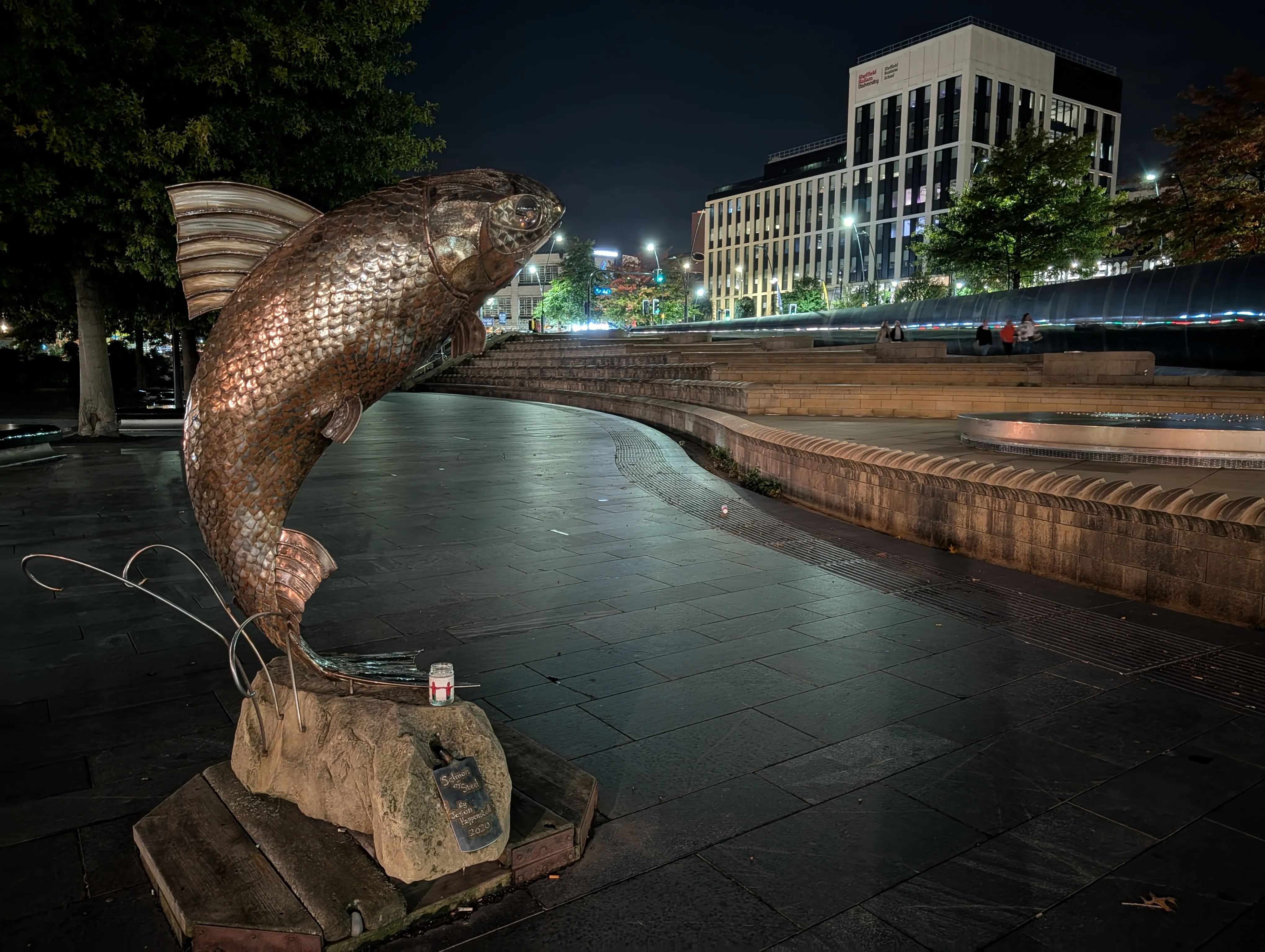
Boasting the highest resolution selfie camera on this list with 42MP, it is ideal for low-light selfies too. The combination of high-resolution sensors, intelligent software, and AI-driven processing ensures that night shots retain detail and color accuracy.
There are excellent astrophotography shooting options available if you want to shoot landscapes in very low light – which could be enough to tip the balance from another model to the Pixel 10 Pro if you like to head out after dark. Put it on a solid surface such as a wall, a beanbag, or a tripod with a phone adapter, and you can get exposures several minutes long.