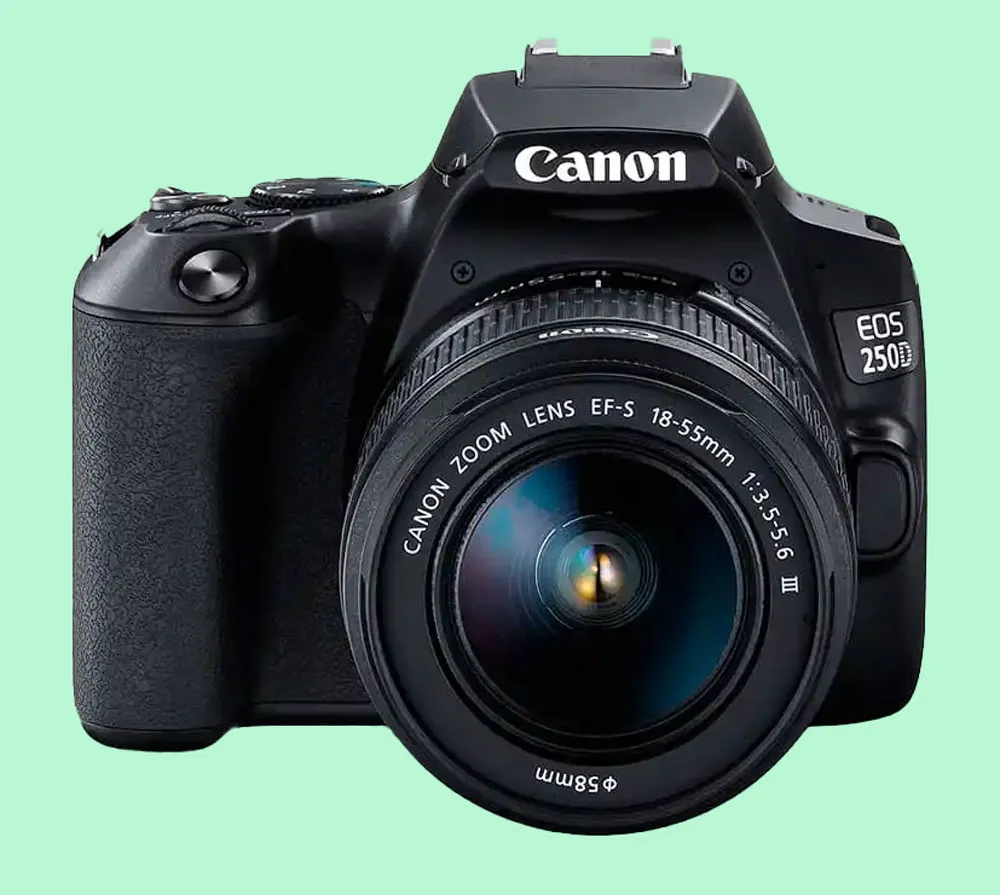
Generous features and easy to use, the EOS 250D is an entry level DSLR with scope to advance your photography. It delivers good image quality and vibrant colours.
Pros
Excellent battery life
Optical viewfinder
Lightweight build
Cons
Rudimentary 9-point AF system
No weatherproofing
At a glance:
£599 / $649 body only
24.1MP APS-C sensor
Dual Pixel CMOS AF
5fps continuous shooting
Articulating monitor
4K 30p
Although mirrorless has made a massive impact on the camera market, there are still photographers who prefer the build and handling of a DSLR system. The main advantages of a DSLR over mirrorless are the optical viewfinder and longer battery life – plus, they are also a bit cheaper. The Canon EOS 250D is a great choice, and a worthy contender for any amateur or beginner photographers.
The small compact body is comparable to a mirrorless camera in size, weighing a mere 449g. Other great features include the 24.1MP APS-C sensor and Dual Pixel CMOS autofocusing that gives pin-sharp results in stills and video.
Best camera for sports photography under $1000/£1000: Sony A6400
Sony Alpha A6400 in hand, with 18-135mm lens, tested by Andy Westlake
Amateur Photographer verdict
It is one of the more expensive cameras on our list, but it also delivers the goods. It is a versatile camera with snappy autofocus and excellent image quality in almost any shooting situation
Pros
Compact in size
Reliable autofocus
Loads of E-mount lenses
Cons
Boxy, uninspiring design
No in-body stabilisation
At a glance:
£849 / $898 body only
24.2MP APS-C CMOS sensor
ISO 100-32,000 (expandable to 100-102,400)
11fps continuous shooting
2.36m-dot electronic viewfinder
3-inch, 921,600-dot tilting touchscreen
When we reviewed the Sony A6400 back in 2019, we gave it a solid 4 stars. We were impressed by the excellent autofocus tracking feature, producing high quality images in almost any shooting scenario. We also appreciated how compact it is in size, with a solid construction. For any action, event, wildlife or sports photographer, the Sony A6400 is a superb of the best cameras under $1000/£1000, as the autofocus system is one of the best for a camera at this price point.
The Sony A6400 is not perfect though, as the design of the camera is unfortunately a bit dated, and the lack of in-body image stabilisation is disappointing. If these aspects don’t concern you, then this camera is well worth considering as it’s a great shooter that will produce high-quality imagery.
Best for: sports photography
Best camera for street photography under $1000/£1000: Fujifilm X-T30 II
Fujifilm X-T30 Mark II Camera Body. Photo credit: Joshua Waller
Amateur Photographer verdict
As expected from Fujifilm cameras the X-T30 delivers great JPEGs with vibrant colours straight out of camera, and its compact size and fast burst mode make it ideal for street photographers
Pros
Gorgeous image quality
Fast burst shooting
Excellent X-mount lens range
Cons
No in-body stabilisation
On the pricey end, body-only
At a glance:
Fujifilm X-T30 II – £769 / $899 body only
26.1MP X-Trans CMOS IV Sensor
ISO 160-12,800 (expandable to 80-51,200)
Up to 30fps continuous shooting with electronic shutter (cropped), 20fps uncropped
3-inch 1.62m-dot, tilting touchscreen
4K 30p video
Wi-Fi and Bluetooth built-in
The Fujifilm X-T30 II is a top-notch camera that works out as excellent value for money. The X-T30 II upgraded the Fujifilm X-T30 (and before that, the X-T20) and was well received across the industry, including by our review team, who gave it the full five stars.
The Fujifilm X-T30 II doesn’t only look good on paper – it delivers when put through its paces. The impressive specs such as the 20-30fps continuous shooting and 26.1MP X-Trans CMOS IV Sensor (as used in the flagship X-T4) perform as well as you’d expect, and even JPEGs straight from the camera produce lovely colours.
On the downside, in-body image stabilisation (IBIS) isn’t included in the X-T30 II like it is in Fuji’s X-S10 listed above. However, this camera retails for a cheaper price, so is worth considering on that basis.
Best for: budget-conscious street photographers
Best camera for wildlife under $1000/£1000: Panasonic Lumix G9
Panasonic Lumix G9 with Leica 12-60mm lens, Photo: Joshua Waller / AP
Amateur Photographer verdict
A robust, weather sealed MFT camera with a generous range of available lenses. With in-body image stabilisation and 4K recording, it is not only ideal for wildlife and action stills but video too
Pros
Great for outdoor shooting
Excellent 4K quality
High-Resolution stitch mode
Cons
Smaller sensor
High end of £1,000/$1,000 budget
At a glance:
£899 / $997 body only
20.3MP Micro Four Thirds MOS sensor
ISO 200-25,600 (expandable to ISO 100-25,600)
60fps continuous shooting
Five-axis Dual IS II image stabiliser
4K video up to 60p (150Mbps bit-rate)
The only camera from Panasonic to make it on to our list is the Panasonic Lumix G9, but what a camera! The G9 is now available staggeringly cheap at under £1000, and is a great option for wildlife and adventure photographers, as can be seen in our Panasonic Lumix G9 field test by Dan Milner back in 2018.
Using a Four Thirds sensor, this camera comes with 20.3MP of resolution. However, the G9 also has the option to shoot at 80MP with Panasonic’s High-Resolution mode. Take note though you are somewhat limited here, as the camera needs to stitch images together to make the high-res composite, meaning it’s only really suitable for stationary subjects.
Videographers and vloggers will appreciate the Lumix G9’s high-quality 4K, and its in-body image stabilisation also comes in handy. A great all-rounder that has plenty to offer.
Best for: wildlife and adventure photographers
Best camera for landscape under $1000/£1000: Nikon D810
Nikon D810
Amateur Photographer verdict
The D810’s full frame sensor delivers impressive amount of detail and high dynamic range at low ISO settings, letting you extract lots of details from deep shadows in post processing.
The full-frame Nikon D810 is a wonderful camera that produces excellent results and is built like a tank. When this camera was launched in 2014 it was aimed at professionals, Nikon having upgraded and fixed all the niggles of the D800 and D800E. The price tag of £2,700 was unaffordable for most non-professionals. Fast-forward eight years, and a second hand one with a low shutter count can be picked up for a great price, easily making it one of the best cameras for under $1000/£1000.
One of the D810’s greatest selling-points is its full-frame 36.3MP sensor that even in today’s market is decent in size. The 51-point AF focus system isn’t as impressive as when it was launched compared with more modern cameras, however the results cannot be faulted and images from the camera are sharp.
This camera won’t suit everyone, as the heavy build (despite being almost bulletproof) will put some off. However, for a landscape enthusiast, or a professional just starting out on a tight budget, this camera is a wonderful choice.
Best for: landscape photographers
Best camera for events under $1000/£1000: Sony A7 II
Sony Alpha A7 II in hand. Photo credit: Andy Westlake
Amateur Photographer verdict
It is already ten years old, but you get a lot of imaging power and other outstanding specs under the hood. Its full-frame sensor paired with 5-axis IBIS make it ideal for events hand held shooting.
Pros
Broad ISO range
Excellent full-frame image quality
Powerful 5-axis stabilisation
Cons
Full HD, not 4K
Only 5fps burst
At a glance:
Used from around £649 / $668
24.3MP full-frame sensor
ISO 100-25,600 (50-25,600)
5 axis in-body image stabilisation
3.0-inch TFT LCD screen
Full HD 60p video
Weight approx 556g
And last but by no means least, the Sony A7 II makes it onto our top ten. This camera was announced back in 2014, but while the technology is not Sony’s latest. there are very few new mirrorless cameras with a full-frame sensor you can get for under £1000.
One of the flagship features of the Sony A7 II is its in-body 5 axis image stabilisation feature, which pioneered the technology at the time. The generous ISO range is also noteworthy for a camera at this price point.
If you’re after a no-thrills, simple mirrorless shooter with a full-frame sensor, and you primarily want to take still images, the Sony A7 II is really your best option for less than £1000.
Sony Alpha A7II
Best for: event photographers
How to choose the best camera under $1000/£1000
Questions to ask yourself:
What camera type do I want?
What image sensor type and resolution does the camera offer?
How big are the LCD screen and viewfinder (size and resolution)?
What features does it include?
What is the weight and build?
What lens mount does the camera support and what lenses are compatible?
Here are the main points to look for when choosing your budget DSLR or mirrorless camera.
Image sensor size and resolution
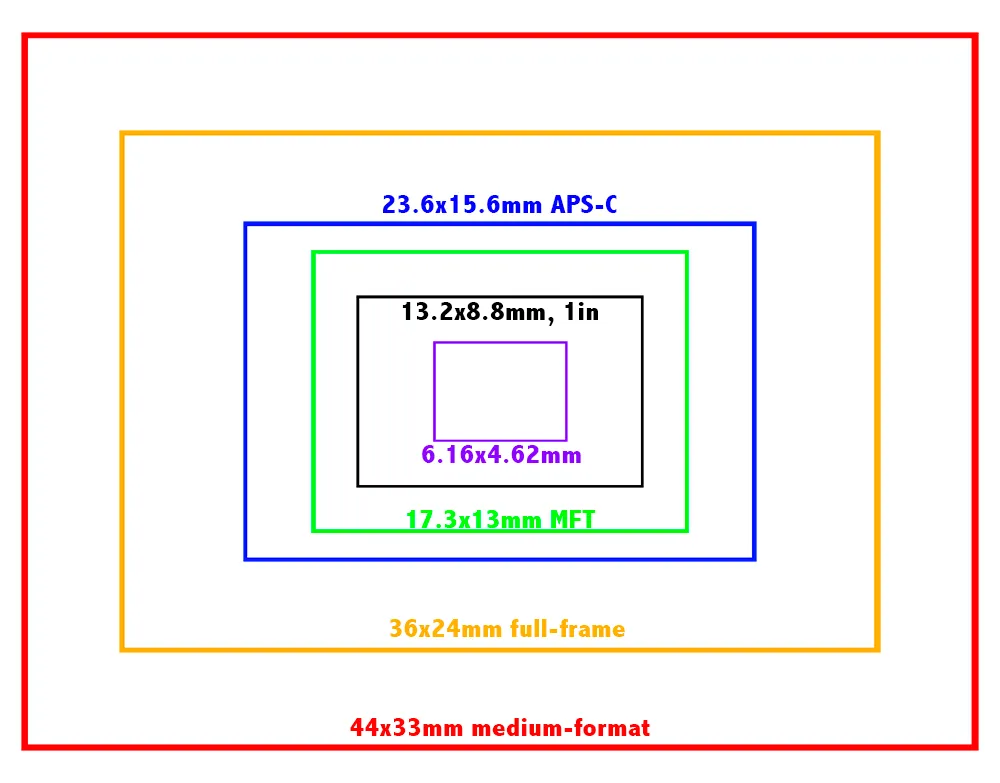
Although we often first take into account how many megapixels a camera has, this really isn’t the most important aspect. The type of sensor generally matters more. There are various sensor types, ranging from medium format, full frame (FF), APS-C (crop sensor), Micro Four Thirds (MFT) and 1-inch, down to a 1/2.3-inch and smaller. In most DSLR and mirrorless cameras, you’ll find either a full-frame, APS-C or MFT sensor.
An advantage of a full-frame sensor is that it is better at dealing with image noise at high ISOs compared with an APS-C or MFT sensor, which makes it more useful in low light. It also has an increased ability to produce dreamy background blur at wider aperture settings, which is great for portraiture. For more on this have a look at our guide to APS-C vs Full-frame vs MFT.
Features
Cameras have a lot of features and functions. Depending on what you plan to shoot, the main ones to consider will likely be ISO range, burst mode capability and video quality. If you are going to be shooting in low light, then a larger ISO range is hugely valuable. If video is a requirement, then check the camera’s video recording specs – its resolution and frame rate. And if you want to capture fast action, then you’ll need a camera with a faster burst mode. You may need to compromise when shopping on a budget, so prioritise one or two key features.
For a new camera up to £1000/$1000, you can expect to get some excellent features, such as 4K video and a generous ISO range. However, where these cameras differ in relation to more expensive ones is often in the build quality and image processing speeds. DSLRs and mirrorless cameras have similar but different feature sets; check out our guide to DSLR vs mirrorless if you want to know the key differences.
If you’re a professional and on a budget, we suggest you take a look at the second-hand camera market. There are many excellent DSLRs and mirrorless models available – just check the shutter count and camera condition before buying.
Lenses
Finally, do some research on lenses before you buy into a camera system. Each manufacturer’s system is different and there is a large variety of lenses out there. If you are switching from one system to another, and want to keep some or all your old lenses, you’ll need to purchase a compatible adapter mount to ensure they fit. This may affect lens functionality and mean you can’t use some features like autofocus, so double-check before making the switch.
Our guide includes cameras that are available in the US and the UK, with $1000 / £1000 as our rough guide. Bear in mind that prices and exchange rates do fluctuate in both territories and while we keep this guide regularly up to date, sometimes a camera will nudge over the $1000 / £1000 mark in one territory or another. In general, it won’t be too significant.
Text by Claire Gillo, with contributions from Jon Stapley.
Claire Gillo is a creative brand, commercial product and event photographer based in South Devon. She shoots all types of genres from portraits, music, interior, product to food & drink. Claire has much experience in the publishing industry too, and has worked across many of the big photography magazine publication titles from Amateur Photographer to Digital Camera. Find out more about her at www.clairegillo.com and follow her on Instagram @clairegillophotography.