


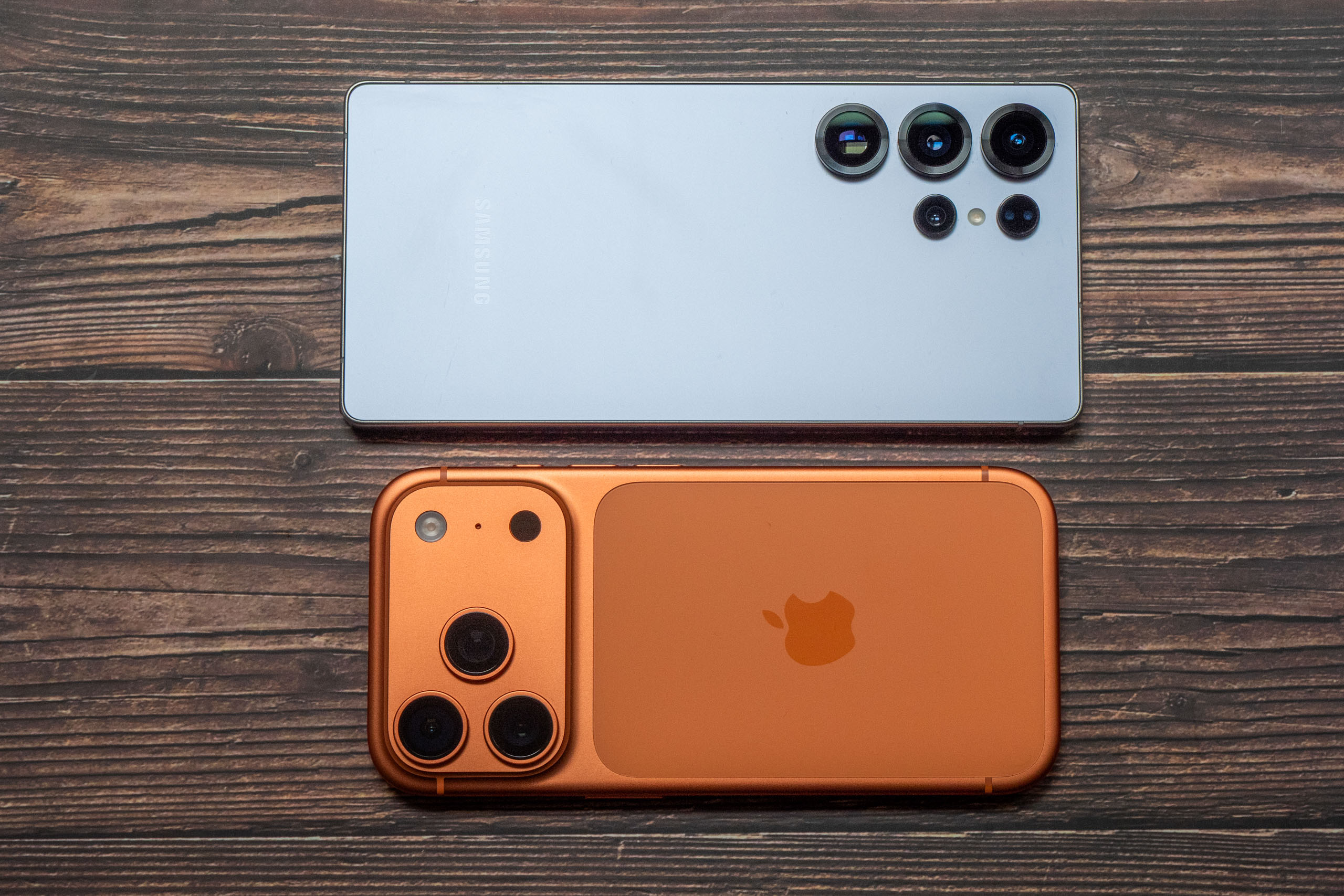
The flagship models from both Samsung and Apple are great performers. Indeed, it’s true that the iPhone 17 Pro and the Samsung Galaxy S25 Ultra both sit happily in our list of the best smartphones for photographers.
If you use either device, you should find that you are able to get great shots in a wide range of conditions, from portraits to low light to macro. However, this is the internet and we want to know which one is better. So, I took a load of photos with both of the models to find out for you.
I used both phones in the same conditions at the same time to discover which took the best shots. There’s two sizes of iPhone 17 Pro, I’ve been using the smaller 6.3-inch version, but as the camera setup is the same on either size of iPhone, then you could easily consider this to be a comparison between the iPhone 17 Pro Max and the Samsung Galaxy S25 Ultra, too.
iPhone 17 Pro vs Samsung Galaxy S25 Ultra: Specs
In the table below I’ve listed all of the most relevant specs for photographers. In bold, ‘ve highlighted those which are better – on paper at least. You’ll see that there’s bold on both sides of the table, indicating that overall the two could be fairly evenly matched.
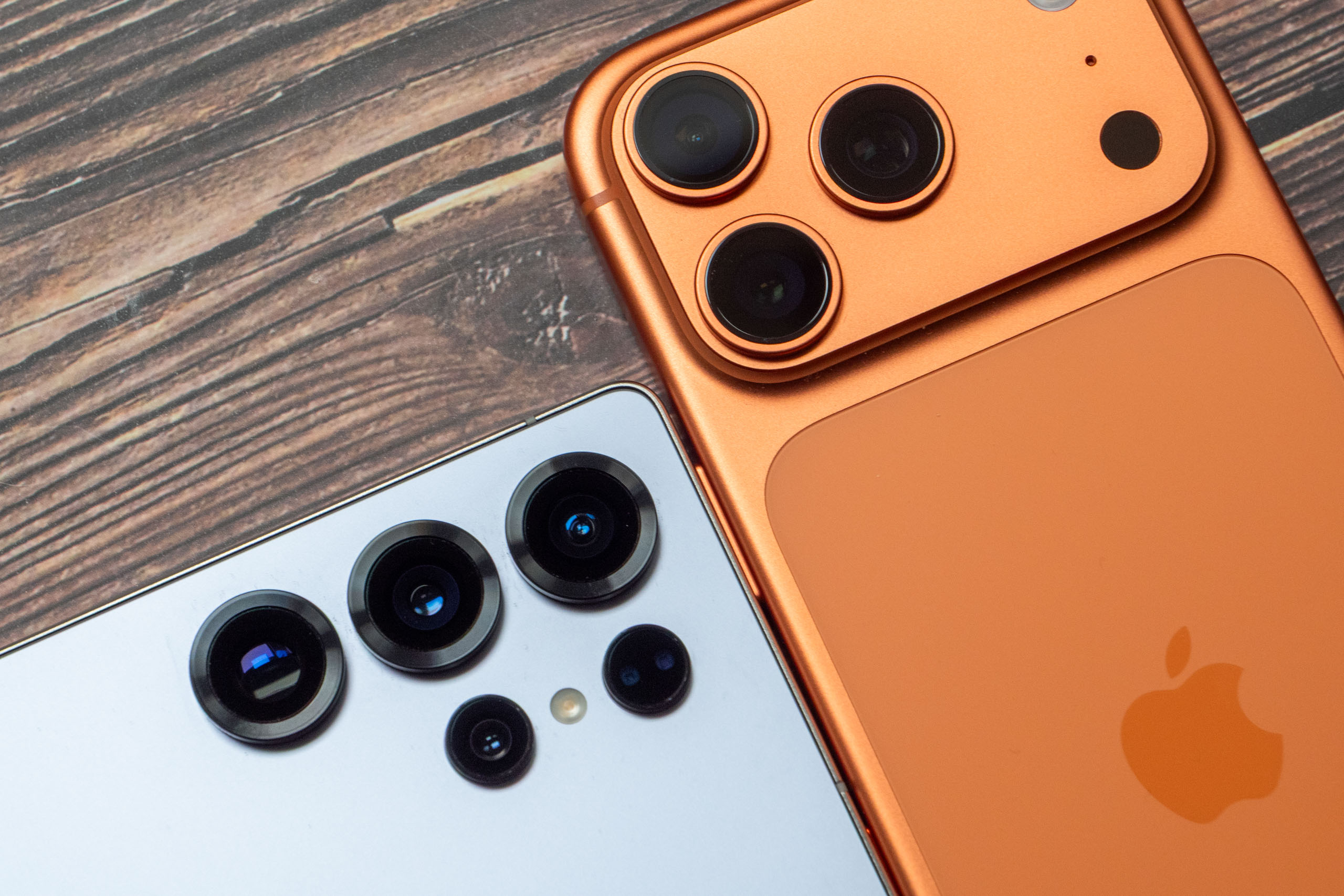
Looking at just the camera specs alone, you get four with the S25 Ultra, and only three with the iPhone 17 Pro/Max. The main sensor for the S25 Ultra is 200MP, whereas the main one for the iPhone 17 Pro is 48MP – though it’s worth noting that the iPhone outputs at 24MP by default, rather than 12MP for the Samsung.
Both phones have an ultrawide lens, both now with high resolution sensors – the S25 Ultra’s is slightly higher in resolution, but not enough to likely any difference. The third lens for the iPhone is also very high resolution – a 4x zoom with a 48MP sensor, while the Samsung has a 3x zoom with a 10MP sensor.
That sounds quite mismatched, but the Samsung has a fourth lens, a 50MP 5x option, which the iPhone simply doesn’t have.
| iPhone 17 Pro | Samsung Galaxy S25 Ultra |
| 48MP f/1.78 main camera, OIS, 24MP output, 24mm | 200MP f/1.7 main camera, OIS, 12MP output, 24mm |
| 48MP f/2.2 ultrawide camera, 24MP output, 13mm | 50MP f/1.9 ultrawide camera, 12MP output, 13mm |
| 48MP f/2.8 4x telephoto camera, 100mm, 8x “optical quality” crop | 10MP f/2.4 3x telephoto camera, 67mm |
| N/A | 50MP f/3.4, 5x telephoto camera, 111mm |
| 18MP f/1.9 selfie camera with square sensor | 12MP f/2.2 selfie camera, AF |
| HEIF, JPEG, raw (DNG) stills | JPEG, raw (DNG) stills |
| 4K 120fps video | 8K 30fps video |
| 6.3-inch / 6.9-inch XDR OLED Super Retina 2622 x 1206 / 2868 x 1320 pixels, 3000 nits max brightness, 120Hz Ceramic Shield 2 front and back | 6.9-inch 3120 x 1440 pixels, 2600 nits brightness |
| IP68 splash, water and dust resistant | IP68 splash, water and dust resistant |
| Apple Intelligence, A19 Pro Processor | Samsung Galaxy AI, Qualcomm Snapdragon 8 Elite |
| 31 / 37 hour battery life, wireless and fast charging (40W) available | 31 hour battery life, wireless and fast charging (45W) available |
| 256GB/512GB/1TB storage | 256GB/512GB/1TBstorage |
| 150 x 71.9 x 8.75mm, 204g / 163.4 x 78 x 8.75mm, 231g | 162.8 x 77.6 x 8.2mm, 218g |
Elsewhere, look at the screen sizes. If you like big phones then both have 6.9-inch options which should make you very happy. If you prefer a smaller device, only the iPhone model gives you that – which is a shame. The iPhone is slightly brighter, but the Samsung has a little more resolution. Both have anti-reflective coatings.
If we think about handling, personally I prefer using the smaller iPhone – especially for non-photography tasks, such as emailing and texting and so on. However, it’s fair to say that the larger devices really do show off your photos and videos extremely well.
It’s also worth considering how you operate the cameras. The iPhone has the “Camera Control” button which the Samsung doesn’t have – though you can use the volume button to release the shutter. It’s disappointing that Samsung got rid of the Bluetooth connectivity from its bundled S Pen (stylus) as that was quite useful for remote photography.
What about the native camera apps of both models? Well, as I generally find to be the case in iPhone vs Android comparisons, the iPhone’s a bit simpler, with fewer options for changing settings and so on. I’d like to see more, but it’s not a deal breaker for me.
Both phones have AI editing tools, with the Samsung offering a little more editing options than the iPhone.
iPhone 17 Pro vs Samsung Galaxy S25 Ultra: Image Quality
I used both phones to take photos in a range of different scenarios to get a good idea of the image quality of both.
Please note that the iPhone 17 Pro is on the left every time, and the Samsung Galaxy S25 Ultra is on the right.
GENERAL
Both the images here are good, in this general landscape scene taken with the main (1x) lens. The Samsung has produced a slightly brighter result, while the iPhone is probably a bit closer to the reality of the scene in front of it. I wouldn’t say either is worse than the other, it’s just a matter of preference. Remember that both of these images were taken with the default colour settings, you can change Picture Styles or Digital Filters with either phone if you want a different look. Both pictures have plenty of detail, but you have a bit more scope to crop after the fact with the iPhone as it’s a higher resolution output.
ULTRAWIDE
It’s a similar story with the two images taken with the ultrawide lens. The Samsung is brighter again, with the iPhone a bit more realistic.
2X
You can use a 2x setting with either model, both of which use the 1x lens and the central portion of the sensor to achieve the effect of a 2x lens. Here again, the colours are brighter from the Samsung, but there’s a bit more fine detail in the iPhone shot – which you can see if you zoom in.
3X/4X
The third lens from the iPhone is a 4x lens, while the Samsung’s is a 3x, so I’ve compared those here. Both images are perfectly usable, but you can see more detail in the 4x (iPhone lens).
5X
There’s a fourth lens for the Samsung, but there isn’t one for the iPhone. I’d actually say that this lens performs a bit better than the Samsung’s 3x lens, with a decent amount of detail.
8X/10X
Both models have a digital zoom setting that goes beyond the maximum optical focal length. Both claim to give “optical quality” results. For the iPhone, it’s an 8x option, for the Samsung, it’s a 10x. Both are pretty good, but the Samsung seems to have a touch more detail here.
MAX – 40x/100x
The maximum digital zoom of the iPhone is 40x, but it’s 100x for the Samsung. Neither are particularly usable, and it’s probably fair to say that both are simply there for “marketing” purposes.
MACRO
With either phone, you’ll be using the ultrawide lens if you engage macro mode. Here, the results are actually fairly similar, but there’s perhaps slightly more detail from the iPhone shot if you look quite closely.
LOW LIGHT
Both phones take great shots in low light, but the Samsung, thanks to its brighter exposures and more vibrant colours looks a bit more pleasing here. Both have a good amount of detail.
PORTRAIT
You can use a portrait mode with both models, creating a shallow depth of field effects. Although both are good, the iPhone’s result is more natural with a better outline, and more natural / flattering skin tones.
SELFIE
The selfie camera for both phones produces fairly nice results. The higher resolution of the iPhone seems to produce slightly more detailed shots.
iPhone 17 Pro vs Samsung Galaxy S25 Ultra: Value for Money
You won’t be buying either of these phones if money is tight, but just because they’re both expensive doesn’t necessarily mean they’re bad value for money. They’re both excellent phones that should last a good length of time, and tend to hold their value well too – usually you’ll get more resale value from an iPhone.
Which one is cheaper depends on the size you’re happy to go with, your location, and any offers.
The cheapest price you can buy a Samsung Galaxy S25 Ultra is $1299/£1249, for a 256GB model. The equivalent iPhone (the 17 Pro Max) is cheaper at $1099/£1199, but, if you’re happy to go for a smaller screen, then you can save even more cash and get the 17 Pro (non Max) for $1099/£1099.
However, taking a look at the 512GB options and things switch around a bit. Here, the iPhone (Max) is more expensive at $1599/£1599, compared to $1419/£1349 for the S25 Ultra. Similarly, the 1TB iPhone 17 Pro Max is the more expensive of the two at $1999/£1999, compared with $1659/$1549. Again though, you can save some money by going for the smaller model, Pro instead of Pro Max.
I’d say overall the iPhone at the 256GB variant represents possibly the best value for money, but if you’re keen on more storage space, then it’s the Samsung.
Verdict
Looking at images taken in a number of different scenarios reveals that both of these phones are great performers and do well at a number of different shooting tasks.
In the end, as ever, it likely comes down to personal preference to pick a “best”. The colours and brightness from the S25 Ultra are great, but I probably prefer the more realistic / muted tones of the iPhone – you might feel differently.
Both do very well in low light, and are similarly matched for macro, but for me the portrait performance is better from the iPhone, so it nudges just slightly ahead there too.
In terms of handling, I much prefer to have a smaller phone, so the fact that you can buy an iPhone in a smaller size without having to compromise on image quality is a real bonus. It also saves you a bit of cash too, which is a nice to have.
Operating systems are very much a personal preference, especially if you’re used to one or the other. I would say if you’re already an iPhone user, you’re probably not going to be tempted to give it up for this Samsung, and the same is true vice versa too.
On the whole, I’d say these two phones are extremely well matched – but for a bit more flexibility in prices and sizes, plus the excellent Portrait performance, I’m going to give the prize to the iPhone on this occasion.
Related reading:
- iPhone 17 Pro vs iPhone 17: is the telephoto camera worth the extra money?
- Why I only use an iPhone and not a ‘real’ camera anymore
- Apple made a big mistake with the iPhone Air – I’d never buy one and here’s why
- Xiaomi 15 Ultra vs Samsung Galaxy S25 Ultra: I’ve taken hundreds of photos with each to find out which is best