

Amateur Photographer verdict
A simple, and intuitive camera that’s all about playful experimentation, yes, the City 300 may ultimately be a bit of a toy, but sometimes toys can appeal to even us big kids
- Lightweight and portable
- Easy to use
- Includes carry pouch, lens cloth, lens cap, USB lead, wrist strap and keyring
- Physically small sensor
- Leisurely power up
- Flip-out LCD not a touch screen, nor can it be tilted
- No eye-level viewfinder
Yashica City 300 at a glance:
- Price: $420/£329
- 50MP 1/1.56-inch CMOS sensor
- 5.68mm lens, f/1.8, 2.5x digital zoom
- Min. focus: 0.15m
- Screen: 2.8-inch LCD
- Video: 4K 30fps
- 192g without battery
Currently the range topping entry in Yashica’s fledgling ‘City’ pocket camera series, the ‘300’ is lightweight, portable and fun to use. But, via its adjustable lens ring, it feels more like a tuition aid to focal lengths than a reasonably priced alternative to an actual enthusiast compact. For example, Ricoh’s GR IV.
The retro styling and slide-on flash help cloak that the City 300 is less sophisticated in operation, handling and delivery than it looks. But while it’s more of a toy for photographers than a serious tool, image quality is acceptable given its size and price. Ultimately this would work best as a first standalone camera for any Gen Z-er wanting to slow down and take a break from their smartphone.
Compact, point-and-shoot cameras are on the comeback trail, with smaller brands like Yashica filling the vacuum currently left by more hesitant major photographic players like Canon, Nikon et al. But, while TikTok and Gen Z may be driving the demand, it feels to me like there needs to be a reason for their re-emergence, beyond social media trends. Previous offerings in Yashica license holder’s City compact camera range have claimed a generous 72-megapixel top resolution, albeit interpolated from a native 13 megapixels. Additionally, I could choose from a 3x optical zoom in the case of its City 100, or a more useful 10x on the City 200. Quality wasn’t bad for the price being asked, but at the same time it didn’t wow me.
YashicaCity 300 – Fetaures
Exuding slightly more sophistication, the black bodied City 300 now joins the family, this time claiming a 50 ‘effective’ megapixel resolution from a 1/1.56-inch CMOS sensor.
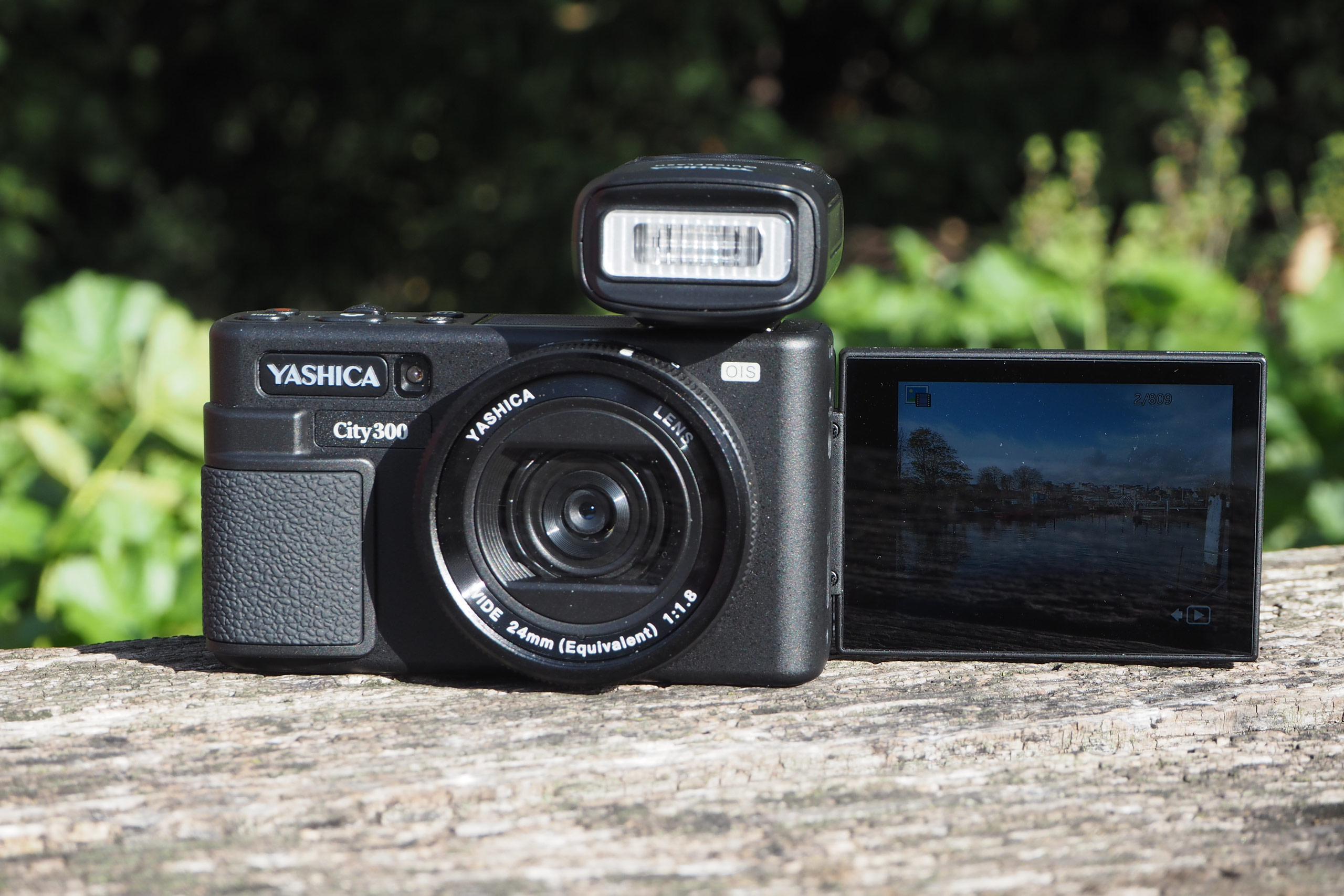
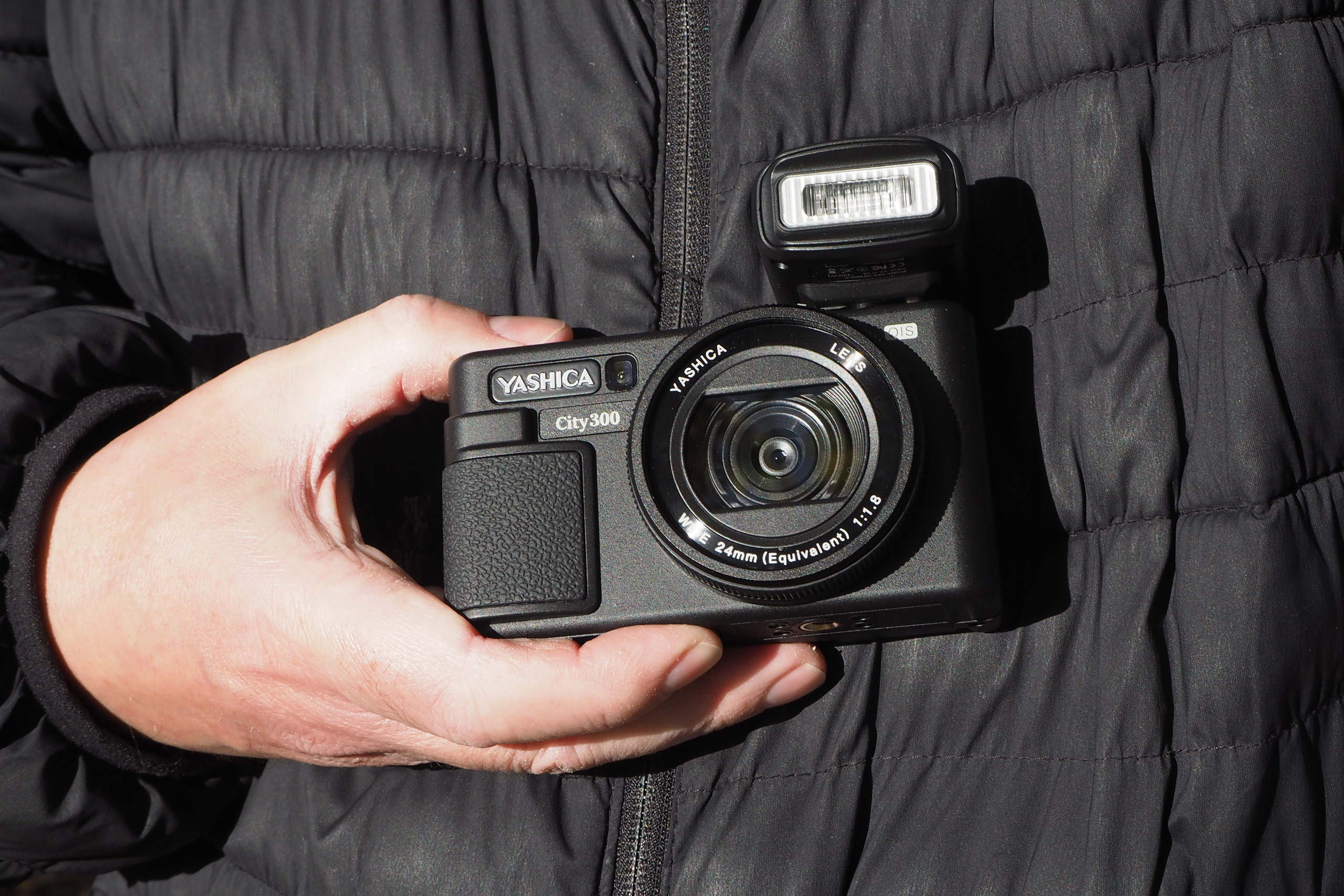
The snapshot has a fixed lens instead of an optical zoom. However, if I choose to ignore its default ‘D’ for digital zoom setting, I can ape the ability to manually select differing focal lengths via an enjoyably tactile ridged lens ring. Marked at intervals around its circumference are 24mm, 35mm, 50mm and 60mm equivalent settings.
But I’m not getting a bunch of lenses in one; instead, the camera is undertaking a series of image crops. And, because cropping is occurring, if I move beyond the widest 24mm setting, which allows for a maximum 50MP capture, the camera automatically drops resolution. For example, down to 24MP at 35mm equivalent setting, 12MP at 50mm and 8MP at 60mm.
The poser is, do those seeking out a point and shoot camera really need such faux framing options? Or would they be better off with a ‘proper’ optical zoom to further differentiate from the smartphone they already own?
Pricing wise, the camera is inevitably more expensive than the previously released City 100 and City 200, which this sits alongside rather than replaces. At an asking price of $420/£329.99 or €379.99 including a bundled mini flash, the City 300 is not an impulse buy. Yet it’s still a less expensive option than an equivalent model from one of the larger, more respected photographic players.
Read on as I attempt to discover whether the Yashica City 300 delivers for anyone anxious the existing 100 and 200 alternatives might be a little too basic. Or who are seeking a bit more hands-on control, while still desiring a snapshot that’s lightweight, portable and moreover fun.
Yashica City 300 – Handling and design
While it does not possess an optical zoom, the Yashica City 300 outwardly closely resembles the 200 model, likewise available in black but additionally white, that sits below it in the current lineup. The front grip, faceplate and top plate control layout are identical. At a body-only 192g weight without battery, however, the newer City 300 is more noticeably lightweight.
Even with NP-40 rechargeable battery, microSD card inserted and accessory flash attached, I had to keep checking the camera was still in my jacket pocket and I hadn’t accidentally mislaid it when out shooting. So, if anything, I’d prefer a bit more heft and solidity to the build. Apart from a metal cover for its speaker, the camera appears entirely plastic in construction and certainly feels it.
While the City 200’s 10x optical zoom may have benefitted from on-board image stabilisation it didn’t have that feature, whereas the slightly pricier City 300 does. Combined with its bright/fast f/1.8 aperture lens, the suggestion is, on paper at least, it might be enable me to keep shooting even as light levels drop. There is also a screw thread provided at the base, should the camera wish to be used with a travel tripod. The unobtrusive size would suggest ideal use as a street photography camera for those who do want to travel light, however.
Incidentally, if you prefer digital compacts that cosplay as vintage film cameras, also check out the Yashica FX-D 100, based on the earlier City 100. There’s also the FX-D 300 and 300S. Like the City 300, these more superior models also claim a 50MP sensor.
With no eye level viewfinder provided, stills and video on the Yashica City 300 are framed via the 2.8-inch LCD screen at the rear. This can be flipped around to face whatever or whoever is in front of the lens for the inevitable selfie, with the widest setting 24mm lens ensuring that group shots are a cinch. However, it’s slightly disappointing the screen cannot be angled to make low- or high-level shooting slightly easier. Like the other options in this series, it’s obvious the City 300 has again been constructed to hit a certain budget / price point. Which is fine. We’re not discussing a Sony compact, that would be three times its price.
The other buttons on the backplate resemble what I’d expect to find on any pocket point-and-shoot digicam. I get a centrally placed ‘OK’ button sitting within a four-way control pad for tabbing through and selecting camera menu options. Ranged above and below this are two sets of buttons, to make four in total, providing thumb access to info, menu, playback and delete options. As noted, this is all industry standard stuff, making for quick, easy, intuitive camera operation.
Once again, I want to give a brief shout out to the bundle of accessories rammed into the surprisingly compact box the camera arrives in. Commendably, this includes a soft pouch for the camera, along with a character keyring, wrist strap, lens cloth, USB lead – but no plug – plus of course the lens cap, and additionally here, an accessory flash with internal battery, which is charged before use via the USB lead. It all makes a good first impression, although subsequently fitting it all back into the small box is a challenge.
Yashica City 300 – Build quality
As this Chinese made camera is so light, I was concerned about being able to hold it sufficiently steady enough to avoid camera shake and resultant image blur. Even with rechargeable battery inserted, nothing noticeably changes. I found the internal clip that keeps the battery in place to be weakly constructed, in that I had to nudge it with my thumb to ensure it latched firmly into place.
Though the Yashica City 300 feels plastic-y in the hand, its budget build is somewhat disguised by its exterior finish. There are enough visible controls borrowed from the City 200 model to prevent the camera wholly resembling a toy. For example, the top plate features a toggle switch for its digital zoom, a dedicated video record button, a shutter release button illustrated with a camera icon, a shooting mode button instead of turnable dial, the power button, plus, more unusually for a consumer compact, an auto exposure / auto focus lock button. These six controls nestle next to a large and prominent built-in speaker, also seen on the City 200, while by contrast a small pinprick above the front grip is provided for the built-in microphone.
Likewise unusual for a snapshot camera, there is not only the vacant hotshoe for accessory attachment, including that of the bundled mini flash, but a slot at the side for an external microphone, for anyone seeking to up their audio game when creating video content. This slot and the one directly below for attaching the supplied USB lead required for charging the camera’s battery in situ are unprotected by the usual rubber or plastic flaps found on compacts, so prove susceptible to pocket lint. That said, my smartphone’s USB port is similarly unprotected.
As there’s no familiar penny/dime sized shooting mode dial on this camera as found on old school compacts, a press of its mode button provides immediate access to a virtual on-screen mode dial. Here we can tab between the familiar options of Program mode, Shutter Priority, Auto mode, Scene Selection mode and video mode, though if I want to shoot video clips a press of the dedicated record button on the top plate will immediately place me in that mode. It all feels very accessible and intuitive. And though I say that from the perspective of having handled hundreds of compact cameras over the past two decades, I can’t imagine anyone stepping up from their smartphone struggling to use the City 300 either. That said, unlike on most digital cameras these days, the LCD screen here is not a touch screen, which would have made operation more intuitive still.
The lens at the front with its tactile, ridged lens ring is protected when not in use by a clip-on plastic lens cap. I did notice it fogging up when bringing the camera in from a damp and cold exterior environment to a warm interior, so perhaps this is an option for fairer climates.
Yashica City 300 – Performance
As with the Yashica City 100 and Yashica City 200 cameras I’ve looked at previously, the City 300 is slow to power up. It requires a firm press of its power button and a wait of 3 to 4 seconds before the rear screen blinks into life displaying the image framed by our lens. For this reason, when I was walking around taking photos, I tended to leave the camera on, rather than switching it on and off to preserve battery life. Photos in default 4:3 or alternate 16:9 aspect ratio plus up to 4K video are committed once again to removable microSD card, with up to a 256GB capacity supported, while this time around we get the added ability to shoot raw as well as JPEG. The accessory small flash is surprisingly powerful, even on its lowest setting, whereby a single top plate indicator is illuminated. So I found myself dialing down the ISO/exposure to compensate and not bleach out subjects.
For those seeking a wider dynamic range there is a well-hidden HDR mode here too. It is blacked out on the menu screens when cycling through the 24mm, 35mm, 50mm and 60mm settings on the lens dial, but appears as an option when the initial default ‘D’ for Digital Zoom lens mode is instead selected, for which resolution is fixed at 12MP. The HDR setting can be turned on or off at will in ‘D’ mode.
Given that the Yashica City 300 ambitiously claims to provide 50MP shots from its modest 1/1.56-inch CMOS sensor, I was intrigued to find out how it handled low light and preferably nighttime photography. So, I took this City to the actual City – and the heart of London’s West End. Would visible grain / image noise be a problem? And would the camera be suitable for handheld snaps in such circumstances – or just deliver blurred results without deploying the flash as a fill-in? I certainly found it hard to tell in situ how the camera was doing regarding critical sharpness as the 2.8-inch, 4:3 aspect ratio backplate LCD isn’t the sharpest itself. As a result, I captured three or four shots of the same subject in the hope of achieving a keeper, a policy which worked.
Top whack 50MP JPEG images produce a file size here a tad north of 10MB each. Even without enlarging sections, images look distinctly video grab-like in appearance, though I did like the fact that they appear bright and colourful in favourable daylight conditions. At 100%, detail distinctly softens however, especially toward edges of frame. A high megapixel count doesn’t always correlate with stunning images and that is the case here, with slightly disappointing – if wholly predictable – results on close inspection. That’s not to suggest the audience for a plastic-y point and shoot will be inspecting image quality as closely. Most likely it won’t, providing said image quality appears ‘good enough’ at first glance.
So yes, I can’t expect the quality here to be on the same level with a 50MP full frame mirrorless or even APS-C sensor DSLR. But the asking price, while not inexpensive, reflects that. There is still a paucity of brand-new point and shoot compacts on the market at the time of writing. So, anyone who doesn’t want to go the secondhand route may well find themselves weighing up the pros and cons of the Yashica City 300 as a starter compact on which to learn the ropes and get some usable results. It’s another option for those who want to take pictures on something other than their smartphone without spending a lot more money on a camera that is more sophisticated and more solid.
Yashica City 300 – Verdict
I said in my AP review of the Yashica City 300’s predecessor, the City 200, photography doesn’t always have to be po-faced and deadly serious. Unexpected as it may have seemed just a couple of years ago, there is now, again, a place in the market for easy-to-use pocket digital cameras that take fun snaps.
The results may not necessarily better the quality achievable from a smartphone – and depending how sophisticated your current phone is, they may in fact be worse – but using a camera instead of a phone provides a different ‘experience’ nonetheless. It slows us down, forces a bit more consideration, and that extra time spent might hopefully result in a better composition and a more engaging shot overall. Given that, there will be those who consider the City 300’s asking price affordable. Its lightweight feel will also encourage you to slip it into a pocket and take it out and about more often, though personally I would wish for a more substantial quality build.
Yes, the City 300 may ultimately be a bit of a toy, but sometimes toys can appeal to even us big kids.
For more options, have a look at our compact camera reviews and mirrorless compact system cameras.
Full specifications
| Sensor | 50MP 1/1.56-inch CMOS sensor |
| Lens | 5.68mm lens, f/1.8 |
| Zoom | 2.5x digital zoom at default ‘D’ focal length |
| Minimum focus distance | 0.15m |
| Screen | 2.8-inch LCD, 4:3 |
| Video | 4K 30p (3840×2160) |
| Storage | MicroSD card slot |
| Battery | Rechargeable lithium ion battery |
| Dimensions | 106.5×45.4×62.5mm |
| Weight | 192g with lens cover, but without battery |