



Amateur Photographer verdict
The brightest in the firm’s continuous lighting options, the AS600B offers portability and power. Although its not exactly lightweight, or cheap it is reliable and made for professional use
- Extremely bright
- Lots of control
- Mains and battery power options
- Good cooling
- Accurate colour temperatures
- Big and heavy kit
- No green/magenta shift control
Neewer AS600B at a glance:
- Price: $999.99/£1499.99
- Powerful COB LED light
- Bowens mount
- Mains or battery power
- neewer.com / uk.neewer.com
It’s not unusual for photographers to be slightly nervous of flash. You don’t know what it’s going to look like until you’ve shot it, and then you might need to fiddle around getting it right before you take the next shot. That’s okay when you’re shooting objects and products, but when there’s a person sitting in front of you we might feel the pressure to get things right the first time. Continuous lights allow us to see what we are going to get just by looking with our eyes, and so things are a whole lot more predictable, but continuous lights – within the budget of the enthusiast – just haven’t been powerful enough for a lot of things, unless you are happy to crank your ISO up to 800 or so.
But, as with most things in our industry, progress is constant and LED lights seem to get brighter and less expensive by the minute. Not long ago the 500W Zhiyun Modus 500B heads marked the pinnacle of the power/cost balance, but with the introduction of this AS600B Neewer shifts the dial a little. Zhiyun were very pleased with themselves that they had managed to incorporate the power supply into the head of the 500B but there comes a point when that’s no longer possible, and when a light reaches 600W it needs an external power pack and the kit gets a whole lot bigger. This dramatic physical growth might seem at first as a bit of an inconvenience, but while there are undoubtedly some downsides there are also a number of valuable advantages.
Neewer AS600B – Features
The Neewer AS600B is a COB type LED light with a maximum power output of 600W and a quoted maximum illumination of 9900lux/1m. Being a COB (Chip-On-Board) type light means that its light emitters are closer together than those used in a standard (or SMD – Surface-Mounted-Device) LED and the illumination is smoother and without hotspots or multiple shadows. COB lights though use more energy for the same light output, need better heat control and are more expensive to produce – but it’s the smoother light that we’ll be interested in as photographers.
Key features:
- Bi-colour: LED head offers warm-to-cool variable colour temperatures of 2700-6500K, as well as a collection pre-set values
- Powerful: When set to full power we can expect up to f/11 at 2m, with 1/125sec and ISO 100
- Control: The kit comes with a separate power pack that controls the head and which allows the mounting of V-Lock batteries
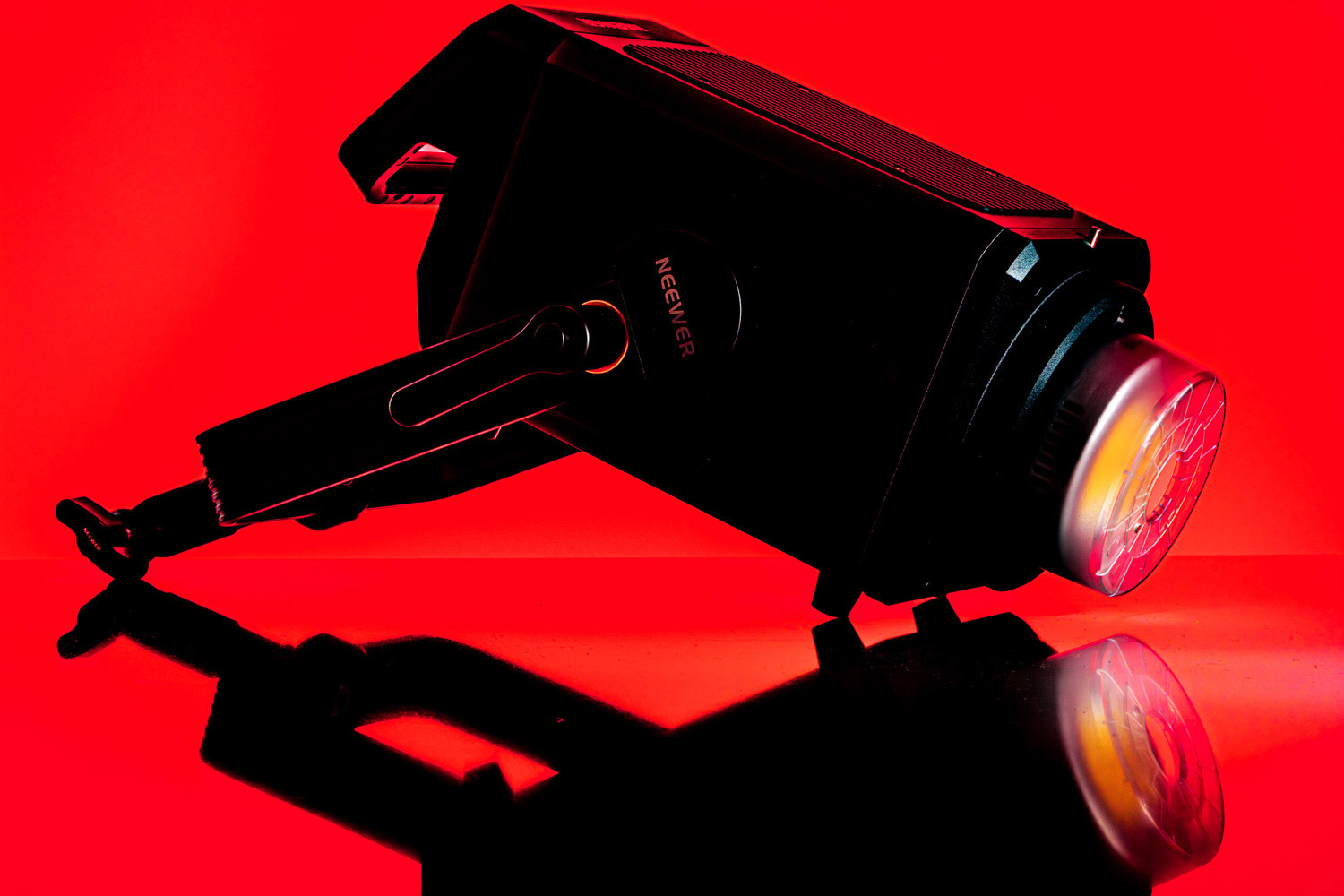
A kit of two parts, we get the lighting head itself and the power pack that controls what the head does. The head itself is quite featureless, having only its Bowens S mount, a modifier release switch and the power-in port as notable facets on the exterior of the housing. The power pack is where it all happens. Here we can plug the kit into the mains when shooting indoors, and when we are away from a regular power supply we can attach V-Lock batteries to the pack to run the show. We can use full sized V-Lock batteries or the mini-versions, and as the pack has mounting points on both sides we can connect two at the same time – which is very handy indeed.
The light is a bi-colour type and gives us temperature options between a very warm sunset 2700K and an extremely cool blue-sky 6500K. Slightly disappointingly there’s no green/magenta shift on this model as Neewer reserves this for its full-colour lights denoted with a ‘C’, and there’s no ‘AS600C’ yet. To be fair, other brands don’t offer this on lights this powerful, but that doesn’t mean it wouldn’t be useful.
As well as the usual CCT (Correlated Colour Temperature) cool-to-warm adjustment mode the AS600B offers us the chance to select one of 11 pre-set colour temperature settings that are designed to match standard lighting fixtures – such as Daylight (5500K or 6500K), Incandescent Lamp (3200K) and various daylight balanced Dysprosium studio lamp types, as well as one called Dawn that gives us 5000K. There are also 12 flicker-box effects to pick from, such as Lightning, Fireworks, Candlelight and Paparazzi. When you find a combination of CCT or FX and a brightness level you like and will want to use again, you can save light settings to your favourites menu, and if you are using the light in a fixed set-up that requires the same settings each time you can activate Studio mode so those settings will be locked in every time you switch the light on.
With built-in Bluetooth and Wi-Fi the AS600B offers us the option to control the head from a smartphone/tablet app as well as via a DMX (Digital Multiplex) desk. We have DMX ‘in’ and ‘out’, so the AS600B can be controlled from a lighting desk on its own, or in a series alongside other lights. We also have a fan for keeping things cool and a means for controlling the fan speed and noise.
The lighting head is quite big in itself, and the power pack is even bigger, so this isn’t a compact kit – and it weighs a lot. The head weighs 5kg and the power pack weighs 3.74kg, but that doesn’t include the cables which are also thick and heavy, the clamp for attaching the power pack to a stand or the excellent rolling case it all comes in. It ends up being about 18kg in all – that’s your holiday suitcase allowance right there.
Neewer AS600B – Build and handling
The head and the power pack are both made very well, and appear as though they will survive a good deal of use and a certain amount of rough handling. The yoke for the head is solid and well able to hold the head in any position even with large and heavy modifiers attached. The yoke is also large enough that the light can rotate inside it without the lamp, rear handle or the power cable colliding with the frame – so we really can position the lamp at any angle. At the rear of the head we have a large handle that makes carrying and positioning the light much easier, while vents top and bottom allow air to be drawn through the body. Four legs on the base keep the light about 15mm off the ground, so the light can be placed on a flat surface as well as on a stand and still remain ventilated.
The cable used to connect the lamp to the power pack locks at both ends, so it won’t be pulled out by accident, and the power cable to the power pack offers the same precaution. The power pack can just rest on the ground, or we have a clamp to attach it at whichever height we like to a light stand.
While the idea of a separate power pack might appear complicated it is actually just as easy to use as a head that has all the controls on its body. From an access point of view, it is very often easier to control a head from a pack at ground level than it is to see the controls on a head that’s mounted high up on a stand. Everything we need on the pack is controlled via three buttons and a dial, and it’s all pretty straight forward. The buttons cycle us through the fan settings, the modes and the menu system, and we can scroll, click and select using the dial. It’s that simple. Shifting from one mode or menu item is about as convenient as it can be, but as useful as it is to have the accuracy of 0.1 increments in the brightness range it makes getting from 10.2% to 98.5% a bit of a drag. We have four Dimming Curves to choose from to help with the way the dial responds to our turning of it – I found Expo(nential) the most intuitive.
The Neewer Studio app is very good for controlling the light, or a group of Neewer lights, especially if the power pack is some distance from your shooting position, and it opens additional features, such as Colour Match where the app uses your phone’s camera to match the colour of a second light.
Neewer AS600B – In use and colour
There are some extra processes involved with using this light. You don’t just take a head out of a box and plug it in – you have to plug in the power pack and attach that to the head as well, and the rolling case it all comes in doesn’t just fit under your arm. There’s some set-up to be done, but boy is it worth the extra effort! I’ve used this light quite a lot now and am stunned by its power every time I use it. Even when I don’t need a massively bright light I’ll dial it up to 100% just to remind myself of how bright it is. I thought the novelty would wear off after a while, but it hasn’t. The power means we can do so much more with the light – it can produce ‘sunlight’ through a window, create immense fill for a whole room and pass through two or three layers of diffusion and still deliver a decent aperture.
I found that with the supplied reflector dish I could get f/11 and 1/125sec at ISO 100 with the colour temperature set to 5500K and the light 2m away from the light meter. Dialling the temperature to 2700K drops the brightness to about f/7.1, while 6500K gives us f/9. Switching to battery power means we can only get about 85% power from the kit with two batteries attached – though the screen tells us it’s 100%, and using one battery drops the output again to about 75% of what we’d get with the mains power supply.
Although this is a powerful light the size of the body, and the vents and fan in it, mean it doesn’t get too hot. I was worried to put it inside a lantern diffuser and some of my smaller softboxes, but it was fine. It certainly got warm and I left it to cool off before putting it away, but it never felt really hot. And the fan isn’t actually very noisy. I left it in Auto mode most the time and it never got to disturbing levels. We have the Mute mode of course, but that instantly drops quite a lot of the light’s brightness.
The colour temperatures I got from this light aren’t always quite as advertised, with the tones being very slightly cool compared to the temperature dialled in. The warmer temperatures seem more balanced. Set to 3200K the AS600B produced a nice neutral result with the camera set to the same temperature, but even when the 5500K results were a touch blue/red the shift was only very minor and not really noticeable in all but the most scientific tests. Compared to other LED lights I’ve reviewed recently I’m very happy with these results.
Neewer AS600B – Verdict
I’m shying away from saying this is a low-cost light, because there’s not much that is low-cost about £1500 (though as I write Neewer has 40% off the AS600B, making it ‘only’ £840). Compared to other lights of around the same power though, we have to part significantly less money to own one. Even at £840 – Neewer lights are rarely without some discount – this will still be a considered purchase, but if you need a continuous light that’s as powerful as this there are few other or better options. This is the first continuous light I’ve been able to frequently use instead of flash safe in the knowledge I’ll be able to get comparable apertures. It’s also the first continuous light I haven’t had to think twice before passing through a couple of layers of diffusion if I wanted to avoid high ISO settings. Yes, the kit is big and heavy, but that comes with the territory. It’s well made though, well thought through and very nice to use – and you can do so many things with it.
Related reading:
- Neewer Q6 flash review – reliable, consistent and persistent
- Neewer Q4 flash review – solid, powerful and value for money
- Neewer HB80C RGB COB LED light review
Full Specifications
| Output power | 600W |
| Input power | 720W |
| Colour temperature | 2700K-6500K |
| CRI/TLCI | 96+/98+ |
| Maximum illumination | 99000lux/1m (standard reflector) 200000lux/1m (highlight reflector) |
| Brightness modes | CL mode (Constant brightness) CP mode (Maximum power output) |
| Special scene effects | 12 |
| Fan mode | High / Auto / Mid / Silent |
| Dimming curve | Exponential / Logarithmic / S / Linear |
| Dimensions | 20″x9″x6″/510x235x155cm (lamp) 12.6″ 7.7″ 5″/320x195x125cm(controller box) |
| Weight | 11lb/5kg (lamp), 8.2lb/3.74kg(controller box) |