

Leica Monopan 50 at a glance:
- $10 / £10 for 36 exposures
- Leica-branded film
- ISO 50 speed
- Very fine grain structure
- Broad spectral response
- Great for landscape work
2025 is a big year for Leica, marking as it does the 100th anniversary of the innovative Leica 1 being launched at the Leipzig Spring Fair. Designed to make use of 35mm cine film as a medium for high quality photography, the designer Oskar Barnack defined the concept of the Leica camera as “small negative – big picture”, placing the emphasis firmly on providing a quality product. Since then, Leica has continued to develop and the brand is now synonymous with desirable, beautifully engineered and – let’s be frank here – hugely expensive cameras. Amid a swirl of centenary celebrations for the camera around the world, one in particular caught my attention: the announcement in June this year of Leica’s very first 35mm film – Leica Monopan 50.
When I enquired about the film, Leica helpfully sent me some review samples to evaluate – which arrived in a stylishly black cardboard box, with the film sitting in a nest of crushed black tissue paper. This may seem extreme, but it certainly protected the film – as well as giving some support to the statement in Leica’s press release that the film’s launch was intended to “pay homage to 35mm photography”.
Leica Monopan 50 – First impressions
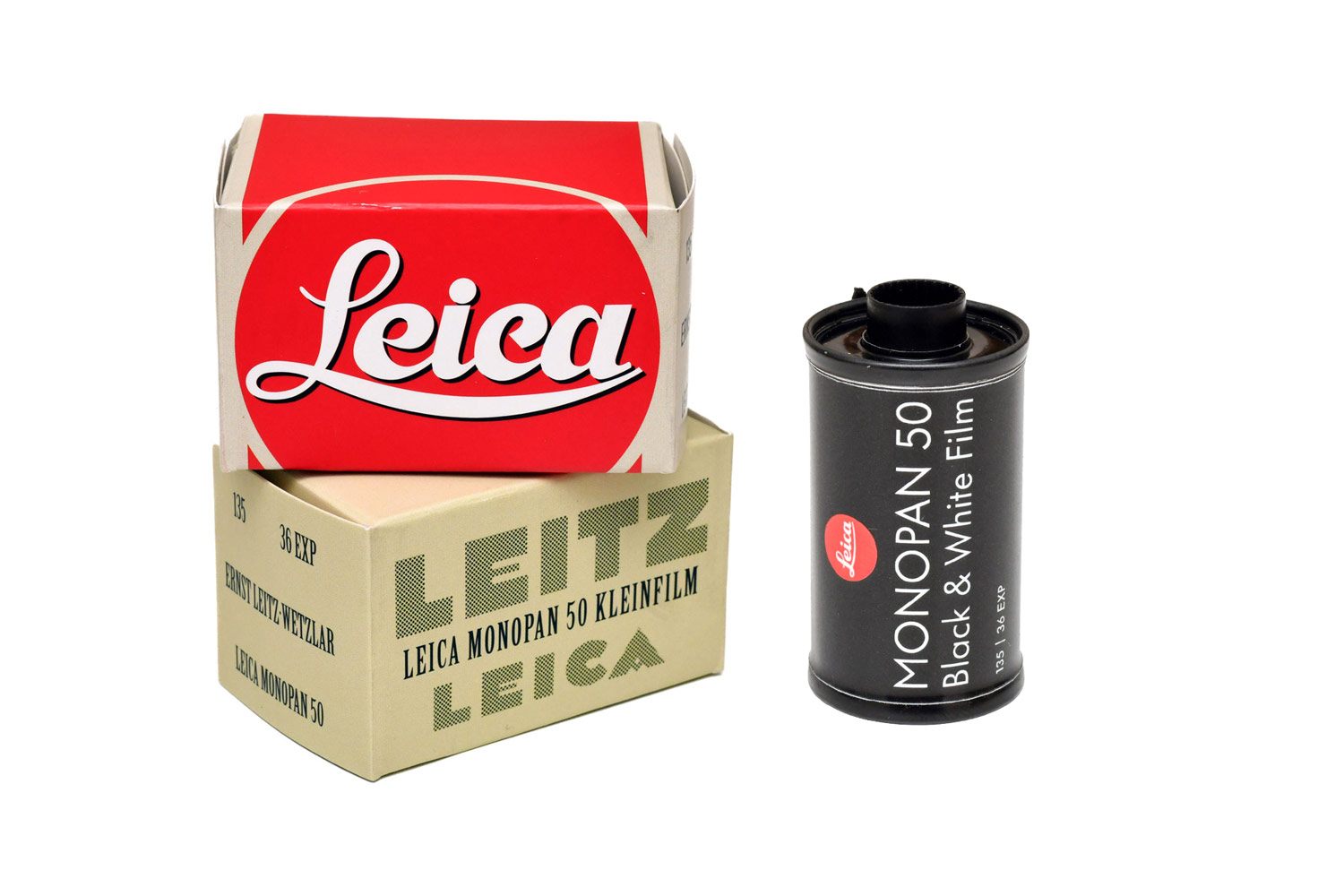
The attractively retro packaging – of which there are four versions in circulation – are clearly designed to play to the heritage aspects of the product, and I suspect that more than a few Leica fans will obtain some of the film just to keep and display as a collector’s item. Happily, however, there is much more to this film than the PR-friendly artwork of the boxes.
The specification of Leica Monopan 50 is fairly straightforward. It is a black-and-white film, hence the “mono” part of the name, and panchromatic – “pan” and the ISO sensitivity of the film is 50. Beyond these bland basics, however, there are some intriguing aspects.
Even for a slow monochrome film, the specified resolution is very impressive – with Leica quoting a figure of up to 280 line pairs per millimetre. The film has a broad sensitivity to different wavelengths of light – which Leica calls “superpanchromatic” – and this extends strongly up to 780nm, right to the edge of the visible red wavelengths and on the slightly blurry border with the infrared.
The film cassette is fairly standard, although it is also in a stylish black with the famous “red dot” Leica logo sitting just next to the light trap. The film is, unusually, not DX coded – but that coding would not help anyway if you are using it in classic Leica cameras, which lack the contacts. The film itself has a fairly thin base 0.1mm thick and feels somewhat delicate, especially when handling it in the darkroom. Not that you should ever handle film robustly, but you are likely to be rewarded for using extra care with Monopan 50. As you would probably anticipate, there is an anti-halation layer beneath the film emulsion to prevent light bouncing back into the emulsion from the film base or pressure plate, which can give a halo effect and reduce the effective resolution.
Leica Monopan 50 – Family resemblance
I found myself wondering about the logistics of a camera company producing a film of this type for the first time. The range of processes and activities involved in producing a film base, coating it and packaging the final product is complex in the extreme – especially with the overarching requirement to deliver a very high-quality film. It seems an awful lot of effort for what might be viewed as a promotional item. So… if a hardware company needs a software product, who do they go to for help?
In conversation, I found that I wasn’t the only one who had wondered about this – and brighter minds than mine had hinted at a possible solution. The data sheet for Monopan 50 helpfully provides a diagram of its sensitivity at different wavelengths of light. This graph is like a signature or fingerprint for a film emulsion, and in the case of Monopan 50 it closely resembles the spectral response of Adox HR50 – which also shares similar reciprocity failure figures and other characteristics. This is not to suggest that Monopan 50 IS Adox HR50, more that they may have a common ancestor from which both films were developed. Further clues exist in the form of the processing advice for Monopan 50, where four of the six suggested developers are Adox products. This all makes perfect sense from Leica’s point of view, as Adox is another German company with a well-established reputation for producing quality films. Why reinvent the wheel?
Leica Monopan 50 – In the Field
To go with the sample film, Leica also offered me a loan camera to try it out with – of which more in another article. Naturally, this was for a limited time and I could only chose a single theme for study. As it was now firmly into autumn, the availability of good light was a serious consideration for a 50 ISO film. The camera, a Leica MP, came equipped with a Summicron 35mm f1.4 lens – so landscape and street photography, rather than my style of portraiture, seemed appropriate. With this in mind, I took myself off on a roadtrip to a variety of out-of-season seaside resorts along the coast of west Wales to see what, as they say, was occurring. I even managed a bag of chips and a pint along the way.
On my return, I processed the film with Adox Atomal – as a stock solution, 8.5 minutes at 20 degrees centigrade – followed by a plain water stop bath and 5 minutes in a 1+9 solution of Ilford Rapid Fixer. Adox Atomal was chosen as it was the first on Leica’s list of recommended developers, and Bristol Cameras happened to have it in stock. After drying, the images were scanned with a Nikon D850 DSLR with PB-6 bellows and a Micro-Nikkor 55mm lens at f/16, using the built-in scanning and inversion software.
The results I achieved from Monopan 50 impressed me very much. I have always been a fan of slow, fine-grained film and often use Ilford Pan F for landscape work and urban infrastructure – all the while bemoaning the sad loss of Kodachrome 25. A slow film, I find, helps you think more about the image you are capturing. The craft you use in your preparation is directly rewarded in an image that is sharp, well exposed and with the appropriate depth-of-field. With Monopan 50 I found I needed to assess exposure more carefully than with a medium speed film – the latitude for error is very slight, especially the risk of blowing out the highlights.
Even when using a Leica camera, I would strongly recommend the use of a hand-held exposure meter in potentially problematic lighting. Having said that, a correctly exposed negative scans well and has a very impressive tonal range, together with very high resolution and an almost complete absence of grain. The film base is very clear, which helps keep the contrast high, and the edge markings identify it as “LEICA MONOPAN 50” in the famous Leica font.
In its marketing material, Leica emphasises that Monopan 50 is “particularly suitable for Leica high-performance lenses”, and I’m sure this is right. One use-case in particular is pressed forward by the exposure recommendations on the technical data sheet, which offer typical exposures for the film based on a shutter speed of 1/1000th of a second. This gives suggested apertures from f/2.8 for bright sun, down to f/0.95 for deep shade – figures which will clearly remove any risk of camera shake but imbue the image with a startlingly shallow depth-of-field. I can see the creative logic, with the current fashion for pin-sharp eyes and bokeh-ed everything else, but as a suggestion for standard operation it did give me a smile or two.
Leica Monopan 50 – Verdict
Leica Monopan 50 is an excellent, very fine grained 35mm film which delivers superior contrast and resolution. Exposure calculation needs the care you would expect for a slow speed monochrome film. The solid sensitivity to the top-end of the visible spectrum, and perhaps a little bit beyond it, gives very interesting foliage effects. I will be using the film again for both landscape and architectural work, where Monopan 50 shows excellent promise. Reviews are, of necessity, done in a hurry, and one aspect I am keen to try in future is the use of colour filters which, while they would reduce the effective ISO speed still further, may add even more versatility to the product.
Overall, I consider that Monopan 50 is definitely worthy to bear the Leica badge. But whether you are a Leica camera user or not, this film certainly deserves a look – and is a welcome addition to the film marketplace.
Related reading:
- Analogue street photography tips
- How to do film photography on a budget
- Pentax 17 review – a film camera worth the money?