

Let’s cut to the chase, you’re looking for the best camera phone for photography, but you don’t want an iPhone. Well this list is for you. Skip all the blurb and waffle, and just dive straight in to the best Android camera phones for photography, you’re someone who doesn’t waste time, you know what you want, and you want it fast. So here you go, here’s the quick list of the best Android camera phones for photography, chosen by our expert phone reviewers:
The quick list of the best Android camera phones for photography:
- Best overall camera phone: Samsung Galaxy S25 Ultra: Buy now
- Best folding camera phone: Samsung Galaxy Z Fold7: Buy now
- Best AI phone overall: Google Pixel 10 Pro (and Pro XL): Buy now
- Best for close-ups and macro: Oppo Find X9 Pro: Buy now
- Best phone for night photography: Honor Magic8 Pro: Buy now
- Best small flagship phone: Samsung Galaxy S25: Buy now
- Best budget Google phone: Google Pixel 9a – Buy now
Now on to the long-list, and why I’ve chosen these cameras:
Why you can trust Amateur Photographer
We spend many hours testing every product we recommend, in detail, in a variety of situations and shooting scenarios, and only use experts for our reviews, so you can be sure that you’re getting the best products. Find out more about our expert writers.
Best overall camera phone
Best overall Android camera phone: Samsung Galaxy S25 Ultra
Amateur Photographer verdict
This is the best all round Android camera phone on the market for both photography and video, with more cameras than most other phones.
- 3x high resolution sensors
- 4x lenses (two telephoto)
- Advanced AI features
- Excellent screen
- Minor update from last model
- Very high price
- Macro mode lacking
- S-Pen lacks Bluetooth
Specifications at a glance:
| Rear cameras | 200MP f/1.7 main camera, with OIS, 1/1.3inch, 23mm 50MP f/1.9 ultra-wide-angle camera (0.6x), 13mm 10MP f/2.4 3x telephoto camera, with OIS, 69mm 50MP f/3.4 5x telephoto camera, with OIS, 115mm |
| Selfie camera | 12MP f/2.2 PDAF selfie camera (same on all S25 models) |
| Video | 8K 30fps video, 4K 120/60/30fps |
| Screen | 6.9-inch 3120×1440 pixel AMOLED, 2600 nits peak brightness, Corning Gorilla Armor 2 |
| Battery | 5000mAh battery with wireless charging |
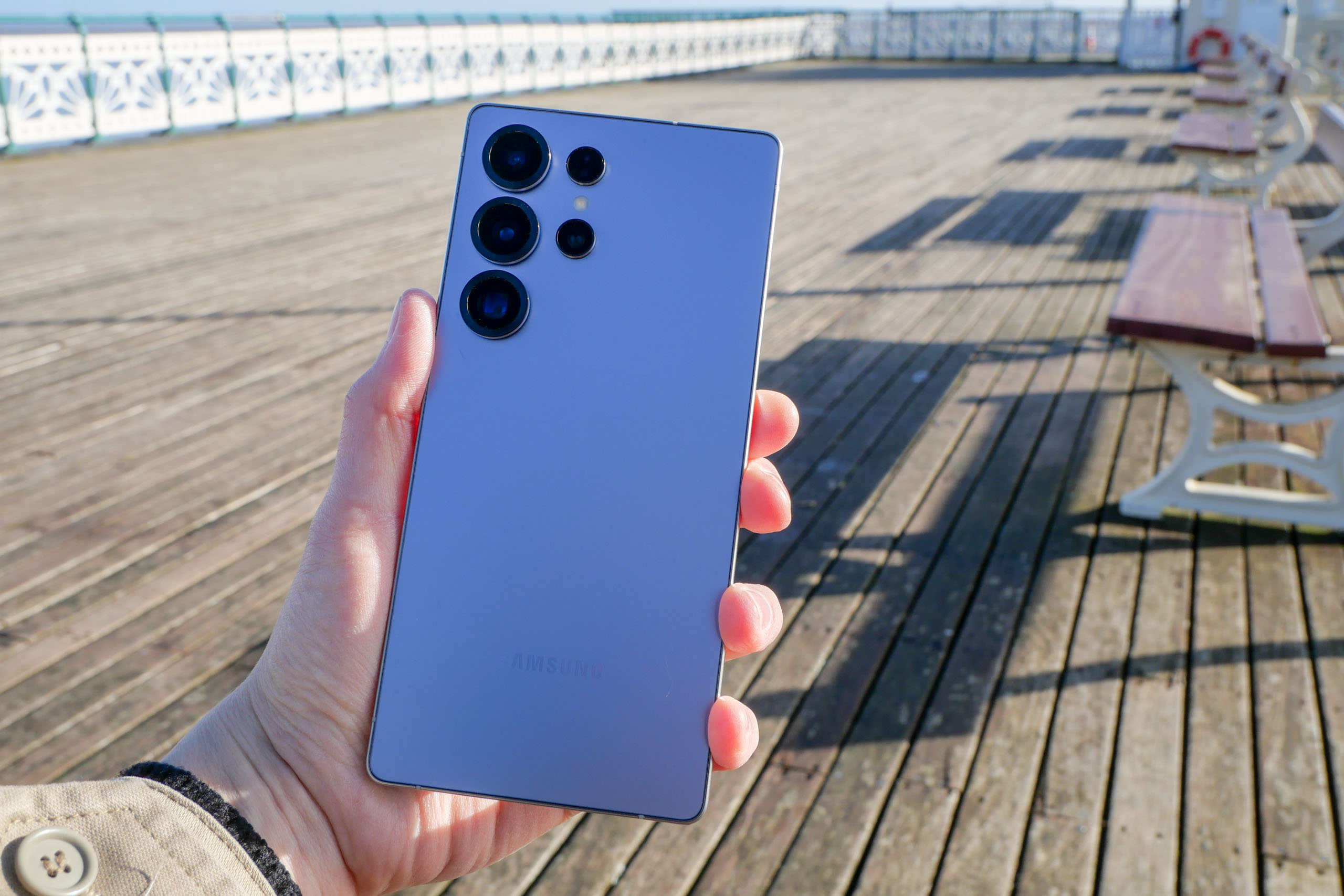
The Samsung Galaxy S25 Ultra has a new ultra-wide camera and designn. The main camera has the same headline-grabbing 200MP sensor that uses pixel-binning technology as its predecessor. The S25 Ultra has range of additional AI features for searching, including inside the photo gallery. There’s also been improvements to Samsung’s photo editing, as well as video recording, with the ability to use AI to improve the audio quality as well as Log tools.
Overall, the Samsung Galaxy S25 Ultra is a great performing device, and it produces excellent photos and video. It’s a big device, which will be to the tastes of some, but perhaps put off others – I’d love Samsung to introduce a smaller Ultra variety, like Google do with the Pixel 10 Pro and Pro XL.
The native camera app has a lot going for it, including the AI editing suite which can really help to improve your photographs. Whether you’re shooting stills or making video content, the S25 Ultra is hard to beat.
Also good for: Most situations, including landscapes, low-light and night, as well as video, vlogging, YouTube, and more. In fact many YouTubers use this camera for video thanks to the wide range of lenses available. If you’re on a budget have a look for the S24 Ultra.
Read our full Samsung Galaxy S25 Ultra review
Best folding camera phone
Best folding camera phone: Samsung Galaxy Z Fold7
Amateur Photographer verdict
Previous folding phones have left me feeling there’s been too much of a compromise, but that’s all changed now with the Z Fold7, offering a great camera setup and an ultra slim folding body.
- 200MP main camera
- Amazing 8inch screen
- Ultra-wide can be used for macro
- Can be awkward switching screens
- 2x 10MP selfie cameras not great
- Price is high
Specifications at a glance:
| Rear cameras | 200MP f/1.7 main camera, with OIS, 1/1.3inch, 23mm 12MP f/2.2 ultra-wide-angle camera (0.6x), 13mm, with AF 10MP f/2.4 3x telephoto camera, with OIS, 69mm |
| Selfie cameras | 2x 10MP selfie cameras |
| Video | 8K 30fps video, 4K 120/60/30fps |
| Screen | 8.0inch inner screen (folding), 6.5inch outer screen |
| Battery | 4400mAh battery with wireless charging |
The Samsung Galaxy Z Fold7 is the latest folding phone from Samsung, and until this model, I’ve felt that there was not enough focus on the camera system to be good enough for photographers, however, that has changed with the Z Fold7. The main camera has the same headline-grabbing 200MP sensor that uses pixel-binning technology as the flagship S25 Ultra, and the ultra-wide camera now has auto-focus to enable some nice macro photography.
Like the S25 Ultra there are some nice AI features, with a range of additional features for searching, including inside the photo gallery. There’s also high quality video recording, with the ability to use AI to improve the audio quality.
Where the Zold 7 really stands out is in the folding screen design, which gives you an impressive 8.0inch inner screen, where you photos look amazing, and your video recording and editing has plenty of room. When folded the phone still feels like a normal phone, thanks to the extra thin design. If your budget allows, this truly is a wonderful phone to use.
Read our full Samsung Galaxy Z Fold7 review
Best AI phone
Best AI phone for photography: Google Pixel 10 Pro (and XL)
Amateur Photographer verdict
For photographers, the Google Pixel 10 Pro delivers exceptional photos, in the majority of shooting scenarios, plus has AI enhanced zoom. However, if you’re a macro fan, then others are better.
- Consistently good photos
- Panorama mode works well
- AI features like Add-me
- Additional 2x and 10x zoom options – plus AI enhanced zoom
- Macro performance is lacking
- 4K 60fps is max video quality (without Cloud upscaling)
- 128GB storage is poor for a flagship
Specifications at a glance:
| Rear cameras | 50MP main camera, f/1.68, OIS 48MP ultra-wide, f/1.7, with macro AF 48MP telephoto, f/2.8, 5x telephoto, OIS |
| Selfie camera | 42MP f/2.2 selfie camera with AF |
| Video | 4K video recording, up to 60fps |
| Screen | 6.3inch screen, 1-120hz, 3300nits (peak), Gorilla Glass Victus 2 |
| Battery | 4870mAh battery with wireless charging |
The Google Pixel series has long been a choice for those who put the photography features before everything else. The Google Pixel 10 Pro continues that tradition with improvements being made to the cameras, as well as shooting features, with enhanced zoom as well, thanks to additional AI improvements.
There’s a great triple camera setup on the back with an ultra-wide camera with AF, a main camera with optical image stabilisation (OIS), and a 5x telephoto camera, also with OIS. The phone also provides a 2x zoom, and a 10x zoom, that uses Super Resolution Zoom to provide ‘optical quality’ zoom, and in my testing, I found this actually worked really well! Beyond 10x zoom the camera system will use AI to add additional detail to images, giving you images that look better than the blurry mess of digital zoom.
There’s also a great selfie-camera, with 42MP, which uses pixel-binning to give 10.5MP images, with auto-focus. The ultra-wide-angle camera has a bright f/1.7 aperture, which is brighter than most.
As a Google phone, the HDR shooting has been updated, and is now more impressive, with the phone coping with high dynamic range situations incredibly well, whether that’s outdoors, or in low-light conditions. There are further improvements made to the AI features on offer as well, with Add-me being a particularly useful feature for people who want to be in the shot when taking group photos.
Unfortunately the phone doesn’t record 8K video on the phone directly, maxing out at 4K 60fps, so if high-resolution (8K) video is what you’re looking for, other phones do this better. There are also others that also offer 120fps 4K video. Other negatives, include the macro performance using the ultra-wide-angle camera and cropping into the shot giving an image lacking in detail.
Google give you a choice of size, with the larger 10 Pro XL, and smaller Google Pixel 10 Pro, both featuring the same impressive camera system, so you can choose which size is best for you.
Best for: AI features that are easy to use, plus night and astrophotography. The AI editing is particularly impressive as well, and Google have hit the ground running with this (as you’d expect).
Read our full Google Pixel 10 Pro review
Best for close-ups
Best for close-up photography: Oppo Find X9 Pro
Amateur Photographer verdict
The Find X9 Pro has an exceptional set of rear cameras, combined with a great selfie camera, and THE BIGGEST battery on offer at a whopping 7500mAh.
- Amazing telephoto close-up performance
- Impressive main camera
- Good value fo money
- Fantastic battery
- Unavailable in the US
Specifications at a glance:
| Rear cameras | 50MP f/1.5 main camera with 1/1.28inch sensor, OIS, 23mm, PDAF 50MP f/2.0 ultra-wide-angle camera, 15mm, AF 200MP f/2.1 3x telephoto camera, with close focus, 70mm, OIS, AF |
| Selfie camera | 50MP f/2.0 selfie camera, with AF |
| Video | 4K 120fps video |
| Screen | 6.78inch AMOLED screen with 3600nits (peak) |
| Battery | 7500mAh battery |
This flagship smartphone by Oppo comes with an impressive triple set of cameras created in collaboration with Hasselblad. All cameras are equipped with high resolution sensors with auto-focus (and OIS / optical image stabilisation on the main and telephoto cameras). There’s a 200MP 3x periscope telephoto camera with impressice 9cm macro focus. The main camera and telephoto camera have brighter apertures than most others, and these specs make the Find X9 Pro a formidable competitor to the well-known flagships.
The main 23mm f/1.5 camera features a 50MP 1/1.28inch sensor, which is larger than many other phones. It delivers consistently impressive results with plenty of detail, excellent colour reproduction, and reliable exposure. Moreover, the dynamic range is great with automatic HDR.
The floating telephoto camera is a periscope design, and it gives you amazing looking close-up photos, even in poor lighting, with plenty of detail. It is backed by a relatively large 200MP sensor, helping capture even more detail. Finally, the ultra-wide-angle 15mm equivalent, f/2 camera provides nice results, with good colour and exposure, as well as good levels of detail. The camera app gives you quick access to 0.6x, 1x, 2x, 3x and 6x making it feel like you’ve got way more cameras than there actually are.
The upgraded and high-quality camera system offers plenty of photo opportunities, and the 50MP selfie camera with autofocus is also a very welcome addition to the spec sheet. Results across all cameras are high quality, consistent and produce really nice natural colours. You’ll also find that this has the BIGGEST battery of any current flagship we’ve tested, with a whopping 7500mAh, and this really does last longer than anyone else on the list.
Best for: Macros and close-up, with great low-light performance. The telephoto lens produces some great results, and the battery life is immense!
Read our full Oppo Find X9 Pro review
Best phone for night
Best camera phone for night: Honor Magic8 Pro
Amateur Photographer verdict
The Honor Magic8 Pro is designed to give excellent low-light shots particularly using the telephoto camera, with good close-up performance and durability too.
- Updated telephoto night camera (3.7x)
- Great close-ups with telephoto camera
- IP69K protection rating
- Up to 7 major updates
- Fixed focus selfie camera
- UK only gets the smaller battery
- Not available in the US
Specifications at a glance:
| Rear cameras | 50MP f/1.6 main camera with AF, OIS, 23mm 200MP f/2.6, 3.7x telephoto with AF, OIS, with close-focus, 85mm 50MP f/2.0 ultra-wide with AF (and macro), 12mm |
| Selfie camera | 50MP f/2.0 selfie, fixed focus |
| Video | 4K 120fps video |
| Screen | 6.8inch screen, 1-120Hz, 2600nits,6.71inch OLED 120Hz, 1800/6000nits (HBM/peak) |
| Battery | 6270mAh (Europe), 7100mAh (International), 7200mAh (China) Silicon Carbon Li-ion battery |
The Honor Magic 8 Pro is Honor’s top performer for photography, with a 50MP main camera with OIS, and a bright f/1.6 aperture as well as a relatively large sensor. There’s an ultra-wide-angle camera that is wider than most, and can be used for macro. But the real star performer is the 200MP telephoto camera with an f/2.6 aperture, optical image stabilisation (OIS), and a larger than normal sensor. This gives impressive low-light and night performance, as well as a close focusing distance of 14cm, which allows for some really pleasing close-up photos, with natural looking background blur.
AI technology is included to help with taking photos as well as editing photos, with editing features that rival the other brands in this list. The phone also offers an IP69K rating, which is the highest available in any phone on the list, making sure your phone will last through the years. Adding to that is 7 years of updates, matching other brands on this list.
If you’re in the UK you can find some impressive deals on this phone, which was first introduced with £200 off the RRP, along with a bundle of extras. Adding to the value on offer, the main processor in this phone is currently one of the fastest available, and you can even use the phone as a desktop computer when connected to a monitor, great if you wanted to edit your photos on a large screen.
Read our full Honor Magic8 Pro review
Best small camera phone
Best Small Samsung flagship: Samsung Galaxy S25/S25+
Amateur Photographer verdict
If you prefer a cheaper and slightly smaller phone, but don’t want to compromise too much on specs the S25 or 25+ could be a great choice. A solid all rounder, even without a dedicated macro mode.
- High resolution main camera
- AF Selfie camera
- 8K video
- No macro mode
- Lower resolution ultrawide and telephoto camera
- Only 128GB on the base S25
Samsung Galaxy S25 (4000mAh battery, 6.2inch) / S25+ (4900mAh, 6.7inch):
If your budget is a bit tighter but you still want to get most of the S25 Ultra specs, the S25 or the S25+ is an ideal choice. The biggest differences from the S25 Ultra are the lack of headline grabbing 200MP super-high resolution main sensor, no dedicated macro mode, and only three lenses instead of four. But in reality both are very capable and well performing camera phones.
Both the S25 and S25+ feature an identical camera set-up, with a 12MP ultra-wide camera, a 50MP main wide camera, 10MP 3x telephoto, and 12MP front selfie camera (with AF), and up to 8K video recording from the main camera. For video or vlogging, the S25/S25+ offer a great setup, as the selfie camera can also be used for 4K video recording.
The only difference between these two flagships are their size, price, and battery life. Both have a smaller body than the S25 Ultra, however the Samsung Galaxy S25+ measures 158.4 x 75.8 x 7.3mm and features a 6.7inch Dynamic AMOLED screen which is not far off from the S25 Ultra’s 6.9inch size. If you want to go for a smaller version opt for the Samsung Galaxy S25 with 6.2inch screen, it sits more comfortably in the hand, however its smaller size means a smaller battery too.
Best budget Google phone
Best budget phone overall: Google Pixel 9a
Amateur Photographer verdict
With a solidl performing 2x camera system, some fun photography options and a great overall feature set, the Pixel 9a is the mid-ranger to beat at the moment.
- Good price
- Macro added to ultra-wide
- AI editing and shooting tools
- Not much memory for the base price
- No telephoto lens
Specifications at a glance:
| Rear cameras | 48MP wide-angle, f/1.7, 25mm equivalent, OIS 13MP ultra-wide, f/2.2, 14mm equivalent, with AF |
| Selfie camera | 13MP selfie camera, f/2.2, 21mm equivalent, fixed focus |
| Video | 4K 30p from all cameras, 4K 60p from main |
| Screen | 6.3inch FullHD pOLED, 60-120Hz screen, 2700nits peak brightness |
| Battery | 5100mAh battery |
| Dimensions | 154.7 x 73.3 x 8.9mm, 186g |
Google’s budget Pixel 9a comes with a new design, a larger screen, and updated camera system. There’s a brighter main camera lens with f/1.7 aperture, as well as an updated ultra-wide-angle camera that now has auto-focus, which allows for close-up macro shots. You have Best Take, Magic Editor, and Audio Magic Eraser to play with, in addition to the more conventional photographic modes that have appeared on previous generations, such as Night Sight and long exposure.
The cameras may sound like fairly standard stuff, but as we found in our review, it results in images of high quality, with a pleasing level of detail and punchy but natural colours. The various shooting modes on the camera app work well, and if you have access to a decent smartphone support like a mini-tripod, you can take advantage of specialised modes like the long-exposure astrophotography function.
The main rival to the Google Pixel 9a is likely to be another Google phone – if you don’t care about the AI features then the Pixel 8a/7a is going to deliver much the same results for a cheaper price. However, with its price still temptingly low, we can safely say that the Google Pixel 9a is the best budget Google phone on the market, and you will not be disappointed with the results it produces.
This is also the best budget phone for astrophotography as well, thanks to the advanced night modes, and astrophotography mode, which increases your slow shutter speed photography performance, with extra long exposures possible when used on a tripod. Google’s latest phones also come with 7 years of updates, so you know it’ll still be secure as time passes.
Read our full Google Pixel 9a review.
How we test Android smartphones
We have tested and reviewed every single phone in this guide, thoroughly, using them extensively for at least 2 weeks, and often longer, so you can trust our recommendations when deciding which budget phone to buy.
We review Android smartphones from the perspective of choosing a phone for its photography and camera performance, so we test every phone by looking at what it offers in terms of the cameras and included features for photography and video, and how it performs in real world use in a variety of different shooting situations.
We test each camera on the phone, whether that’s the ultra-wide angle, the main camera, and telephoto camera(s), as well as the digital hybrid zoom options. We also pay particular attention to testing the selfie camera, as some models can skimp on features in this area, especially if a budget phone.
We use the phone for photography in a range of lighting conditions, including low-light, where camera phones can struggle, particularly budget models where the camera sensor is often smaller than more premium models.
We test in in harsh lighting, where lens-flare can be an issue, and also look at how the camera copes with scenes with high dynamic range (HDR) as this stresses the sensor as well as the image processing.
We also look at specialist shooting modes on offer, whether that’s the portrait modes (looking at skin tones, background blur, and subject outlines, particularly around hair lines) or AI features for both shooting and editing.
Another aspect we pay close attention to is how good the overall phone is, in terms of battery life (and charging options), screen quality and brightness (testing outdoors in bright sunny conditions), plus overall build quality and value for money.
Recent updates:
- February 2026: Article written, prices and specifications checked.
Further reading
- The best camera phones for photography
- The best budget camera phones
- The best smartphone apps for photography