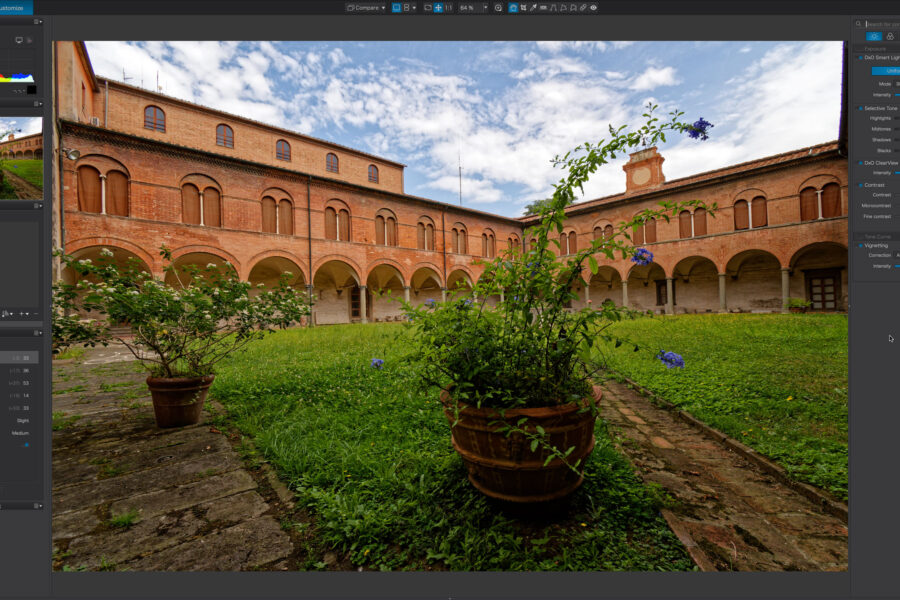




Nikon Z DX 16-50mm f/2.8 VR Review – a versatile and almost perfect lens


A versatile, lightweight and sharp “everyday” lens for your APS-C format Nikon
Amateur Photographer verdict
There’s a lot to like about this lens. It can be used in a wide variety of situations and produces sharp results with attractive bokeh. The only potential sticking point is the price.
- Wide constant aperture
- Lightweight
- Close focusing distance
- Inbuilt vibration reduction
- Expensive for DX
Designed as a “do-it-all” lens, the Nikkor Z DX 16-50mm is the first f/2.8 constant aperture lens for Nikon DX (APS-C) mirrorless cameras. With an equivalent focal length of 24-75mm and a wide aperture, it should work well for a wide variety of different subjects, as your only or main lens for your camera.
At A Glance
- $895 / £799
- f/2.8 constant aperture
- 24-75mm equivalent focal length
- 0.15m minimum focusing
- 330g
- Nikon Z mount for DX
For a DX lens, it’s got a fairly high price tag – indeed it costs almost as much as the cameras you’ll likely put it on. That said, considering how versatile it should be and the wide range of applications it offers, then it could easily be considered good value for money, too – especially if it’s the only lens you use for most of your shots.

Features
Many photographers like to have a 24-70mm standard zoom in their kit bag, and this is exactly what this lens offers to DX users thanks to the crop factor – in fact at 75mm equivalent at the telephoto end, you get a touch longer.

The f/2.8 constant aperture is useful for a variety of things. It means you can use it in low light without having to ramp up ISO, but also means you can blur backgrounds nicely, making it suitable for a wide range of different subjects.
A combination of the classic zoom length and the wide aperture means that it’s great for landscapes, portraits, street, events, still-life and probably more besides. I’ve been using it for a few weeks and crossed off many different genres, and would conceivably happily have it as my only lens if I was short on space, or perhaps budget.

The lens construction consists of 12 elements in 11 groups, including 1 ED element and 2 aspherical elements. It’s not the most complex of lens constructions, but it’s about what I’d expect for a lens of this nature and price, and should still yield good results.

It is dust and drip resistant, making it useful for shooting outdoors. There’s a metallic lens mount, which helps with a good feeling of high quality.
For video users, there’s the promise of fast and quiet autofocus, reduced focus breathing, a silent control ring and “Hi-Res Zoom”, where you can extend the length of the lens by 2x when recording video – that could be useful for travel vloggers and so on.
Build and Handling
At just 330g, this is a very lightweight lens for what you get. The lens extends a little when zooming, but not hugely or to be problematic when carrying it around in the zoomed out position.
Attached to a Z50 II, you’re looking at a combined weight of just 880g. Now compare that with full frame – a Nikon Z6 III plus a 24-70mm f/2.8 S II lens for example – here the weight would be 1.4kg.

This is a far more friendly travel or everyday option than full-frame, which is a major selling point of crop factor cameras and their accompanying lenses. In my experience, it’s certainly a much more pleasant experience to carry this around with you for a few days than a bulkier full-frame equivalent – while the pictures are still great.
The outward design isn’t hugely complicated. There are no switches or buttons (I’d probably like to see an AF/MF switch if I could choose freely), but there is a control ring which you can use to adjust a limited number of settings, comprising of focus, aperture, exposure compensation and ISO.

Just over half of the lens is taken up by the zoom ring, which is marked in increments of 16, 24, 35 and 50mm for quickly jumping to the most commonly-used focal lengths.
The lens can be used with 67mm filters and comes supplied with a HB-118 lens hood in the box. You can reverse the lens hood when not in use, or take it off altogether if you prefer.
Autofocus
Focusing is very quick in most situations. In very low light it can sometimes take a little longer to lock onto the intended subject, but it’s not a huge problem in most situations.

Pleasingly – especially for video work – it’s also very quiet at focusing. You can only just about hear it if you put the lens up to your ear in a silent room. Switching on silent mode when in discreet situations, such as in a museum, church or at an event, means you can shoot unobtrusively.
Image Quality


Pleasingly for a lens at this price point, the 16-50mm performs very well indeed, making it a superb addition to your APS-C camera for a range of different shooting tasks.

The images are nicely sharp, with a fantastic overall impression, but which is also maintained if you examine closely on a computer screen.

Edge-to-edge sharpness is very good, throughout the focal lengths and across the aperture ranges.
Being able to focus fairly closely means you can fill the frame with the subject, or leave room around it for different compositions.

The f/2.8 maximum aperture results in some nicely rendered out of focus areas (bokeh), which is nicely soft and natural looking.

Lens profiles are applied automatically, and appear to be unable to be switched off in camera raw. There’s very little in the way of vignetting even with the aperture wide open, and you can correct this further if it proves to be any kind of issue.
Distortion also appears to be kept to a minimum via lens profile correction, with some very natural-looking results for the most part.

There is a slight hint of chromatic aberration in some shots when shooting very high contrast scenes, but it’s only really by zooming in on some parts of the image that you can really see it – it’s not obtrusive when looking at images at normal printing or web sizes.

Similarly, flare and ghosting is generally kept well controlled, however there are some instances when shooting in very bright light / high contrast situations some creeps in – angling the lens for a different composition would have eliminated it in the example above.
On the whole, the lens is capable of taking great shots and is very versatile indeed.
Verdict
For those who have a DX-format camera, like the Nikon Z50 II or the Nikon Zfc, this is simply a fantastic lens to pair it with.
It can be used in a huge variety of different situations and setups, and would make sense as your only lens, perhaps paired with a nice wide-aperture prime lens for those times when you want to stop down even further.

A great travel companion, the broad range of different subjects it can cope with make it very suitable for every day work and always having on your camera or in your kit bag.
As far as DX lenses go, this is quite an expensive option, it’s true. But, considering you get great image quality, a lovely wide aperture and something which can be used for almost every subject, then it’s easy to consider it good value for money.
If you’re buying into the Nikon DX format for the first time, I’d be tempted to eschew the standard kit lenses and look at this – it proves that shooting with a crop-sensor camera doesn’t always have to be a compromise.

Nikon Z DX 16-50mm f/2.8 VR full specifications
| Filter diameter | 67mm |
| Lens elements | 12 |
| Groups | 11 |
| Diaphragm blades | 9 |
| Aperture | f/2.8-f/22 |
| Min focus | 0.15m (at 16mm) – 0.25mm (at 50mm) |
| Length | 88mm |
| Diameter | 74.5mm |
| Weight | 330g |
| Lens Mount | Nikon Z |
| Included accessories | front and rear caps, HB-118 Lens Hood |

Follow AP on Facebook, Instagram, YouTube and TikTok.