

Have you ever had that moment as a photographer when you’re part way through a project and it’s in danger of imploding? For prominent conservation photographer Jon McCormack that moment loomed into view several times during the development of his new book, Patterns. ‘I printed everything out, laid it on the table and thought, this is awful. Nobody would want to look at this,’ he admits, adjusting his statement thick-rimmed round glasses.
Taken during the COVID-19 pandemic, the initial photographs mainly consisted of small, impressionistic landscapes. He describes them as an homage to Claude Monet’s haystack series. One subject seen in multiple ways. The idea was abandoned, McCormack moved on. Rather than admit failure, he simply identified a shift in seeing.
The COVID Lockdowns were democratic in the way that it constrained most of us (except perhaps the then UK government). McCormack, an Australian and fellow of The Royal Geographical Society living in the Bay Area of San Francisco, relocated his family to a small coastal town. Swapping Silicon Valley for the seaside suited McCormack, returning each day to photograph the same stretch of beach. ’I must have shot that beach for 200 days. At first, you do the obvious: sunsets, wide scenes. But then you start asking: what else is here?’ he remembers.
What was there was shifting light patterns, ebbing tides and an eclectic atmosphere. McCormack stripped everything back and began to work in a slower, more deliberate way. Exposures grew from seconds into minutes. At times he swapped the viewfinder for a cable release. It became almost meditative. ‘You’re not hunting images anymore. You’re waiting for them,’ he says succinctly.
This freedom from the pressure to get ‘the shot’ allowed McCormack to look deeper and in that depth, something clicked. ‘I realised that pattern and texture had always been there in my work. I just hadn’t articulated it,’ he explains.
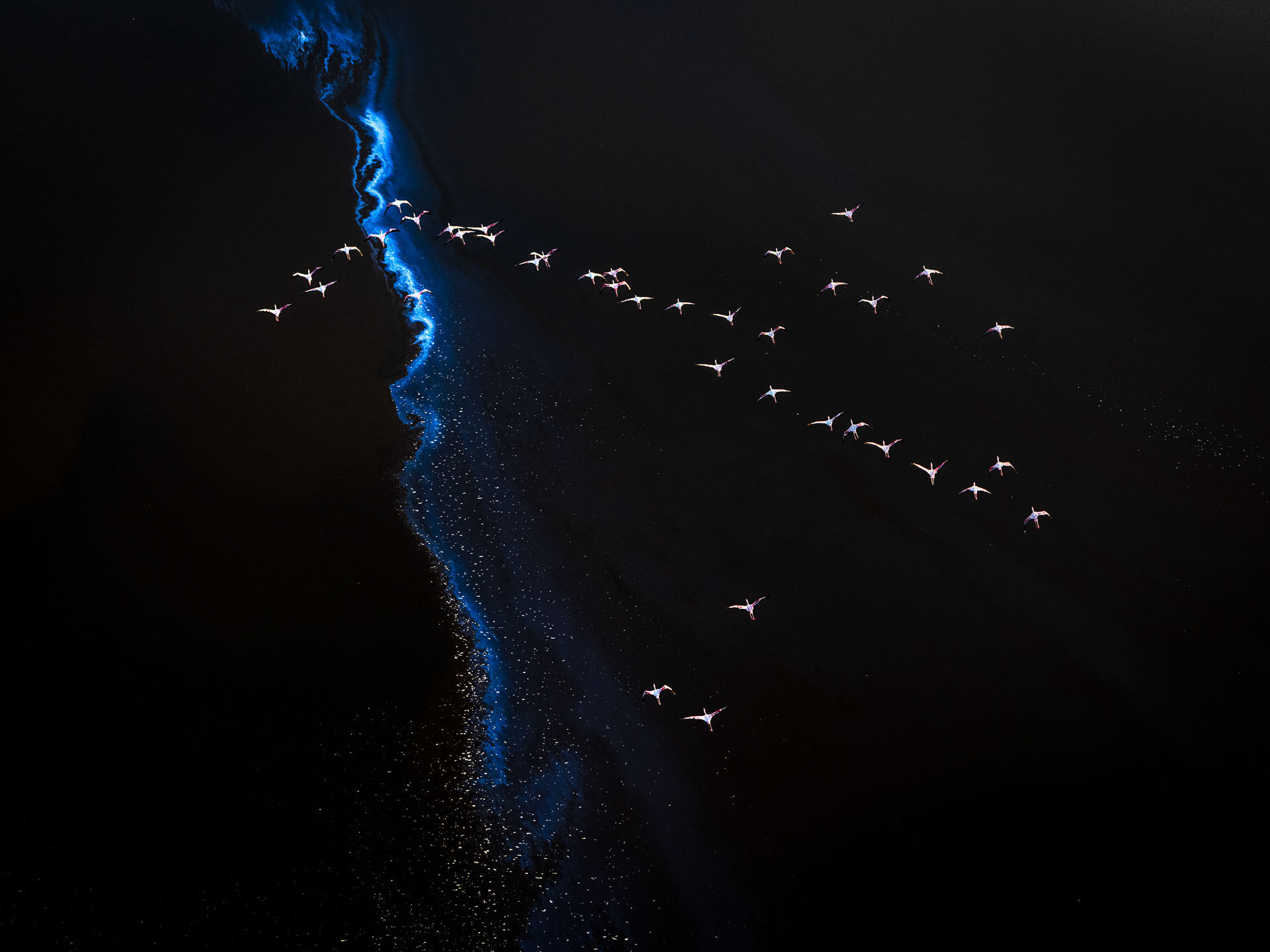
That realisation is the seed from which Patterns grew. The visual thread that binds the images of vastly different scales from aerial landscapes to microscopic details. It’s these patterns connecting animal markings and fossilised shapes that McCormack calls the “language of the earth.” Throughout the book the viewer encounters these recurring visual similarities.
The tawny patchwork of a giraffe’s coat mirrors cracks spidering across a sun-baked riverbed. A detail of the striped forehead of a Zebra is uncannily parallel to the microscopic structure of caffeine crystals. ‘It was one of those revelatory moments. You realise these patterns aren’t random. They’re efficient, they’re repeated and they’re beautiful,’ reflects McCormack.
McCormack may have the edge in recognising these connections. In tandem with his photography career he has worked in technology. A pivotal figure in the development of Apple iPhone cameras, serving as the Vice President of Camera & Photos Software Engineering. He leads the teams responsible for the computational photography, software algorithms, and image processing that drive the iPhone camera system. ‘Computer science is fundamentally about pattern recognition. Understanding how things fit together,’ he says.
Combine that with the revelation that McCormack is colourblind gives Patterns another layer. ‘For many photographers, colour is the primary way they interpret a scene. For me, it’s pattern and texture. That’s where my attention naturally goes. I’ll look at a scene and ask: what is the essential thing here? Then I keep removing elements until I get to that core,’ he explains. It’s this combination that makes Patterns more than just a book of pretty pictures.
McCormack roamed across six continents and through his archive to find the images.
Ranging from the volcanic coasts of Iceland, wilds of Kenya, icy fjords of Antarctica to the rainforests of British Columbia. That was one challenge. Turning them into a book was another. Working with a photo book editor to construct the narrative, an initial 30 images were expanded into the final 90+ images included in the book. Leafing through the book, it cleverly avoids grouping the subjects by landscape, wildlife, Ariel view etc but is structured to disrupt expectations.
Animal textures and macro details tangle with a geological form or views from above. ‘You want the viewer to be surprised every time they turn the page. I didn’t want it to feel predictable. I wanted that moment of – I didn’t see that coming – but I understand it.’
The strategy seems to be working. When I spoke with him via Zoom, early feedback from the book suggests it resonates across generations. Friends, family and colleagues trying to decipher what they’re looking at before reading the captions. It’s that sense of curiosity that McCormack was hoping Patterns would achieve.
Environmental messaging has, in the past, been guilty of telling people what not to do. ‘People don’t respond well to that. If you can get people to fall in love with something, to be intrigued by it, that’s a much more powerful starting point,’ is McCormack’s approach.
All proceeds from book sales will benefit Vital Impacts, an organisation dedicated to empowering local photographers and storytellers in environmentally sensitive regions founded by photographer Ami Vitale. Vitale also supplies text for the book along with Daniel Katz, David George Haskell, Sylvia Earle, and Wade Davis. McCormack explains, ‘It’s about giving people a voice. Not flying someone in from New York or London, but supporting those who are already there, who understand the place.’
Patterns is meticulous in the assembly of imagery but McCormack remained flexible in his approach, choosing to shoot with an iPhone when practical. ‘If I’m doing a 15-mile hike, I don’t want a tripod and a full setup. ‘The iPhone becomes the best tool for the job,’ he says.
It’s reassuring to hear a photographer of McCormack’s reputation that advances in stabilisation and image quality doesn’t compromise quality. In fact he relishes the new possibilities that an iPhone allows – working in places and ways that might otherwise be inaccessible. ‘It’s changed how I think about photography. You can make credible work with the camera you have with you,’ he says.
McCormack is keen to inspire readers to explore patterns in their own work and has some simple advice. ‘Ask yourself, what is it about this scene that really interests me? Then go and find that. Don’t just take the photo and move on. Work the scene. Be willing to linger.’
In a time of instant gratification from endless scrolling on social media, that advice feels welcome more than ever. McCormack often returns to the words of Georgia O’Keefe to intensify his point; ‘To see takes time, like to have a friend takes time,’ emphasising the need for slow, deliberate observation to truly appreciate the beauty in small details.
After four decades behind the lens, you’d expect McCormack to have seen it all and said it all. Patterns feels like it needed those decades for him to distill and refine his way of seeing into a clear and confident narrative. ‘I love the discovery process. Figuring out what a place says to mean and what I want to say about it,’ he says, undiminished by time.
Patterns is a deceptively simple book that brings together an idea of what meaningful photography should be. Not just a record of what was there but a personal and unique interpretation of it. ‘Photography is a way of giving yourself a voice,’ says McCormack and in Patterns, he has spoken fluently, translating the intricate language of the natural world.
Patterns is published by Damiani and is available to order now. ISBN: 9788862088572
Related Reading:
- These fantastic wildlife photos by this young photographer document life in our fragile ecosystems
- These unusual photos of London are certainly striking – but do you think they’re art?
- These absolutely stunning close-up images from nature will really blow your mind