





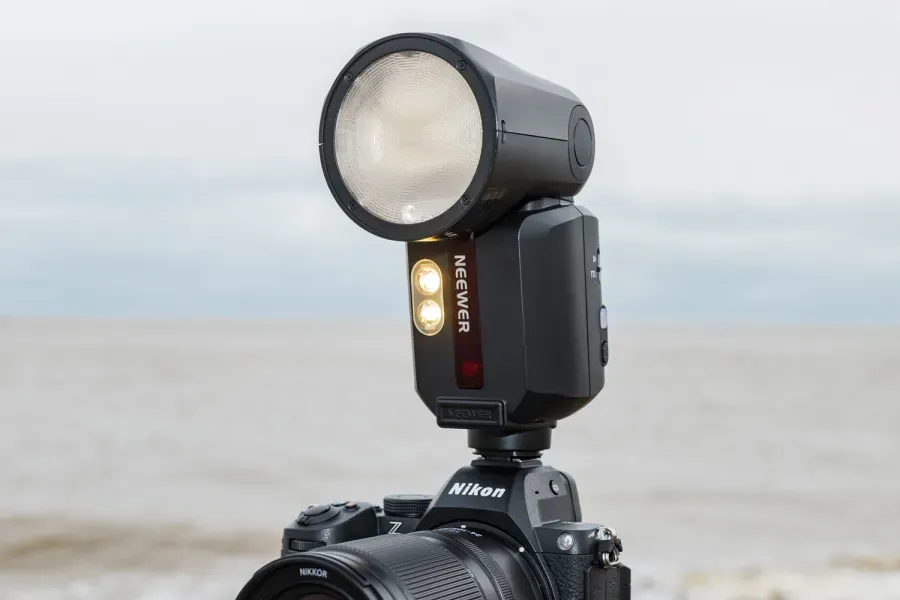
Neewer’s latest round-head on-camera flash unit offers 100W of output, a 100m wireless range and can pop 100 times in sequence. Damien Demolder gets to grips with its touch-screen interface
Amateur Photographer verdict
An excellent and reliable flash unit with innovative touchscreen control. Can can take some getting used to but undeniably useful and smooth to operate
- Good power output
- Touch screen interface
- Effortless wireless control
- Compatible with Neewer flash system
- Excellent battery life
- USB power option would be nice
Neewer Z3R flash at a glance:
- $289.99 / £250
- On-camera flash unit
- 100W output
- Off-camera 2.4GHz wireless control
- Canon, Fujifilm, Nikon and Sony versions
- neewer.com
Every time I review a flash unit, I’m compelled to remark how far these things have come. We’ve had a lot of power in small units for some time, and more reliable radio controls take over from optical communication, lithium batteries that last 10 times as long as wasteful AAs – and now, somehow, we’ve advanced to full colour touch-screen control panels.
The Neewer Z3R is the company’s new and most powerful on-camera flash unit, and is an updated version of the original Z3 that had an octagonal head. This R version costs $289.99 / £250 and has a round head that is compatible with the company’s existing range of magnetic modifiers and filters, but otherwise it’s exactly the same. We didn’t review the original as it was replaced by this R model quite quickly.
Neewer Z3R flash – Features
The Neewer Z3R is a hotshoe flash unit that comes in varieties dedicated to Canon, Sony, Fujifilm and Nikon cameras – there’s no Olympus or Panasonic version. The unit I have for review is the Neewer Z3R-N, and I’ve used it in i-TTL mode with the Nikon Z5ll, but also in non-TTL manual mode with Lumix cameras.
Key features
- 100W on-camera flash unit: Tilt-and-twist head with 100W max output that can be turned down to 1/256th power in 1/10th steps
- 2.4GHz wireless: Internal wireless receiver and transmitter modes, to work alongside other Q-System and Godox flashes
- Touchscreen: Large panel on the rear of the flash offers touch control for menus and adjustments
- Modelling lights: Dual 12W lights, one for AF assistance on the body, and a modelling light inside the head
- Compatibility: Neewer offers dedicated models for Canon, Nikon, Sony, and Fujifilm, but in Single Pin Contact mode it will trigger manually on almost any camera
Neewer seems to have abandoned the traditional Guide Number standard for hotshoe guns and instead tells us this is a 100W head. I suppose this is a better measure, as it tells you what comes out of the head and avoids the corruption that GN reporting faces with manufacturers using varying ISO ratings and zoom settings that inflate power readings. My measurements suggest this 100W head delivers the same sort of power as the Hahnel Modus 600RT MKll unit that professes to have a GN of 60 when used with the 200mm zoom setting. I measured f/22 at 1m and ISO 100 when the coverage was set to 28mm, and f/32 when the flash head was zoomed to 105mm.
Although designed primarily as a hotshoe flash unit, the Neewer Z3R is also well equipped to work off-camera, using radio communication to send and receive advice from a remote controller on the camera hotshoe or indeed from another Neewer flash unit – such as the Neewer Q6 or Neewer Q200 heads, or another hotshoe style unit. The Z3R can act as a master unit when on the camera to control other units, or as a slave to other units or one of company’s wireless remote triggers.
Godox users will also be able to use their X series triggers with this flash, and will also be able to control it from their own Godox heads. While this head is compatible with Neewer’s QPro controller the company has introduced the new QZ (£130) controller that more closely matches the look and handling of the flash itself. Wirelessly controlled flashes can be collected into four groups, and Neewer provides 32 channels should you be working in a busy wireless environment. We have 1-99 IDs as well, to really make sure they connect, but most users will use channel 1 and have the ID system set to ‘Off’ – handy though should you need it.
Wireless triggering can also be achieved using a basic optical system, that senses when other flashes fire and will synchronise this flash with it. The optical slave has an S1 mode that is a basic trigger, and an S2 mode that ignores pre-flash bursts from the master flash. The head can also be triggered by the wireless system used in the Sekonic L-858D light meter. Radio communications have a range of 100m.
The head itself has a zooming lens that allows the flash to cover the angle of view of focal lengths between 28mm and 105mm. Focal lengths can be set manually, or automatically via instructions from the camera itself. And to help us see in dark conditions, and to get an idea of where the flash’s light will fall, we have twin modelling lights built-in. One set of lights is positioned on the front of the unit, to also assist camera AF systems, and the other set is alongside the flash bulb itself – so will follow the direction of the flash even when the head is set to bounce. The modelling lights have ten levels of brightness and can achieve 12W output at a colour temperature of 3300K.
Power comes from a 3000mAh NB-Z1 Pro battery (spares $60 / £54) that charges in two and half hours, and which Neewer says is good for 500 full-power pops. The standard full-power recycle time of 1.7 seconds can be brought down to just 0.8 seconds with the use of the Godox PB960 power pack that can plug into the front of the body. There’s a USB-C port on the battery itself that accepts charge while inside the flash, but which does not power the flash. A separate battery charging block is available that takes half an hour longer.
Other key features to know about include the 6000K colour temperature of the flash light, and a high-speed sync mode that allows shutter speeds as short as 1/8000sec. We can expect flash durations of 1/180sec to 1/20,000sec according to the output.
Neewer Z3R flash – In use
It took me a while to get used to this touch-screen-based control system as it’s quite unlike the systems I’m used to. I found I was touching things I shouldn’t have, and then losing my way in the swipe up/down left/right options. However, after a reasonably short period of time I got used to ways to combine the touch screen with the physical buttons to whizz around the controls.
Previously, I’ve been grateful for the ability to adjust output in 1/10EV steps in other flash units, but it takes ages to change the power from 1/256th to full, for example. This system though lets us turn the touch screen dial to make big jumps and then tune them with the +/- buttons. It’s actually a great system, once you get to know how to use it. At first I thought it a bit clumsy, but I learnt how to lock the touch display and how to find my way around with swipes up and down.
When mounted on the Nikon Z5ll, the flash delivered a very good exposure every time the camera got things right, but dialling the power up and down on the touch screen to compensate is easy and intuitive. In manual mode it is equally easy to adjust and simple to operate. Switching between slave and transmitter modes, and controlling the other flashes connected to it is also straightforward – again, once you’ve done it a couple of times.
When I started this review the Z3R couldn’t trigger other flashes via the radio wireless system when mounted in the hotshoe of a non-dedicated camera, but when I asked Neewer about this I was told they were working on it. Two days later they sent me new firmware and now the flash can work as a master to other flashes when in the hotshoe of a non-dedicated camera – all in manual mode. I’m impressed the company enabled this so quickly.
Going deeper into the menu system lets us set flashes bursts for sequence shooting, so we can fire up to 100 times at set frequency intervals. Further in the menu we can control the way the modelling light works, switch the bleep on and off, and control the power saving modes.
The colour temperature of the Z3R is a little higher than I expected. At 6000K it’s cooler than standard daylight at 5200K, but knowing its value allows us to white balance effectively – while sometimes making a day-lit background a touch warmer.
Coverage is pretty good at the advertised focal lengths, though at the widest 28mm setting there’s a bit of shading in the corners – but nothing too dramatic for natural scenes. Beyond 28mm the frame is covered nicely, and that coverage is even and without texture. Using the flash on its own creates quite a hard light obviously, but Neewer offers a range of magnetic filters and attachments as well as the CRB1 (£40) bracket for mounting the Z3R on a stand and attaching Bowens S-Type modifiers – like soft-boxes and dishes. The unit actually comes with a magnetic diffuser dome that makes a big difference to the quality of light that hits the subjects.
Neewer Z3R flash – QZ remote trigger
Neewer has introduced a new trigger to sit in the camera hotshoe and control flash guns like the Z3R. The QZ is much smaller than the previous QPro, and features a touch screen interface that reflects the handling methods of the Z3R’s control panel. In fact, it works in almost exactly the same way, so once you understand one, you’ll understand the other.
If you intend to use the Z3R off-camera with the QZ in charge, you can expect to be able to put a lot of distance between the flash and the camera. I measured 70m before I ran out of garden, but also found the signal could pass through multiple thick walls. Neewer quotes 100m, and I have no reason to doubt their word on it.
Connecting the Z3R to the QZ wireless remote was simply a question of switching them both on – they found each other like two dogs in a field. I was able to use the Z3R in manual mode on Lumix cameras with no problem, and the QZ trigger also works without issue on non-dedicated cameras – once the Single Pin Contact mode is activated in the menu.
The QZ is a neat little controller that requires a little more action on the part of the user compared to the QPro, but it also does a lot more things – such as controlling flash head modelling lights.
Neewer Z3R flash – Verdict
I wasn’t sure how I’d get on with the touch screen on the Neewer Z3R at the beginning of this review, but with use and some practice it’s revealed itself to be a really useful and smooth way of operating the main controls. I actually really like it, and appreciate how much easier it makes changing settings quickly. As the handling experience is so different to other flashes, new users will need to give it a minute. But that time pays off and will be saved within a short period.
I’ve found this to be an excellent flash unit that’s reliable and well equipped for most tasks anyone would throw at a hotshoe gun. It recycles quickly, has a consistent wireless connection and the light it emits looks nice. The white balance is at the cooler end of the norm, which makes it a better match for outside on a nice bright day than as an indoor flash. But as we know the temperature is 6000K, we can adjust easily enough. And for the money, we’re getting a lot of power, some great features and an innovative handling experience.
Follow AP on Facebook, Instagram, YouTube and TikTok.
Neewer Z3R – Full Specifications
| Specifications | Neewer Z3R flash |
|---|---|
| Output | 100W output |
| Wireless range | 100m |
| Wireless groups | 4 |
| Zoom coverage | 28-105mm |
| Power settings | 1/256-1/1 |
| Optical slave | S1/S2 |
| High speed sync | up to 1/8000sec |
| Flash duration | 1/180-1/20,000sec duration |
| Modelling light | 12W, 10 levels of power, 3300K |
| Battery life | 500 full power |
| Recycle time | 1.7sec |
| Colour temperature | 6000K |
| Weight | 629g |
| Dimensions | 73x78x211mm |