





Amateur Photographer verdict
If you are overwhelmed by an unmanageable photo or video collection, Excire’s tools could be just what you need. Both Excire Foto 2025 and Search 2026 accelerate and enhance your Lightroom workflow an
Pros
- Easy to use but powerful photo and video management tools, whether as an app or Lightroom plug -in
- Particularly well suited to photographers who take a LOT of pictures on a project
- Ability to fine-tune searches
- Includes powerful keywording features
Cons
- Maybe overkill for photographers who generate a smaller volume of images/have very small libraries
It’s all very well shooting thousands upon thousands of photos but at some point, you’re going to have to sort the wheat from the chaff and that takes time, effort and a healthy dose of dedication. Fortunately, you can take the tedium out of managing your images with Excire’s software.
Working through the results of a busy shoot, keywording, rating and culling your photos, is a tedious chore but there’s no escaping its importance. Anything that can take the pain out of the process is very welcome and that’s where these two tools from Excire come in.
Excire Foto 2025 and Excire Search 2026 use the same technology and have very similar AI-powered photo and video management features. The key point of difference is that Foto 2025 is a standalone app so a perfect workflow partner to your favoured editing software, while Search 2026 is an Adobe Lightroom Classic plug-in which means you can rate, organise and cull your shots without leaving the host software.
Both are available for Mac and Windows, cost $229 / £199 each for an outright purchase (no subscription here!) and a bundle of the pair costs $299 / £299. In this test, we’ll take a close look at both.
Excire Foto 2025 at a glance
- £199 / $229 outright purchase
- Mac and Windows compatible
- AI-assisted culling
- Powerful Find tools – Text prompt, People, Faces, Keyword, GPS, Similar, Duplicates
- Automatic keywording
- AI-powered Aesthetic rating
- Tools for creating collections of people photos
- Fast image display
- Integral video player
- Runs locally
- 14-day free trial available
Getting started with Excire Foto 2025
Open Foto 2025 and you’re presented with an easy to navigate interface. Not having any editing features and only tools to organise photos means fewer palettes and a cleaner look.
The central area is reserved for picture previews with tool icons across the top and down both sides and thumbnails running along the base when viewing a single image.
To enjoy Excire’s talents images need to be initialised, so the first job is to find a home for the database with adequate capacity as it grows. I use a 4TB NVMe SSD in a 40Gbps enclosure connected to a Thunderbolt 4 port on my M2 Mac Studio to store my Adobe Lightroom catalogues, so that where’s my Excire database went.
Excire Foto 2025 is powerful enough to cope with a huge number of images without compromising performance so you can just have one database for all your work even if you have hundreds of thousands of Raws. Over the period of my test, I ended up with a database of over 650,000 files and that took up 234GB of storage.
With the database’s destination decided, make sure Excire is set up to suit your needs by going to Excire Foto>Settings>Preferences. The software’s quick start guide walks you through the process.
During import, having the Analyze photos option active ensures images are fully processed, which means keywords are automatically generated, previews created and images aesthetically analyzed. It’s worth saying that all the work performed in the two Excire apps is done locally so no files or data is uploaded which means there’s no risk when it comes to privacy.
Initialising thousands of Raws takes time and Excire suggests importing big image collections overnight. I started with 179,733 images (camera Raws, DNGs and TIFs) which took nine hours, 52 minutes and 12 seconds according to the Status Report that appears at the end of the process.
Upload time is only a consideration in your early days with Excire as it’s a one-off process and adding new shoots is much quicker. Adding 4454 Raws from a new shoot took only 13 minutes!
Excire Foto 2025 – Auto keywording
Manual keywording is a tedious process and many photographers don’t bother. Excire has auto keywording that works well and is more than a good start especially with people pictures, which is its strength. The level of detail is impressive with gender, face, eyes open or closed, smiling or not and hair colour common keywords but there’s so much more.
The auto keywording did okay with other subjects too although don’t expect too much detail. For instance, pictures of pelicans, dragonflies and birds in my database were correctly identified and keyworded but if you need the next level of detail, i.e. the actual species, you’ll have to add that manually.
Excire wasn’t so good with specific locations, but you get general keywords so it’s still useful. The exception was London’s Elizabeth Tower, and my shots were keyworded Big Ben. However, some random church spires received the same tag as did shots of pedicabs taken on Westminster Bridge.
While Excire’s auto keywording is not infallible it’s more than useful. My keywording is sketchy at best so having a software that does it for me is brilliant. Moreover, the majority of my 650,000 images were not keyworded in any way, but they are now.
Thanks to Excire, after a few Find by text prompt searches, each taking 10-20 seconds, I know I have 1829 photos of fountains, 191 sandy beaches and 4193 images featuring balconies.
Excire Foto 2025 – Searching skills
With images initialised you can start appreciating more of Excire Foto 2025’s skills. There’s a seven-button panel to search for images in the database. You can search by GPS, duplicates, similar images and keywords although perhaps it’s the remaining three that are the most interesting, Find Faces, Find People and Find by text prompt.
Using Find faces allows you to search by different numbers of faces, by age, smile and gender. With Find people start with an image containing the subject, select the face, pick whether you want eyes open or smiling or not and hit return. This tool’s appeal is enhanced by the ability to name the subject and everyone else in group photos.
The searches within Excire can be controlled in respect of targeting and the final number of images shown can also be varied. I left my favourite search parameter till last, and this is the Find by text prompt. Type in a description of what you’re looking for and Excire will search through the database. Searching for ‘reflections’ in my database I got 1822 hits, ‘red buses‘ resulted in 2091 images and ‘parakeets’ a total of 3002 files.
Where this search impresses is if you’re looking for images that show a mood, emotion or people performing a specific activity. A search for ‘people using phones’ found 3980 images and I got 3121 photos with ‘couples having a relaxing time’.
All searches and the images found are retained in the Results palette for future reference and these can be made into collections, shared or exported in different formats. You can even export the file names and their full path in .csv format.
To be honest, the software’s search powers are impressive and versatile especially for people photographers but speaking as an all-rounder I found its skills very useful too.
Excire Foto 2025: AI assisted culling and more
The ability to shoot sustained bursts can help you capture the decisive moment but going though the results and picking the best from lots of very similar shots takes time.
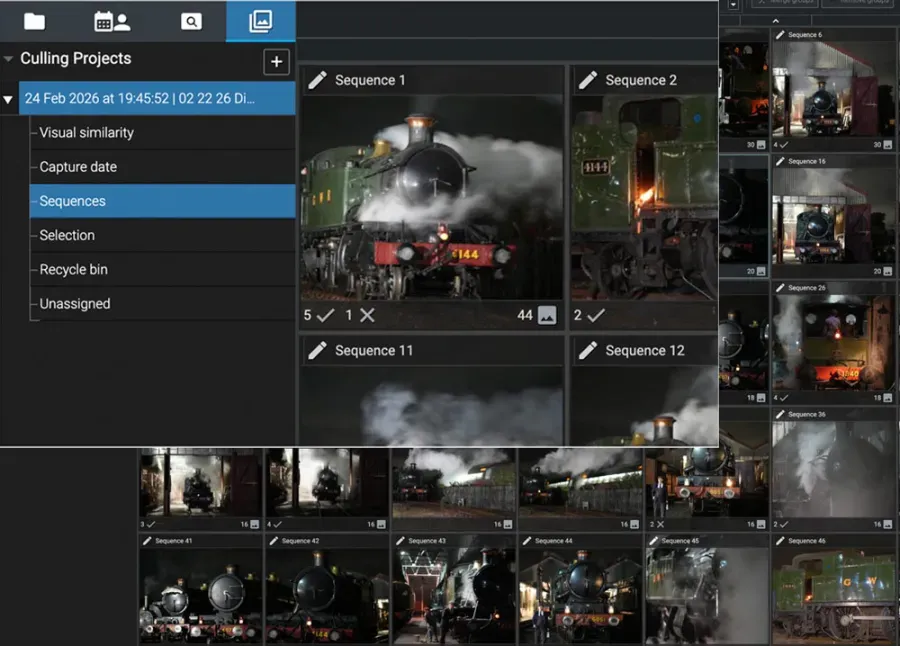
Excire can help with its AI-culling module where the software assesses images, grouping them into sequences or similar-looking pictures. There are a few other options as well (grouping by people, grouping by content, grouping by date/time). Culling projects are retained for future use and can be removed later. Working with 487 Raws of birds, it took six minutes to analyze the results to show 71 sequences, two capture date groups and 31 visual similarity groups.
Having your photos organised in this way makes checking lots of images faster. There’s also a Smart Selection option where you can refine the images further with criteria such as Aesthetics, Eye Sharpness and Face Sharpness.
During initialisation every image is analyzed and given an Aesthetic score out of 100. Whether this feature appeals is a matter of opinion, but it can accelerate the selection process when you have lots of similar pictures, such as from a portrait session to sort through.
When it comes to dealing with large numbers of images, speed is important. Excire is fast with its searches, and it really impresses how quickly high-quality previews are produced, even with over 650,000 images in its database.
It’s possible to rapidly view and rate full screen Raws using 1-5 for stars, 6-9 for colour tags, P for pick and X for delete (same keys as Lightroom) without having to wait for previews to sharpen or refresh. Lightroom is miles behind in this respect.
Excire 2026 Search at a glance
- Works as a plug-in for Adobe Lightroom Classic
- £199 / $229 outright purchase
- Mac and Windows compatible
- Powerful search tools – Text prompt, People, Faces
- All-new Excire Search Panel
- AI-assisted photo culling
- Automatic keywording
- AI-assisted photo selection
- Auto aesthetic rating
- Automatic focus checking
- Runs locally
- 14-day free trial available
Excire Search 2026: Starting up
Excire Search 2026 is a plug-in for the legions of creators employing an Adobe Lightroom Classic-based workflow. The two Excire apps have similar features, so the comments already made relating to Foto 2025’s auto keywording, aesthetic scoring and search skills apply here.
As you’d expect, the two apps handle differently. Opening a Lightroom catalogue also opens the Excire Search Panel and it’s this here where searches and culling projects are initiated. The results of searches are shown back in the Lightroom Classic’s Collection interface.
The Lightroom catalogue must be initialised by the Excire app. In Lightroom go to Library>Plug-in Extras and you’ll find all Excire’s processes including Initialise Photos. As with Foto 2025, the analyzing process takes time so if you’re working with a big catalogue leave the computer to run overnight.
To start my Search 2026 database, I used a Lightroom catalogue of 40,167 images comprising camera Raws, DNGs, JPEGs, TIFs and movie files. In this case, the initialisation process took just over five hours.
Excire Search 2026: Performance
With Search 2026 being a plug-in, the Excire Search Panel might not be showing when Lightroom Classic is open. If not, you can bring it up with Library>Plug-in Extras>Open Excire Search Panel – or shortcut keys Alt+X (Windows), Opt+X (Mac). You can also set up whether you want the plugin to launch when Lightroom Classic opens (under file>plug-in manager).
If you’re using a single monitor and have Lightroom filling the screen and the Excire panel is behind, use the shortcut keys to bring the panel forward. Get round this by shrinking the Lightroom window so you can have it and the Excire Search Panel showing side by side. You can also minimize the Excire Search panel – it collapses to a strip with icons that can sit unobtrusively off to the side (though you do lose the preview functionality when you do that, so there’s a trade-off).
If you have a dual monitor set-up, having the two windows open on separate screens makes life much easier.
In the Search panel, the large area shows the active image in Lightroom, and the search and culling project tools are ranged down from the top right corner. The main search features are the same in the two apps although the dialogue boxes look different and the only missing find feature in Search 2026 is GPS search.
In terms of performance, the two apps work similarly so no issues there. One difference is speed and while I found Foto 2025 working with large previews and full screen views very quick, Lightroom with many fewer images can be slower, laggy and sometimes needs to catch its breath. At least, this is what I found and, of course, it’s no reflection on Search 2026.
The way Search 2026 is integrated into Lightroom Classic is impressive. For instance, I like that the Excire’s culling projects appear in Lightroom’s Collection panel and Excire’s keywords show in a separate folder in Lightroom’s Keyword List after they have been transferred. Excire’s Aesthetic ratings are also viewable in Lightroom once they have been transferred over.
Excire Foto 2025 & Excire Search 2026: Verdict
If you’ve been looking for a photo and video management software that’s easy to use, effective, works locally and truly takes the drudgery out of organising your photos, you may have found it.
Which Excire app appeals depends how you prefer to work and the sort of photography you do. Look, I’m talking broad brushstrokes here, but if your main photo interest is landscape and you typically shoot hundreds of photos (or fewer!) when you go out, you may find Excire less appealing compared with a portrait, event or nature photographer who might blast through thousands of pictures on every shoot.
After using both apps for a couple of weeks and speaking as a Lightroom Classic user with a broad photographic remit, my current feeling is that if I had to choose one Excire app I would go for the standalone Foto 2025.
That might sound odd, but I loved Excire Foto 2025 for its speed with my 650,000-image database. In my experience, Lightroom is sluggish – to put it mildly – with large collections. Of course, whichever way you go, you benefit from Excire’s search and keywording skills.
Ultimately, having everything in one place made sense to me hence my leaning towards Foto 2025 but there’s an argument for Lightroom Classic users to take the $299 / £299 plunge and buy the bundle. Both apps are available as fully functional 14-day trials so you can experience for yourself.